From Korea to India

Korean Squier Stratocasters

THE PLYWOOD ERA

The first Korean Squier Stratocasters

Toward the end of the 1980s, the prices of Japanese electric guitars rose as manufacturers in Japan proved their ability to make high-quality instruments. However, the market was too competitive to allow this, and they began to lose market share.  
Therefore, although Fender Japan still exported some Fender-branded guitars and a few Squiers, in 1987, the Korean Young Chang factory, which had connections to the Japanese Moridaira company, started manufacturing Squier Standard Stratocasters and soon became the main supplier of affordable Squier guitars for North American and European markets (the last Japanese Squier Standard Stratocasters were sold in 1988).

Serial Numbers explained

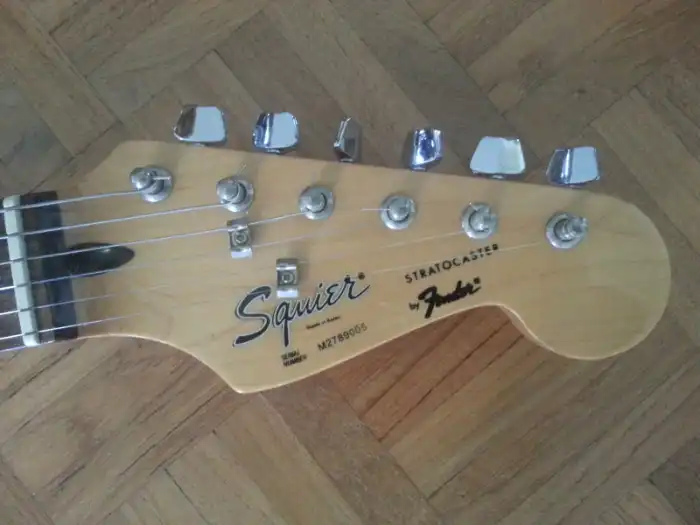
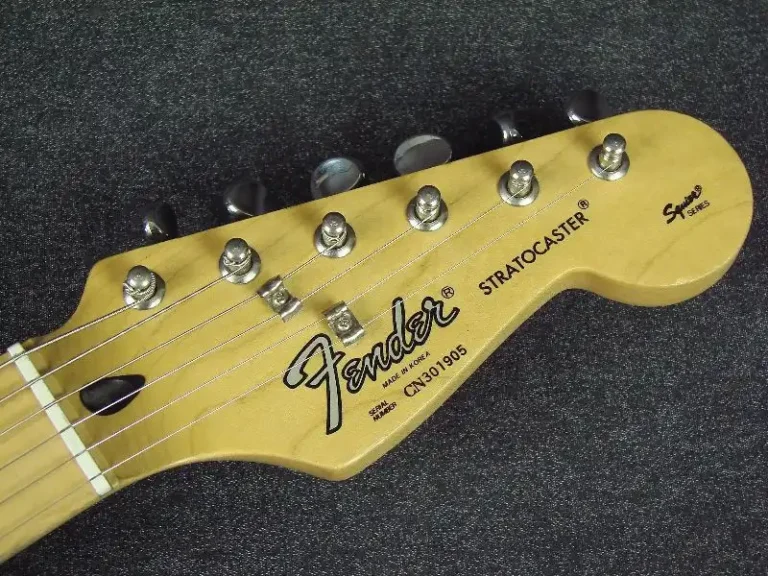
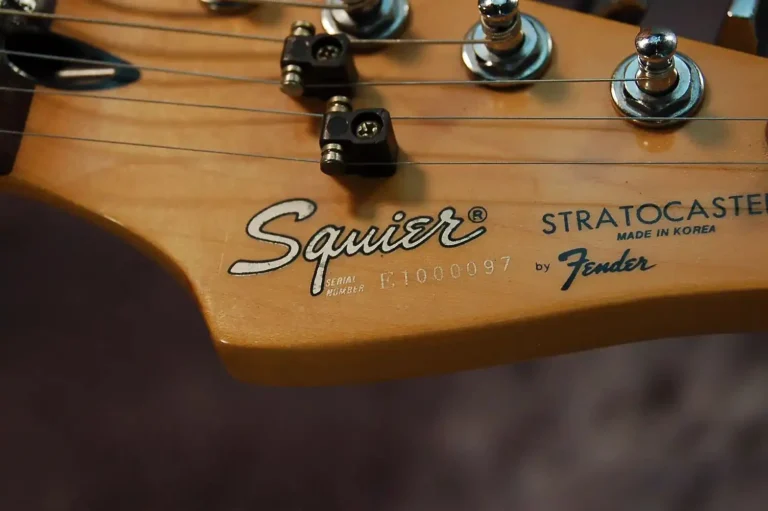
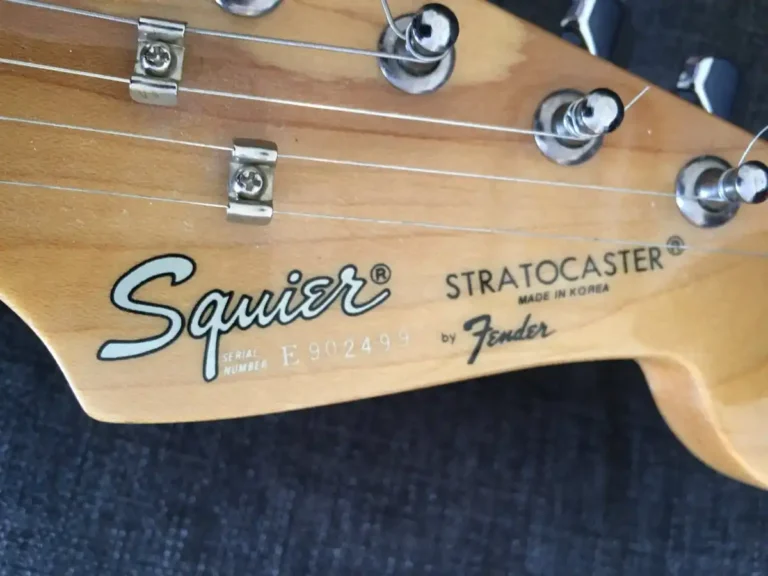
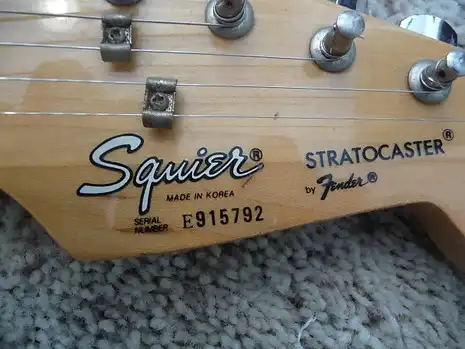
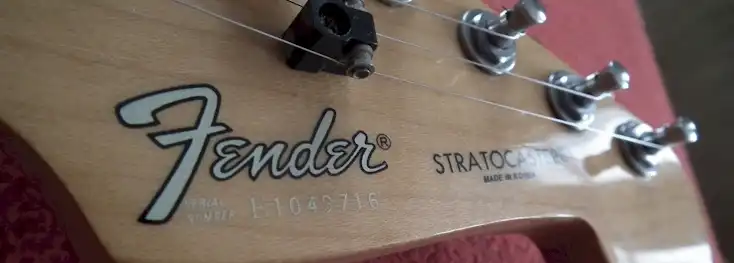
These early Korean Stratocasters could be identified by a very light silver serial number that began with E7, E1, or E9 (and occasionally E2 and E8), as well as by a small rectangular sticker placed on the neck heel and the neck pocket.

Silver E1 + 5-digit number
Silver E1 + 6-digit number
Silver E1 + 5-digit number
Silver E9 + 5-digit number

Young Chang stopped making Squier guitars in late 1988 or early 1989 when production was transferred to Sung Eum and Samick factories. 
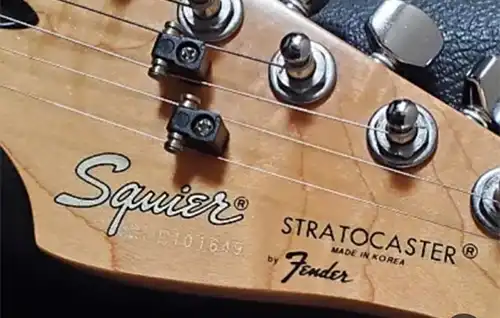
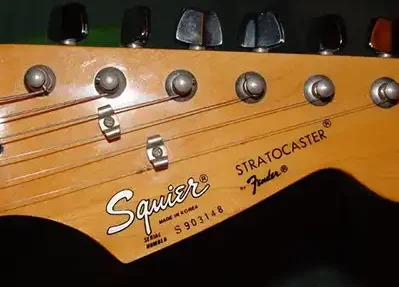
The Sung Eum factory also used serial numbers starting with E9. However, they could be distinguished from those on guitars made at the Young Chang factory because the serial numbers on Sung Eum guitars were always black.
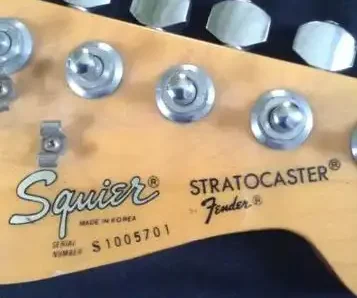
The serial numbers of guitars manufactured at the Samick factory started with the S9 or S1 prefix and were also printed in black ink.

A Consistency Problem

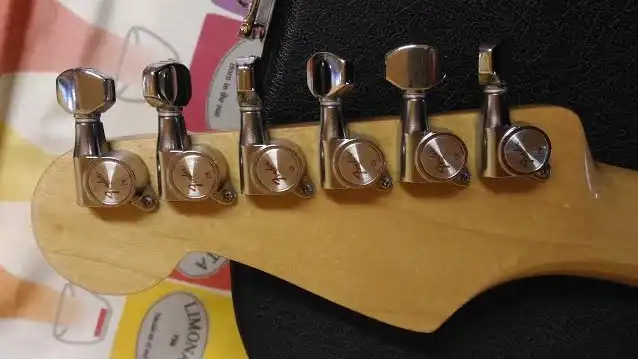
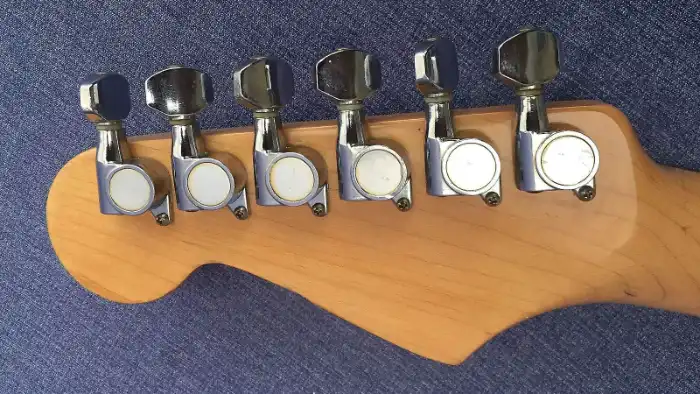
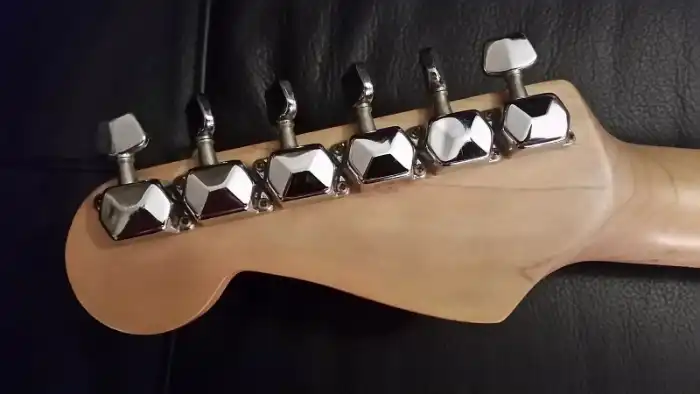
The tuning machines of the first Korean Squier Stratocasters made at Young Chang were the Fender/Gotoh Standard type, like those used in Japan, while guitars built in Samick or Sung Eum were usually fitted with unbranded Standard tuners or the cheaper Jin Ho “trapezoid” tuning machines.  
Early Squier Stratocasters built in Young Chang typically featured black roller string trees, while guitars made in Samick or Sung Eum factories had butterfly-shaped trees.

Black E9 plus 5-digit number
Black S9 plus 5-digit number
Black S1 plus 6-digit number

“Sometimes the guitars for the domestic market would come from one factory and the guitars for international sales would be produced by another,” Brad Townsend, Fender Vice President of international sales, recalls in an interview with Tony Bacon. “Sometimes one factory would have a quality issue or a delivery issue—since Fender wasn’t their only customer—and we would move production out of one factory into another. But eventually, Fender would end up doing business with that factory again, because there were basically only the three good factory choices.” Changes like this to the sources of guitars made it challenging to maintain consistency.  

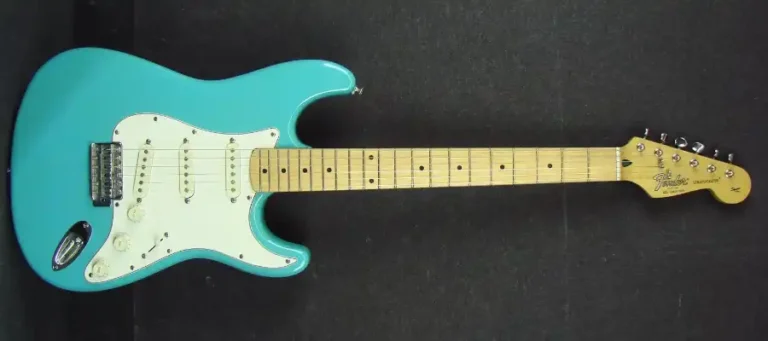
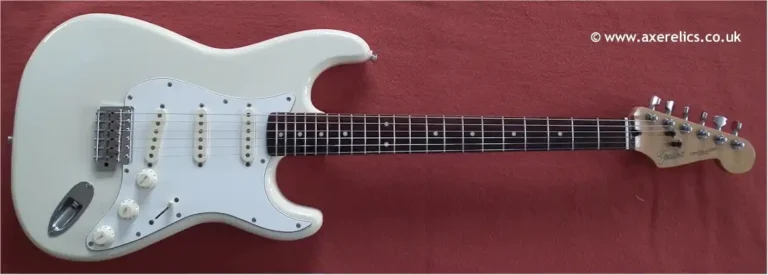
Korean Fender Stratocaster
Korean Fender Stratocaster (photo: Axe Relics)
Note the very light silverish ink used for the serial number on this Korean Fender-branded Stratocaster
Note the very light silverish ink used for the serial number on this Korean Fender-branded Stratocaster (phptp: Axe Relics)

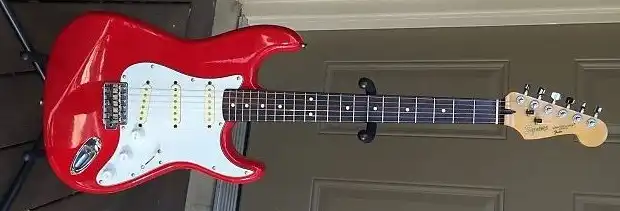
The Korean Squier Standard Stratocaster was first listed in the US catalog in 1988 at a very competitive price of $299.99. Initially, it was available in Black, Red, and White finishes, and later in Black, Midnight Wine, Arctic White, and Electric Blue. 

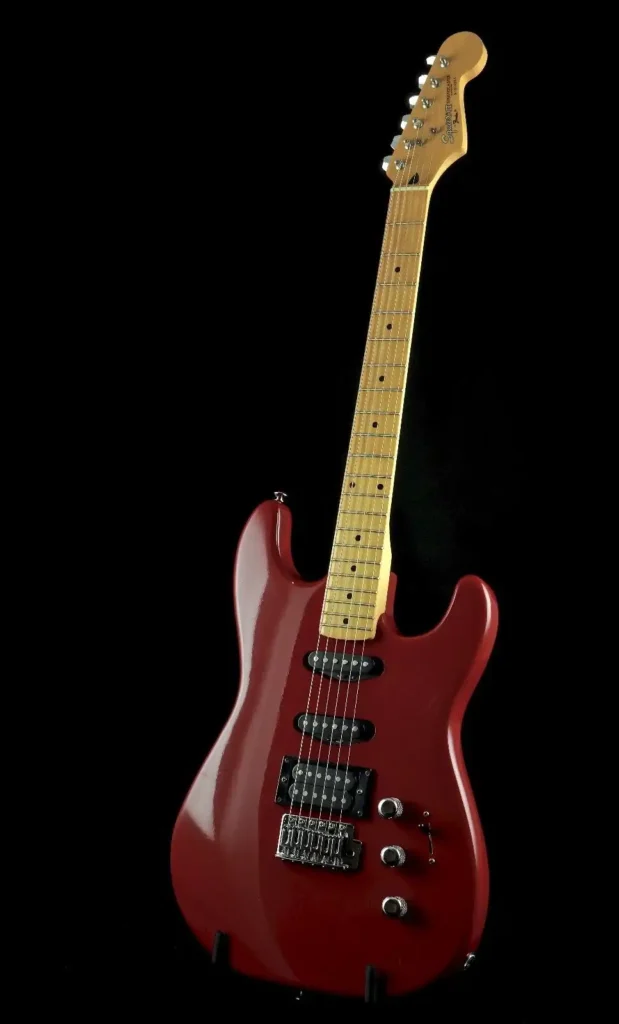
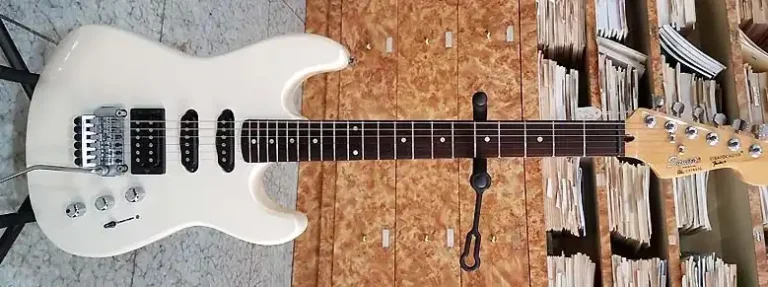
The Korean Squier Contemporary Stratocaster was equipped with two single-coil pickups and one humbucker, a rosewood fretboard, and a Schaller Floyd Rose Licensed bridge with a locking nut. Its body featured a side-mounted jack socket and lacked a pickguard. It was priced at $399.99, and the available finishes were Black, Razz Berry, Frost White, and Flash Pink. 

Squier Contemporary — first series made in Korea
'80s “E” Series Korean Squier Stratocaster

The Plywood Body

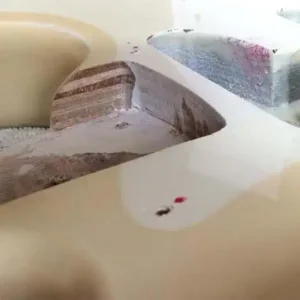
After a promising start with strong sales, Korean strats did not achieve the expected success because their build quality had significantly declined. The main reason for the drop in Squier guitars was the laminate construction of the body.

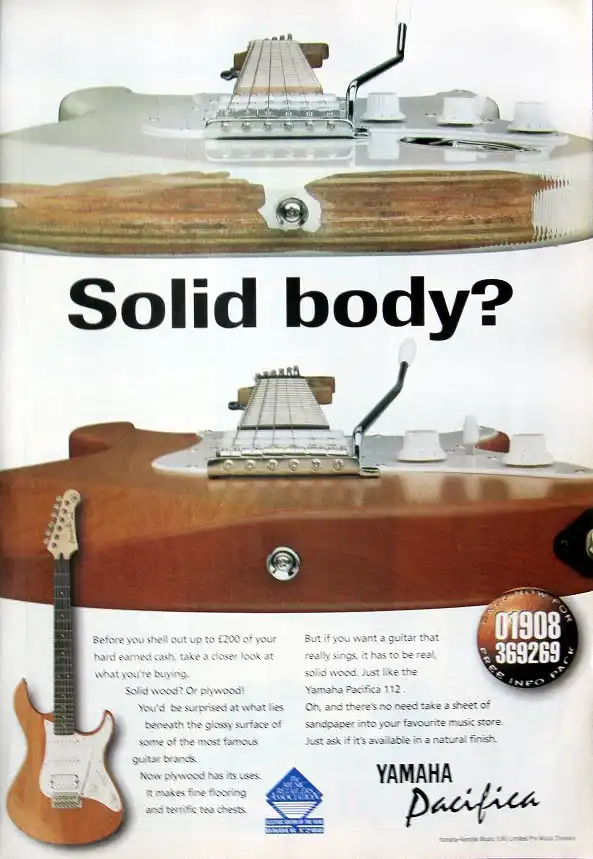
1995 Yamaha Pacifica ‘solid vs. plywood’ advert

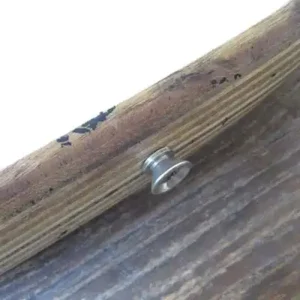
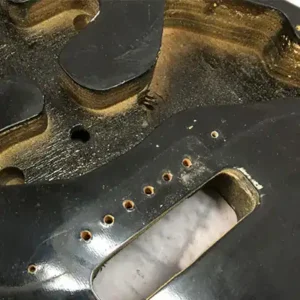
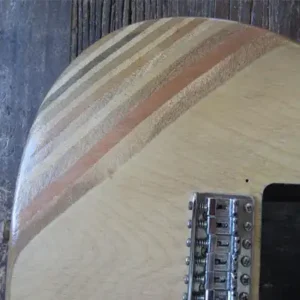
Although the first Korean guitars made at the Young Chang factory (with the silverish serial numbers) had bodies made of a multi-piece alder core with a veneer top and back, those produced at Sung Eum and Samick (with black serial numbers) had plywood bodies concealed by thick polyester coats. The only exception was the Young Chang guitars with silverish E9 serial numbers, which had plywood bodies.

Fender never listed body composition in their catalogs and price lists, but plywood bodies were an easy target for competitors.

In 1995, the Yamaha Pacifica ad featured a paint-stripped plywood Squier body, with the tagline: “Before you shell out up to £200 of your hard-earned cash, take a closer look at what you’re buying. Solid wood? Or plywood! You’d be surprised at what lies beneath the glossy surface of some of the most famous guitar brands. Now plywood has its uses. It makes fine flooring and terrific tea chests. But if you want a guitar that really sings, it has to be real, solid wood. Just like the Yamaha Pacifica 112. Oh, and there’s no need to take a sheet of sandpaper into your favorite music store. Just ask if it’s available in a natural finish.”

Examples of Korean plywood bodies

The Japanese Hypothesis

There is a common belief that the first MIK Squiers were assembled from leftover parts from the Japanese Fujigen Gakki factory. In reality, Fujigen continued manufacturing Fender “Standard” guitars, so there was no surplus stock to send to Korea. And, indeed, the differences between the Korean and Japanese Squiers were significant: electronics, hardware, and pickups on the Korean guitars were cheaper, although some hardware components came from a shared source.
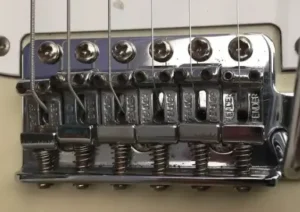
Someone also suggested that the saddles on the Korean Squiers came from the USA. Still, aside from the contradiction in this claim, since FMIC aimed to lower costs for MIKs, the double “Fender” stamps on US saddles were oriented in opposite directions, while those on Korean guitars faced the same way. In fact, according to John Page, the saddles used on Korean Squiers were made at the Taiwanese Ping factory. 

Early MIK double “Fender” stamped saddles, with both scripts oriented in the same direction
Fender/Gotoh Standard tuners as found on early “E” Series Korean Stratocasters
Fender/Gotoh Standard tuners as found on early “E” Series Korean Stratocasters (phpto: Daniele Zurma)
Unbranded tuning machines on an “S” Series Korean Strat

1992 Squier Standard and Contemporary Stratocasters

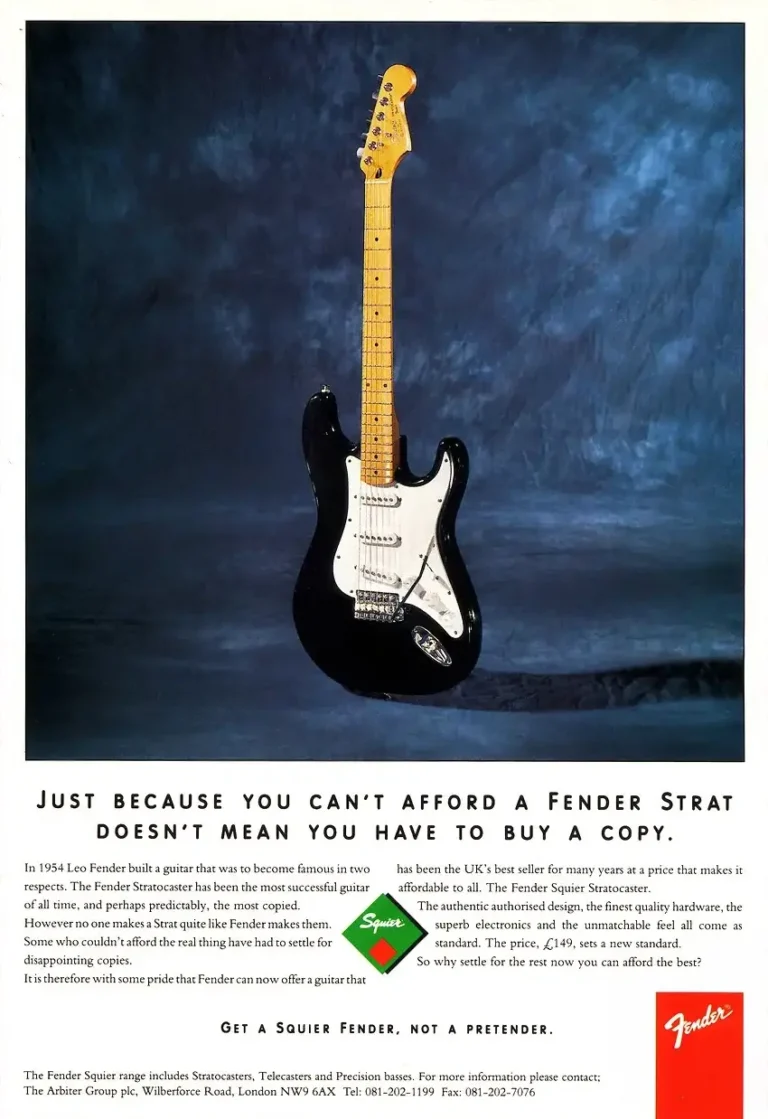
Fender Squier Stratocaster print ad, spring 1992

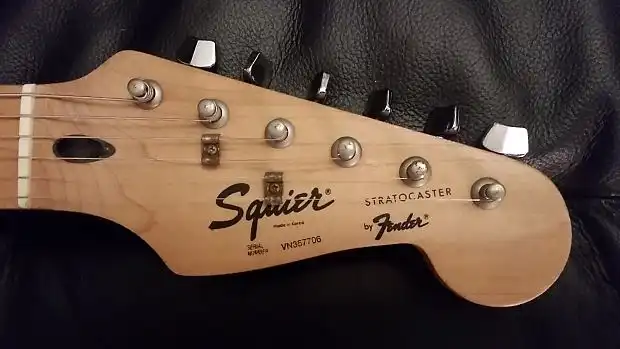
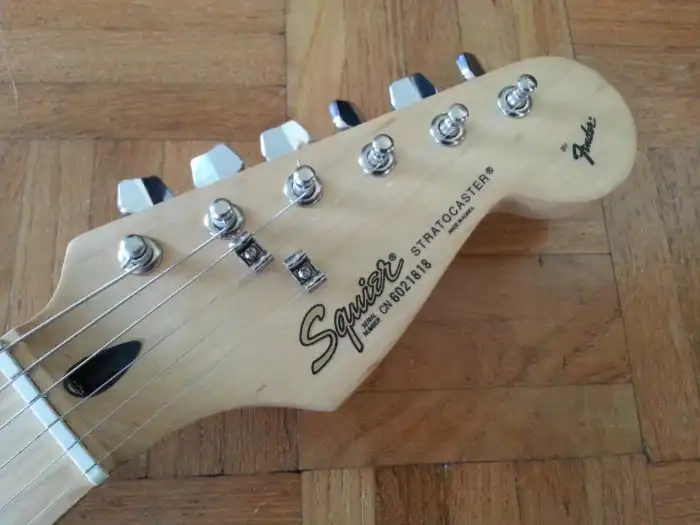
In 1992, production was moved to the Cor-Tek (Cort) and Saehan (Sunghan) factories. The new Squier guitars could be recognized by a new black silkscreened Squier logo and serial numbers starting with CN and VN, respectively.
To cut costs and reduce prices, the thickness of the plywood body on the Korean Stratocasters was reduced, as opposed to the full-sized bodies of guitars made in Young Chang, Samick, or Sung Eum. As a result, the new Squiers were not only made of plywood, but they were also smaller! Furthermore, the 1-ply pickguard was sometimes poorly fitted and misaligned with the edges of the body.
They also featured the cheap Jin Ho “trapezoid” tuning machines, which were already used on some Stratocasters manufactured at the Sung Eum factory.  
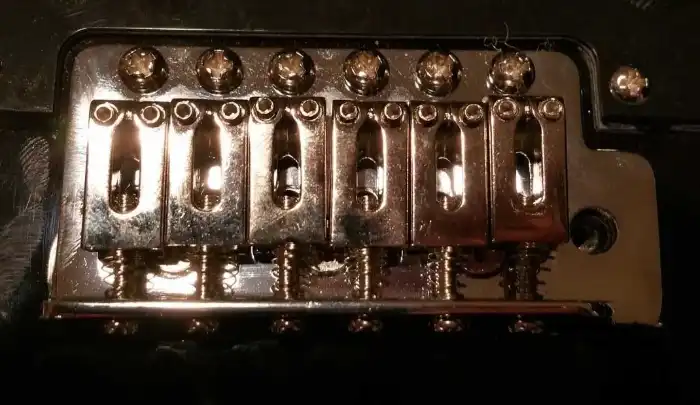
A low-budget bridge with thin die-cast block saddles replaced the vintage-style bridge on the Squier Standard Stratocaster, and the Floyd Rose Licensed bridge used on the Squier Contemporary Stratocaster, which became a sort of Standard HSS model.
Both models were available exclusively with a maple fingerboard (at least until 1994), and the color options were limited to Black, Arctic White, and Torino Red.
With the 1992 models, the Squier brand had truly hit rock bottom.

The new low-budget bridge design used on Korean-made Stratocasters
The new headstock, featuring the black Squier logo and “CN” or “VN” serial numbers
Low-budget trapezoid tuners manufactured by Jin Ho

In 1994, the serial number was moved to the neck plate, and the markings on the headstock were redesigned while keeping the black Squier logo.

The mystery of the M2 guitars

In 1992, a few Squier Standard (SSS) and Contemporary (HSS) Stratocasters featured a catchy black logo with silver trim and a serial number with an M2 prefix.

They were likely produced for a very short period between the first and second series of the Korean Standard and Contemporary Stratocasters, and little is known about these guitars.

Headstock of a 1992 Squier M2 Stratocaster

The end of the plywood

Print ad for the 1996 Squier Standard Series

The Korean Stratocasters suffered from negative marketing by competitors due to their plywood bodies, and Squier was on the verge of collapse, prompting Fender to reconsider its strategy.

In 1996, Fender ran for cover, introducing significant updates to Squier guitars. They replaced the thin plywood bodies with thicker ones made of alder, used a 3-ply pickguard that fit better to the body, and installed a more efficient Synchronous Tremolo with die-cast CBS-style saddles.

The new guitars were available in Midnight Blue, Midnight Wine, Black, Arctic White, and Brown Sunburst finishes.
They were offered in the SSS and HSS—now called Squier Standard Fat Stratocaster instead of Contemporary—models.
To highlight these changes, a new Gold Logo was applied to the headstock.

Headstock redesigned with a gold Squier logo

Despite everything, they were not well constructed—changing the body alone wasn’t enough to improve them—so Fender introduced new “deluxe” Squier models to complement the more affordable Squier Standard series, the Pro Tone Series (described in the next chapter), which only cost a little more.

It should also be noted that in late 1994, Fender began manufacturing some Squier guitars in China, and, in 1998, for a few months, the production of the Standard Squiers was temporarily moved to Mexico, where the “Black Label” Squier Classic Stratocaster and the Mexican Fender Squier Series had been produced some years earlier. 

Squier II Stratocasters

In 1988, aiming to offer instruments at an even more affordable price, Fender briefly attempted to manufacture guitars in India at the Greeta factory, Madras (now Chennai), adopting the Squier II brand name.  

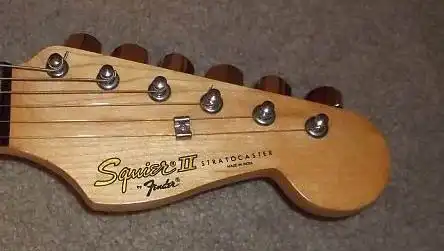
The Indian Squier II Stratocasters were easy to recognize because of the unusual shape of both their headstock and pickguard. Their quality was inconsistent, and it seems that Fender destroyed more of them than they shipped. In a letter to dealers, dated September 1988, Fender apologized for the situation and stated that supply would be significantly less than expected

As a result, the production of Squier II guitars was moved to the Samick factory in Korea, partly through an agreement with Texas-based distributor IMC. Still, they were discontinued between 1992 and 1993.
The Squier II Stratocaster body, available in Black, Torino Red, and Frost White, was made of plywood even though the Fender catalog reported “hardwood.” It was thin and heavier than other Korean guitars, with hardware that was definitely cheap. 

The Squier II Standard Stratocaster was available in both SSS (made in Korea and India) and HSS (only made in India) versions.  

The Squier II Contemporary Stratocaster, equipped with one humbucker and two single coils, was manufactured exclusively in Korea. It differed from the Squier II Standard HSS Stratocaster by featuring a side-mounted jack socket and no pickguard.

Indian Squier Stratocaster HSS
Indian Squier Stratocaster HSS (photo: Antelopebob from Strat Talk)
Squier II Contemporary Stratocaster made in India

Indian instruments didn’t always feature the “Made in India” marking on the headstock. At the same time, their serial number, which followed a US-style serialization scheme (“E” for the ’80s and “N” for the ’90s), was printed on a sticker attached to the base of the neck that often peeled off. 
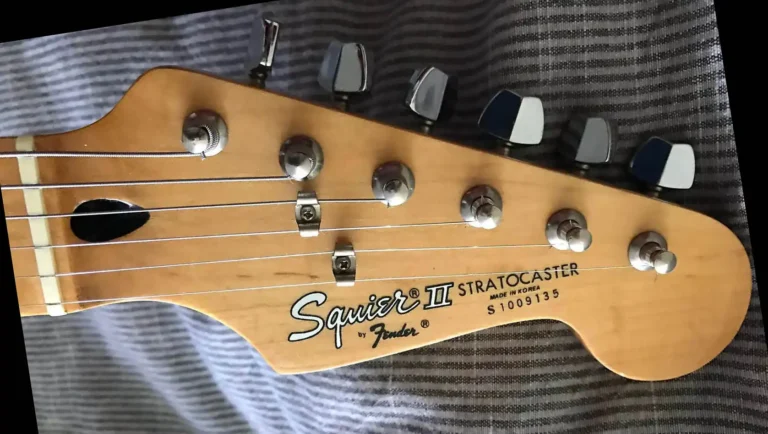
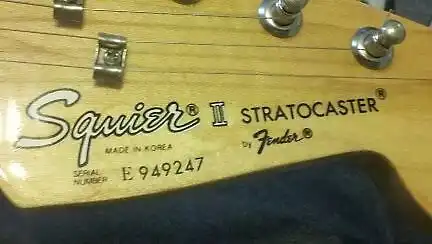
The serial number of the Korean Squier II Stratocasters was black, located on the headstock, and started with an E9, S9, S1, J1, or M1 prefix, depending on the manufacturing plant.

Headstock of a Squier II “S” Series Stratocaster, made in Korea
Headstock of a Squier II “E” Series Stratocaster, made in Korea
The unusual shape of the headstock on the Squier II Stratocaster, made in India

Squier HM Strats

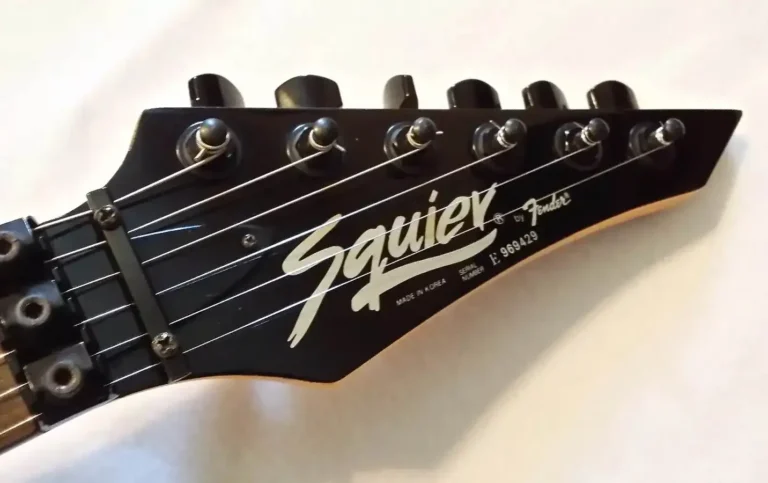
The HM Strats were not only Japanese guitars: between 1989 and 1992, Korea also produced five models of these superstrats, all featuring small bodies, twenty-two frets, black hardware, no pickguard, and equipped with a 2-pivot bridge, either under Floyd Rose license or, from 1991 onward, an authentic Floyd Rose. The headstock was very distinctive: aggressive, edgy, and bearing a large “Swooshy” Squier logo.
The HM I and HM II had one humbucker and two single coils; the HM III, HM IV, and HM V had two humbuckers and one single coil. The necks of I, II, and III were bolted to the body using a 4-bolt asymmetrical neck plate; in contrast, IV and V had neck-through designs.
Unfortunately, even these guitars were of much lower quality than the Japanese versions.

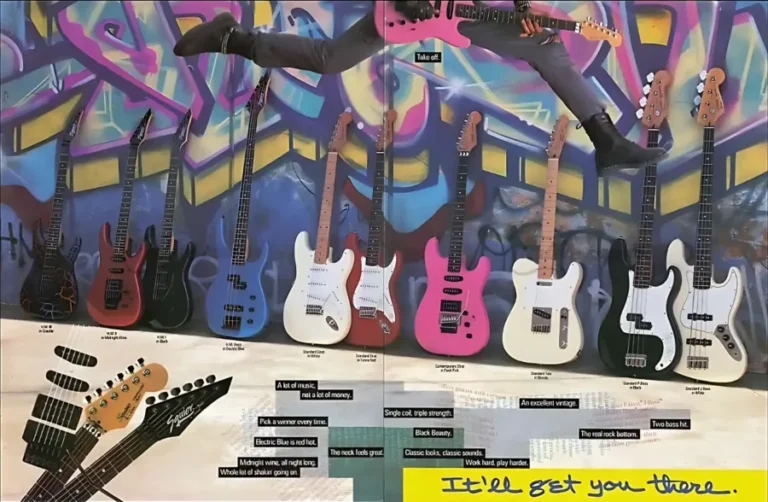
Squier catalog page: on the left, three Squier HM Strats and a Squier HM Bass
Squier HM Strat, swoosh-style headstock

The Korean Squier Series Stratocasters

In 1992, Fender launched the Squier Series Stratocaster to help revitalize Korean Squier guitars. This Fender-branded instrument had a laminate hardwood body and featured a small Squier Series logo on the tip of the headstock. It should not be mistaken for the Japanese and Mexican Fender Squier Series Stratocasters.  
According to Fender, the Squier Series Stratocaster was a step above other Squier guitars, as the advertisement stated: “For musicians who want the quality and the performance of a Fender guitar but don’t think they can afford it, the Fender Squier Series is the answer.” 
It was available in Black, Torino Red, Arctic White, and also in the catchy Pacific Blue finish. 
However, the vintage-style bridge, 3-ply pickguard, and Fender logo on the headstock weren’t enough to rekindle interest in the Korean Squiers. 

1993 Pacific Blue Fender Squier Series Stratocaster, made in Korea
Headstock of a Korean Fender Squier Series Stratocaster

The Bullet Stratocasters

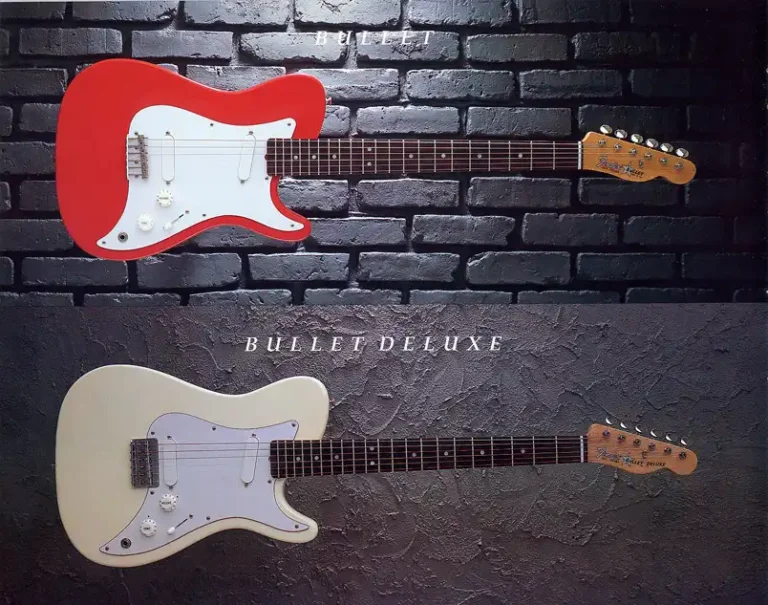
The Fender Bullet was a guitar designed by John Page and launched in 1981 for a young, budget-minded audience, aimed at replacing the outgoing Mustang and Music Master. 

Fender initially planned to have the Bullet manufactured overseas in Korea. However, it didn’t work out because of some quality control issues, and the first two models, the Bullet—known as “Standard Bullet”—and the Bullet Deluxe, were produced in the USA at the Fullerton plant.

By late 1983, Fender decided to move the production of Bullet guitars to Japan and market them under the Squier brand. Japanese Squier Bullet guitars featured solid wood bodies and ceramic pickups, and they no longer had strings-through-body bridges.

Bullets models, 1982 Fender catalog

In 1987, production of the Bullets was moved to Korea, updating the Squier Bullet S-3T and the Squier Contemporary Bullet HST (two versions), and introducing the Squier Contemporary Bullet HSS.

It’s worth noting that, up to this point, the Bullet series was not yet considered a type of Stratocaster, although the 1987 Korean S-3T models closely resembled it. The first genuine Bullet series Stratocaster was the Squier Bullet Stratocaster, which was manufactured in Korea beginning in 1989.

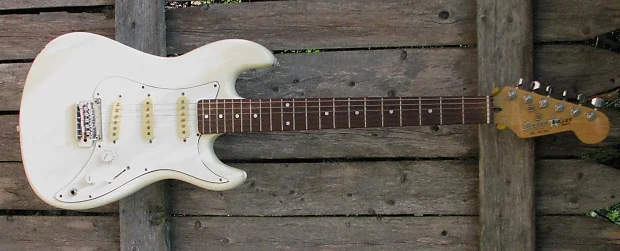
It was an affordable guitar that, like many Korean-made instruments, had a plywood body. The tuning machines were the budget Ping models, replacing the previous “Fender-stamped” tuners found on the Japanese Bullets. The two-pivot bridge had die-cast saddles, and the pickguard had an unusual shape reminiscent of Indian Stratocasters. This guitar lacked the second tone knob, and in its place, there was a jack socket.

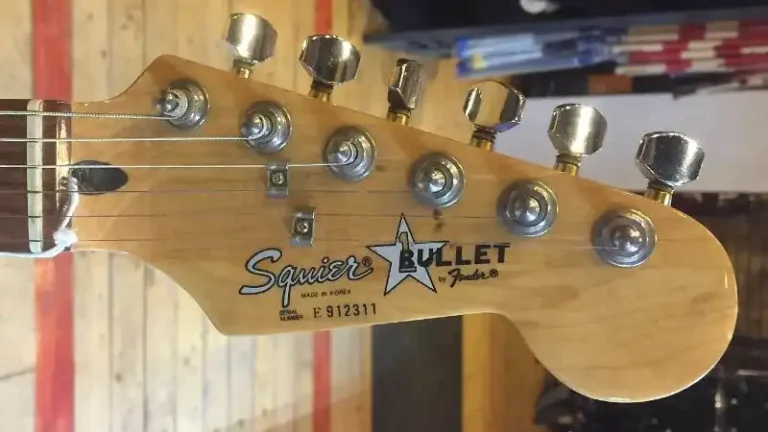
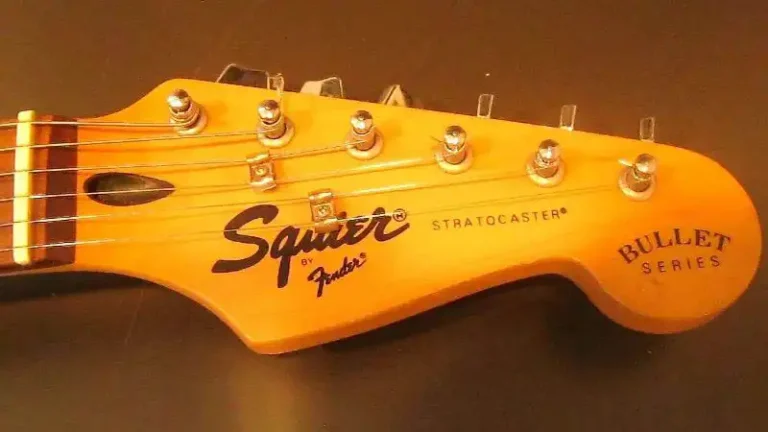
The serial number of the very first Bullet Stratocasters was stamped on the neck plate and featured an “E9” prefix. The headstock sported the Silver Squier Logo along with a silver star near the Fender logo and the “Bullet” inscription. Initially, it was equipped with only one string tree. However, the serial number was soon moved to the headstock, and a second string tree was added afterward.

First-generation Squier Bullet Stratocaster
Headstock of the first-generation Squier Bullet Stratocaster

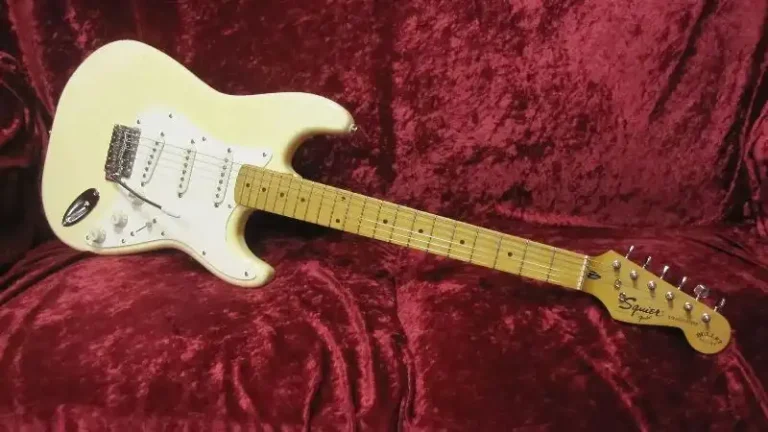
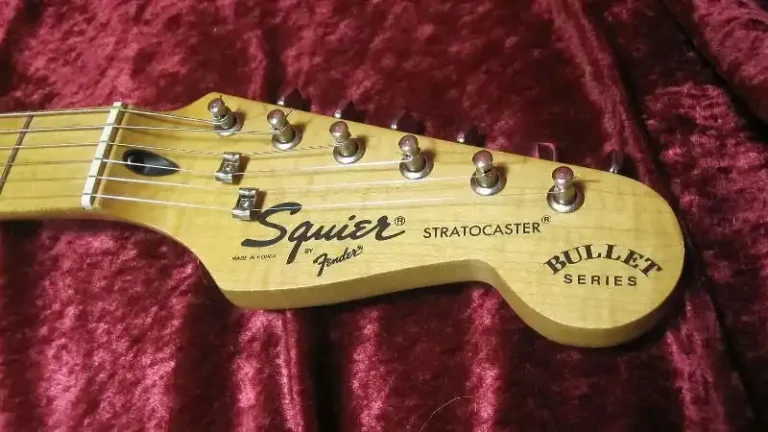
The next Squier Bullet Stratocaster, made between 1994 and 1995, stood out from its predecessor due to several unique features. These included a bridge with six screws, a headstock featuring the Black Squier Logo along with the “BULLET SERIES” decal, two string trees, and, most notably, the addition of a second tone control. 
Later on, the production of the Bullets was moved to China and Indonesia.

Second-generation Squier Bullet Stratocaster
Headstock of the second-generation Squier Bullet Stratocaster
Headstock of the second-generation Bullet Stratocaster without the “Made in Korea” decal, which was instead engraved on the neck plate
Antonio Calvosa
Antonio Calvosa
Antonio Calvosa is a pharmaceutical chemist with a deep passion for electric guitars. He is a former guitarist for Lost Property Office, with whom he won the Italian edition of Emergenza Rock in 2004 and performed at the Taubertal Festival in Rothenburg, Germany. In 2014, he founded Fuzzfaced, a valuable platform for electric guitar enthusiasts, and in 2022, he contributed to the book "Stratocaster: sei corde nella leggenda."
Antonio Calvosa
Antonio Calvosa
Antonio Calvosa is a pharmaceutical chemist with a deep passion for electric guitars. He is a former guitarist for Lost Property Office, with whom he won the Italian edition of Emergenza Rock in 2004 and performed at the Taubertal Festival in Rothenburg, Germany. In 2014, he founded Fuzzfaced, a valuable platform for electric guitar enthusiasts, and in 2022, he contributed to the book "Stratocaster: sei corde nella leggenda."