A Badge of Honor:

Squier Pro Tone Series

HOW THE PRO TONE SERIES SAVED SQUIER

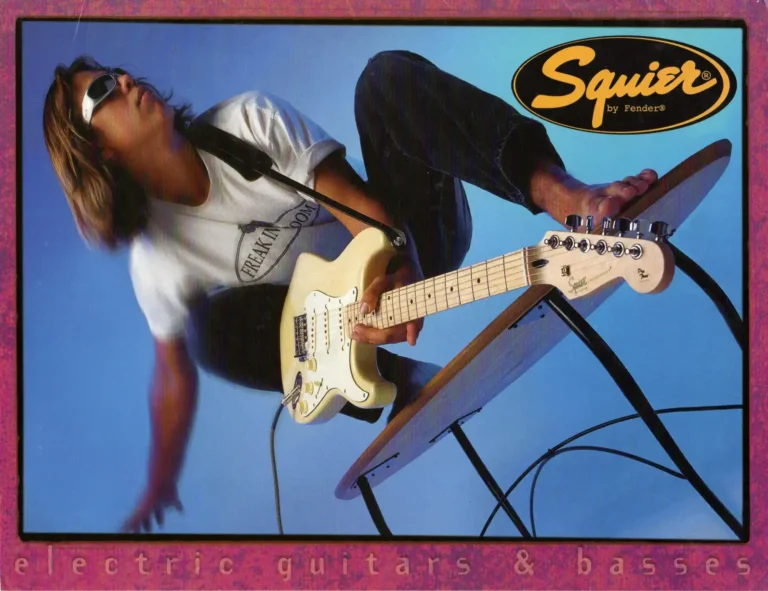
Squier Pro Series advertisement, 1996 Fender Frontline. For guitarists of a certain vintage, this ad might have recalled the series of classic ’50s and ’60s Fender ads headlined “You Won’t Part With Yours Either,” which featured guitars in unlikely outdoor action settings

Squier had been helpful to Fender in competing with Eastern copy guitars, but by the early 90s, its role had become unclear. It appeared on the verge of collapse because competitors began targeting the Squier brand by offering more features, better woods, and a wider range of colors and finishes at the same price points where Squier operated. 
Korean Squier instruments were proving to be a notable failure, as their plywood bodies suffered from negative marketing, and Squier was gradually losing market share to its competitors.
Fender had to improve the quality of the Squier brand, so they decided to introduce new “deluxe” Squier models to complement the more affordable Squier Standard series already in the catalog, the Pro Tone Series.
The design and technical drawings for the Pro Tone instruments were developed at Fender’s headquarters in Scottsdale and then sent to Korea. Once the prototypes were finished, John Carducci, who was then the Marketing Manager for Squier, traveled to the Cort factory in Korea to make sure every detail met Fender’s standards.

The Squier Pro Tone Stratocaster and the Squier Pro Tone Fat Strat were available from 1996 to 1998 at a moderate price compared to other Squiers.
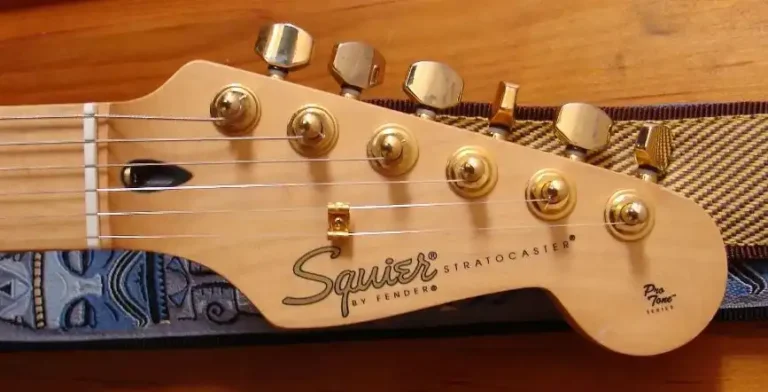
A new type of logo that recalled the spaghetti-style design of the classic vintage Fenders was used on these guitars. 
According to John Carducci, they made this change because the Squier logo should have been a “badge of honor, instead of implying that it was the badge of dishonor. It was all done to help Squier stand on its own, to give it its own identity.”

The New Gold Squier Logo of the Pro Tone Series

Building the Pro Tone: Design and Features

The original plan was to remove the words “By Fender” from the headstock. Still, they prefer to keep it next to the Squier decal, not primarily to add credibility to Squier, but for trademark protection.

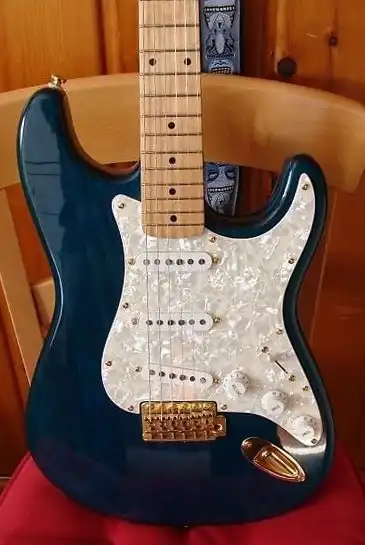
The beautiful Sapphire Blue finish

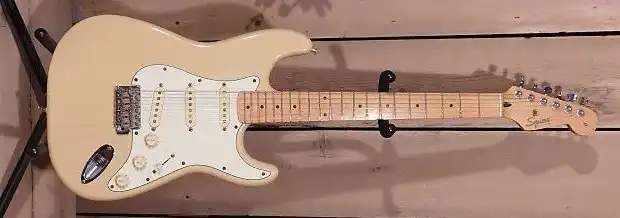
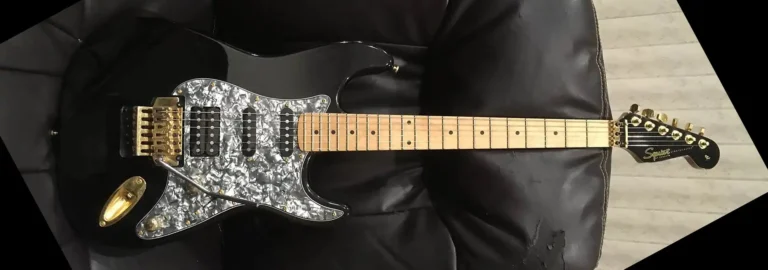
The beautiful, solid ash body of Pro Tone Stratocasters was available in stunning “see-through” finishes such as Vintage Blonde, Trans Crimson Red, 3-Tone Sunburst, Trans Sapphire Blue (which sometimes turned green over time), and Trans Green. Additionally, Olympic White was offered for the SSS model and Black for the fat model, both with matching headstocks. Moreover, Crimson Red, Sapphire Blue, and Black Pro Tone Strats featured all gold hardware.  
Appreciated upgrades included the Precision Die-Cast tuning machines and the alnico-loaded single-coil pickups with staggered pole pieces—whereas earlier Korean Squiers featured rather sharp-sounding ceramic pickups—that delivered an authentic woody twang with plenty of clear-toned attack on top. 
The bridge humbucker of the fat model darkened things quite a bit, but it boosted output and sustain.
The 21-fret fingerboard radius on the Pro Tone Stratocaster was 9.5”—just like Fender USA—while the Pro Tone Fat Strat had a modern 12” radius for smooth bending and 22 frets.

The Pro Tone Stratocaster featured a vintage-style tremolo bridge with hardened steel saddles that didn’t wear out as easily, preventing those razor-sharp edges from causing the strings to snap at the worst times. 
The Pro Tone Fat Stratocaster featured a Floyd Rose-licensed double-locking vibrato system, allowing for a generous amount of up-bending.
The “Crafted in Korea” decal was located at the base of the neck, just above the serial number, which was either made up of a “KC” prefix followed by an 8-digit number or a 7-digit number with only numerals.

Pro Tone Stratocaster
Pro Tone Fat Strat
Pro Tone Fat Strat

The Pro Tone Paradox: How Success Led to Its Demise

The reason the Pro Tone disappeared from the catalog in 1999 was, strangely, because of their success. The Squier Pro Tone series was very popular, but some of its price points were comparable to those of Mexican-made Fenders, causing Fender to lose sales from their Mexican guitars. In 1997, the regular Mexican Standard Stratocaster was priced at $429.99, while the Floyd Rose model was $529.99. During the same year, the prices of Pro Tone Strats increased from $499.99 to $639.99, depending on the model. As a result, it was the Pro Tones that captured the attention of guitarists. However, Fender was too focused on Ensenada’s guitars to allow this. 

Antonio Calvosa
Antonio Calvosa
Antonio Calvosa is a pharmaceutical chemist with a deep passion for electric guitars. He is a former guitarist for Lost Property Office, with whom he won the Italian edition of Emergenza Rock in 2004 and performed at the Taubertal Festival in Rothenburg, Germany. In 2014, he founded Fuzzfaced, a valuable platform for electric guitar enthusiasts, and in 2022, he contributed to the book "Stratocaster: sei corde nella leggenda."
Antonio Calvosa
Antonio Calvosa
Antonio Calvosa is a pharmaceutical chemist with a deep passion for electric guitars. He is a former guitarist for Lost Property Office, with whom he won the Italian edition of Emergenza Rock in 2004 and performed at the Taubertal Festival in Rothenburg, Germany. In 2014, he founded Fuzzfaced, a valuable platform for electric guitar enthusiasts, and in 2022, he contributed to the book "Stratocaster: sei corde nella leggenda."