When Fender was Fender

The Golden Era of the Fender Stratocaster

THE STRATOCASTER IN THE PRE-CBS ERA

In 1954 the foundations of rock and roll had been laid. Television, radio, and long-playing records had arrived.  On January 4, 1954, Elvis Presley’s first commercial recording session occurred at Sun Records in Tennessee.  In April, Bill Haley & His Comets released “Rock Around the Clock,” the first rock’n’roll record heard by millions of people worldwide.
The time was ripe for the Stratocaster’s success.
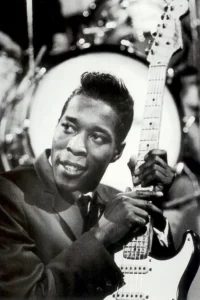
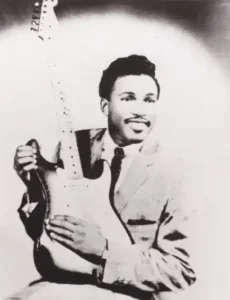
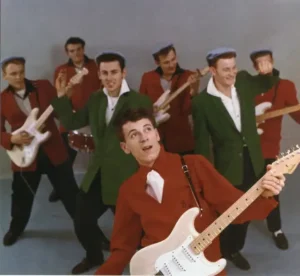
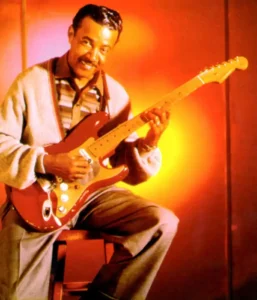
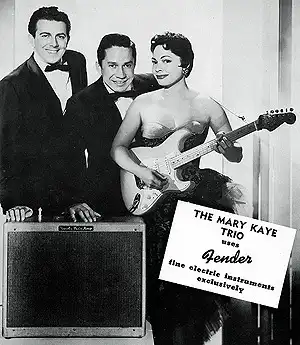
Soon the new guitar came into the hands of many musicians, including Pee Wee Crayton, responsible for Stratocaster’s debut on vinyl in the recordings that included The Telephone Is RingingOtis RushBuddy GuyGene Vincent, author of Be-Bop-A-Lula, and Mary Kaye, nicknamed the First Woman of Rock’n’Roll, who posed in 1956 for Fender catalog with a blonde Stratocaster with the gold-plated hardware which passed into history with her name.  Kaye, in reality, didn’t play the Stratocaster in that period.  She’d only used it for a few minutes for the 1956 Cha-Cha-Cha Boom! making, and for the advertising, at the insistence of Don Randall.  After that, the guitar was returned to Fender.

Mary Kaye posing with the famous blonde Stratocaster with the gold-plated hardware, 1956

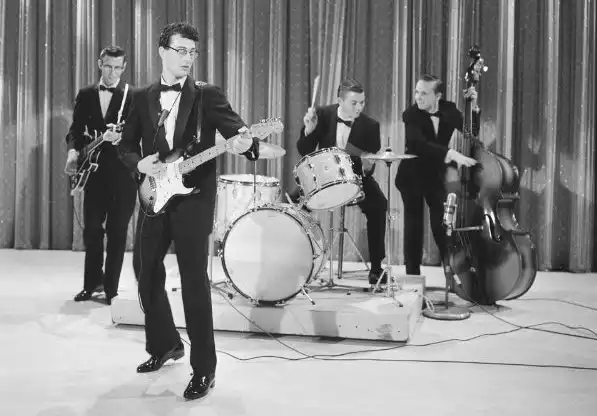
The most important guitarist who widely used the Stratocaster in the ’50s was Buddy Holly, a Texan musician who in a few years composed many rock’n’roll, country, and rockabilly songs.  With a modern and impeccable style, he pushed guitar performance to the limit soon becoming a teen idol.
In 1957, the 21-year-old Buddy Holly and his Stratocaster first appeared at the Ed Sullivan Show.  Certainly, his television appearances increased the sales of Stratocasters.  However, despite his enormous contribution to the spread of the Fender brand in the 1950s, Buddy Holly did not enter any catalog until 1982.  This was probably due to Randall’s conservative tastes, which were not inclined toward rock ‘n’ roll.  In fact, he preferred to use more traditional artists to promote his products. 

Buddy Holly and the Crickets at the Ed Sullivan Show in 1957

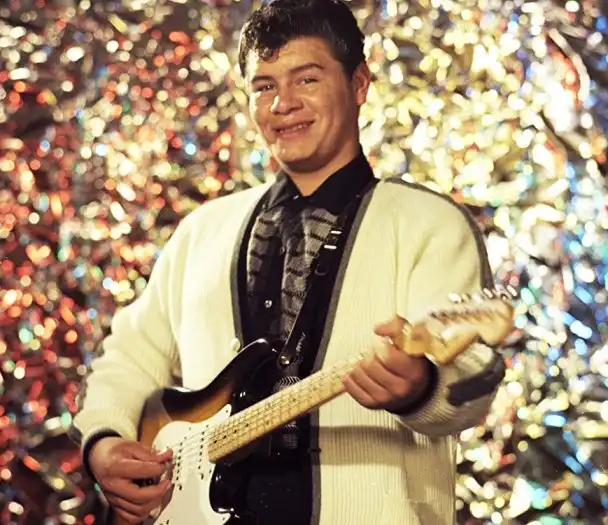
Unfortunately, Buddy Holly died prematurely in February 1959, along with another Stratocaster enthusiast, Ritchie Valens, a Mexican-born guitarist famous for his performance of La Bamba.
Business was going so well that in 1956 Fender built four more plants on South Raymond Avenue and, a little later, Fender Sales also moved to a larger location, at 1536 East Chestnut, in Santa Ana.
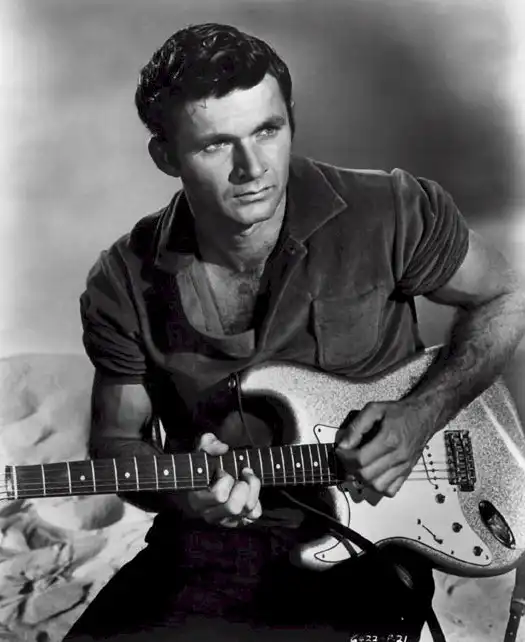
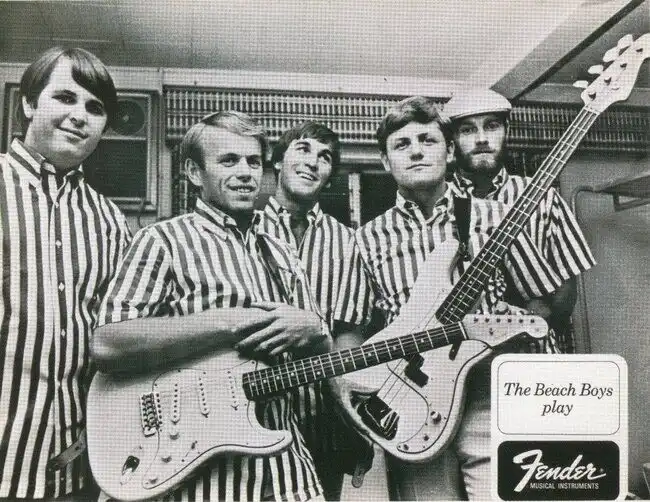
In the ’60s the fame of the Stratocaster grew even more, due to the surf music of the Beach Boys and Dick Dale, the left-handed guitarist famous for his Misirlou and Let’s go trippin’, who used to play a Stratocaster along with a cranked Showman amplifier and a Fender reverb unit.

Ritchie Valens
Dick Dale
Dick Dale
The Beach Boys posing for a Fender ad

Breaking the Ban: The Strat in the UK

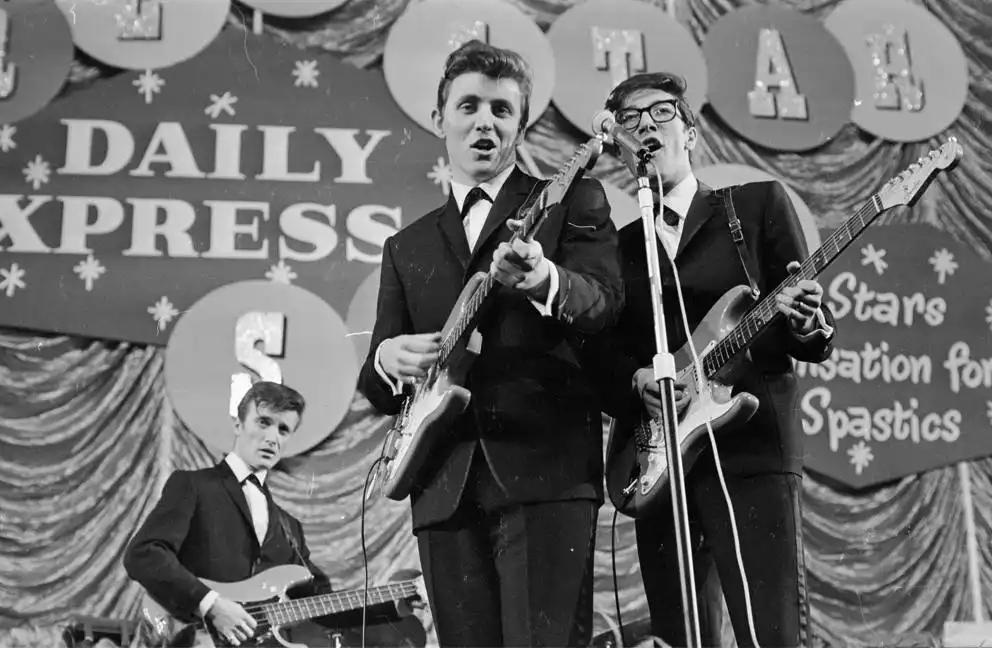
One of the first Stratocasters to arrive in the UK was that of Hank Marvin, the guitarist of the Shadows.
Between 1951 and 1959, the UK had a ban on the commercial imports of US instruments. It turned out that British guitarists had great difficulty buying any American-brand guitars, Fender instruments included.
However, during this time, there were still a few ways to acquire an American guitar. One option was to convince a sailor to bring one back from a trip to the USA. Another was to hunt down one of the rare second-hand instruments that occasionally appeared for sale. Or it was possible to privately import a new one by ordering it through the mail. That’s exactly how the guitarist of the Shadows, Hank Marvin, got his first Fender Stratocaster, a Fiesta Red (referred to as “Flamingo Pink” by Marvin) maple neck strat with gold hardware.
He and his friend Cliff Richard sent away to Fender for a brochure. When the 1958/59 catalog arrived, they spent a considerable amount of time admiring the contents and decided on the most expensive guitar in the book: a stunning red Stratocaster with gold-plated hardware and a maple neck.

Hank Marvin
On the right, Hank Marvin (Getty Images - Victor Blackman)

It was 1959. Shortly after that, the commercial import ban was lifted, but it took some time before instruments started appearing in stores.
Hank’s strat was one of the first Stratocasters in the UK, but not the first, as is often claimed. There were earlier, unofficial arrivals—some made possible by a helpful crew on the U.S.–UK liner fleet, who could visit a musical instrument store in the USA and bring back a Fender for British guitarists with the right contacts and money.
However, Hank’s became the most visible one.
Thanks to the success that the Shadows had in Great Britain, the Stratocaster’s popularity spread very quickly overseas.

Refining the Strat

In the middle of 1956, Fender started using alder, easier to work, than ash, as the main body wood for Stratocasters that were not finished in Blond.  Because of the more stunning results with ash, Fender continued making see-through blonde Stratocasters from this beautiful, figured-grain wood.
At first, Fender used a two-color sunburst finish.  In mid-1958, the 2-Color Sunburst was changed for the 3-Color Sunburst, with red blended between dark brown and yellow.  The following year there were two other important changes: the introduction of Brazilian rosewood fretboards and the replacement of the old eight-hole pickguard with eleven-hole celluloid ones.  Because of its unstable nature, celluloid had the characteristic of turning brown over time, especially if subjected to light or smoke. So, these pickguards were never completely white but showed a greenish-yellow hue, hence the name of mint green pickguards

Antonio Calvosa
Antonio Calvosa
Antonio Calvosa is a pharmaceutical chemist with a deep passion for electric guitars. He is a former guitarist for Lost Property Office, with whom he won the Italian edition of Emergenza Rock in 2004 and performed at the Taubertal Festival in Rothenburg, Germany. In 2014, he founded Fuzzfaced, a valuable platform for electric guitar enthusiasts, and in 2022, he contributed to the book "Stratocaster: sei corde nella leggenda."
Antonio Calvosa
Antonio Calvosa
Antonio Calvosa is a pharmaceutical chemist with a deep passion for electric guitars. He is a former guitarist for Lost Property Office, with whom he won the Italian edition of Emergenza Rock in 2004 and performed at the Taubertal Festival in Rothenburg, Germany. In 2014, he founded Fuzzfaced, a valuable platform for electric guitar enthusiasts, and in 2022, he contributed to the book "Stratocaster: sei corde nella leggenda."