Rebuilding the Brand
fender signature guitars & Tribute Models
THE ORIGINS OF THE FENDER ARTIST SERIES

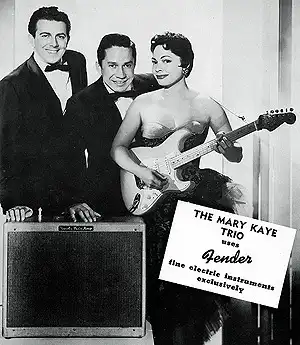
Since its earliest catalogs, Fender showcased musicians with their Jaguars, Piggybacks, and steel guitars. But unlike its main competitors, the company did not release any signature models until the late ’80s.
The name “Mary Kaye” was never a formal signature—it was simply a nickname applied to all blonde Stratocasters with gold hardware. In contrast, the 1980 Stratocaster with a reverse headstock, inspired by Jimi Hendrix, appeared only a decade after the guitarist’s death and should be considered a tribute rather than a true signature model.
Indeed, Fender never intended to release signature guitars.
Dan Smith recalled examples such as the Gibson Les Paul—often considered the only successful signature model, even though many guitar players didn’t realize Les Paul was a real person—and the story of Joni Mitchell’s name being removed from her Ibanez signature model in stores to boost sales. Signature models were very much a Gibson or Gretsch phenomenon, rather than a Fender one.

So why did Fender change its mind and launch the Signature Series guitars? The story begins with Dan Smith and John Hill.
By the end of the 1970s, Fender’s reputation was badly damaged after a decade in which CBS had relied heavily on the strength of the Fender name while investing too little in quality control and technological development.
Consequently, many guitarists had simply lost interest in Fender. David Gilmour relied mainly on vintage Fenders and Steinberger guitars; Eric Clapton favored vintage instruments and guitars built by Roger Giffin, while Jeff Beck and Dave Murray had moved to Jackson guitars.
The situation was made worse by Fender’s own manufacturing limitations. Years of heavy use had left many of the company’s jigs and machines worn and outdated, reducing both efficiency and quality. In effect, Fender had become its own fiercest competitor: the second-hand market, where older instruments were often better made—and cheaper.
In 1981, when John McLaren took over as President of CBS Musical Instruments, he replaced Llewellyn with Bill Schultz and brought in a new team from Yamaha, including Dan Smith, now Director of Marketing for electric guitars.

Rebuilding Fender’s Image Through Artists
When Dan Smith joined Fender, he immediately reached out to John Hill, the English Fender representative who knew every major UK guitarist. Hill had been sending reports to Fender/CBS President Ed Llewellyn for years, arguing that these pieces of wood—crafted on furniture machinery—were more than just instruments. They were objects guitarists formed emotional bonds with, instruments capable of creating magic.
Smith invited Hill to meet the new team—Dan Smith, Bill Schultz, and John McLaren. McLaren was taken aback. He had assumed he was the first Brit working at the corporate level for the world’s biggest guitar brand, only to learn that Hill had been quietly shaping Fender’s presence from England for years.
McLaren formalized Hill’s role, expanding his remit to become Fender’s first Artist Relations and Brand Director for Europe. Reporting directly to McLaren and Schultz, Hill became the vital bridge between Fender and Britain’s top guitarists, setting the stage for the company’s first true Signature Series instruments. Until then, Fender had always left Artist Relations to the Sales Division.
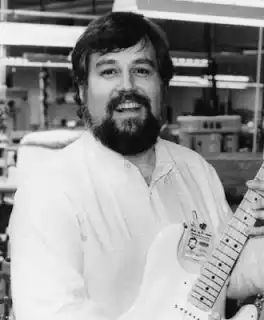
Dan asked John Hill who he thought were the most influential Fender players. Without hesitation, Hill rattled off a list: David Gilmour, Eric Clapton, Jeff Beck, Jimmy Page, Ritchie Blackmore, Pete Townshend, Keith Richards, George Harrison, Andy Summers, Mark Knopfler, Hank Marvin, Dave Evans (The Edge), Richard Thompson, Johnny Marr, Steve Hackett, Steve Howe, Dave Murray, John McLaughlin, Allan Holdsworth, Stuart Adamson, and Alan Murphy!
Dan laughed. “I didn’t mean the most influential in the UK,” he said. “I meant in the world!”
“I meant in the world!” Hill replied with a grin. “They just happen to be all from Great Britain. I know all of them and have been supplying them with shirts and hats, pickups and parts, backup guitars, amps… oh, and freebies for use in promotional campaigns, like win-a-guitar contests!”
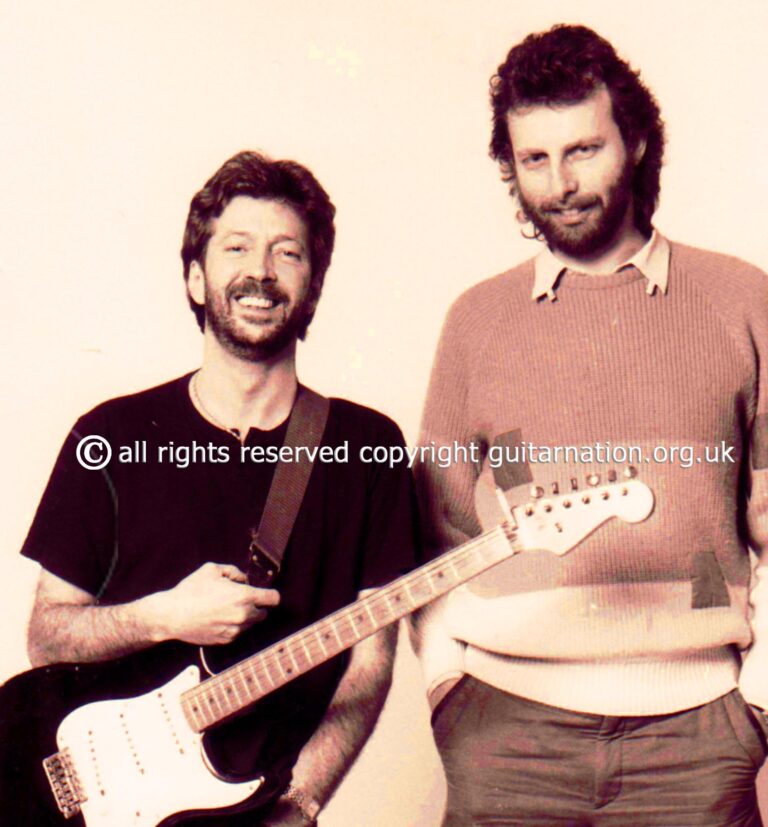

For Dan Smith, the work that John Hill had done in the preceding years was invaluable. Hill had spent countless hours trying to make Fender relevant again—speaking to the world’s top guitarists, visiting record label boardrooms, and building relationships with roadies and guitar technicians. Most importantly, he worked directly with the artists and their managers.
None of this meant the road ahead would be easy. Reversing Fender’s damaged reputation and restoring the brand’s prestige would be an enormous challenge. Yet Hill had no doubts about Smith’s ability to lead the effort. “If anyone could do it,” he later said, “Dan Smith could. He had so many great ideas, he was completely focused, and his knowledge of guitars was unsurpassed.”
Fender needed to relaunch itself by creating a strong emotional connection with guitarists and by invoking the musicians who had made music history with their pre-CBS Fenders—and who, John and Dan hoped, would continue to play the new and equally excellent post-CBS instruments. At least, that was the plan.

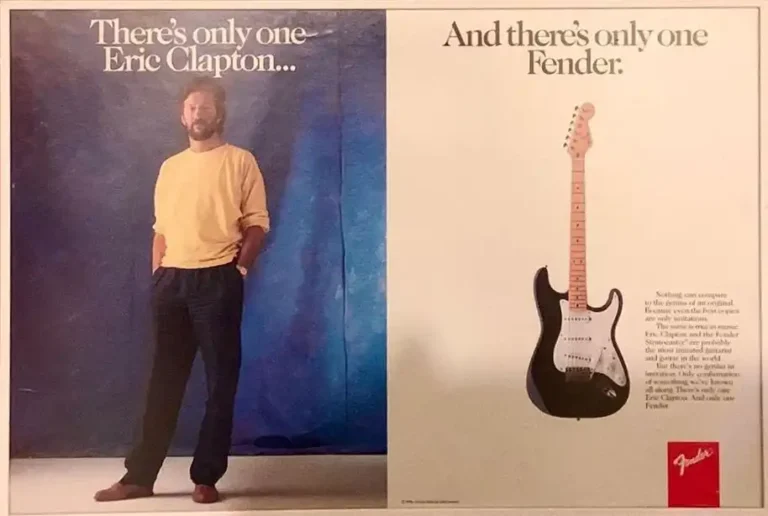
It was no coincidence that one of the very first advertisements for the Eric Clapton signature model—the instrument that inaugurated the Signature Series—appeared in Rolling Stone magazine with the line: “There’s only one Eric Clapton… And there’s only one Fender.” The advertisement was developed by Joe Phelps and Roger Forrester (Eric’s manager), with John Hill acting as the intermediary.
From Custom Guitars to the Signature Series
The initial concept was to provide each of the “Britpack” guitarists with a custom-made instrument tailored to them, along with a clone of one of their most important guitars—an “Iconic Guitar.” The idea was that their treasured pre-CBS Fender could be retired and replaced with a new custom model representing the finest craftsmanship Fender had ever achieved.
To bring this vision to life, John Hill purchased the Woodstock Strat from Mitch Mitchell to use as a template, while Roger Forrester entrusted Blackie to Hill for delivery to Fender. Hill became the driving force behind the Eric Clapton partnership, shaping both the guitar itself and the long-term relationship between the artist and Fender.
The idea for signature models began during negotiations with Eric Clapton’s manager, Roger Forrester, over a contract to use Clapton’s name and image in conjunction with a custom-built guitar. During discussions, Forrester asked why Fender didn’t produce more of the custom guitar, so they could give copies to Clapton’s friends, such as Ian Botham and Pete Townshend.
John Hill recognized an opportunity: why not put the guitar into production and make it available to players?
Initially, Dan Smith and Bill Schultz were hesitant. They felt that selling the same guitars used by artists was more of a Gibson approach; Fender had traditionally focused on production models that dealers could stock on the showroom floor.
Moreover, in 1985, producing custom guitars seemed impractical—Fender USA’s production lines were limited, and the Custom Shop did not yet exist.
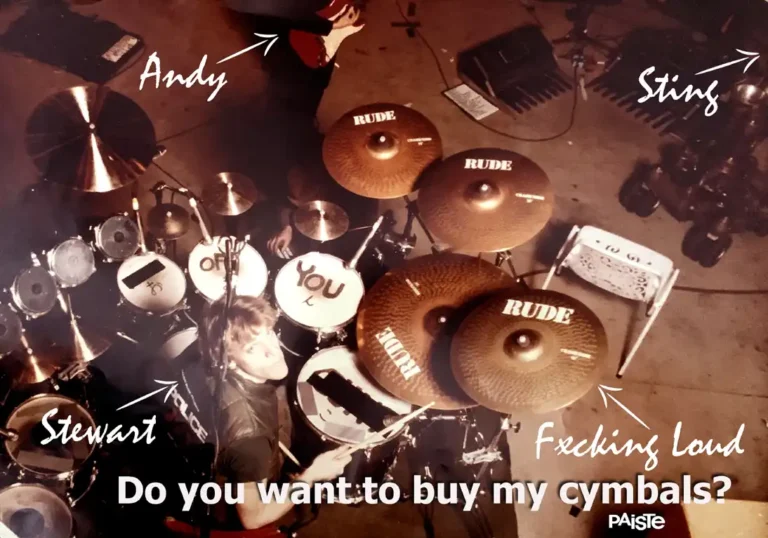
However, John Hill showed Roger Forrester, Bill Schultz, and Dan Smith the Stewart Copeland advertisement he had created, and they all agreed: “Let’s put it in the contract.” This gave them the option to act on the idea in the future, should the planned production facilities prove capable.

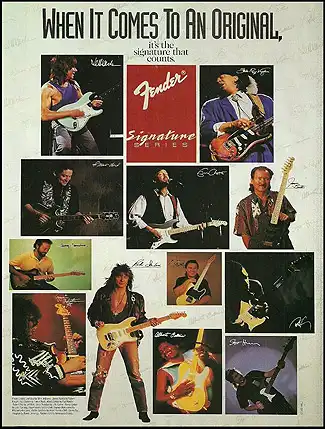
The signature models ultimately emerged from a merger of elements drawn from the individual Artist Custom Models concept, the Iconic Series guitars, and the early Clones projects.
Initially, the signature models included both factory and Custom Shop instruments, such as the Robert Cray Stratocaster.
However, in the late 1990s, Fender began distinguishing between the two, dividing them into the Artist Series (for a time called the Artist Signature Series) and the Custom Artist Series, depending on whether they were produced in the factory or the Custom Shop.
Signature vs. Tribute Models
Signature models are instruments developed in collaboration with the musicians whose names they bear. Consequently, these guitars are not intended as replicas of an artist’s most famous instrument, but rather as models built to specifications agreed upon with the artist.
During the 1990s, Fender also began using the term Tribute to designate a different type of instrument. The name was applied to both Custom Shop creations—such as the Merle Haggard Telecaster and the Waylon Jennings Telecaster—and factory-produced models like the 1997 Jimi Hendrix Stratocaster.
Unlike Signature (or Artist) models, which were developed according to the specifications of living guitarists, Tribute models were initially conceived as instruments dedicated to musicians who had passed away. Over time, however, the term’s meaning expanded to include replicas of historically significant Fender instruments associated with still-active artists. Notable examples include reproductions of Eric Clapton’s Blackie (2006) and Brownie (2013), as well as John Mayer’s Black One (2010).
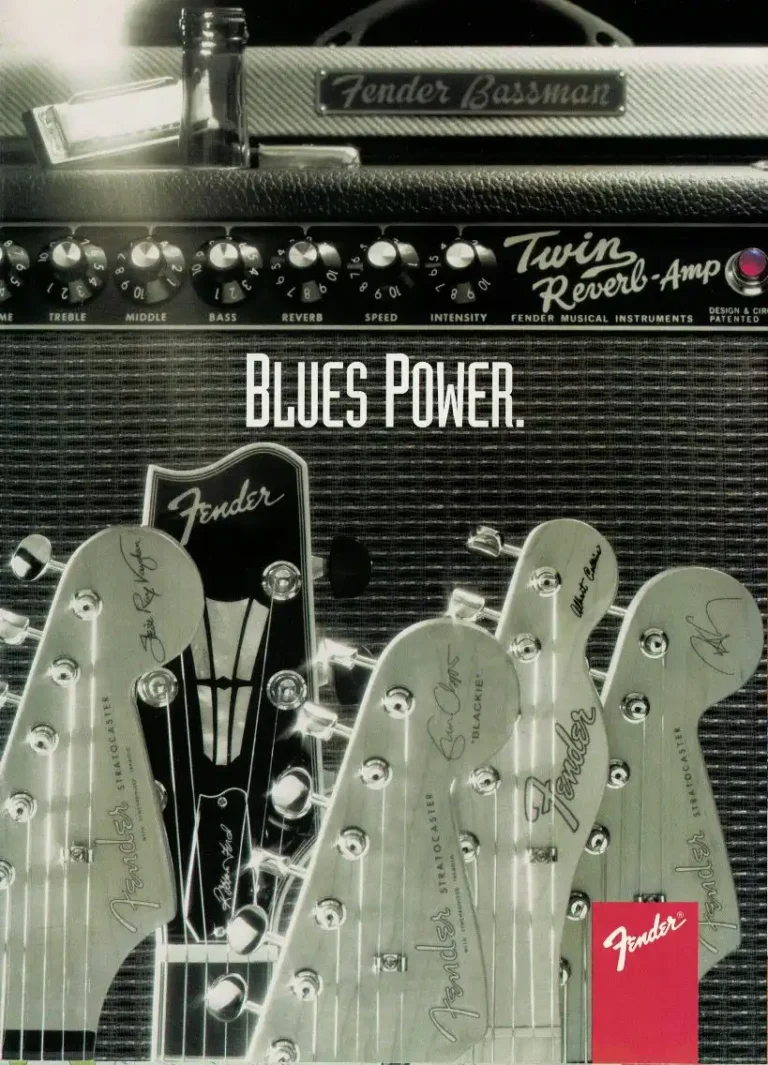
Tribute models could take different forms. In some cases they were straightforward recreations of earlier production instruments, such as the Mary Kaye Tribute Stratocaster (2005). In others, they reproduced guitars that had been extensively modified by their owners, as in the case of Stevie Ray Vaughan’s Number One (2004) and Lenny (2007), the Rory Gallagher Stratocaster (2004), or Yngwie Malmsteen’s “Play Loud” Stratocaster (2008).
To capture the “mojo” of these instruments and more closely associate them with the artist, Fender often accompanied the guitars with dedicated accessories such as road cases, CDs, DVDs, certificates, photographs, books, or posters. These models were typically produced in limited editions—often fewer than one hundred units—and could be built either by a single Master Builder or by a team of Master Builders. In most cases, the entire run sold out within a day or two.
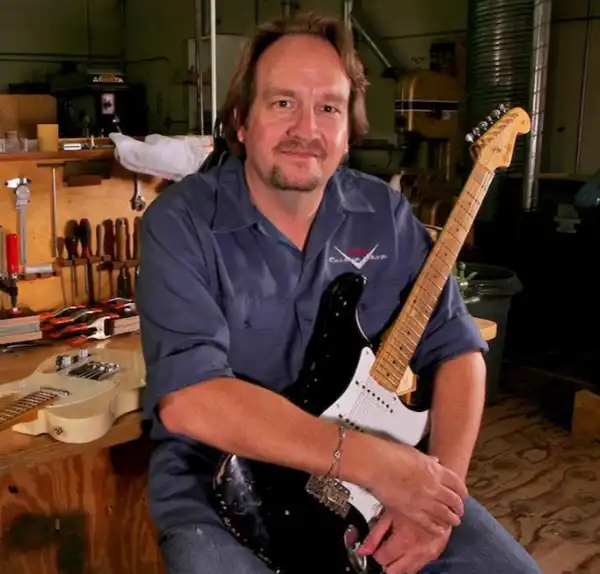
The price of these Tribute models was undeniably high, yet Fender’s profit margins were not necessarily significant when weighed against the costs involved. These included the additional planning required for each project, the travel needed to meet the owners of the original instruments, the many hours spent examining the guitars and documenting every stage of the process, and, in some cases, even the time necessary to refine or develop new production techniques.
According to Mike Eldred, who headed the Custom Shop from 1997 to 2014 and was the driving force behind many of these replica projects, the artist—or the artist’s family—often earned more than Fender from the sale of a Tribute model.

