Signature & Iconic Strats
The Hank Marvin Stratocaster
THE TRUE STORY BEHIND THE FLAMINGO PINK STRATOCASTER AND THE HANK MARVIN SIGNATURE STRATS


Table of Contents
ToggleHank Marvin’s First Stratocaster: The True Story Behind the Legend
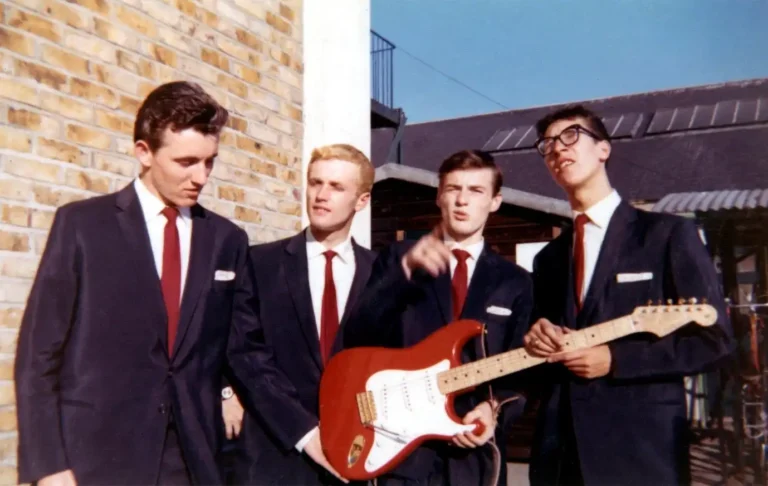
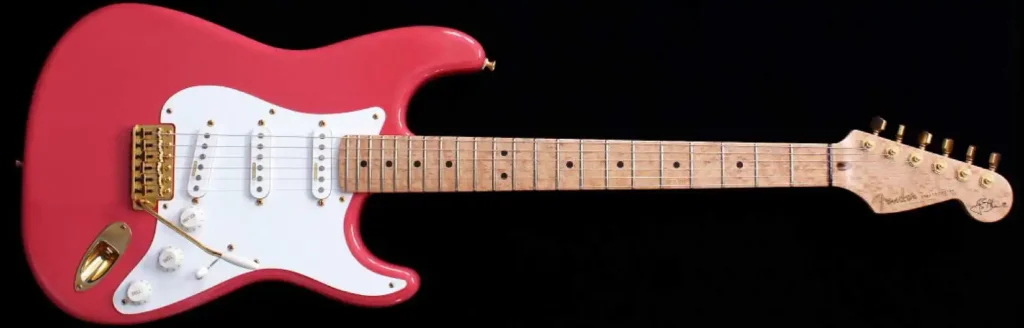
There are numerous legends surrounding how Shadows’ guitarist Hank Marvin, acquired his first Fender Stratocaster—a Fiesta Red (which Marvin referred to as “Flamingo Pink”) maple-neck Stratocaster with gold hardware. Some claim that British singer Cliff Richard, whose original name is Harry Rodger Webb, obtained the guitar during a promotional tour in the United States. Others suggest that he visited the Fender factory, where Leo Fender personally gave it to him, or that he simply purchased it from a music store.
However, the story is well documented in Bruce Welch’s book Rock ’n’ Roll – I Gave You the Best Years of My Life, and has also been recounted by both Hank and Bruce in various interviews.
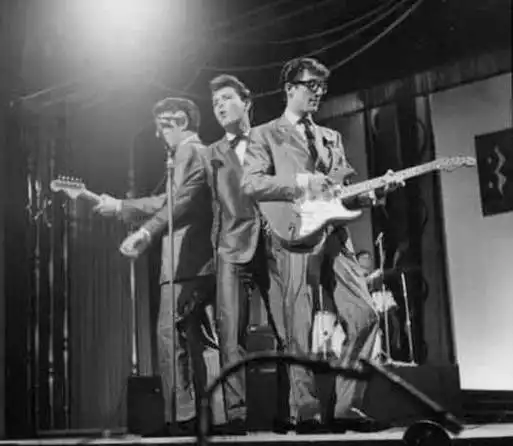
Hank Marvin was a great admirer of Buddy Holly and knew that he played a Fender Stratocaster. He also admired James Burton’s sound, initially believing that Burton played a Stratocaster—only later discovering that he was, in fact, a Telecaster player.
Between 1951 and 1959, the United Kingdom enforced a ban on the commercial import of American instruments. As a result, British guitarists found it extremely difficult to obtain guitars from U.S. brands such as Fender.
Nevertheless, there were still a few ways to acquire one. Some musicians relied on sailors to bring instruments back from the United States, while others searched for rare second-hand examples. Another option was to privately import a new instrument by mail—this is precisely what Cliff Richard did.

Cliff, who was earning significantly more than the Shadows at the time, agreed to purchase the guitar for Hank. He contacted Fender for a brochure, and when the 1958/59 catalog arrived, they spent considerable time studying it before selecting the most expensive model available: a striking red Stratocaster with gold-plated hardware and a maple neck. This took place in 1959. Shortly thereafter, the import ban was lifted, although it took some time before Fender instruments became widely available in UK stores.
Hank’s Stratocaster was among the first to arrive in the UK, though not the very first, as is often claimed. Earlier examples had already made their way into the country—some thanks to contacts within transatlantic shipping crews, who could purchase instruments in the United States and deliver them to British musicians.


However, Hank’s instrument quickly became the most visible and influential example.
About a year later, Hank acquired another Stratocaster, this time with a rosewood fretboard, and returned the original maple-neck guitar to Cliff. Cliff later had it refinished in white. At the time of writing (2017), the instrument belonged to Bruce Welch, who had it repainted red once again by Barry Gibson of Burns Guitars, effectively removing any trace of its previous finishes.
The Party for Hank Marvin’s Stratocaster
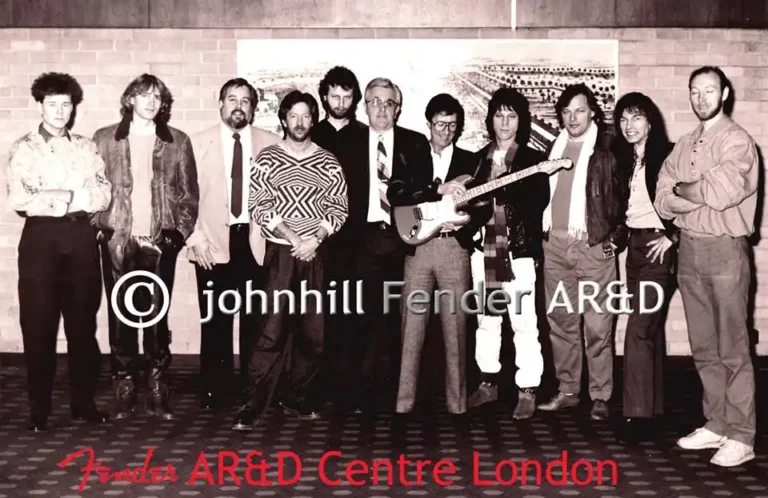
On February 12, 1986, John Hill—Fender’s Brand and Artist Relations Director, originally from the UK—organized a party at a Hilton hotel in London. The event marked a significant step in the rebranding of the post-CBS Fender era and celebrated a pivotal moment in the company’s history: the arrival of the “first” Stratocaster in the UK—more precisely, the first to gain national prominence—the Fiesta Red Stratocaster of Hank Marvin.
The gathering was attended by Dan Smith and Bill Schultz, as well as Hank Marvin, Eric Clapton, David Gilmour, Jeff Beck, and other leading British musicians.
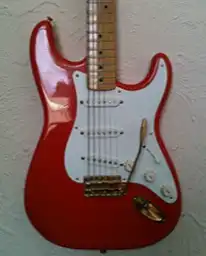
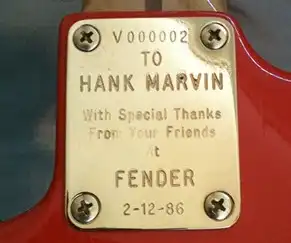
On this occasion, Smith and Schultz presented Hank—who was preparing to relocate to Australia—with a red Vintage Reissue Stratocaster. Its neck plate was engraved with the inscription: “To Hank Marvin, with special thanks from your friends at Fender,” along with the date of the event.

The idea of building this special guitar to commemorate the “first British” Stratocaster was conceived by John Hill. Dan Smith, therefore, asked George Blanda to produce a Fiesta Red Vintage Reissue Stratocaster with gold hardware. At the time, Fender’s newly established factory was still small, and neither the Signature Series nor the Custom Shop yet existed.
George Blanda, who had only recently joined the company, began work on the reissue of a 1959 Fiesta Red Stratocaster in October 1985. The process did not take long, as it largely involved assembling parts already in stock. What made the instrument unique were a few key elements: the custom finish, a bird’s-eye maple neck, and—most notably—the gold hardware, which was not yet available from Fender’s new facilities.
To source these components, Blanda turned to the same supplier that had produced gold hardware for Fender during the CBS era. He later recalled that the company asked how many hundreds of units were required—when, in fact, he needed just one.
The guitar’s serial number, “V000002,” can be misleading. It does not indicate the second Vintage Reissue ever produced, but rather the second built at Fender’s new Corona plant.

Custom Shop Hank Marvin Stratocasters
Hank Marvin never had a true signature model in the strict sense of the term. In reality, all so-called “Hank Marvin” Stratocasters were dealer-ordered custom instruments, with no formal collaboration between Hank and Fender.
The 1990 Hank’s Strat
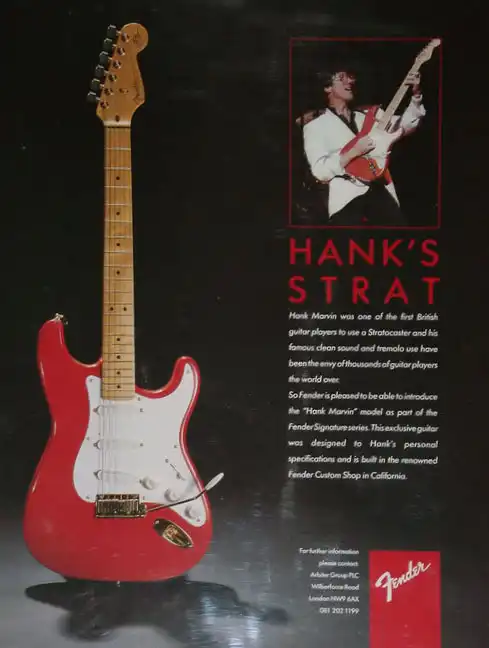
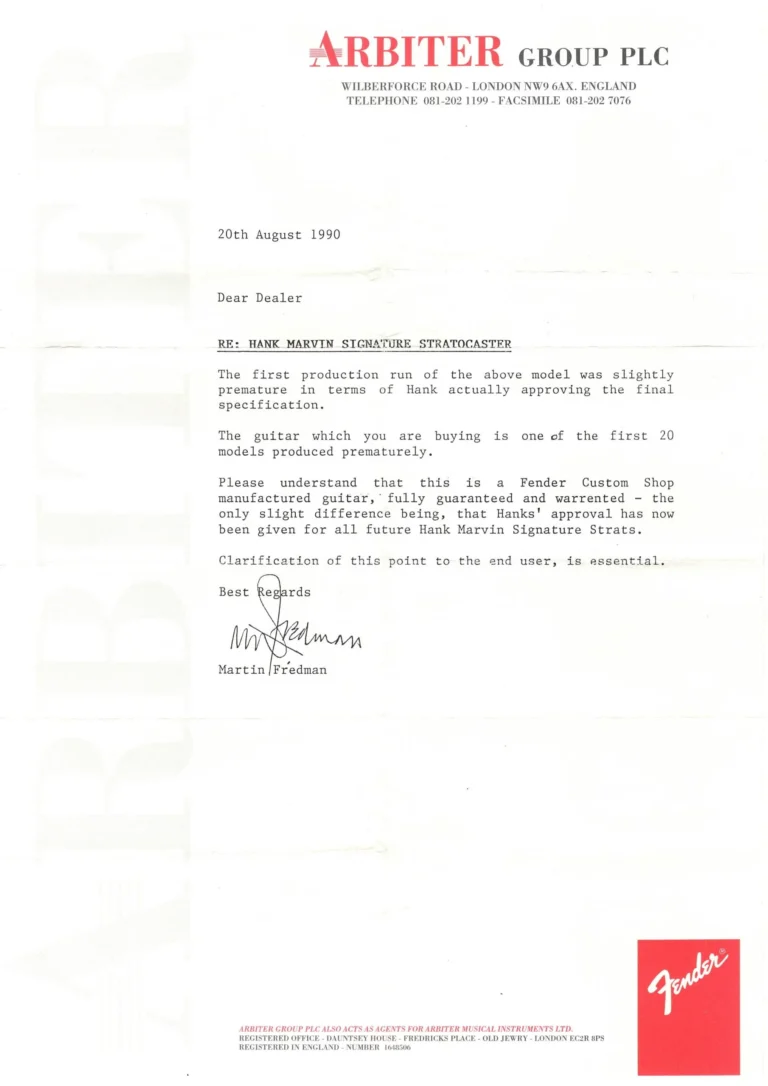
In 1990, Arbiter—the official Fender distributor in the United Kingdom—commissioned the Fender Custom Shop to produce a red Stratocaster featuring three Lace Sensor pickups and the MDX circuit, marketing it as the “Hank’s Strat” model. Despite its branding, the instrument was not an official signature model but rather a dealer custom order—part of a program that allowed distributors and retailers to commission instruments, provided they met a minimum order quantity of 25 units.
Crucially, Arbiter did not have formal authorization from either Hank Marvin or Fender to associate the model with his name, and no compensation was ever paid to the artist. The project was therefore ended, and the guitars that had already been shipped—estimated at around 20 units, all made by Master Builder J.W. Black—were recalled, although a number of examples remain in circulation today.

The 1992 Hank Marvin Signature Stratocaster and the Autograph Edition
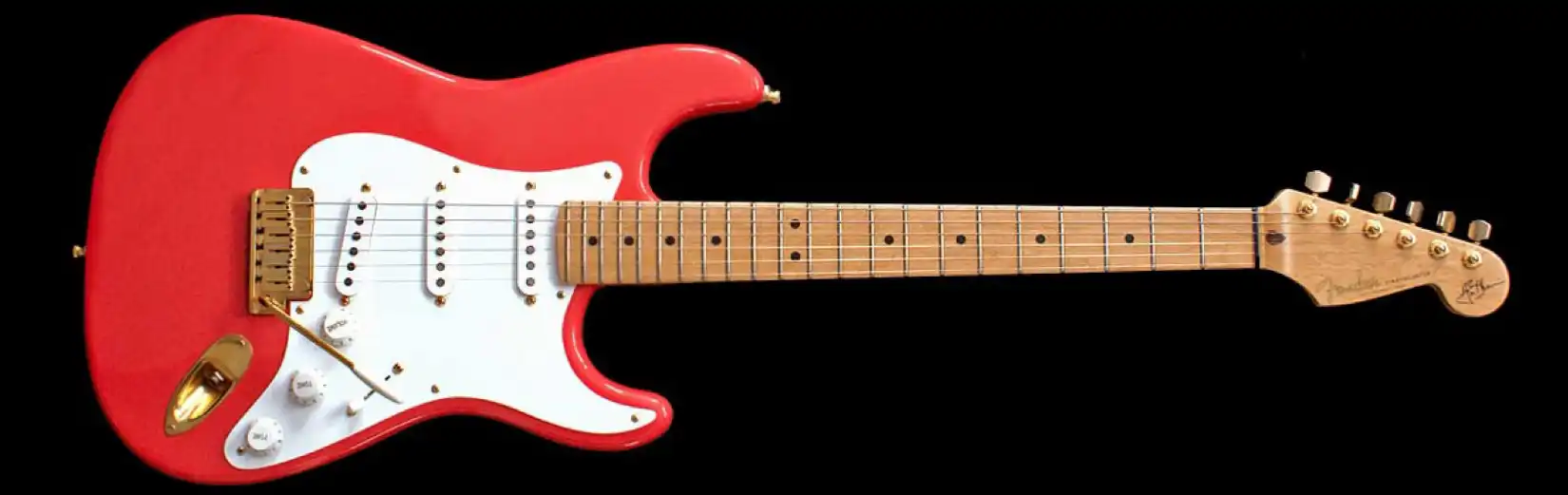
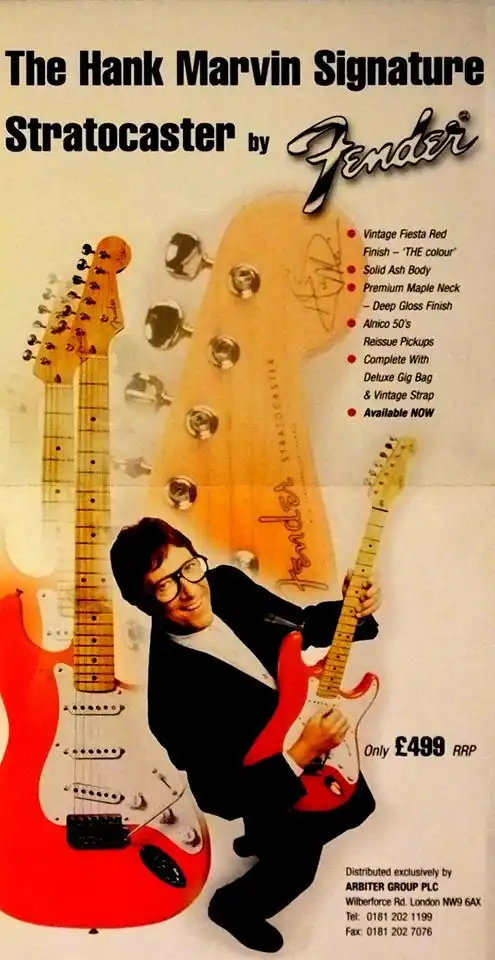
In 1992, a new Hank Marvin Signature Stratocaster was introduced, once again without being an official Fender signature model. This limited edition of 100 units was commissioned by Arbiter.
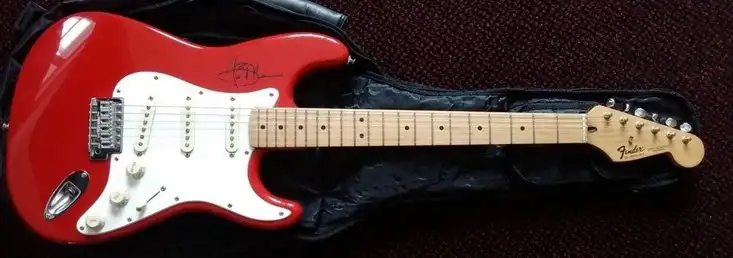
In 1995, production was extended by a further 64 instruments, including a special “Autograph Edition” featuring two pickguards, one of which was signed by the guitarist.
Both versions featured a Vintage Fiesta Red alder body, a highly figured maple neck, gold hardware, a graphite nut, locking tuners, and a two-point tremolo bridge. The pickup configuration consisted of Seymour Duncan Vintage Staggered SSL-1 units in the bridge and middle positions, and a DiMarzio FS-1 at the neck. A push-pull switch on the second tone control enabled the neck-and-bridge pickup combination.

The Hank Marvin 40th Anniversary Stratocaster
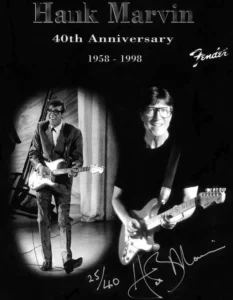
In 1998, Fender introduced the Hank Marvin 40th Anniversary Stratocaster, limited to 40 units. The model was equipped with Kinman pickups, gold hardware, and a neck plate engraved with “40 Years 1958–1998.”
A distinctive feature was Hank Marvin’s signature on the headstock, with a genuine ruby used to dot the “i.” Unlike previous versions, this model featured an ash body finished in Fiesta Red and a vintage-style six-saddle bridge.
The instruments were retrofitted in the United Kingdom with LED position markers embedded along the upper edge of the fretboard. These were activated via a push-pull switch on the first tone control. A second push-pull switch on the tone control also enabled the neck-and-bridge pickup combination.

The Limited Edition Dealer Select 1959 NOS Custom Red CRS-59 Stratocaster
In 2008, Howard Gillespie of Oasis Music—a Fender dealer in Great Britain based in Ringwood, Hampshire—commissioned Fender Master Builder Greg Fessler to produce 54 Limited Edition Dealer Select 1959 NOS Custom Red CRS-59 Stratocasters.
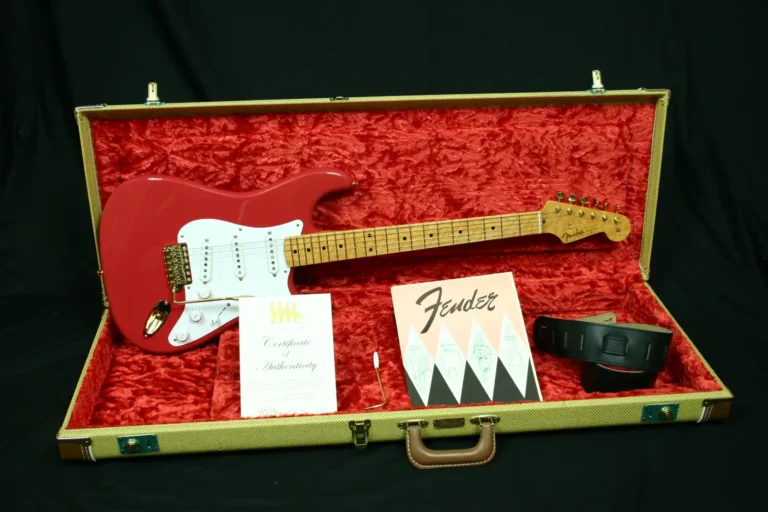
Also known as the Shadows 50th Anniversary Stratocaster Collector Outfit, these instruments were faithful reproductions of Hank Marvin’s 1959 Fiesta Red Stratocaster.
The pickups, featuring the characteristic G pole piece set flush with the pickup cover, were hand-wound by Abigail Ybarra.
The design of the bird’s-eye maple neck was entrusted to Mick Johnson, a luthier with a long-standing affinity for the Shadows.
The neck profile was also distinctive: “C”-shaped on the treble side and “D”-shaped on the bass side. The “CRS-59” designation, the individual xx/54 serial number, and the Custom Shop logo were stamped on the neck plate.
Contrary to common belief, “CRS” does not stand for “Cliff Richard Stratocaster,” but rather for “Custom Red Stratocaster.”

Gillespie’s goal was to create a guitar whose finish matched the original as closely as possible. This was no easy task, as Hank’s guitar had been refinished and all traces of Fender’s original paint had been lost. As he explained: “Both Bruce and Hank are adamant that the guitar was a Flamingo Pink color and not Fiesta Red, and we went to great lengths to get the color right.”
It is worth noting that a custom color named “Flamingo Pink” never officially existed. However, Fender finishes from the 1950s were not always entirely consistent, and Fiesta Red itself could vary depending on application techniques, undercoats, and clear coats. Environmental conditions and long-term exposure could also significantly alter the appearance of the finish over time.
In the end, it was Mick Johnson who identified the shade of red that, according to Bruce, came closest to the original appearance.
The guitar was accompanied by a certificate of authenticity, a leather shoulder strap bearing the “The Shadows 50th Anniversary” logo and the signatures of Hank Marvin and Bruce Welch, a reproduction of an early Fender catalog, a CD featuring a conversation between Hank Marvin and Bruce Welch, and two tremolo arms: one shorter unit modified by Hank, and the “Easy Mute” arm, which the guitarist had used for many years and which allowed him to mute the strings while operating the vibrato system simultaneously.
The Shadows 50th Anniversary Stratocaster was the only Hank Marvin Custom Shop signature Stratocaster not to feature a Teflon nut, instead using a synthetic bone nut. It also differed in having 21 frets and a vintage-style truss rod.

Hank Marvin Stratocasters made in Japan
There were also factory-produced Hank Marvin Stratocasters that differed from the Custom Shop models in that they lacked gold hardware.
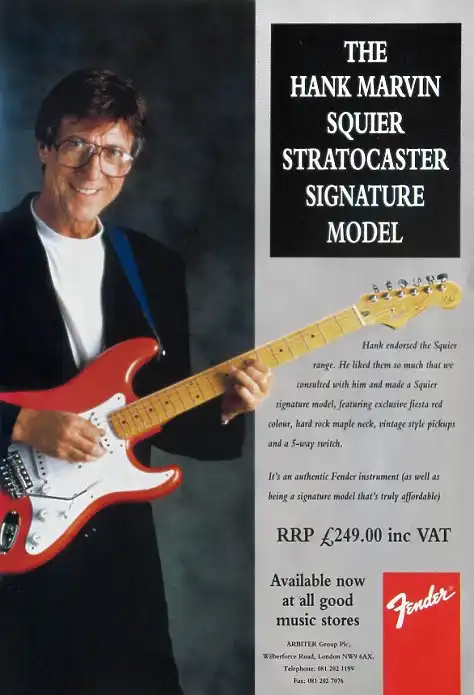
The first of these was a Japanese Squier.

There were also factory-produced Hank Marvin Stratocasters that differed from the Custom Shop models in that they lacked gold hardware.
The first of these was a Japanese Squier.
Until 1987, the Squier brand was produced exclusively in Japan, where it enjoyed considerable success.
However, when production was shifted to Korea in the late 1980s, the overall quality of the instruments declined significantly—featuring plywood bodies, inexpensive electronics, and lower-grade hardware. This led to a downturn in sales, further intensified by strong competition from low-cost Korean copies.
As a result, a perception of diminished quality began to surround the Squier brand, prompting Fender to resume production of selected Squier models in Japan in late 1991.
The Squier Hank Marvin Stratocaster, introduced in 1991, was among the first Japanese-made Squier models of the 1990s. It featured a maple neck, a Fiesta Red basswood body (rather than plywood), ceramic pickups, Gotoh sealed tuning machines, a vintage-style truss rod, and Hank Marvin’s signature on the headstock.
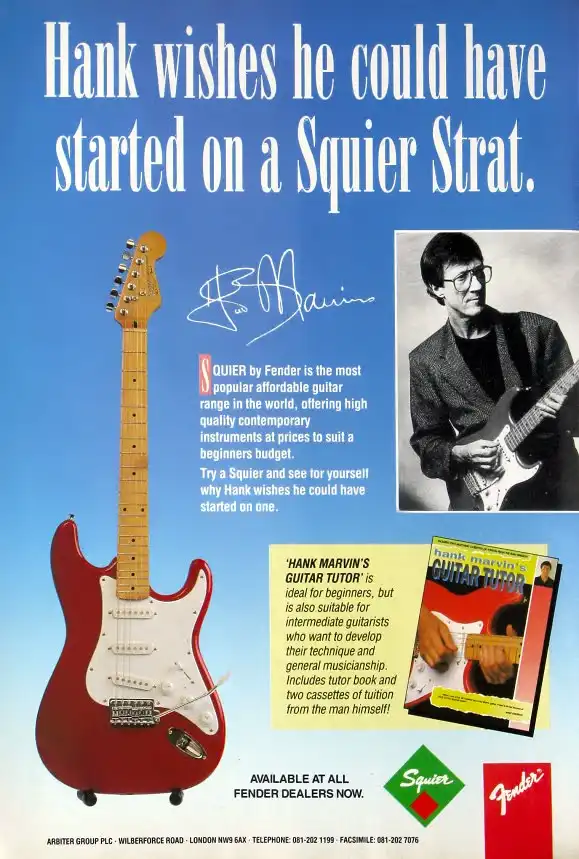
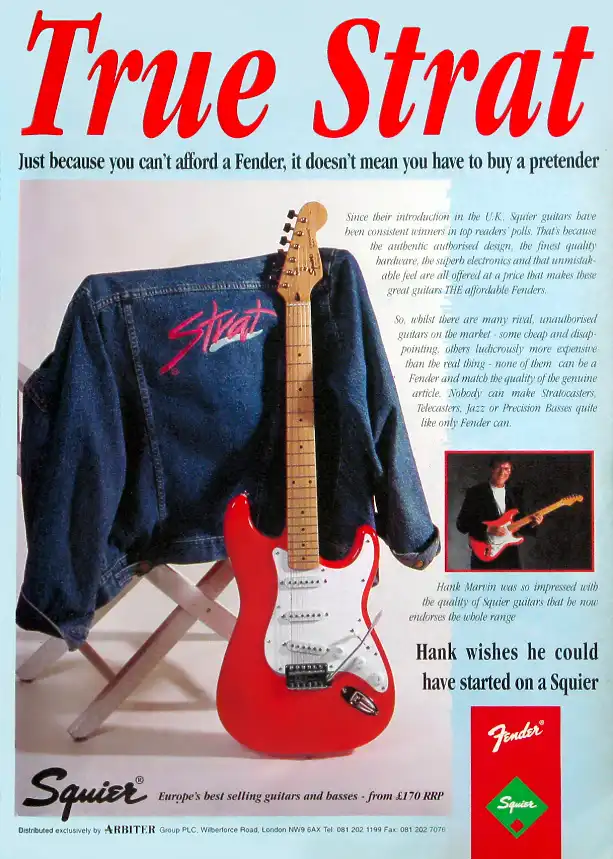
Many believe this was a Korean-made guitar, largely because early-1990s advertising imagery showed Hank with Korean-made Squiers.
In early 1991, an advertisement featured Hank Marvin holding a Korean-made Squier Stratocaster. It carried the slogan ‘Hank wishes he could have started on a Squier Strat’ along with his signature. However, this Strat actually referred to a guitar that never went into production: a Torino Red finish instrument with serial number S1xxxxxx (indicating production at the Samick factory in Korea), a single-ply 11-hole pickguard, a maple neck, two wing string trees, and, notably, a “MADE IN KOREA” decal on the headstock.
In 1994, another advertisement appeared, showing the guitarist with a Korean Stratocaster. The guitar featured a black Squier logo with a “CN” serial number. It was a Korean Squier by Fender, produced at the Cort factory, and was not a Hank Marvin model.

In 1996, on the occasion of Fender’s fiftieth anniversary, Fender Japan introduced a new Hank Marvin signature model, simply named the Hank Marvin Stratocaster (this time bearing the Fender logo and exported exclusively to the United Kingdom).
The guitar featured an ash body finished in polyurethane Fiesta Red and was equipped with a vintage-style bridge with saddles stamped “FENDER.” Its design paid tribute to the Shadows’ guitarist, incorporating Alnico ’50 Reissue pickups, vintage-style tuning machines, a vintage-style truss rod, and a single-ply 8-hole pickguard.
Hank Marvin Stratocasters made in Mexico
The Hank Marvin Classic Stratocaster
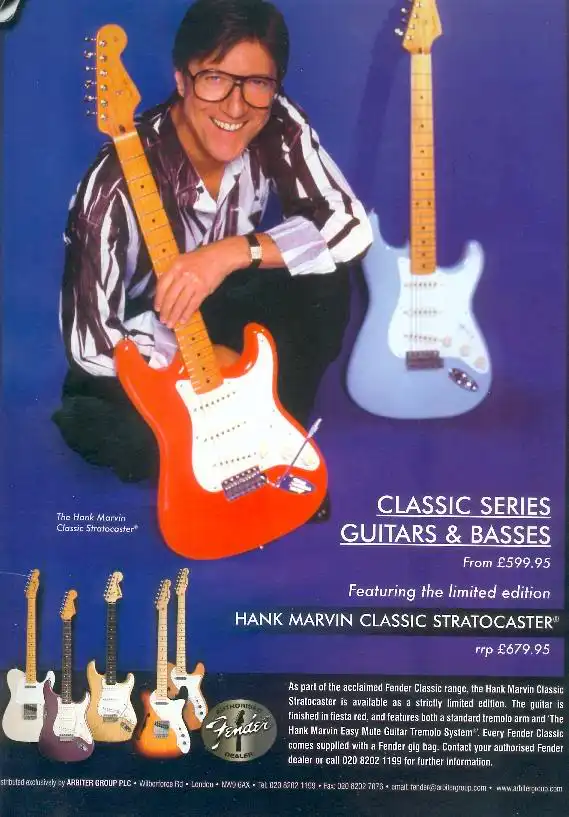
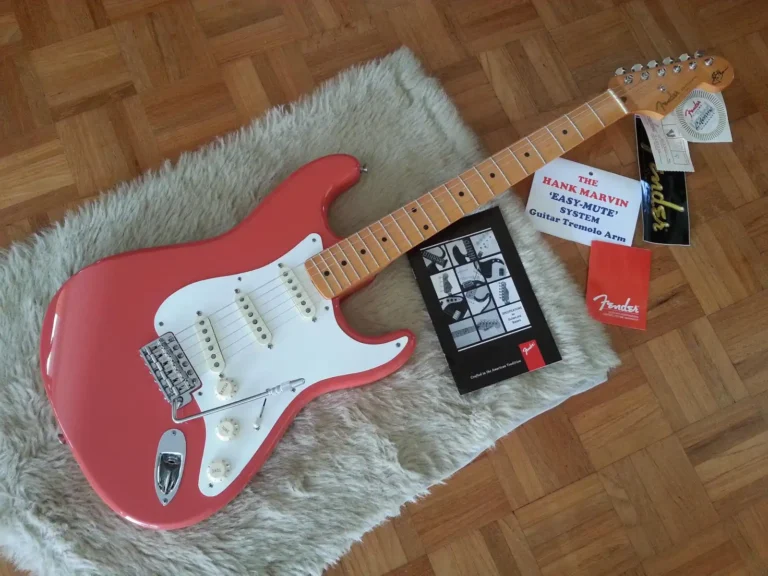
In 2000, the Mexican Fender factory in Ensenada produced the Hank Marvin Classic Stratocaster—sometimes simply referred to as the Hank Marvin Signature Stratocaster. Based on the Classic Series ’50s Stratocaster, it was released exclusively in the United Kingdom and Australia (with 350 units and 60 units, respectively).
It featured a six-saddle tremolo system equipped with the Easy Mute tremolo arm, as used on the Custom Shop 40th Anniversary model.
The Mystery Behind the Hank Marvin Signed Stratocasters
Tony Bacon, in his book The Stratocaster Guitar Book, refers to approximately 300 Hank Marvin Stratocasters produced in Mexico in 1997 and sold in Great Britain. These instruments were similar to the Traditional Stratocaster models and featured the guitarist’s signature on the body.
However, there is little clarity regarding these guitars, and Fender itself has no official record of their production. Vintage & Rare Guitars on Denmark Street in London, when consulted on the matter, recalls a much more limited run of around 12 units.
According to this account, the instruments originated as Traditional models (featuring the Black Label logo and die-cast sealed tuning machines), to which Hank Marvin’s signature was later added to the body.
It appears that Arbiter commissioned these Mexican-made Hank Marvin Stratocasters as part of a promotional initiative tied to a beginner’s guitar instruction book.