Signature and Iconic Strats
The Ritchie Blackmore Stratocaster
INSIDE RITCHIE BLACKMORE’S STRATOCASTER: FROM EARLY EXPERIMENTS TO SIGNATURE MODELS


Table of Contents
ToggleFrom Gibson to Stratocaster: Ritchie Blackmore’s Early Transition
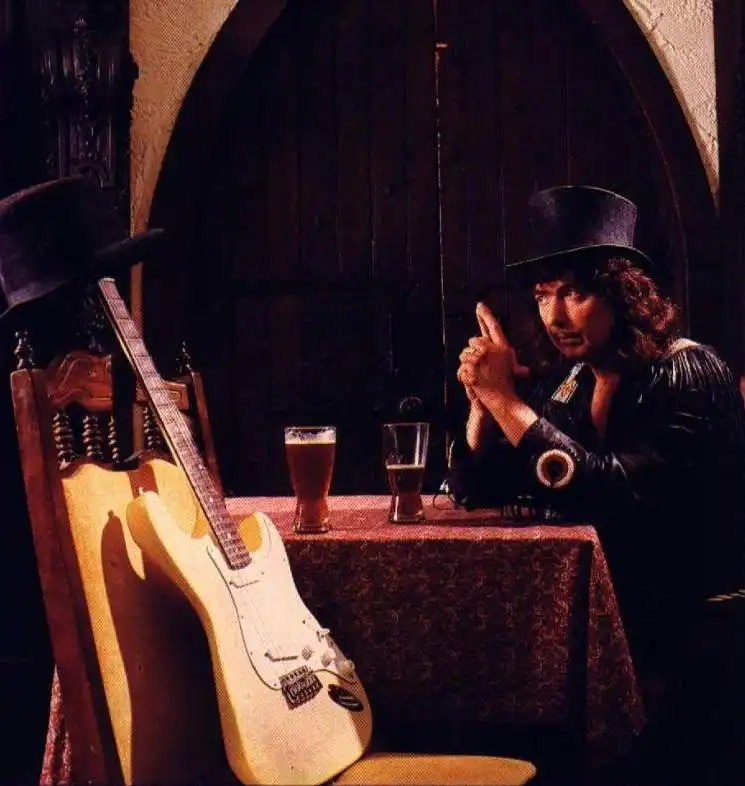
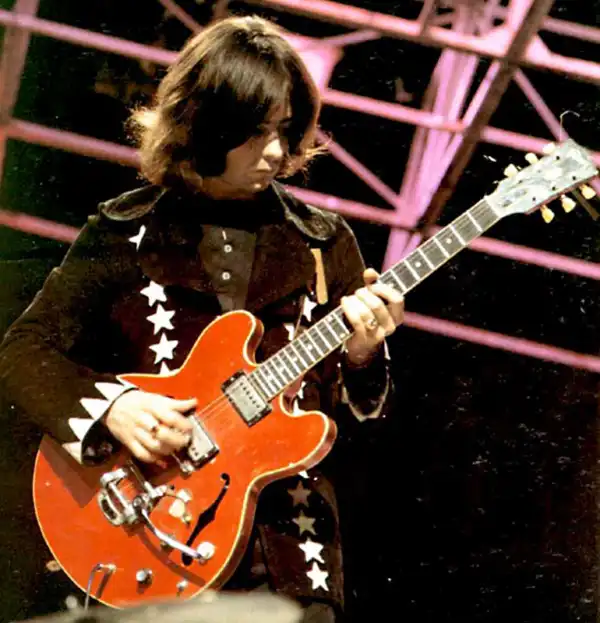
Few know that Ritchie Blackmore, at the beginning of his career with Deep Purple, played a 1961 Gibson ES-335. However, inspired by Jimi Hendrix, he began developing an increasing interest in the Stratocaster.
In 1969, Blackmore acquired his first Fender through Mick Turner, Eric Clapton’s roadie, for £60. “It wasn’t very playable, that’s why Clapton gave it to Mick. It was a Stratocaster body and a Telecaster neck,” recalled Deep Purple technician Ian Hansford. It was used on the track Emmaretta, featured on 1969’s Deep Purple. However, due to its bowed neck, Ritchie Blackmore soon replaced it, purchasing two new Stratocasters from a London music store.
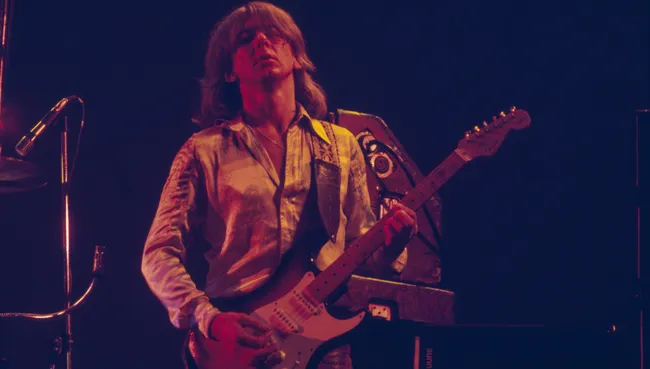
From that moment on, Blackmore began playing Stratocasters almost exclusively. He favored the instrument for its tone, despite finding it more difficult to play.
“I prefer the Stratocaster because it has a more ‘attacky’ sound,” Blackmore explained in a 1973 interview with Martin Webb for Guitar Player. “At first, I couldn’t get used to the Strat after the Gibson. The necks are quite different. But now I can’t get used to the Gibson again. A Stratocaster is harder to play than a Gibson, too. I don’t know why. I think it’s because you can’t race across a Strat’s fingerboard so fast.”

Vibrato, Scalloping, and Control: Blackmore’s Stratocaster Approach
Blackmore also developed a strong appreciation for the Stratocaster’s vibrato system:
“I liked the way Hendrix used his tremelo, though I don’t think I use it the same way. A lot of guitarists think that a tremelo arm is for someone who can’t play a hand vibrato. But the tremelo arm gives a different vibrato all together. It affects whole chords. I can do the old hand vibrato just fine, but I like attacking the strings and getting all those sounds. You can get a lot of aggression out with a tremelo arm. I’ve got a Bigsby on my Gibson, and it’s a waste, because it’s got too much leeway. You have to pull it back a half-an-inch before it does a thing. But the vibrato on the Strat reacts immediately. As soon as you pull on it, the strings start going back.”

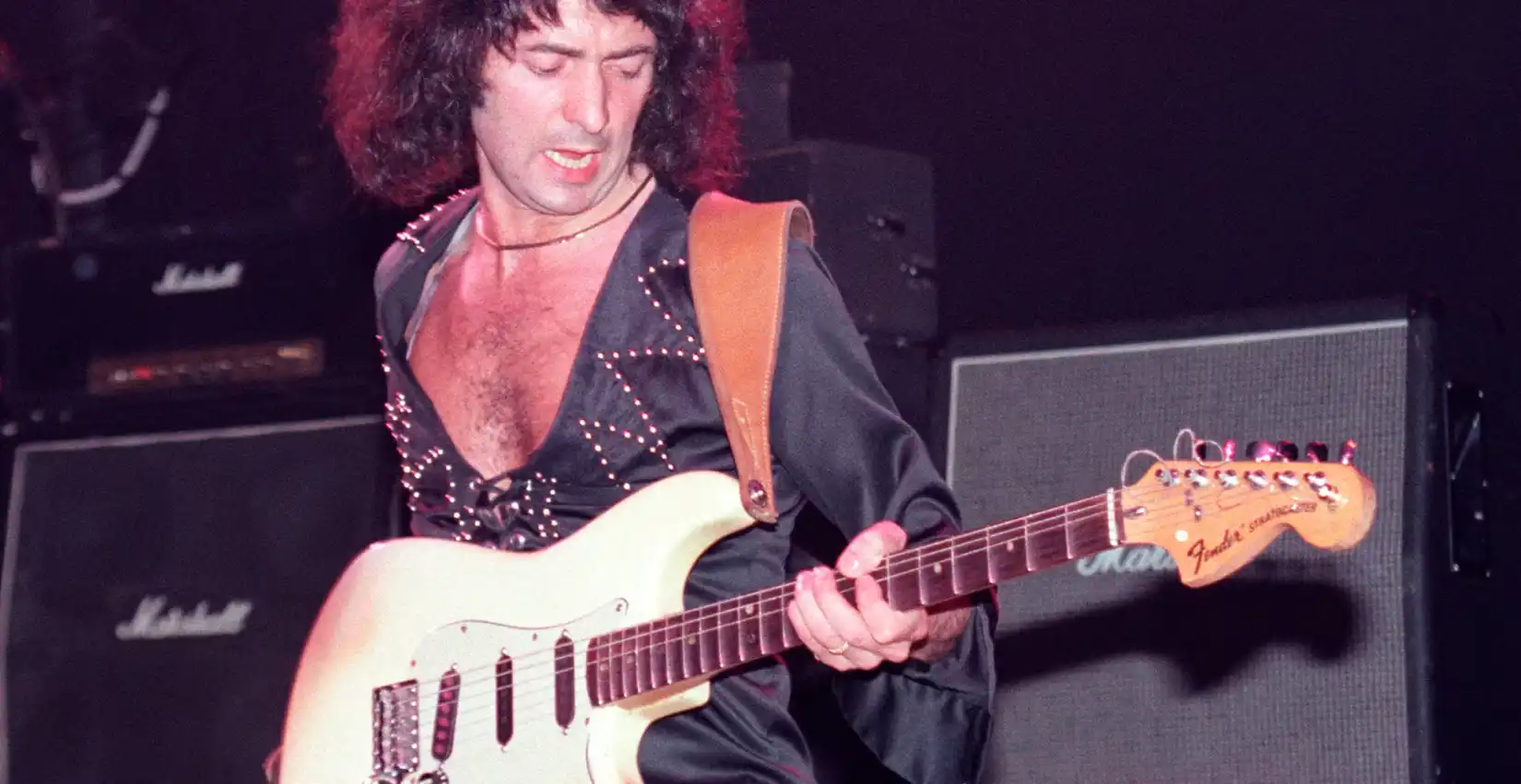
In the 1980s, Ritchie Blackmore developed an increasingly physical approach to the Stratocaster’s vibrato system, using the tremolo arm with considerable force and frequency. This playing style quickly exposed the limitations of standard hardware, as he repeatedly broke conventional tremolo bars during performance.
In an interview with Guitar World’s Andrew Daly, Ritchie Blackmore explained that, to address the issue, he commissioned progressively stronger replacements for the tremolo arm. The first modification doubled the arm’s thickness, but even this proved insufficient. He eventually moved to a substantially reinforced design, specifying a solid ½-inch round tremolo arm intended to withstand his aggressive technique:
“I also went through a period in the ’80s of playing with a tremolo arm, but I kept breaking them, so I had them made twice as thick so I wouldn’t break them. Funnily enough, I still broke them. So, I had them made three times as thick [with, Editor’s Note] a ½” round tremolo arm.”
Over time, this preference evolved into a highly personal approach to the instrument, with extensive modifications that would become central to his sound and playing style.
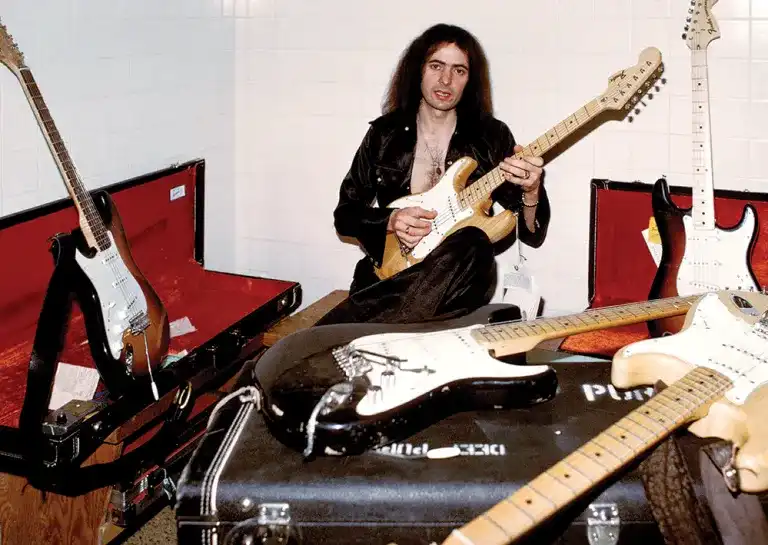
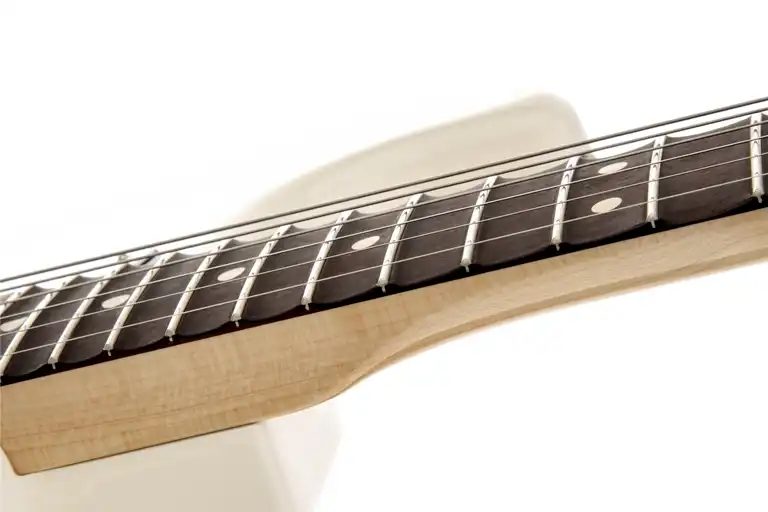
Ritchie Blackmore was known for extensively modifying his Stratocasters, including lowering the middle pickup—which he felt interfered with his picking hand—and scalloping the fretboard by removing wood between the frets. “It’s a very arduous process that takes about four days to shave down the wood,” Blackmore recalled. “I cover the frets with tape, but I usually wind up having the guitar re-fretted with Gibson fat frets. I like really thick frets. I find the Fender frets are a bit too thin, personally.”

The Fender Ritchie Blackmore Stratocaster
The origin of the Blackmore Signature Stratocaster
The Blackmore signature project began following a meeting between Ritchie Blackmore, his guitar tech Clif “Cooky” Crawford, and Fender’s Artist Relations director John Hill in Blackmore’s dressing room at Wembley Arena.
The meeting was arranged by Mick Ralphs during Deep Purple’s Perfect Strangers tour in December 1984, when Bad Company were the opening act at Wembley.
At the time, Blackmore had already shown interest in one of the early Squier Vintage reissue models, instruments that were already circulating among Mick Ralphs and his circle.
By 1987, during Deep Purple’s House of Blue Light tour, Blackmore’s interest had grown further. He had become aware of Fender’s renewed efforts, including early prototypes of what would later become the Fender Eric Clapton Stratocaster and Fender Jeff Beck Stratocaster, which were circulating within Ralphs’ close circle.

The Evolution of the Ritchie Blackmore Stratocaster
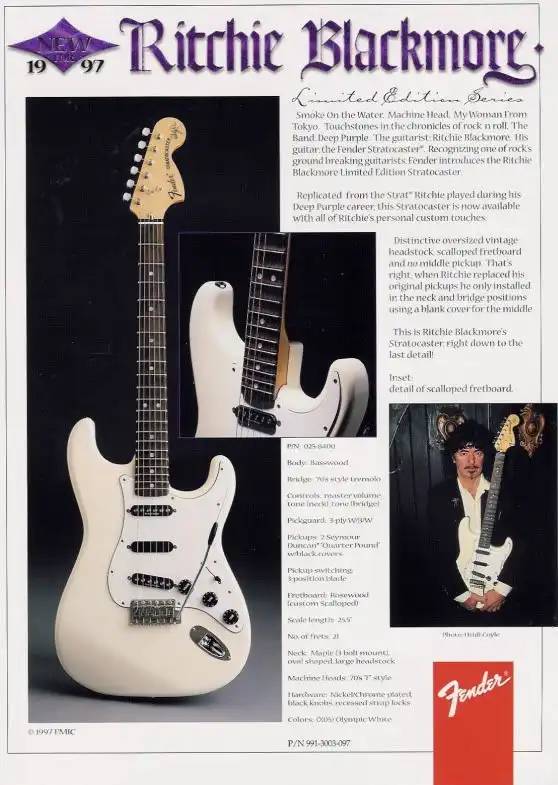
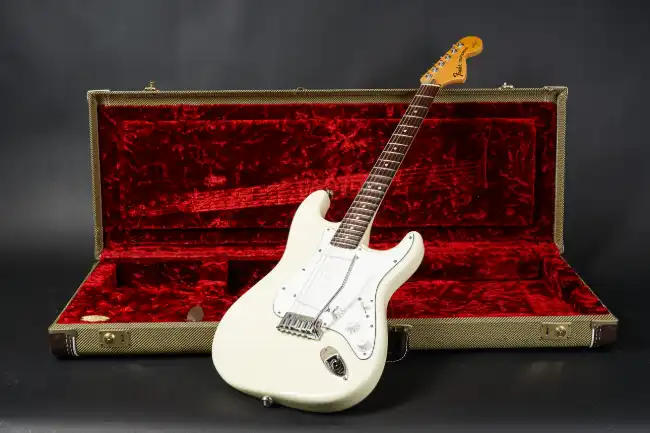
The first Ritchie Blackmore signature model was launched in Japan in the late 1990s as the Fender ST72-145RB. Developed by Fender Japan, it translated Blackmore’s highly individual modifications into a production instrument based on a ’70s-style Stratocaster. It featured a large headstock, bullet truss rod, and a three-bolt neck plate with Micro-Tilt adjustment, combined with a basswood body typical of Japanese production of the era.
Its most distinctive feature was the 21-fret fingerboard with a custom scalloped design. Electronics were simplified and tailored to Blackmore’s preferences, with Seymour Duncan Quarter Pound pickups in the bridge and neck positions and a dummy cover in the middle position, effectively removing the middle pickup from the circuit while preserving the traditional Stratocaster layout.
This Japanese model was produced for the domestic market from 1997 to 2004 and was also exported in a limited run of 383 units under the name “Ritchie Blackmore Stratocaster,” marking the first official global recognition of his modified Strat identity.

A precursor to this concept had already appeared in Japan between 1994 and 1996 with the Fender ST72-85SC, a scalloped-fretboard Stratocaster produced exclusively for the domestic market. Although it did not carry Blackmore’s name, it is often considered a “pre-signature” model, featuring ST-HR7 pickups designed to visually echo the Seymour Duncan Quarter Pound units later associated with his official signature guitar.
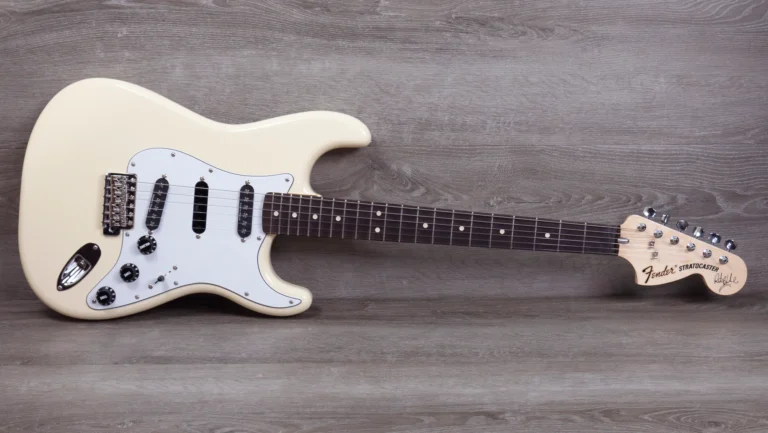
More than a decade later, Fender revisited and expanded the concept at its Ensenada factory in Mexico, introducing an updated Ritchie Blackmore Stratocaster in 2009. While still rooted in ’70s Stratocaster design language, this version introduced several structural refinements, including an alder body and a “U”-shaped neck profile, replacing the more specialized Japanese neck carve.
Hardware was also revised, with a vintage-style six-screw tremolo with bent steel saddles replacing the CBS-style bridge used on the Japanese model. The pickup configuration remained conceptually identical, with Seymour Duncan Quarter Pound Flat SSL-4 units in the bridge and neck positions and a dummy cover in the middle position.
The scalloped fingerboard was retained but executed with a graduated, asymmetrical depth pattern, becoming progressively deeper toward the treble side and upper frets. This factory-applied design reflected Blackmore’s focus on articulation, string control, and right-hand clearance rather than uniform fretboard shaping.

Set-Neck Ritchie Blackmore Stratocasters
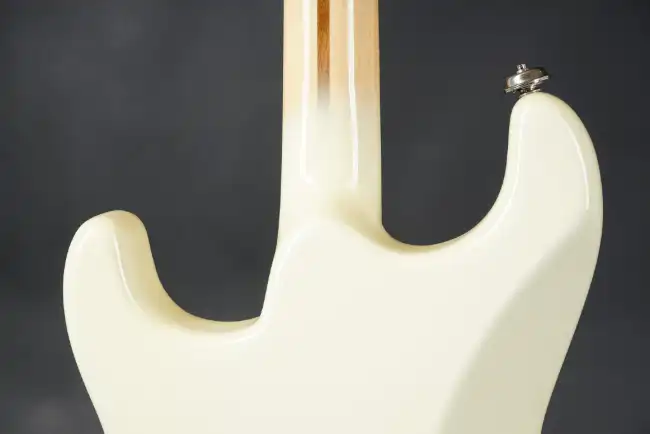
Alongside the Japanese and Mexican production models, Fender developed a more radical reinterpretation in the Fender Custom Shop Ritchie Blackmore Signature Stratocaster. Developed as a prototype in 1998 and produced from 1999 to 2004, the model represented a significant departure from traditional Stratocaster construction.
Unlike the Japanese and Mexican models, it featured a set-neck design and a streamlined electronic layout with two Gold Lace Sensor pickups in the bridge and neck positions. A three-way selector allowed for the neck and bridge pickups to be used together.
The instrument was built with a lightweight premium ash body, a custom oval-profile neck, and a 22-fret scalloped fingerboard.
Additional specifications included a bullet truss rod, Fender/Schaller Deluxe Cast/Sealed locking tuners, and a two-point tremolo with block saddles. Like the other signature models, Ritchie Blackmore’s signature was applied to the headstock.
An optional Roland-ready version of the Fender Custom Shop Ritchie Blackmore Signature Stratocaster was also available, equipped with a specially designed Roland GK-2A pickup that enabled the instrument to function as a guitar synthesizer controller.
The Fender ST72-175RB was a Japanese set-neck Blackmore Stratocaster produced exclusively for the domestic market. While broadly similar to the Fender Custom Shop Ritchie Blackmore Signature Stratocaster, it differed in several key respects, most notably featuring a vintage-style six-screw tremolo rather than a two-point system, as well as a flatter fingerboard radius.
Body and set-neck joint of the set-neck Ritchie Blackmore Stratocaster (photo courtesy: Guitar Point)

The Ritchie Blackmore 1969 Light Relic Stratocaster
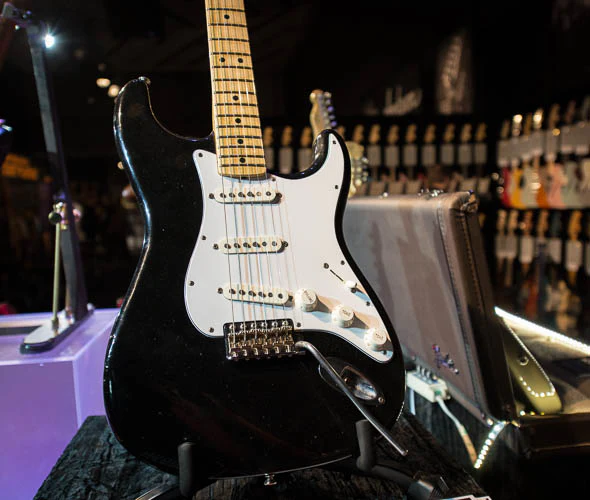
The 2013 Fender Custom Shop Ritchie Blackmore 1969 Light Relic Stratocaster was presented as a tribute to the black Stratocaster associated with Ritchie Blackmore’s early ’70s period, including the recording of Machine Head and Smoke on the Water, although historical accounts of the exact instrument used in the studio remain less definitive.
The instrument featured a lightly relic’d, nitrocellulose-finished two-piece alder body, paired with a U-shaped maple neck and a 7.25” radius fingerboard fitted with 21 medium-jumbo frets.
Its electronics consisted of Custom ’69 single-coil pickups, hand-wound by Abigail Ybarra, controlled via a three-way selector switch.
Additional specifications included Fender/Schaller “F” tuning machines, a four-bolt neck plate stamped with the Fender “F” logo and serial number, and a vintage-style tremolo bridge with a 1/4” custom tipless arm, in line with Blackmore’s preferences.
The rear of the headstock bore the Custom Shop logo along with a “Tribute Series” decal.


Which Strat Was Used on Smoke on the Water?
The exact Fender Stratocaster used by Ritchie Blackmore to record Smoke on the Water in 1971 remains a subject of debate.
While Blackmore is most commonly associated with black Stratocasters from the early 1970s—an image reinforced by live performances and later visual documentation—he stated in several interviews that the track was recorded using a sunburst Stratocaster from the late 1960s.
Complicating the picture further, Fender’s 2013 Fender Custom Shop Ritchie Blackmore 1969 Light Relic Stratocaster was marketed as a tribute to the black Stratocaster associated with the Machine Head era and the recording of Smoke on the Water, effectively cementing this version in the public imagination.
As a result, two parallel narratives persist:
- A historically grounded account based on Blackmore’s own recollections, pointing to a sunburst instrument
- A widely recognized visual and commercial association with the black Stratocaster
Rather than a contradiction, this reflects the fluid nature of instrument use during that period, when multiple guitars were often in rotation, and later memories, imagery, and marketing contributed to shaping the definitive story.