Fender’s Fight for Survival and Rebirth:
The end of the CBS era and the new FMIC
HOW FENDER ROSE FROM THE ASHES OF CBS
Table of Contents
ToggleThe End of the CBS Era: Inside the 1985 Fender Buyout
The heavy crisis that hit the music industry in the early ’80s prompted CBS to finally give up and sell Fender. But what would happen now to the company created by Leo?
Some potential buyers considered moving the entire production line outside the United States; others preferred to reduce Fender to a simple import and promotion company, cutting the workforce down to just a handful of employees. These possible outcomes were so frustrating for those who had dedicated their lives to Fender and worked in its plants for years that many felt the need to organize and take action to prevent another collapse.
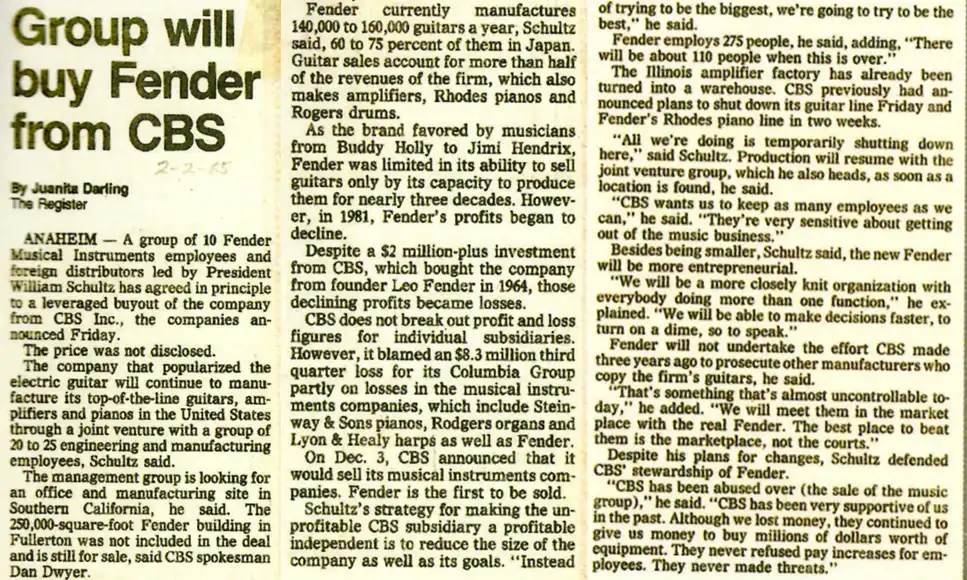
On February 1, 1985, at the NAMM Winter Convention, Bill Schultz announced that a group of around ten Fender employees—supported by several investors, including Servco Pacific Inc. (Hawaii’s largest privately held company, active in automotive distribution, retail, car sharing, and capital investments), FootHill Savings & Loan bank, the Chicago investment firm Mesirow, and a musician, probably Tommy Tedesco—was going to buy the company.
Schultz would remain at the head of Fender, but from then on, he would report to his colleagues and the investors, no longer to CBS.
The purchase was formalized on March 12, 1985, for about $12.5 million. At the same time, the company was renamed to its present-day name: Fender Musical Instruments Corporation (FMIC).
Fender’s future hung in the balance. There was no U.S. manufacturing, as CBS had sold off the world’s most prominent guitar and amp brand in 1985 for roughly the same price it had paid in 1965—almost exactly 20 years earlier. To make matters worse, the sale didn’t include many of Fender’s patents, machinery, or even the original Fullerton factory, where all U.S.-made Fender instruments had been built. As a result, U.S. production was officially shut down in 1985. Between February and October of that year, all Fender guitars were made in Japan.
But Dan Smith and Bill Schultz were determined that this new chapter—the post-CBS era—would mark a return to prestige and quality for the iconic brand.
Dan Smith, referring to the new adventure, declared:
“Scary but exciting. We’re not going to be in the position to be able to make any mistakes. There’ll be nobody behind us with a big cheque-book if we have a bad month.”
Dan Smith
FMIC's First Steps: New Headquarters and Factory
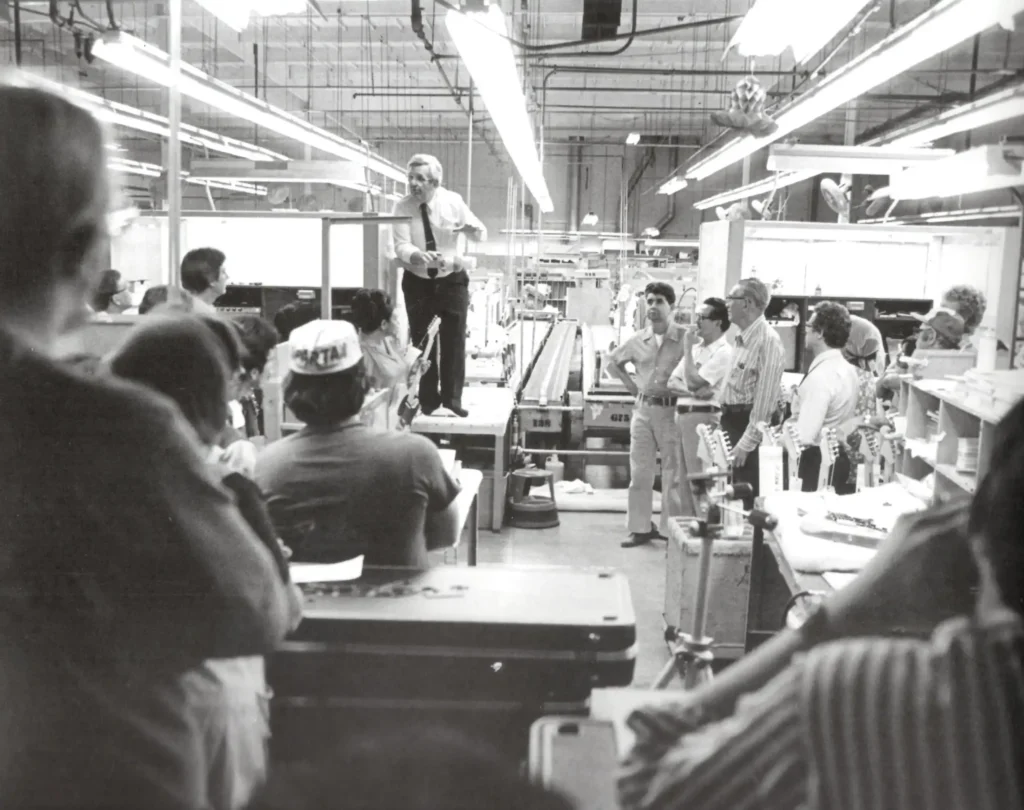
Once the agreement was concluded, Schultz reassured everyone that Fender products would still be made in both the U.S. and Japan, contrary to widespread claims. However, since the Fullerton factory was too expensive to purchase, the headquarters would be moved to Brea, just a few miles from Fullerton, and production would shift to a smaller plant in Corona. This new factory wouldn’t be ready until October 1985, so for about eight months, Fender didn’t produce any guitars in the U.S. Instead, they sold only “Made in Japan” guitars and leftover stock—possibly a few boxes of necks and bodies—but certainly nothing that supported the exaggerated stories circulating then.
In the early days after the buyout, when FMIC was a brand-new company, Fender Japan not only supported Fender by manufacturing a large number of guitars for the American market (including Standard, Reissue, and Squier models) but also contributed to the evolution of the Stratocaster. This was done through the introduction of superstrat guitars, which aligned with the growing use of the vibrato bar and the excess of rock music at the time: the Contemporary Series and the HM Series.
The First U.S.-Made Guitars After CBS
At first, the small Corona plant could produce only between seven and ten guitars a day. As per the new owners’ decision, only the reissues would be built in the U.S.A., while the other guitars, including the Standard Stratocaster, would be imported from Japan.
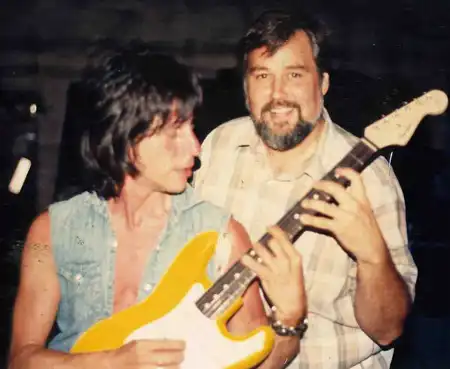
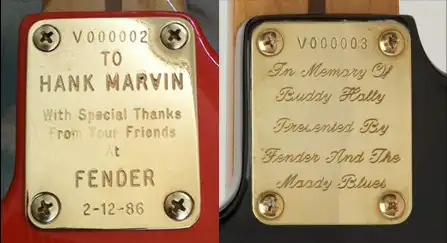
The first two Stratocasters made in the new factory were Fiesta Red reissues: the first one (S/N V000001) was owned by Dan Smith, while the second (S/N V000002) was shown to Hank Marvin at a party hosted by John Hill in 1986 to celebrate significant moments in Fender history.
The third guitar (S/N V000003) was a commemorative reproduction of the two-tone sunburst Stratocaster used by Buddy Holly and featured a brass neck plate engraved with “In Memory of Buddy Holly, Presented by Fender and The Moody Blues.” This guitar was presented directly to Buddy Holly’s widow, Maria Elena Holly
Fender’s strategic shift: key developments in 1987
In October 1985, George Blanda was hired to set up a small Custom Shop. However, this project was postponed due to the rise in the value of the yen against the dollar, which made importing guitars from Japan less cost-effective and forced Fender to revise its plans. This new economic reality, combined with a strong patriotic spirit, prompted Dan Smith and George Blanda to create a new “Made in USA” Stratocaster line, the American Standard Series, which was launched in 1987. Until then, the only Stratocasters available in the “post-CBS” era had been the Japanese models and the Vintage series. However, the Corona plant gradually began to produce new models, including the Plus Series and the first Signature models, such as the Eric Clapton and Yngwie Malmsteen Stratocasters.
1987 was a memorable year for the company, as it also marked the founding of the Custom Shop, established by Michael Stevens and John Page. In addition, the Squier brand was moved to Korea, and Fender opened its first Mexican factory in Ensenada, Baja California. However, the first Mexican-made guitars would not be produced until a few years later.
The Vintage Plus Stratocaster should also be mentioned; it was a reissue with the same electronics as the Elite and Freeflyte Tremolo. Two prototypes of this model were introduced at the 1986 NAMM, but it never went into production.
CBS to FMIC: buyout timeline
New headquarters and a new factory
In 1991, the year Leo Fender passed away, Fender relocated its main offices from Brea to Scottsdale, Arizona. The new headquarters managed the Squier, Charvel, Gretsch, Jackson, EVH, and Fender brands, while U.S. production and Custom Shop operations remained in the Corona facility.
In the second half of 1998, Fender consolidated its manufacturing operations by moving from the multi-building Pomona Avenue site to a new purpose-built facility on Cessna Circle in Corona, which opened on July 18. The former setup spanned ten separate buildings totaling just over 10,000 m², while the new plant centralized all production under one roof, covering approximately 177,000 m². With a capital expenditure of $20 million, it was regarded by Fender executives as the most advanced and costly guitar manufacturing facility ever constructed. The upgrade was designed to optimize production flow, reduce inter-building material handling, minimize downtime, and scale output capacity to meet projected demand growth.
Expanding the Line: Fender's Evolution from the 1990s to the 2000s
During the 1990s, Fender significantly expanded its production, introducing a broader range of models. The catalog became extensive—but also somewhat chaotic. Guitarists could choose from American, Mexican, and Japanese-made instruments, each with distinct build characteristics and price points.
Beyond Fender-branded models, Squier guitars—initially produced in Japan—were also manufactured in various other countries, including Korea, India, China, Indonesia, and even Mexico and the United States, further diversifying the lineup.
Numerous models were introduced, discontinued shortly after, and quickly replaced by new ones. Keeping track of the constant changes across Fender’s catalogs—and distinguishing between the many variations—was difficult, if not impossible, even for dedicated players and collectors.
In addition to the regular American Standard Series and its Hot Rodded variants, Fender’s ’90s lineup included several other series, such as the Vintage Series, Plus Series, Signature Series, and the first team-built Custom Shop models— all offering a wide range of specifications tailored to different player profiles.
1998 marked another milestone for Fender. In July, the American Deluxe Series was introduced as a successor to the Plus Series, while the American Vintage Series replaced the earlier Vintage Reissue line.
In the 2000s, little changed—Fender continued to expand its catalog by introducing new series and phasing out older ones, further increasing the complexity and breadth of its lineup.
