Bringing back the good old days
Vintage Reissue Stratocasters: the origins
HOW FENDER RECREATED THE CLASSIC
Table of Contents
ToggleThe Origin of Fender’s Vintage Reissue Stratocasters
Despite the innovations introduced with the Smith Strat, as well as the launch of the Gold Stratocaster and the Walnut Strat in the early 1980s, guitarists’ passion for the Stratocasters of the ‘50s and ‘60s showed no signs of fading.
In European markets, Tokai was dominating sales with superb, low-priced vintage copies. Since it was difficult to protect Fender’s designs from foreign competition, Bill Schultz and Roger Balmer (then Fender’s Head of Marketing and Sales) decided to produce vintage-style Fender Stratocasters in Japan.
In early 1982, Fender entered into agreements to have guitars manufactured in Japan, after which it dramatically scaled down production at the Fullerton plant.
For a time, most Fender guitars were made—ironically but strategically—in the factories of its Japanese competitors.
At the same time, Dan Smith realized that if Fender wanted to survive, it also needed to build a new line of vintage reissues in the U.S., even if they couldn’t be produced in large quantities.
They began with the ’52 Telecaster, developed by Freddie Tavares, followed by the ’57 and ’62 Stratocasters, as well as Precision and Jazz basses.
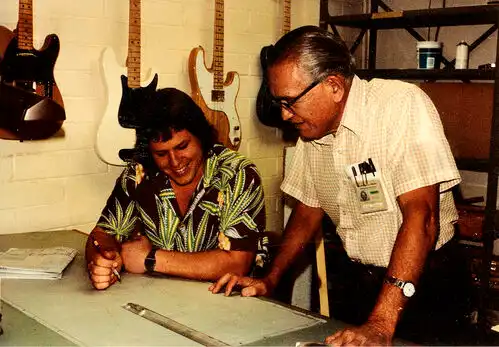

Dan Smith and John Page were looking for original pre-CBS Stratocasters to use as references for their prototypes.
Their search led them to Larry Hendrikson’s store, Ax-In-Hand Guitars in DeKalb, Illinois, where they discovered a remarkable collection of around 200 vintage Fender guitars.
They tested and analyzed many pre-CBS Stratocasters, using them as benchmarks for developing the new Vintage Series models.
“We knew that the best thing for Fender to bring out to show people that we were back was to reissue what everybody loved, which is why we did the ‘57s and ‘62s and all that kind of stuff. So, we looked at a lot of vintage guitars”, Dan Smith said. “I’ll never forget John and I going to DeKalb, Illinois, where we’d found that Larry Henrikson at Ax-In-Hand had about 200 Fenders in place. So, we went there, landed in Chicago in January, freezing cold, about 70 below. Can’t remember how many hire cars we went through before we found one that worked. Finally, we got to Larry’s shop and spent the whole day there.”
“We were there on the mission to make sure we measured the stuff and got the data. We wanted to get it as close as we could. We took pickguards off, took pictures of pockets, tested paint, measured necks, all that kind of crap. And we left having bought perfect examples of each era, too. I remember we spent $5,600 on three guitars, which for Fender at the time was ludicrous. We went out and bought back our own product!”
Dan Smith
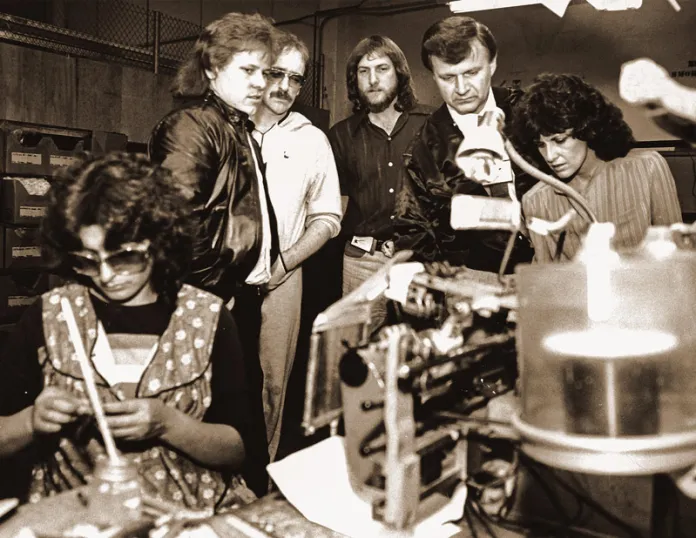
John Carruthers, a renowned luthier who had customized and repaired instruments for some of the world’s most celebrated musicians, assisted Dan Smith with the Vintage Reissues project. He measured numerous vintage Fenders, redefined the reference specs, and helped update—or replace—some of the worn-out tooling.
However, one major challenge was recreating vintage-style pickups. Fender no longer remembered exactly how they had been made. While Abigail Ybarra was still able to replicate the original winding techniques, there was no surviving technical documentation. That’s when Seymour Duncan entered the picture. A longtime friend of Fender, he generously shared his expertise and knowledge.
There was even a rumor that Fender returned the favor when Seymour asked to see Seth Lover’s original files and specs from his time at Fender.
The prototypes were built by Senior Luthier Scott Zimmerman in 1981 and were officially unveiled at the NAMM Show in Anaheim in January 1982. Officially named Vintage Stratocasters, these new models featured serial numbers beginning with a special “V” prefix. The ’57 reissue came with a single-ply pickguard and a 1-piece maple neck, while the ’62 model featured a 3-ply pickguard and a maple neck with a rosewood fretboard.
However, the reissues weren’t released until later that year. This delay was due to a major overhaul of the Fullerton factory, which was retooled to focus on lower production volumes—far fewer than the 250–300 guitars produced daily in the 1970s—in order to significantly improve quality control.
Although it may seem ironic that two “old” designs became some of the most important instruments ever produced by a company known for innovation, these reissues demonstrated that Fender was still capable of crafting world-class guitars.
According to Dan Smith, sales of the Vintage Series helped finance the development of the Standard line and ultimately paved the way for the creation of the Fender Custom Shop.
Were They Accurate Reproductions?
According to Fender, the Vintage Stratocasters were exact replicas of the originals. A promotional flyer for the Vintage series featured the phrase in capital letters, “We brought back the good old days,” and further down it stated, “To call them ‘new’ isn’t quite accurate. Because we went back to the original blueprints and meticulously reincarnated two guitars that helped to shape musical history.”
In truth, however, they were not an entirely accurate reproduction of vintage instruments. For example, the headstock was slightly different from the pre-CBS one and lacked the patent numbers, the ’62 model didn’t feature a mint green pickguard, nor the clay dots, and also pickups, string trees, and neck shape were different.
The truth is, Fender had access to the correct parts and the capability to build highly accurate reissues, but dealers insisted that players wouldn’t be receptive to guitars that looked too old. As a result, certain compromises were made to balance vintage styling with modern market appeal.
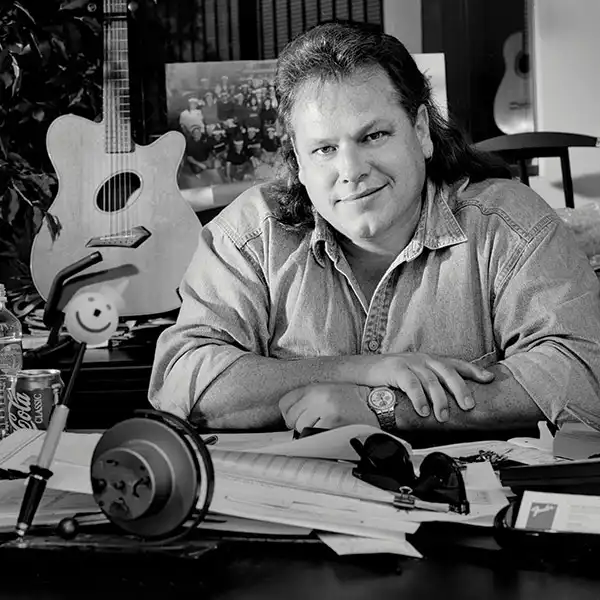
“There ended up being a lot of things that were not very accurate, by design, because players at the time didn’t care about deep-V necks and dot spacing—at least that was the feedback our marketing department was getting,” Page said. “Dan had to decide on things like neck shapes based on that, which is why we came up with the medium-C shape.”
John Page
“Another issue was finishes. We started with 100-percent nitrocellulose, but when the first Vintage models came out, dealers complained about grain shrinkage and irregularities showing through. We told them, ‘Well, it’s lacquer, like vintage…’ But they said, ‘Yeah, but we don’t want to see that.’ So, we started doing urethane undercoats with nitro top coats.”
John Page
Those concessions for the sake of marketability helped make the Vintage line successful.
The catalog controversy
Looking at the 12th fret marker spacing in the images from the 1982 Fender catalog, it appears that the Vintage Reissues were faithful to the original pre-CBS guitars. In reality, though, the reissues did not have the vintage-correct marker spacing. Recreating that detail would have required costly factory retooling, which Fender opted to avoid.
Ironically, the Vintage Stratocasters produced by Fender Japan during the same period did feature the correct 12th fret marker spacing—highlighting the paradox that the overseas versions were, in some ways, more historically accurate than their American counterparts.
So, what kind of guitars were those in the catalog?
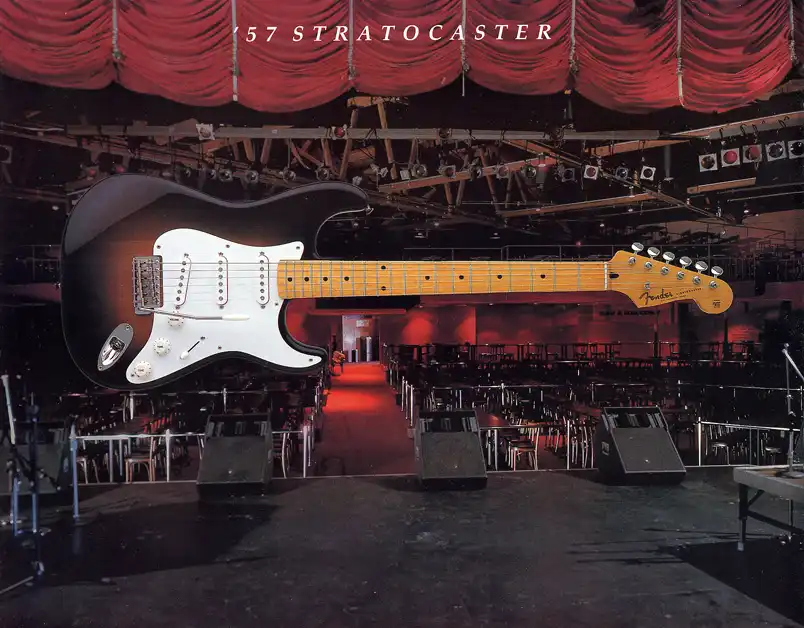
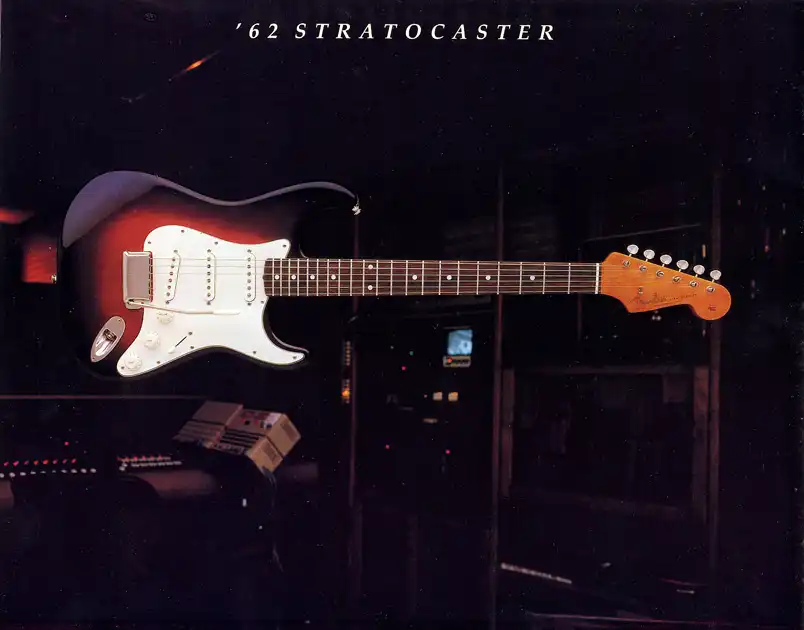
Dan Smith, John Page, Freddie Tavares, and Scott Zimmerman all contributed to the production prototypes, drawing on a collection of vintage instruments gathered from various stores. Dan Smith had also been sourcing sample guitars from Japanese manufacturers, including, among others, models branded by Tokai.
When they were ready to launch the Vintage Series, Fender enlisted the Joe Phelps Advertising Agency to produce the catalog. Fender’s UK consultant collaborated on the project, securing clearances and approvals for the artist photos and the layouts in which they appeared.
Max Kay, founder of London’s legendary store EFR Guitars, was told by Tokai that the new Fender catalog included photographs of Tokai guitars. This wasn’t entirely true, however—there was only a single image showing the back of a Tokai Stratocaster headstock, clearly displaying the machine heads with “TOKAI” embossed into the metalwork of the gear covers.
When questioned by European agents about the “bogus” Tokai machine heads, Dan Smith explained that it was the only Tokai neck available at the time and was used simply because it was on hand when the photographer was working. Fortunately, the issue was spotted during the approvals process of what has since become regarded as one of the best—and most coveted—Fender catalogs ever printed.
Fullerton Reissues vs Corona Reissues
The first run of Vintage Stratocasters—now known as Fullerton Reissues—was built from early 1982 until the factory’s closure in January 1985. An estimated 16,000 guitars were made, and they are now highly sought after by collectors. Unfortunately, their desirability has also made fakes common.
Production moved to Corona in late 1985. In 1998, the series was revisited and renamed the American Vintage Series.
