Inside the Vintage Reissues:
Vintage Reissue Stratocasters Specs
A DEEP DIVE INTO EVERY DETAIL
Table of Contents
ToggleHeadstock
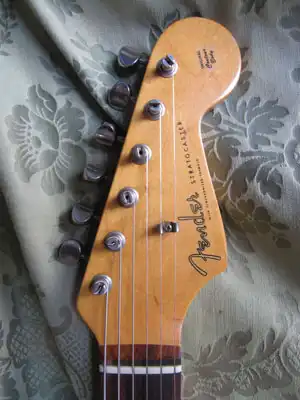
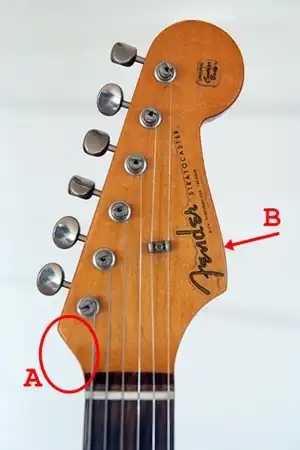
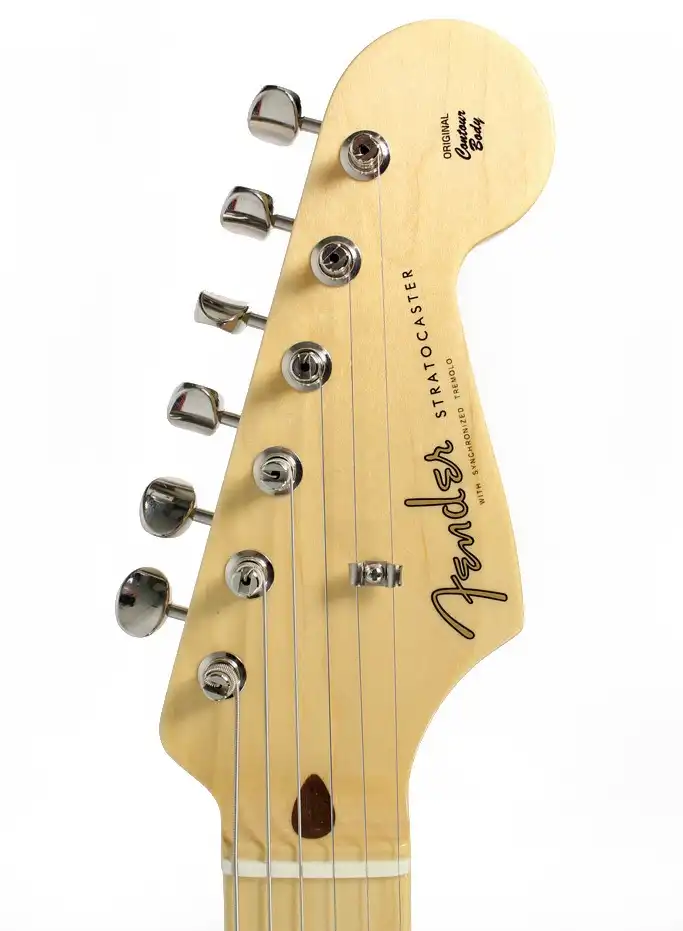
The headstock of the Fullerton Vintage reissues followed the “Dan Smith style,” similar to that of early 1980s Standard Stratocasters, and quite different from the original 1957 and 1962 Stratocaster designs.
However, when production moved to the Corona factory and the supply of necks with Dan Smith headstocks ran out, Fender introduced a new, smaller headstock. This version was slightly elongated and rounded, though still unlike the Fullerton shape. It became commonly known as the “pregnant headstock.”
In 1998, with Mark Lewis leading a complete overhaul of the series—coinciding with the launch of the Time Machine Series—the American Vintage reissue headstock was finally redesigned to match the correct pre-CBS shape. This was largely thanks to research conducted by master builder Michael Stevens on vintage Stratocasters.
Logo and decals
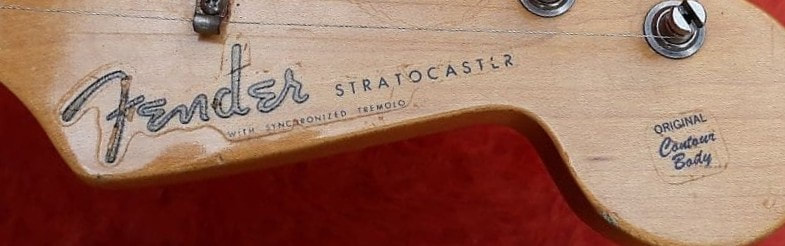
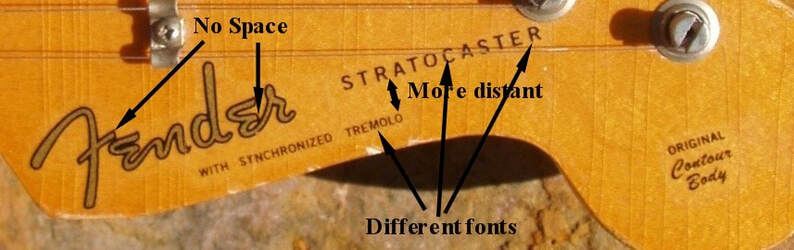
Fender used three different batches of decals for the Vintage Stratocasters, all applied over the finish—just as they had done in the ’50s and ’60s. Therefore, it is not uncommon to see instruments with imperfect decals.
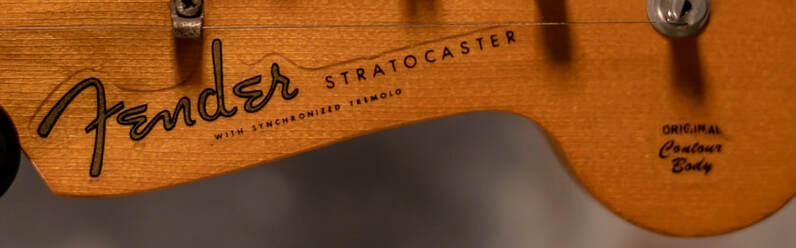
The first type appeared on Vintage Stratocasters produced between 1982 and 1986. This decal featured a Fender logo with a pointed “e,” and the decal edges were fairly straight, not closely following the contours of the letters.
The second batch was introduced in 1986 and gradually replaced the first. In this version, the Fender logo no longer had a pointed “e,” and the decal edges were tighter and followed the letter contours more closely than those used on the first batch.
A third, much more unusual batch was also used briefly in 1982 and 1983. These decals were misaligned, with the word “STRATOCASTER” positioned far from the “WITH SYNCHRONIZED TREMOLO” line. The letters were larger and used a slightly different font—noticeable in characters like “R,” “C,” and “M.” The Fender logo was also distinct: the “e” was pointed and intersected with both the “F” and the “r.”
This odd batch of decals was likely a mistaken or misprinted order. Rather than discard them, Dan Smith and other Fender executives probably chose to use them anyway, focusing more on capturing the vintage “vibe” than on strict historical accuracy.
Body
Body Contours
The early Vintage Reissue Stratocaster bodies produced at the Fullerton plant between 1982 and early 1984 had several distinctive features that set them apart from the later bodies made at the Corona plant from late 1985 onward.
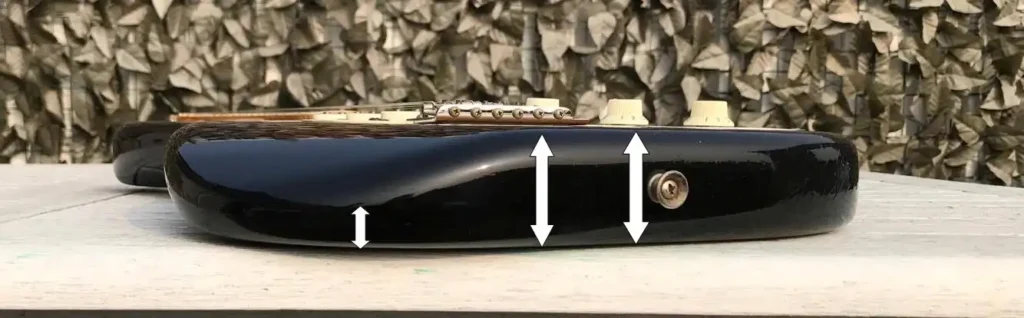
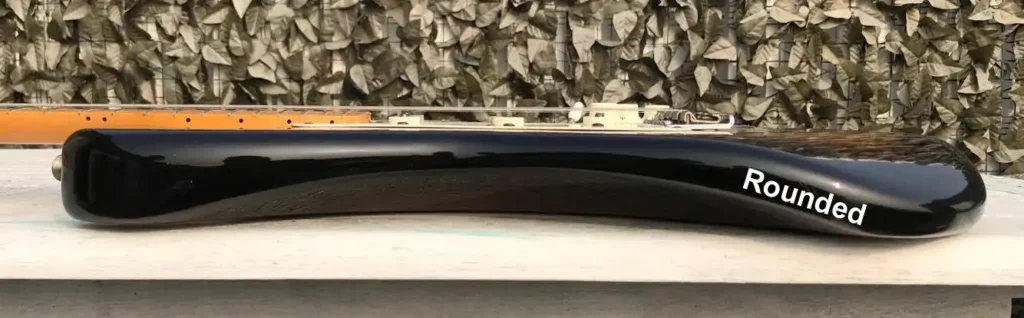
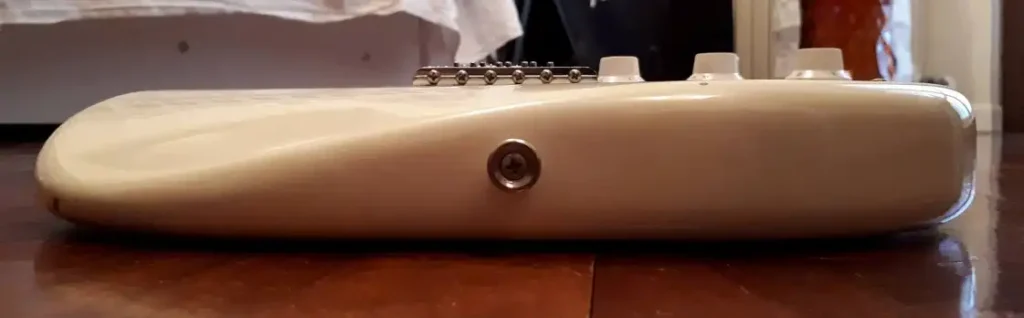
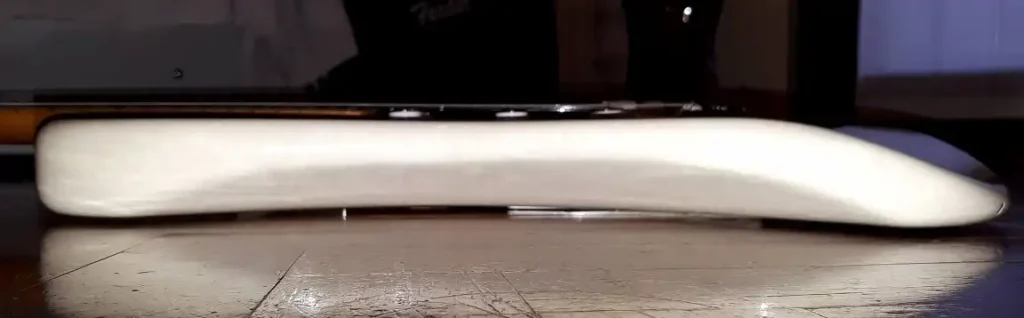
Most notably, the rear body contour on Fullerton-era Strats was deeper, longer, and featured a more gradual transition into the rest of the body. This resulted in a sleeker, thinner top edge compared to the more squared-off edge seen on later reissue Strats.
These refined “Fullerton contours” were also present on the very first reissue Strats produced at the Corona facility. Those early Corona-built guitars either used leftover bodies from the Fullerton factory (very few) or were crafted using the same dies and machinery as the earlier Fullerton reissues.
Fullerton
Corona
JV
In the pictures shown above, you can see a comparison between a 1982 “Fullerton” (Massimo Salmoiraghi), a 1988 Corona (Francesco Palmitessa), and a 1983 JV (Paolo Bassi). The top contour on Corona reissues is noticeably deeper than on Fullerton Stratocasters, and when viewed from the side, the Corona contour appears sharper and less rounded. JV Stratocasters also have a very deep contour.
Body Routings
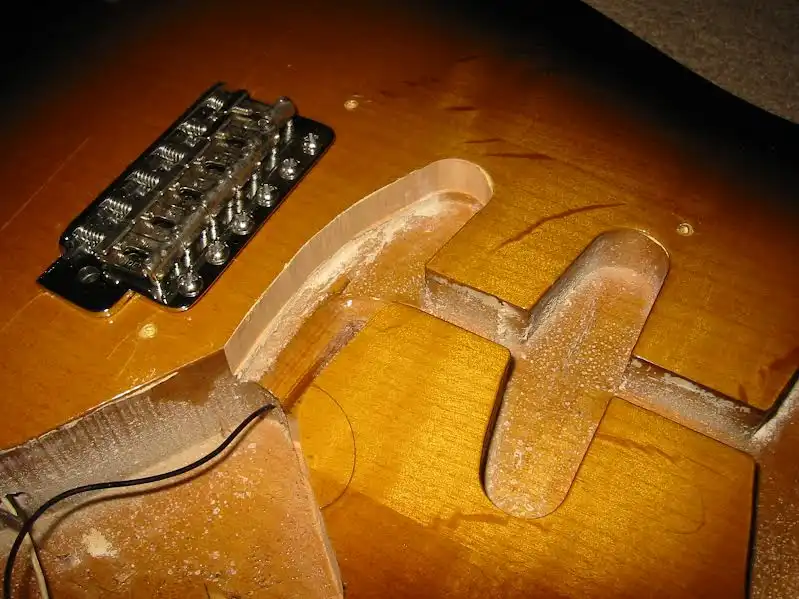
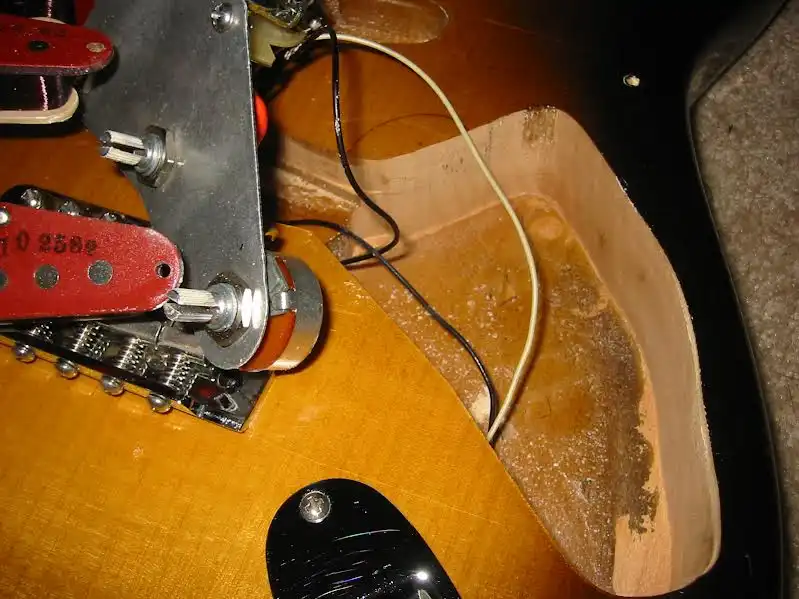
During the initial assembly of the very first 1982 Vintage Stratocasters, Fender encountered problems fitting the completed pickup assemblies into the pickup and control cavities. As a result, many of these early 1982 reissue Strats had to be modified by removing small sections of wood to accommodate the components. This was done on the assembly line using a small handheld pin router—after the bodies had already been finished.
The modifications resulted in thin sections of wood being routed from the backside of the bridge pickup cavity and around the edges of the control cavity. On the very first reissue Strat bodies, it’s common to see more extensive routing, as it took several weeks to determine exactly which areas were causing the issue. Tooling changes implemented at the end of 1982 corrected the problem, eliminating the need for additional hand-routing during assembly.
All Vintage Reissue Stratocasters have a “worm-hole” route in the bridge pickup position. The shape of this route varied over the years—it may appear as a straight line with a small triangle, or in an L shape.
Woods Used
The Vintage Stratocaster bodies were made of alder for both the ’57 and ’62 reissues. However, between late 1987 and 1989, Fender also offered a “Mary Kaye” version of these Stratocasters, featuring an ash body, blonde finish, and gold hardware.
Dates and serial numbers
Serial Numbers
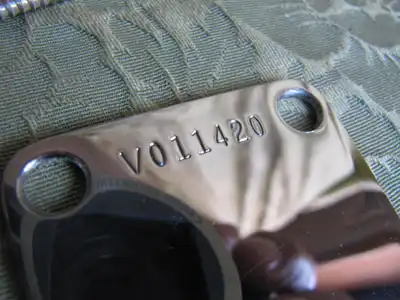
Each American Reissue Stratocaster that left the factory had the serial number starting with “V” stamped into the neckplate. As a general rule, serial numbers can help indicate a year range for a particular guitar but should not be relied upon for exact dating. Fender kept a large box of neckplates and placed them on guitars in a semi-random fashion. Therefore, the only accurate way to date a Vintage Reissue is by correlating the serial number with the neck date and the codes on the potentiometers.
Some popular books claim that serial numbers restarted at V0000001 when the Corona factory opened; this is incorrect. At no point did the serial numbers reset, although Fender did manufacture three Stratocasters with serial numbers V0000001, V0000002, and V0000003.
Since late 2012, the reissue serial numbers have also included a year code: for example, “V12” for American Vintages made around 2012, “V13” for those from 2013, and so on.
For more detailed information about these serial numbers, please refer to the resources provided here.
Dates on the Neck
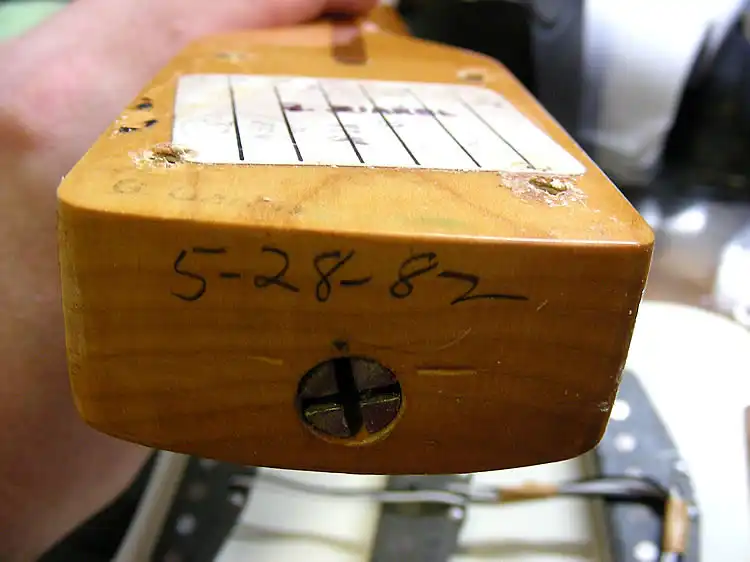
From 1982 to 1988, all neck dates were handwritten in pencil underneath the nitrocellulose finish. These penciled dates used only numbers, with months represented numerically rather than spelled out (MM-DD-YY).
Starting in 1988, neck dates began to be stamped in black ink, using three-letter month abbreviations (MON-DD-YYYY). From 1988 through the 1990s, neck dates could be either handwritten in pencil or stamped in black ink, with the latter being more common.
It was not unusual for some necks—especially from the late 1980s—to leave the factory without any neck date.
Additionally, a few late-1980s reissues have been found with handwritten neck dates missing the last digit of the year.
Dates on the Body
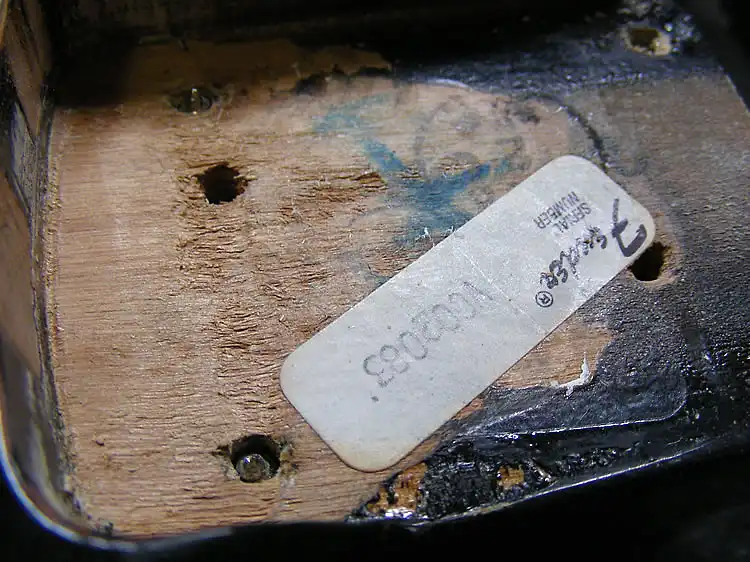
A few early 1982 reissue Stratocasters had a small rectangular sticker stamped with the serial number placed inside the neck pocket. This is a rare feature found only on early 1982 models.
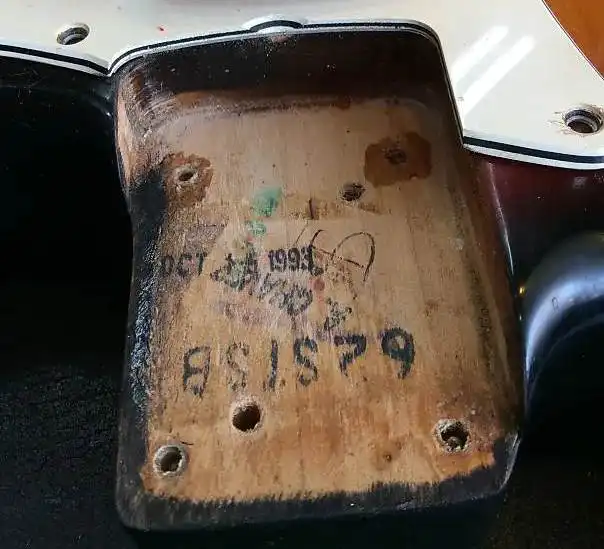
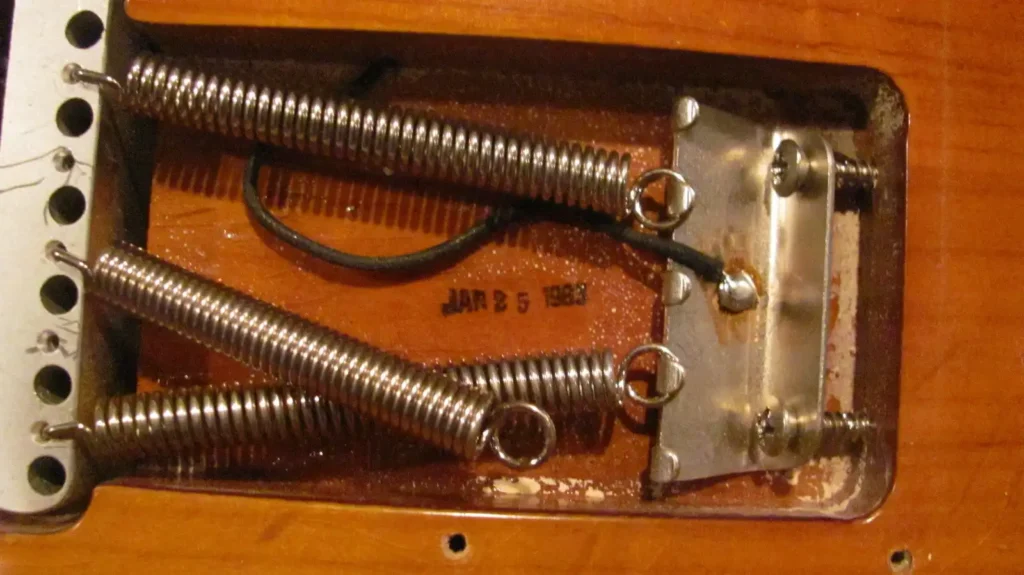
Early 1982 Vintage Stratocasters made at the Fullerton factory do not have date stamps in the neck pocket. Only a few left the factory with a small black ink date stamp inside the tremolo cavity on the rear of the body.
Date stamps in the neck pocket became more regularly used starting in 1987, though inconsistently throughout the late 1980s. It was not until the 1990s that date stamps were applied consistently in the neck pocket.
Finishes
John Page stated that the very first units featured a 100-percent nitrocellulose finish, but when the initial Vintage models were released, dealers began to complain about grain shrinkage and finish irregularities showing through. As a result, Fender started applying poly undercoats with nitrocellulose topcoats.
The standard color for the ’57 model was, naturally, two-tone sunburst, while the ’62 featured a three-tone sunburst. Custom colors such as Lake Placid Blue, Fiesta Red, Vintage White, Candy Apple Red, and Black were also available, though only a small percentage of guitars leaving the Fullerton factory had custom finishes.
After production moved to Corona, the number of custom-colored Vintage Stratocasters increased significantly. New colors like Surf Green, Daphne Blue, Ocean Turquoise, and, in 1997, Shoreline Gold were introduced.
Between late 1987 and 1989, Fender offered the limited-edition Mary Kaye version, which featured a blonde-finished ash body and gold hardware.
Pickups and electronics
Pickups
All pickups used in the Vintage Reissue Series employed staggered AlNiCo V pole pieces with flat-ground tops, mimicking late-’50s and early-’60s specs. Rounded-top magnet poles did not appear until the 1998 retooling of the American Vintage series, which introduced revised pickup specs and construction methods.
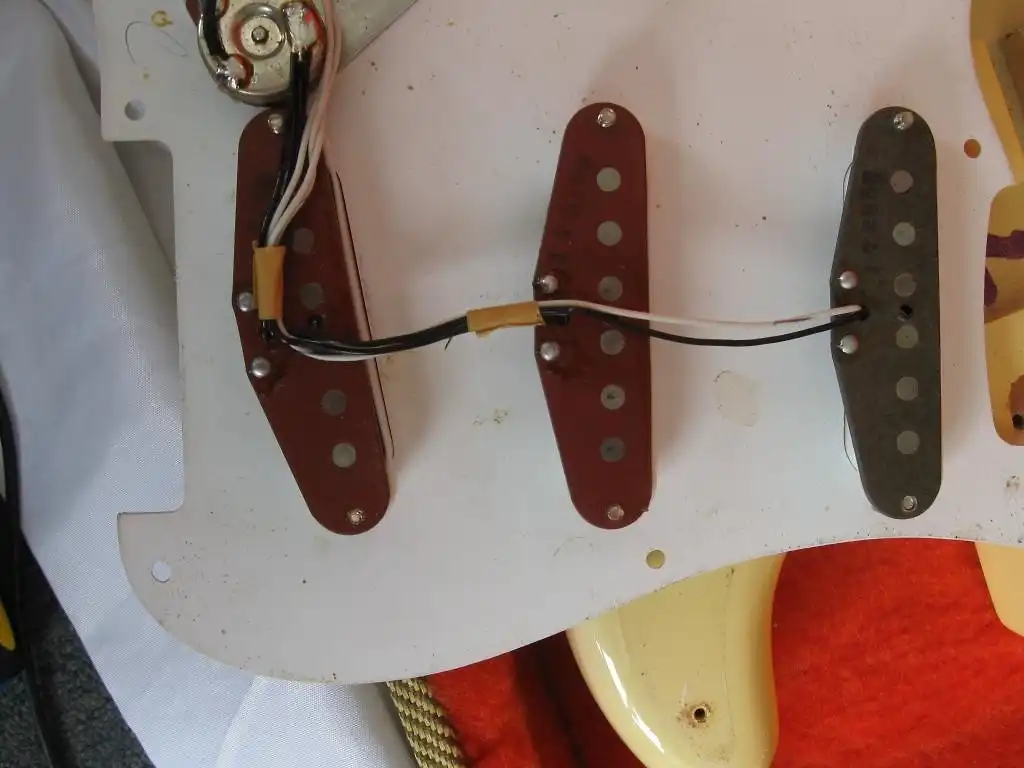
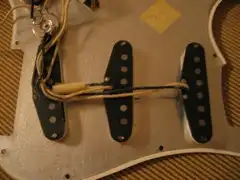
The earliest Vintage Reissue Stratocasters, introduced in 1982, were fitted with red bottom pickups, identifiable by thin plastic-coated leads and 1982 date stamps. These pickups are exceptionally scarce and were limited to the initial production run. Early ’82 reissues may feature red, grey, or black bottom pickups, with black bottoms being by far the most prevalent. Instruments equipped with red bottoms are highly sought after and typically fetch a premium over their standard counterparts.
Only the black bottom pickups were wired with vintage-correct cloth-covered leads in white or black; red and grey bottoms instead used modern-style plastic-insulated wire.
Pots
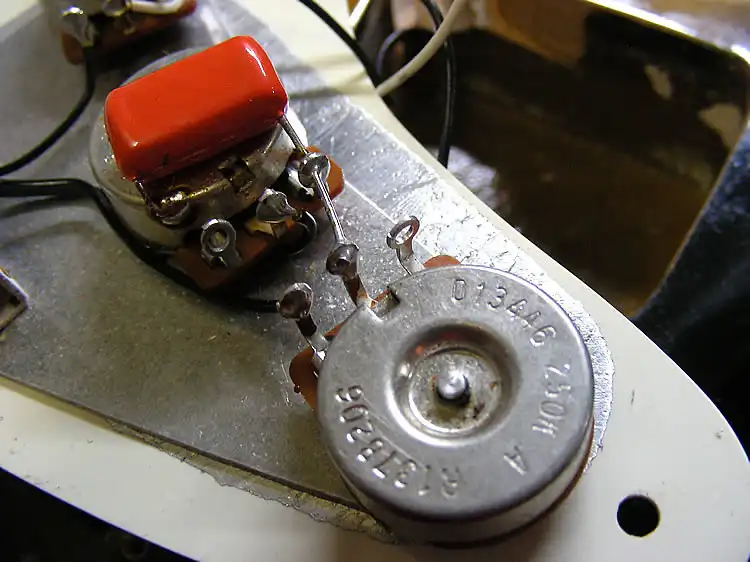
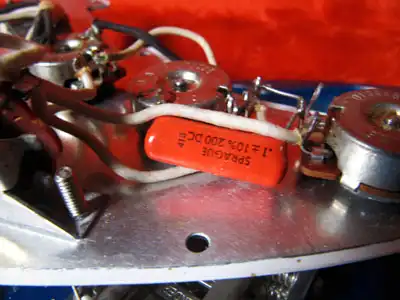
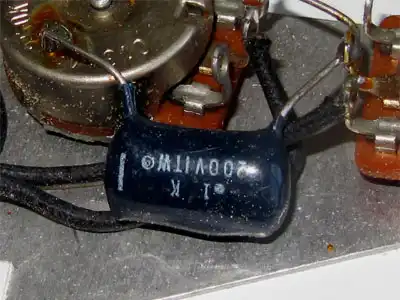
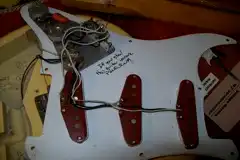
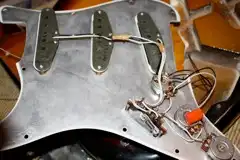
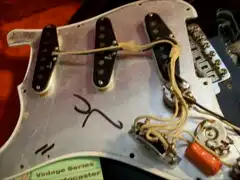
Vintage Stratocaster reissues were fitted with CTS potentiometers, each bearing a date code in the 137YYWW format—where “137” identifies CTS, followed by the year and week of manufacture. During the Fullerton era, these reissues typically featured large Sprague capacitors, most commonly bright orange, though black variants were occasionally installed. Over time, several styles of these orange capacitors were used; the earliest units often had a more cylindrical casing, while later Fullerton-era capacitors adopted a slightly squarer profile. In subsequent reissues, Fender began incorporating smaller red or orange film capacitors.
Switch
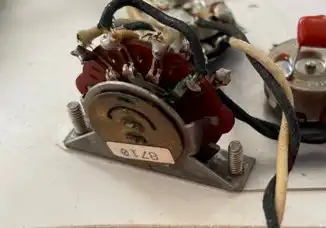
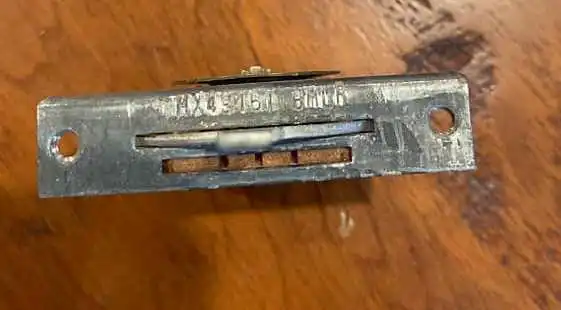
Factory-installed switching consisted of a 3-way Oak Grigsby MX49161 6MLR selector, faithful to pre-1977 Stratocaster wiring schemes. Although a 5-way switch was included with every guitar, many dealers swapped the original 3-way for the 5-way before the instruments left the showroom floor, catering to player preferences for the additional pickup combinations introduced in later Stratocaster models.
Neck and fretboard
Reissue necks featured a slim “C”-shaped profile and were finished with a thin coat of nitrocellulose lacquer to replicate the vintage feel and aging characteristics.
Unlike the original 1957 and 1962 Stratocasters, early reissues used narrow dot markers at the 12th fret, which differed from the vintage wider spacing. Interestingly, Japanese-made reissues maintained vintage-correct wider dot spacing at the 12th fret.
The fretboards were typically made of maple or rosewood, depending on the model, with a radius of 7.25”—a hallmark of early Stratocasters that contributes to their classic playability. Beginning in 1998, Fender’s American Vintage Series adopted wider twelfth-fret dot markers, adhering closely to original Fender specifications in both neck profile and fretboard dimensions.
Pickguard
All ’62 Stratocasters use a 3-ply, 11-hole white pickguard with full-size metal shielding on the underside. All ’57 Stratocasters feature a 1-ply, 8-hole white pickguard with shielding only around the pots and switch. It wasn’t until 1998 that the white pickguards on both the ’62 and ’57 reissues were replaced with mint green guards.
At first, Fender misplaced the upper screw hole, positioning it above the middle pickup; this error was corrected later that same year.
Many early reissue Strats have the initials “JC” handwritten with a marking pen on the underside of the pickguard. This marking was once incorrectly attributed to John Cruz, who actually began working at Fender on October 23, 1987.
Bridge, saddles and knobs
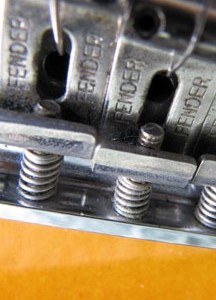
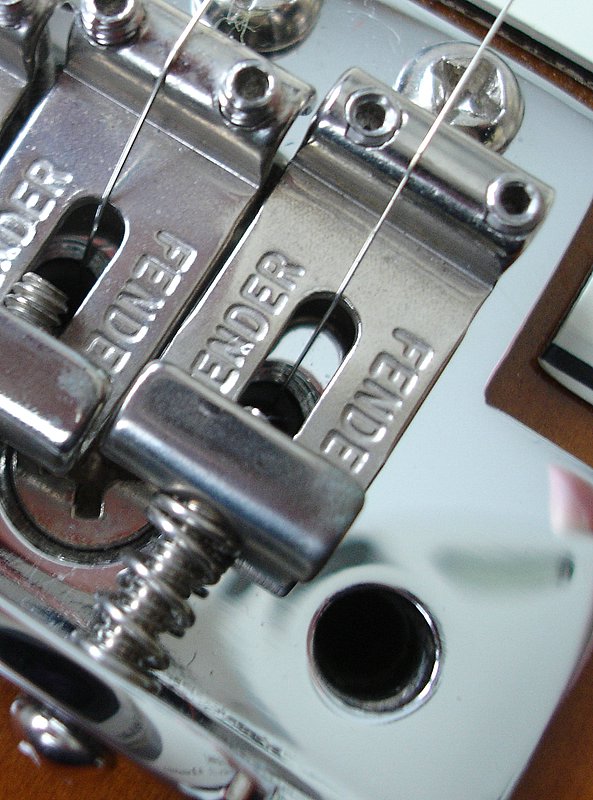
The 1982 Vintage reissues featured a bridge visually similar to the pre-CBS design, with saddles stamped “FENDER” on both sides. Initially, the engraving on the saddles ran in the same direction on each side; however, starting in 1989, new saddles were introduced with the “FENDER” engravings oriented in opposite directions.
According to Dan Smith, reissue saddles and bridge plates typically consist of stamped steel with a nickel-plated base, often followed by a thin chrome layer. This dual-layer plating—commonly referred to as nickel-chrome plating—balances corrosion resistance while delivering a shiny, polished look.
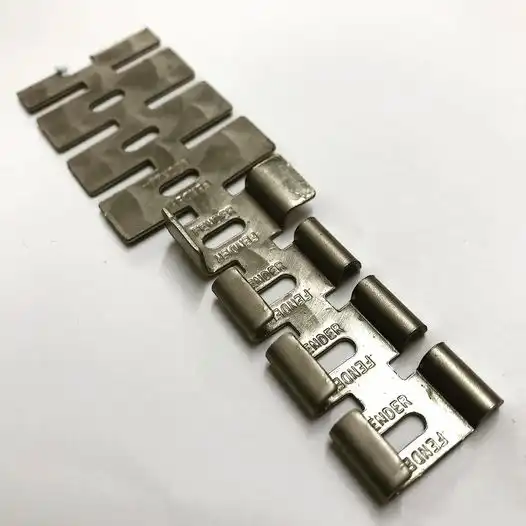
Section of in-process fabrication of vintage Stratocaster saddles, showing the progressive stages of the die stamping. This was just a small cutout section of a very long coil that was fed into the press. Then they were they were cut. In a secondary operation, they were drilled and tapped. Finally, the saddles were deburred, case-hardened, and plated. (Photo: John Page)
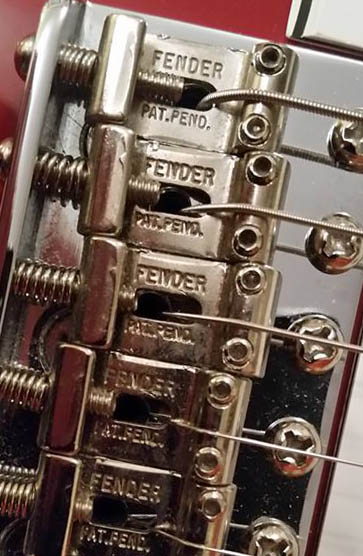
In 2013, during the refresh of the American Vintage Series, the saddle engraving was updated to “FENDER” / “PAT. PEND.” to better replicate the markings found on pre-CBS Stratocasters.
The slot that the string goes through was longer and had an improved position that allowed the strings to go through without resting against the front edge of the slot.
On the contrary, older “FENDER FENDER” stamped saddles had a slot that was back toward the intonation screw and thus, in some cases, the string rested on the forward edge of the slot before it rested on the intonation point of the saddle. Hence, the string often had three contact points: the inertia block/bridge plate junction, the forward edge of the saddle, and the intonation point of the saddle. With the new saddles, strings had only two contact points, like the originals.
At the same time, the original knobs were replaced with “eggshell” style knobs, which featured smaller numbers for a more vintage-accurate appearance.