Signature & Iconic Strats
Bill Carson's Cimarron Red Stratocaster
AND THE CUSTOM SHOP TRIBUTE MODEL

Table of Contents
ToggleBill Carson’s Cimarron Red Stratocaster
Will a man cry and beg for a guitar? Apparently, yes.
Many vintage enthusiasts and Fender aficionados will recognize Bill Carson in this portrait—an influential salesman and early endorser of Fender instruments. A seasoned country guitarist, Carson performed throughout the 1950s with the Eddy Kirk Band and worked alongside artists such as Hank Thompson, Lefty Frizzell, Spade Cooley, and Billy Gray.
The Cimarron Red Stratocaster seen in the photograph is among the very earliest examples produced by Fender.
According to Carson, that particular color had already been used by Leon McAuliffe, the steel guitarist for the Cimarron Boys, Bob Wills and His Texas Playboys.
At the time, Cimarron Red was not a standard Fender finish, but rather an early example of a custom color requested outside the official catalog—testifying to the flexibility of Fender’s production in its formative years.
McAuliffe requested a Fender instrument in that shade and, to ensure accuracy, sent the factory a can of nitrocellulose paint mixed to his own specifications. A small quantity remained unused, and Carson asked to have it applied to his Stratocaster.
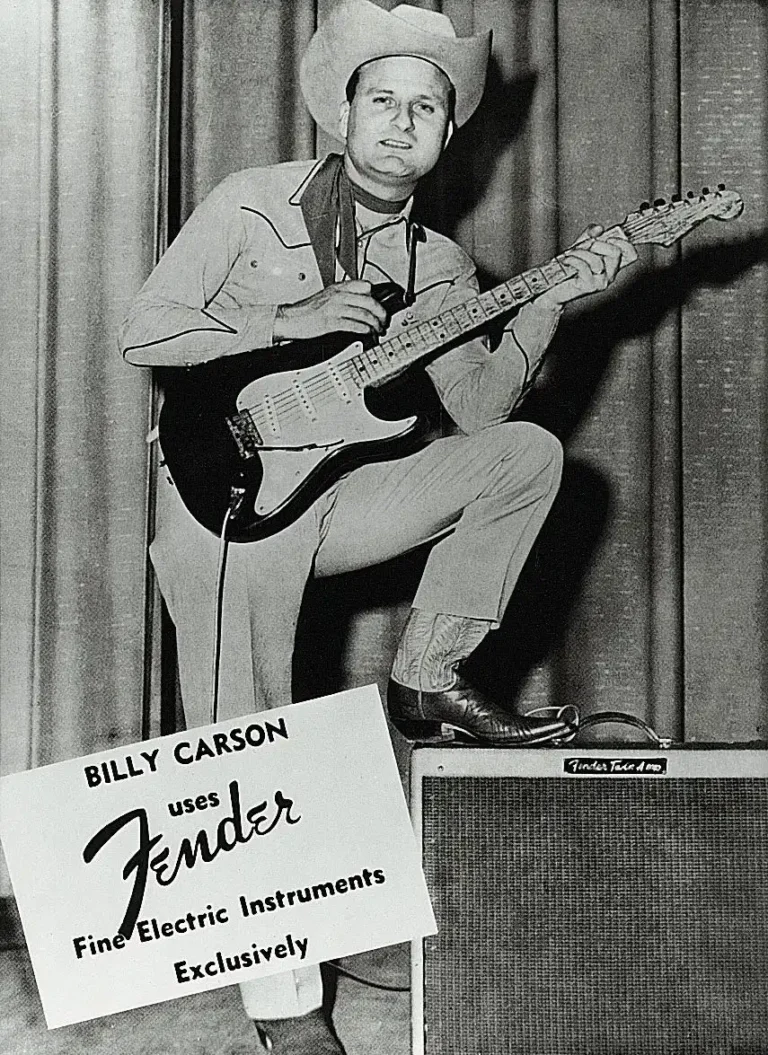
He later named the color Cimarron Red, drawing inspiration both from McAuliffe’s band and from the Cimarron Ballroom, where the steel guitarist frequently performed.
But few are aware that the neck seen in the photograph is not the one originally fitted to the instrument. The bird’s-eye maple neck shown here had, in fact, been selected for his own use by Forrest White, Fender’s plant manager and a close associate of Leo Fender.
One Saturday morning, Bill—who at the time was playing with Billy Gray—entered Forrest White’s office in search of a replacement neck, as the one on his Cimarron Red, custom-finished Stratocaster had been ruined.
Under normal circumstances, Forrest would have had several spare necks available in the warehouse, but on that particular day, the only one at hand was a striking bird’s-eye maple piece he had set aside for himself.
At the time, highly figured maple such as bird’s-eye was not routinely selected for production instruments and was often set aside, as in this case, for personal use or special builds.
Desperate, Bill asked to see it, even as Forrest repeatedly insisted it was not available. The moment he laid eyes on that remarkable piece of figured maple, Bill began to plead for it—like a child, on the verge of tears, imploring Forrest to give it to him.
“You have never heard such begging in your life,” Forrest recalled. “It is painful to hear a grown man cry, and Bill Carson could put on an act like you had never seen or heard before.”
Bill’s desperation and persistence were such that Forrest ultimately realized the only way to put an end to it was to give him the neck and install it on the Cimarron Red Stratocaster body.

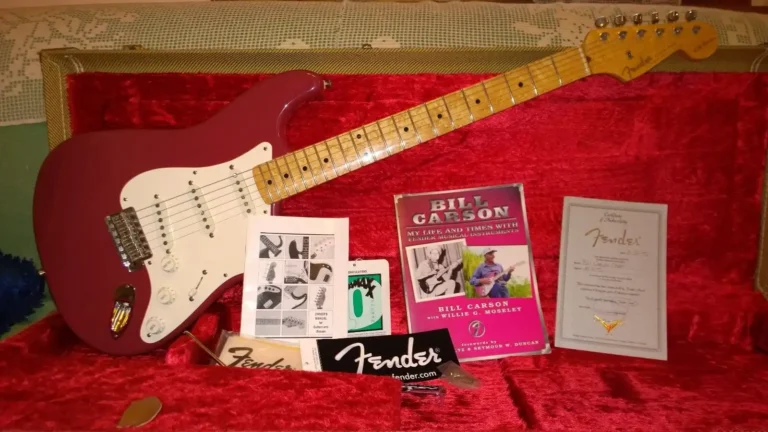
The Custom Shop Tribute Stratocaster
The guitar became so renowned that, in July 1991, Don Schwartz, owner of Music Trader, contacted John Grunder, then head of sales at the Fender Custom Shop, to propose the production of a commemorative Stratocaster. The idea was well received and, after securing Bill Carson’s approval, a limited run of 100 Bill Carson ’57 Stratocasters went into production.
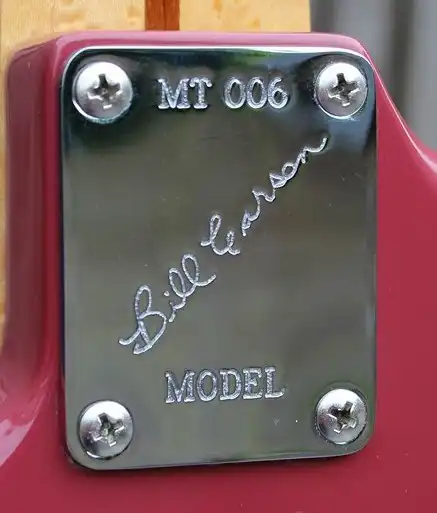
Built in ’57 style, each instrument bore a serial number beginning with “MT” (for Music Trader), featured a Cimarron Red finish, and was fitted with the distinctive bird’s-eye maple neck—the very element that had once driven the country guitarist to plead for it with such intensity.
The first 41 instruments were sold through Music Trader; however, due to financial issues related to the Bill Carson project, production was halted in July 1992 and later resumed under Fender’s distribution.
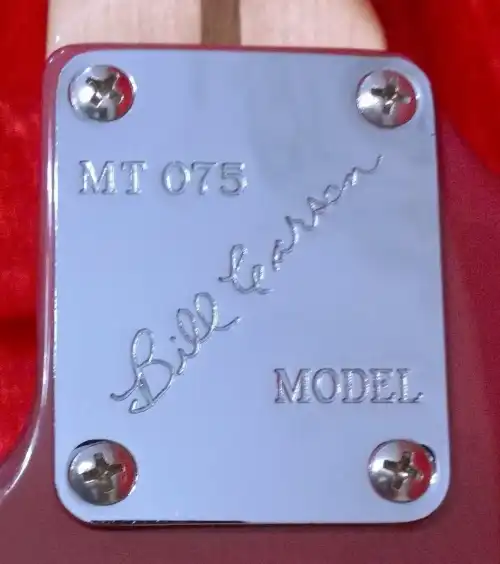
The right-handed guitars bearing serial numbers from MT000 to MT039, along with the left-handed example MT100—on which the signature was mistakenly omitted from the headstock—were distributed by Music Trader. The remaining instruments, from MT040 to MT099, were distributed by Fender.
Unfortunately, 51 neck plates were lost under unknown circumstances at the Corona factory. For this reason, many Bill Carson Stratocasters distributed by Fender—rather than by Music Trader—feature the serial number and Carson’s signature stamped on the neck plate, but in a different position from those on instruments distributed by Don Schwartz’s company.