Signature & Iconic Strats
David Gilmour Stratocasters
THE BLACK STRAT, THE RED STRAT, THE 0001 STRAT, AND THE MAKING OF THE DAVID GILMOUR SIGNATURE STRATOCASTER


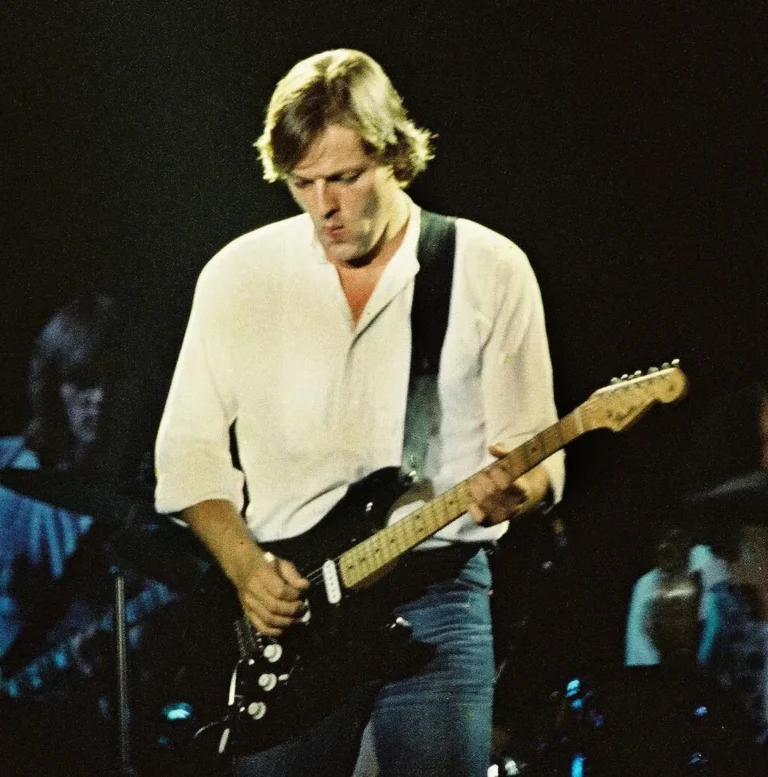
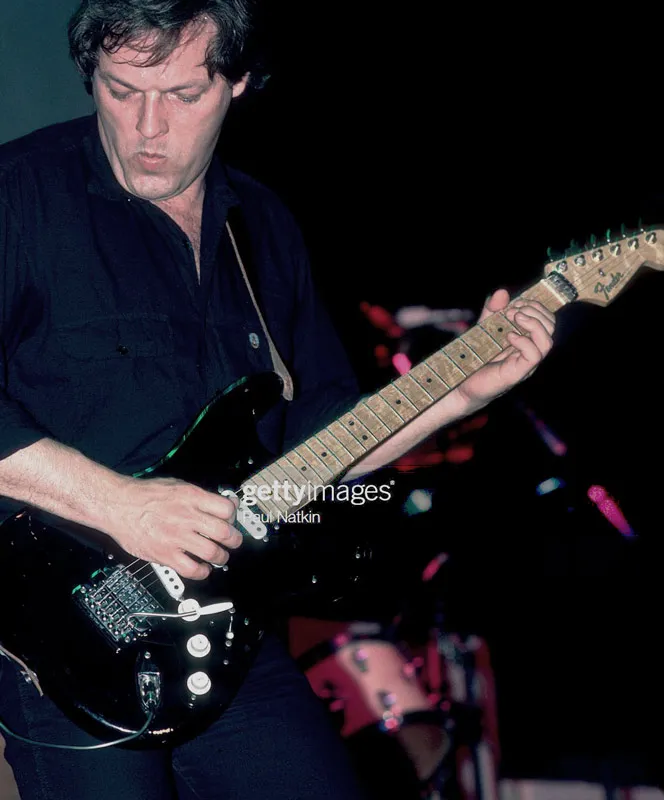
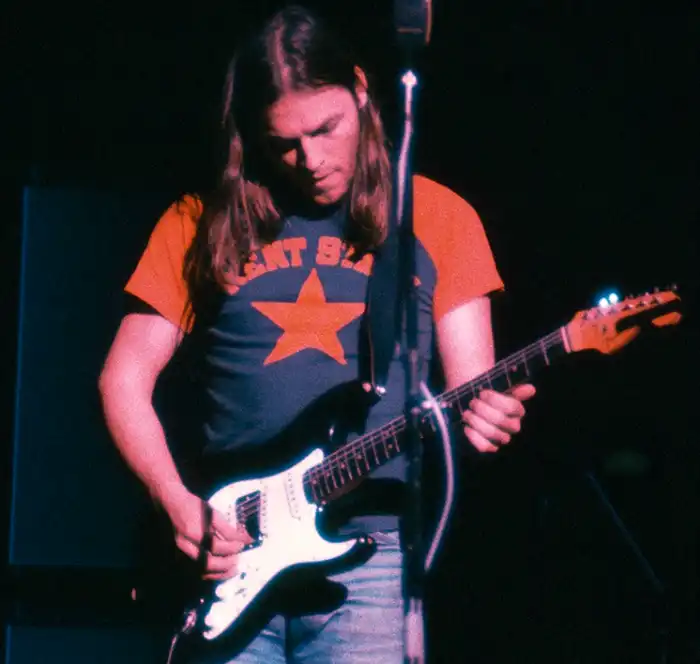
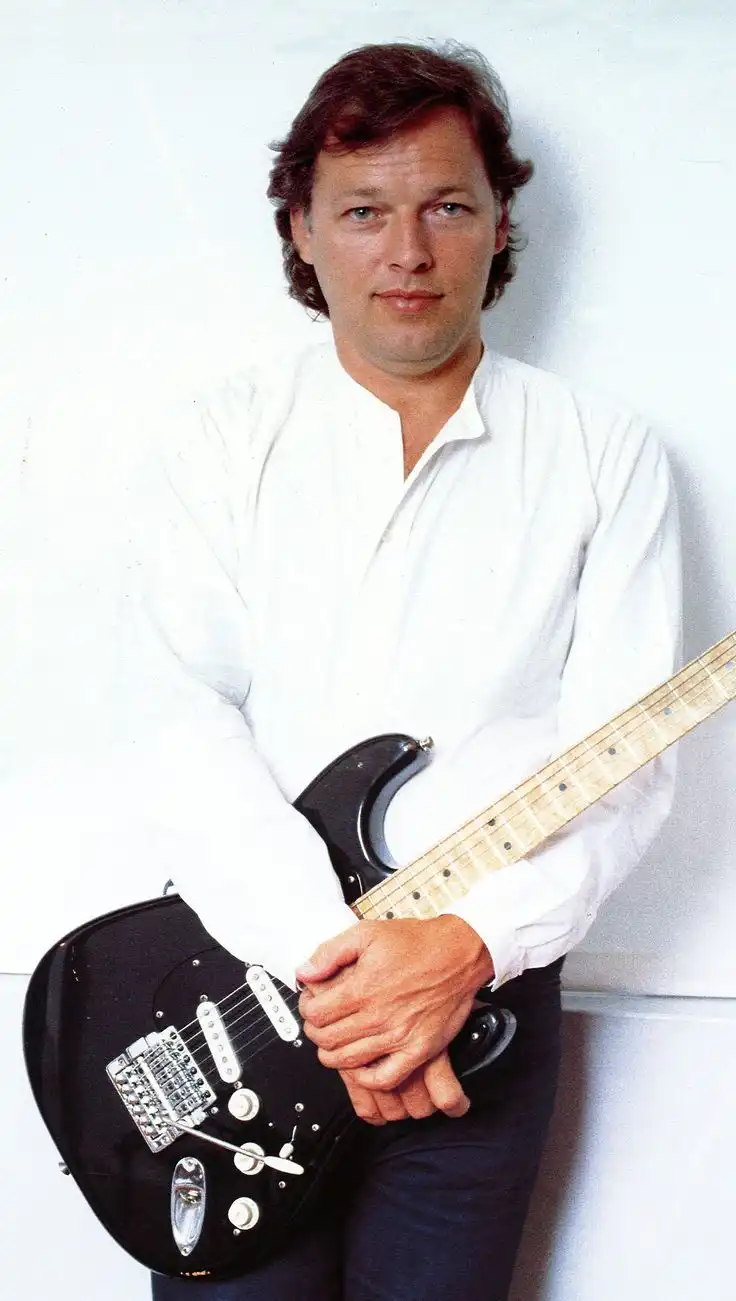
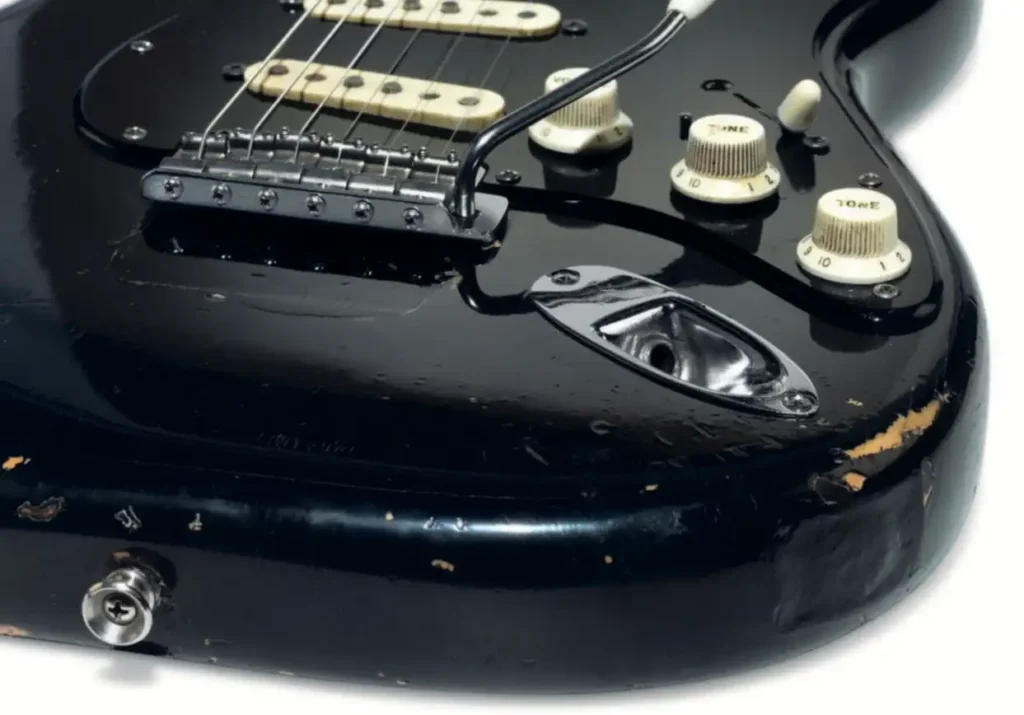
David Gilmour’s Black Strat was originally a 1969 black-over-sunburst Fender Stratocaster featuring a large headstock, maple neck, white pickguard, and white single-coil pickup covers. It was used during the recording of Pink Floyd: Live at Pompeii, as well as on numerous tracks from The Dark Side of the Moon, Wish You Were Here, Animals, The Wall, and Gilmour’s solo album On an Island.
Gilmour purchased the Black Strat in May 1970 to replace another black Fender Stratocaster with a rosewood fingerboard that he had acquired just six weeks earlier during Pink Floyd’s 1970 American tour. That guitar was stolen, along with the band’s other equipment.
Following the theft, David Gilmour went to Manny’s Music, owned by Manny Goldrich, on West 48th Street in New York City to purchase a replacement guitar. Since the black finish was no longer available, he chose a Fender Stratocaster with a black finish over sunburst and a maple neck.
The new guitar, which David Gilmour played publicly for the first time at the Bath Festival in June 1970, became almost as legendary as its owner.
On June 20, 2019, the Black Strat was sold at Christie’s, one of the world’s most famous auction houses, for $3.3 million, together with many of David Gilmour’s other instruments. The proceeds were donated to charity.
Over the years, photographs and video footage documented the Black Strat’s gradual transformation through numerous modifications.
Today, it stands as one of the most historically significant and heavily modified Stratocasters ever played.
The Evolution of the Black Strat
Neck Changes
In 1972, David Gilmour replaced the original Fender “F” tuners on the guitar’s neck with Kluson tuning machines.
He later replaced the original one-piece maple neck, which featured a CBS-era large headstock, with a pre-CBS neck featuring a small headstock and a rosewood fingerboard. The neck had been fitted to a 1963 sunburst Fender Stratocaster but originally came from a 1959 Fender Stratocaster.
The Black Strat, now fitted with a rosewood neck, first appeared at The Dome in Brighton in June 1972.
It was later replaced, ahead of the 1979 recording sessions for The Wall, with a custom Charvel bird’s-eye maple neck featuring a Fender logo and 21 frets.
In 1982, for the recording sessions of The Final Cut, he replaced this neck with a new 22-fret Charvel bird’s-eye maple neck, extending the instrument’s upper range by a semitone. The neck also featured a Fender logo.
In early 2003, the custom Charvel neck was replaced with a new ’57 Vintage Reissue maple neck bearing the “Original Contour Body” decal on the ball end of the headstock. Gilmour used the Black Strat in this configuration while recording several passages from The Dark Side of the Moon for Eagle Rock’s documentary The Making of The Dark Side of the Moon.
Prior to the recording sessions for On an Island, the Black Strat received its current 1983 neck from Gilmour’s ’57 Vintage Reissue known as the Cream Strat, which lacked the “Original Contour Body” decal.
Gilmourish further reports that between late 2003 and 2006, the Black Strat was fitted with different ’57 Reissue maple necks, identifiable by the presence or absence of the “Original Contour Body” decal.
Pickups and Electronics
David Gilmour made major modifications to the Black Strat’s electronics and pickups over the years. In 1973, for a very brief period, a Gibson PAF humbucker was installed between the bridge and middle pickups.
The guitar was later returned to its traditional three-single-coil configuration, with the bridge pickup first replaced by a DiMarzio FS-1 with a black cover, and later by a custom-wound Seymour Duncan SSL-1C.
In 1972, David Gilmour added an edge-mounted XLR socket to the Black Strat, as he later recalled: “At one point, I drilled a big hole to put one of those big XLR things on it because I wanted to have the sound coming out of the guitar, going out through a pedal board, coming back into the guitar, and going through a volume knob again. That didn’t last terribly long, so I made some paste out of sawdust and wood glue and filled it back in again.”
The repair work remains clearly visible on the guitar today.
In the same year, David Gilmour also installed a mini-switch on the pickguard to activate the neck-and-bridge pickup combination, with the aim of achieving a sound similar to that of a Fender Jazzmaster:
“There’s a sound on a Jazzmaster which you get by having your bridge pickup and your neck pickup on at the same time. Now, on a Strat because you’ve got a middle pickup, the switch doesn’t do that. So, I got a little piece of metal in a U-shape and glued it on to the underside and drilled a little hole and put a little switch in, and that switch switches on this pickup, which creates a sound a bit like the Jazzmaster. That was one of the experiments that I did that I still have.”
David Gilmour
During the “PAF period,” this switch was used to activate the Gibson PAF humbucker.
Finally, in 1985, David Gilmour replaced the original three-way selector switch with a five-way selector.
Hardware and Structural Modifications
Other significant modifications included the adoption of a thick custom beveled black pickguard in 1974 and, in 1984, a shortened (4.25”) tremolo arm to allow greater control while playing: “I just one day took a hacksaw to it and cut it off and stuck the plastic bit back on the end of it. It suits me—I’ve found it much more useful, and it’s helped to create a style, I guess.”
In 1983, David Gilmour replaced the original bridge with a Kahler tremolo system. Due to its dimensions, the body of the Black Strat had to be routed to accommodate the Kahler system. However, the modification proved less successful, as it altered the guitar’s tone.
As a result, in 1997, David Gilmour decided to revert to the original bridge and sent the guitar to Charlie Chandler for restoration. The cavity left by the Kahler tremolo system was then filled, as far as possible.
The David Gilmour Signature Stratocaster
In the autumn of 2006, Mike Eldred, then Director of the Fender Custom Shop, and Master Builder Todd Krause met Phil Taylor, David Gilmour’s longtime guitar technician and custodian of his instrument collection, in London to lay the foundations for a signature model based on the Black Strat.
Eldred oversaw the project at a managerial level, Krause was responsible for the technical build, and Taylor provided detailed measurements and specifications of the original instrument, which would serve as the basis for the first prototype.
Over the next two years, three additional prototypes were produced, and five different pickup configurations were tested and refined with David Gilmour’s involvement.
On the one hand, Phil Taylor insisted that the guitar be replicated in exact detail, a decision that directly affected the instrument’s final cost. On the other hand, Gilmour favored a more accessible instrument, despite its high price, while remaining particularly focused on accurately reproducing the pickups’ sound and the tremolo setup.
After at least two years of discussions and rejected prototypes, the Fender Custom Shop unveiled the David Gilmour Signature Stratocaster in the summer of 2008, following David Gilmour’s approval of the fifth and final prototype.
“They’ve done a fantastically good job to make it as good as I wanted it to be. We’ve worked quite hard on it, it’s taken a while for us to get every part of it dead right.”
David Gilmour
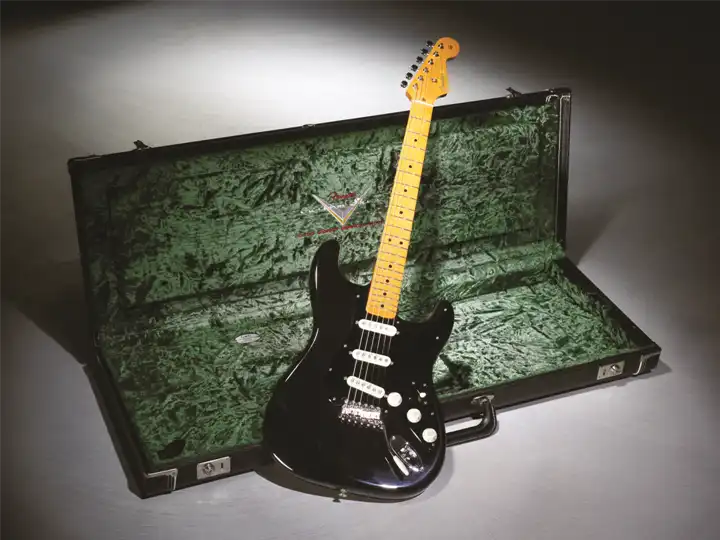
The guitar entered production and was released in September to coincide with the release of David Gilmour’s three-disc Live in Gdańsk CD/DVD set. It was available in two versions: Relic Black over Sunburst, with visual wear and distressing to the finish, aged parts, and no backplate, and NOS Black, which similarly replicates the guitar as it is now, but with new parts, an ‘as new’ paint finish, and a white plastic backplate.
However, a number of superficial inaccuracies remained compared to the original guitar, including the body contours. “The Relic version looks a lot like David’s guitar, but we didn’t do the maniacal level of detail you see on a Tribute, where we duplicate every microscopic scratch and ding,” said Mike Eldred.
David Gilmour was enthusiastic about the result: “I have some final prototypes of the two different versions, and they are brilliant. In my opinion, they are just as good as my Black Strat, if not better, and I would have no hesitation about using them on a gig. In fact, I used the NOS model when I did an Atom Heart Mother show recently.”
The maple neck of the Custom Shop “Black Strat” was based on David Gilmour’s 1983 ’57 Vintage Reissue neck, featuring 21 frets and a 7.25″ radius.
The guitar featured a Seymour Duncan SSL-5 at the bridge position, a Custom Wound Fat ’50s at the neck position, and a Custom Wound single-coil at the middle position (in the earliest versions, a Custom ’69).
The tremolo arm was shortened, and the thick black pickguard featured a switch that added the neck pickup in positions 1, 2, and 3.
The 0001 Stratocaster
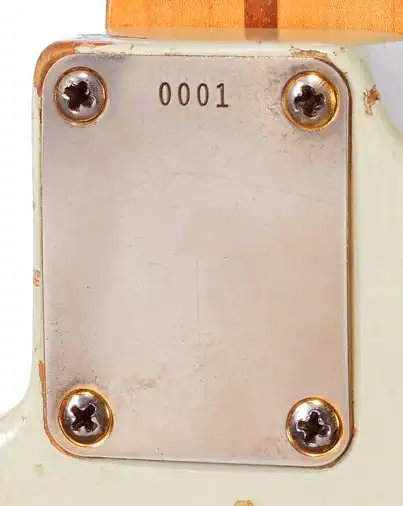
One of the most debated Fender guitars is the “White Strat” bearing the “0001” serial number, played by David Gilmour during the 50th Anniversary Stratocaster concert at Wembley Stadium on September 24, 2004.
The guitar apparently featured a Desert Sand-style finish, an anodized aluminum pickguard, and gold hardware.
It was also used in several live performances and on numerous recordings, including the rhythm guitar track for Another Brick in the Wall (Part 2), which was recorded by plugging the White Strat directly into the mixing console.
According to Karl Dallas of Melody Maker, David Gilmour purchased the guitar in 1978 directly from Phil Taylor, who was looking to buy a house. As Gilmour recalled in 1981: “Eventually Phil wanted to borrow some money to buy a house, so I blackmailed him! I said the only way I’d lend him the money to buy the house was if he sold me the white Strat.”
Despite its serial number, the guitar was not the first Stratocaster ever produced. It is widely believed to have been one of the pre-production Stratocasters selected by Leo Fender and distributed to musicians who helped promote the emerging Fender brand.
Around 1955, Stratocaster “0001” was reportedly given to Rex Gallion, a guitarist who had assisted Leo Fender during the development of the Stratocaster. According to Rex’s brother, Von Gallion, the guitar left the Gallion family after being traded to the Sousa Music store in Santa Maria.
In 1966, the White Strat came into the possession of Richard Hoxie Green, a young guitar student from Nipomo, California.
However, the guitar’s history remains shrouded in mystery.
Seymour Duncan has stated that there are two Stratocasters bearing the “0001” serial number. Before beginning his long career as a pickup maker, Duncan repaired guitars at Jensen’s Music in Santa Barbara.
In 1976, Richard Hoxie Green brought him a 1957 Stratocaster with an ash body and a neck plate stamped with the “0001” serial number for repair work, with the intention of refinishing it in a transparent finish similar to that of Bonnie Raitt’s guitar.
Duncan sent the neck to Phil Kubicki for refinishing, while the body was entrusted to his friend and colleague Wayne Charvel, an authorized Fender repair technician. However, because the body had scratches and dents too deep for a transparent finish, Charvel opted to replace it with a new body—a fairly common practice in the 1970s.
Seymour Duncan reassembled the guitar and returned it to Richard Hoxie Green. Sometime later, Green’s guitar was stolen.
Sometime later, while visiting Wayne Charvel’s workshop, Seymour Duncan recognized the original body and bought it back. The guitar was then reassembled with a ’57 neck and a set of pickups made by Duncan himself.
This Stratocaster also featured a neck plate stamped with the “0001” serial number. Duncan later stated that neither this neck plate nor the one fitted to Richard Green’s guitar was original.
Duncan later sold the guitar to Alan Rogan, Pete Townshend’s guitar technician, who in turn sold it to Phil Taylor.
A different account was provided by David Mead, who inspected the instrument and wrote about it in a 1995 article for Guitarist. According to Mead, the body was signed “Mary”—referring to Mary Lemus—and dated September 28, 1954, while the neck was dated June 1954 and bore the initials of Tadeo Gomez.
Mead also stated that the pickups appeared to be original 1954 Fender units. The finish, which resembled a faded Olympic White, displayed a blue-green hue, suggesting that the guitar may originally have been finished in Sonic Blue and had faded extensively over time.
Many collectors and enthusiasts consider Mead’s account more reliable and believe that Seymour Duncan may have mistaken the instrument for another Fender guitar he had previously dismantled and reassembled.
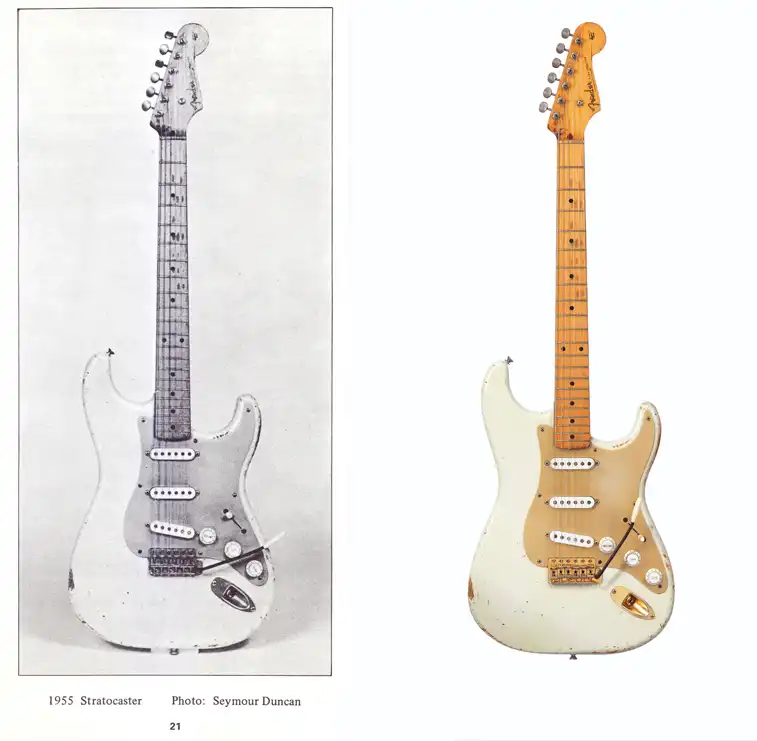
At this point, however, the mystery deepens further: the guitar also appears in The Fender Guitar, a book by Ken Achard published in 1977.
The publication includes several black-and-white photographs of pre-CBS Stratocasters, including one taken by Seymour Duncan of a guitar dated 1955. The instrument in the photograph appears to match David Gilmour’s Black Strat, raising the question of whether the discrepancy stems from a printing error or from an incorrect dating of the instrument.
Fender never produced an official replica of the “0001” Stratocaster. As Fender CEO Andy Mooney recalled: “My holy grail was the David Gilmour Strat. “I tried to convince David for many years to at least give me access to it so we could do some Custom Shop replicas, but he was never willing to do it.”
Nevertheless, in 2013, former Fender Custom Shop Master Builder Fred Stuart—who had left the Custom Shop in 2001—built a replica of the White Strat. The guitar was later sold for $93,750 at Christie’s in New York on June 20, 2019 (Lot 21), immediately after the original “0001” Stratocaster (Lot 20), which sold for $1,815,000 during the David Gilmour guitar auction that also included the Black Strat.
Even Andy Mooney attempted—unsuccessfully—to acquire the “0001” Stratocaster when it came up for auction at Christie’s. “I bid on it, actually,” Andy Mooney said. “I played it at Christie’s when they put it on a roadshow along with his black Strat. So at least I got to touch it and play it, but sadly that one will never make it into the collection.”
David Gilmour’s Red Strat
The Vintage Series Shift: How the Red Strat Became Gilmour’s Main Guitar
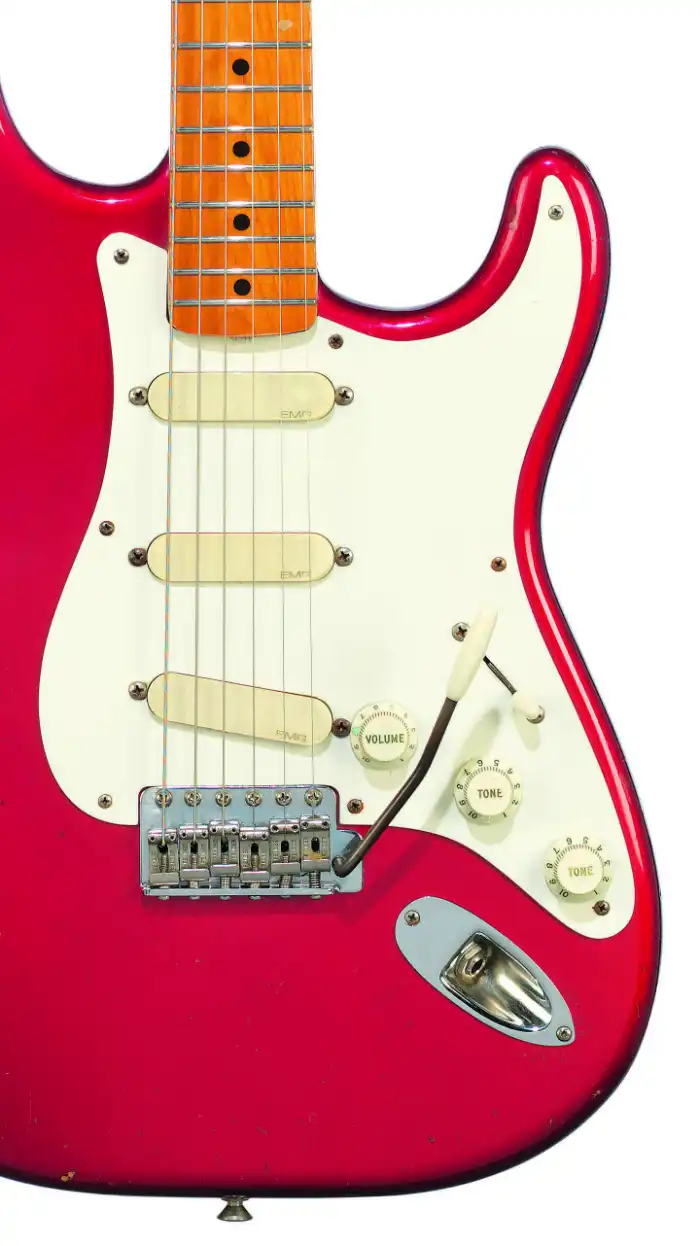
For many fans, David Gilmour’s Candy Apple Red 1957 Vintage Reissue Stratocaster, serial number V013327, stands alongside the Black Strat as one of the most iconic guitars of his career.
If the Black Strat came to define the classic Pink Floyd years, the red Strat became the visual and sonic signature of the post-Waters era. Over time, it replaced the Black Strat as Gilmour’s principal studio guitar for nearly two decades, becoming inseparable from the sound and image of the Gilmour-led Pink Floyd years.
Acquired from the CBS Fender UK warehouse in Enfield, Middlesex, in early 1984, the Candy Apple Red Stratocaster, or Red #1 as Gilmour refers to it, appears to have been part of a second batch of instruments personally selected by David Gilmour from Fender’s newly introduced Vintage Series.
Earlier that year, Gilmour and his longtime guitar technician Phil Taylor visited the Fender warehouse in Enfield, where they spent time trying a selection of newly arrived reissue models shipped from Fender’s Fullerton factory in California. During that visit, Gilmour selected a first group of guitars from the new range, including a 1957 Vintage Reissue Stratocaster in Vintage White—later known as Cream #1—a 1962 Vintage Reissue Stratocaster in Fiesta Red, a 1952 Vintage Reissue Telecaster, and a Stratocaster Elite.
The impression these guitars made was immediate. Gilmour was especially taken by the sound and feel of Fender’s new reissues, to the point that they briefly surpassed the Black Strat as his guitars of choice. For a period, the Black Strat—so central to his work throughout the 1970s—took a back seat while the Vintage Series instruments became his preferred tools both in the studio and on stage.
Gilmour himself later confirmed this in a 1985 interview with John Stix for Guitar for the Practicing Musician, stating: “The new Fender Vintage Series guitar I bought is probably as good as any Fender I own, old or new.”
It was remarkable praise from a player with access to some of the finest vintage Fenders in the world—and an early indication of just how important the red Stratocaster would become in the years that followed.
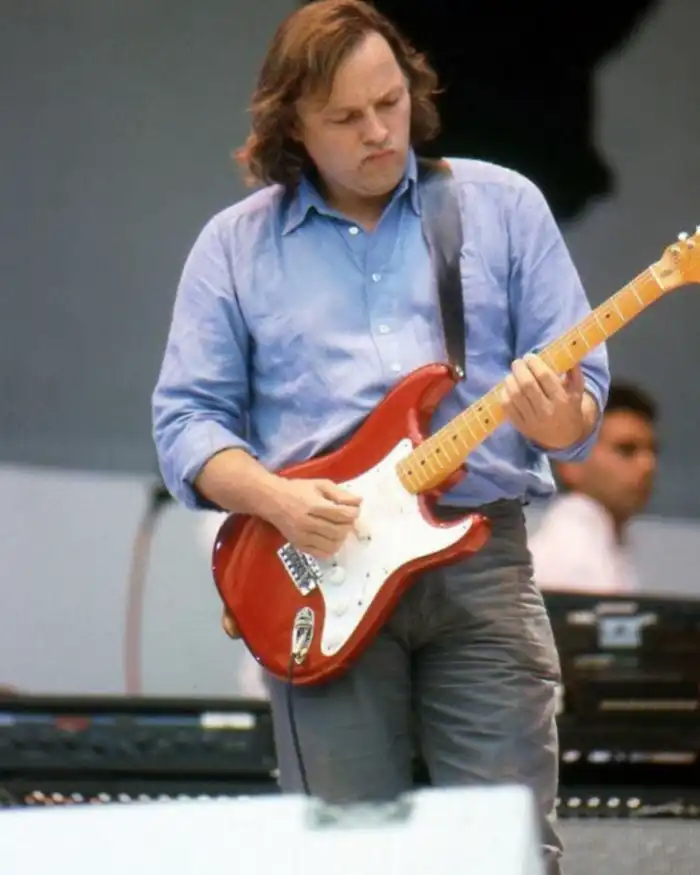
Used in hundreds of performances and documented in countless photographs and live recordings, the Red Strat became one of David Gilmour’s most closely associated instruments. For many fans, it remains his most instantly recognizable guitar. With its distinctive voice, it shaped some of Gilmour’s most memorable performances and became a defining part of his sound.
Gilmour held the Red Strat in such high regard that he chose it for the Fender Stratocaster’s 50th anniversary celebration at London’s Wembley Arena on 24 September 2004. Appearing alongside an exceptional lineup of guitarists gathered to honor the legacy of the Stratocaster, he performed that evening using both the Red Strat and his 0001 Stratocaster.
From Noise to Control: The EMG Modification of Red #1
As with the Black Strat, Red #1 underwent a series of significant modifications over time, gradually evolving into a highly personalized instrument shaped by Gilmour’s changing tonal and performance needs.
Beyond the addition of a custom shortened 4.25” tremolo arm, the most significant modification was the replacement of the original Fender single coils with EMG SA pickups, which used a single AlNiCo 5 bar magnet and featured active, low-impedance circuitry and internal shielding. The system was powered by a 9V battery installed in the rear cavity of the Red Strat, positioned alongside the tremolo spring assembly.
Traditional passive single coils, combined with long cable runs, were prone to picking up radio frequency interference and hum, particularly in increasingly complex live environments dominated by large lighting rigs and dimmer systems. Even studio settings were not free from similar issues at times.
As Gilmour explained: “It was always tricky when you have the sort of setup that we had, with a vast amount of lighting and dimmers. Our guitar technicians were constantly struggling to stop buzzes and when you use effect pedals, they tend to amplify all the bad noises. Through the ’70s, the battle to not have loud hums and buzzes coming out of your amps was constant; it was a nightmare, and these pickups made by EMG in this guitar prevented that. Their low impedance electronic pickups didn’t pick up hums and buzzes and it made life so much easier on tour.”
Gilmour also noted that active pickups offered the added benefit of delivering a strong, stable signal across large pedalboards and amplifier chains.
The EMG SA pickups were broadly reminiscent of early Fender single coils, especially those from the 1960s, while offering a slightly more forward midrange and a subtle increase in compression driven by their higher output.
Although EMG recommended positioning the pickups relatively close to the strings, Gilmour preferred to set them lower to retain a response closer to that of traditional passive Stratocaster pickups. During the Sydney dates in February 1988, guitar technician Greg Fryer deepened the pickup cavities of the Red Strat so the EMGs could be lowered even further, bringing the guitar’s tone closer to that of Gilmour’s vintage Stratocasters.
Gilmour also fitted EMG active tone-shaping circuitry, including the SPC control, which boosted lower midrange frequencies around 400–500 Hz, and the EXG control, which enhanced both bass and treble frequencies.
As he further explained: “They also have tonal circuitry which can boost the thickness of the guitar’s sound. When you’re playing solos, the high notes can sometimes get a bit thin on a regular Strat, and this guitar had a solution for that, and it became my go-to guitar for quite a while. This guitar has served me very well.”
Gilmour tended to keep the EXG control at low settings or switched off entirely, while the SPC was used more selectively—often in a moderate range for lead work—helping the guitar cut through the mix and sustain more effectively. For clean tones and lighter overdrive, the controls were generally left off or used only subtly.
The Early Public Appearances of Red #1
Red #1 first appeared in its original state in promotional photographs for Gilmour’s second solo album, About Face, released in March 1984, although it was the Vintage White Stratocaster known as Cream #1 that served as his primary instrument for the supporting tour.
The upgraded Red Strat made its first major stage appearance at the now-legendary Live Aid concert at Wembley Stadium in London on 13 July 1985, when Gilmour joined Bryan Ferry’s band for a short set that included Sensation, Boys and Girls, Slave to Love, and a cover of John Lennon’s Jealous Guy. Live footage of the performance captures a striking moment in which Red #1 effectively steps into the spotlight, moving from backup instrument to primary guitar after Gilmour’s sunburst ’57 Vintage Reissue Stratocaster failed during the first song.