Signature and Iconic Strats
The Eric Johnson Stratocaster
AND THE VIRGINIA STRATOCASTER

Table of Contents
ToggleThe Eric Johnson Signature Stratocaster
The Development of the Fender Eric Johnson Strat
The Eric Johnson Stratocaster is widely regarded as a milestone in Fender’s history. The extensive research and development behind this signature model led to meaningful improvements across the company’s broader Stratocaster production.
Fender had approached Eric Johnson several times about creating a Stratocaster bearing his name, but he consistently declined. That changed when he became aware of Michael Frank-Braun, Fender’s Principal Engineer and Custom Shop Designer. Frank-Braun had been working at the Corona factory since 1997 and had contributed to numerous signature projects, including those for Jimmie Vaughan, Marcus Miller, and Bonnie Raitt.
Eric Johnson greatly admired Michael Frank-Braun, noting his ability to capture the essence of vintage guitars while integrating forward-looking refinements. For his part, Frank-Braun appreciated working with Johnson, particularly for the guitarist’s relentless pursuit of the “perfect tone,” a mindset he likened to that of many classic German musicians.
Eric Johnson and Michael Frank-Braun began collaborating in 2003, developing a series of ideas.
Johnson was looking for a light, highly resonant instrument with an appealing “vibe” and effortless playability.

Specifications Overview

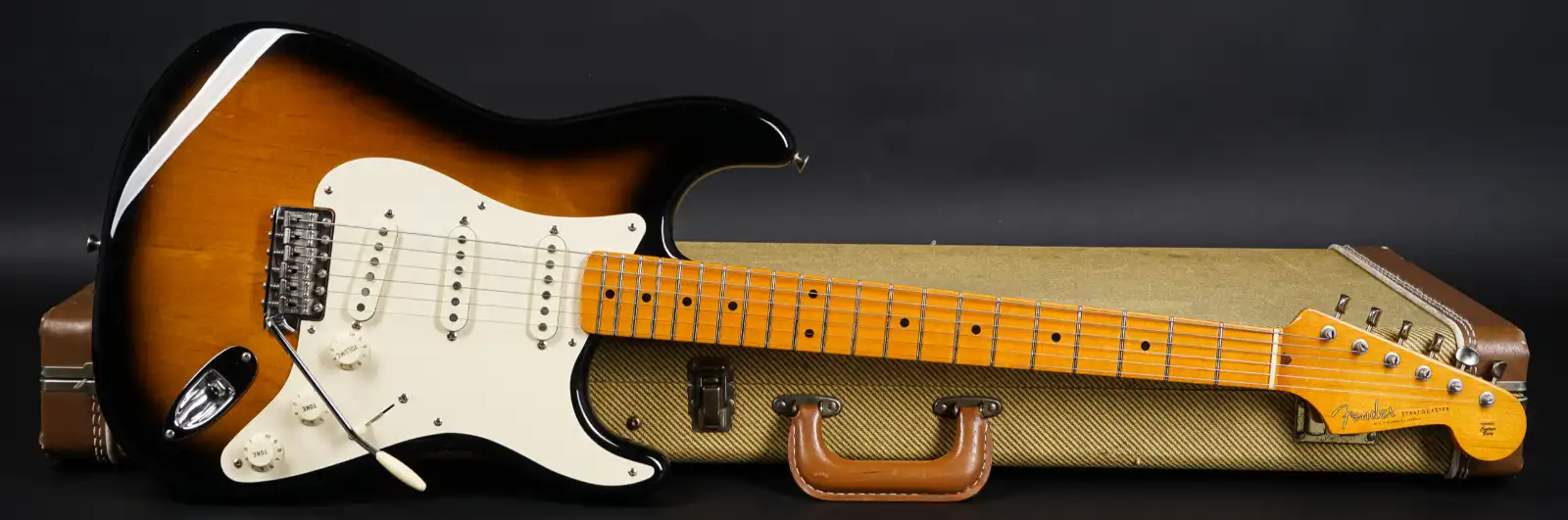
The starting point for the development of the Fender Eric Johnson Stratocaster was one of Eric Johnson’s own ’57 Stratocasters. “They used my favorite Stratocaster,” Eric told Neville Marten in a 2008 interview for Music Radar. “It’s a 1957 sunburst with a maple neck that I found in Florida while I was on tour several years ago.”
Despite his appreciation for rosewood fingerboards, Eric Johnson ultimately requested a nitro-finished, tinted quartersawn maple neck for its superior vibration transfer. It was fitted with 21 medium-jumbo frets and a modern 12-inch fingerboard radius—“flat enough that you can lower the action and bend the strings without them ‘fretting out’,” as Johnson recalled.
Together with Fender’s R&D engineers, Eric developed a custom ’57-style soft “V” that gradually transitioned into a wider “C” shape by the 12th fret.
“Again, this is taken from my favorite ‘57 Strat,” said Eric. Like so many Fenders these days, it’s almost a work of art, its fingerboard’s edges having received the ‘rolling’ treatment that leaves it feeling smooth as silk, and its slightly larger frets perfectly set, dressed and polished.”
The body was specified as lightweight, two-piece alder—“because that’s what they used in the ’50s,” as Johnson noted, a claim some might dispute—and contributed to the tonal character he was seeking. In line with his preferences, it was deeply contoured and finished in a thin nitrocellulose lacquer.
The back plate was omitted from the Eric Johnson signature model, as Eric was firmly convinced that this configuration brought the instrument closer to its ideal tonal character: “Actually, the backplates are removed from all my guitars because I think they sound better with them off.”
The headstock featured a bone nut—the first time FMIC had used this material for a factory Stratocaster—as well as the absence of both Johnson’s signature on the headstock.

Eric wanted a string-tree-free headstock because “string trees hinder a guitar’s ability to stay in tune,” he recalled, “but they’re necessary because of the headstock’s pitch—that is, the degree to which the headstock is tilted. We changed the pitch slightly, which, in combination with the [Gotoh] staggered tuning keys, allowed us to eliminate the trees. As a result, you can actually use the guitar’s vintage tremolo system a small amount without the guitar going out of tune.”
He also added: “It was my idea to stagger the tuners, then Michael Braun at Fender made it work by skimming the face of the peghead to increase string angle over the nut.”
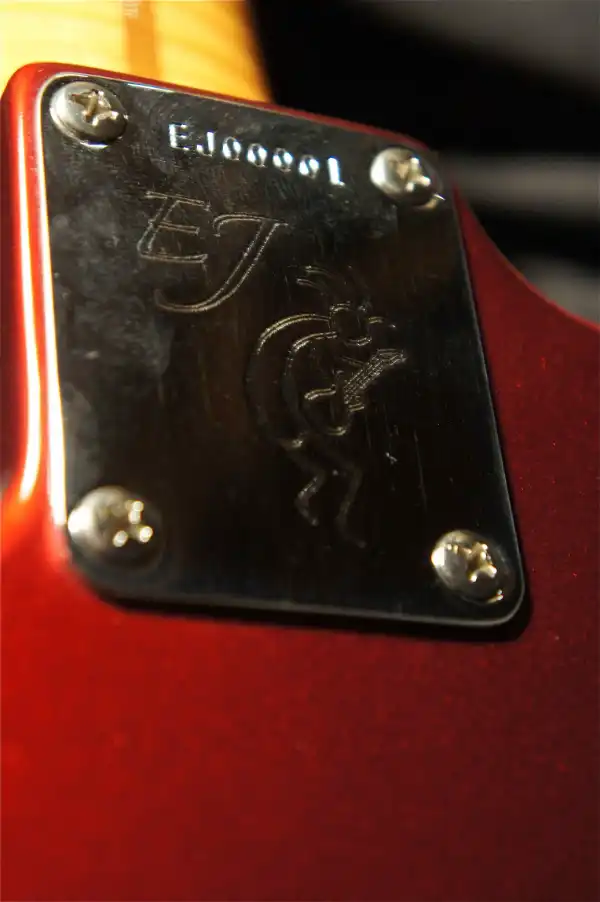
The neck plate featured an engraving of Kokopelli (a figure from Native American mythology often associated with music), along with the “EJ” initials and a serial number format that always began with “EJ” followed by five digits.


The Bridge
During Leo Fender’s era, the holes in the tremolo block where the strings were inserted featured two diameters: a larger upper section designed to accommodate the bullet-shaped string ends used at the time, and a narrower lower section for the string itself.
Over the years, string manufacturers gradually replaced bullet ends with more conventional rounded wraps. While bullet-end strings fit securely in the original tremolo design, the newer strings proved less stable. In response, Fender began modifying the block by drilling the string holes deeper, progressively removing more metal.
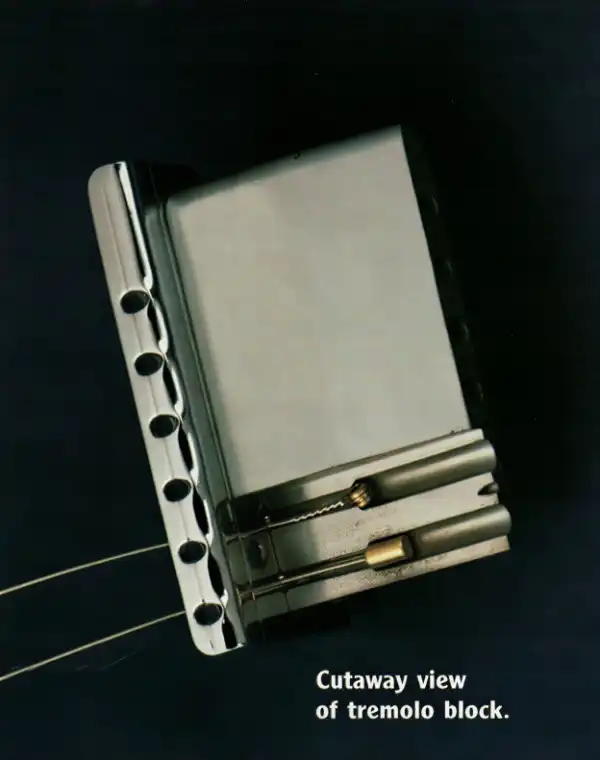
For his signature model, Eric Johnson requested a bridge equipped with a heavier tremolo block containing more mass, in keeping with the original characteristics of Leo Fender’s Synchronized Tremolo. “It really made a difference capturing some vintage tone,” he noted.
He did not even want the junction between the tremolo block and the base plate to be painted. In fact, when Fender launched the American Standard Stratocaster, the bridge block began to be powder-coated rather than painted. The junction between the base plate and the block was intended to remain uncoated; however, it is not entirely clear why—or how—the entire block was eventually powder-coated.
For his signature model, Eric Johnson chose to revert to a silver-painted finish on the entire block, while preserving direct metal-to-metal contact at the junction between the block and the base plate.
The bridge was fitted with the full five springs but not blocked up as with Eric Clapton’s guitar. “All my guitars are like that,” Eric said.
Inside the Eric Johnson Pickups
Rather than replicating a single vintage Stratocaster pickup set, Johnson and Frank-Braun sought to recreate the broader tonal character and dynamic response associated with the best late-1950s and early-1960s Fender pickups. Johnson also requested a bridge pickup that retained the sparkle and openness of vintage units while offering greater presence and articulation.
“I wanted them to sound like ’50s pickups, with the exception that the bridge was a bit brighter. These weren’t copied from my guitar, but Michael Braun and I sought out magnets and copper wire close to the 1950s specs.”
Eric Johnson
Starting from around 180 prototypes, Michael Frank-Braun progressively narrowed the field to 19 versions before arriving at the final design, which reproduced the tonal behavior of wound and plain strings with greater distinction.
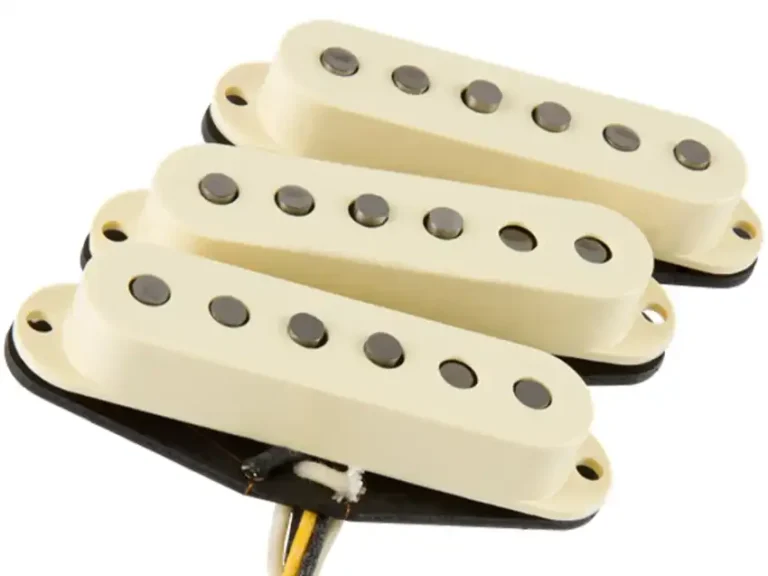
The Eric Johnson pickup set combined vintage-inspired construction with carefully calibrated voicing for each position.
The neck pickup was based on a 1954 Stratocaster unit and featured oversized AlNiCo 3 magnets, chosen for their smooth attack, clarity, and rounded high end.
The middle pickup drew inspiration from a 1963 Stratocaster pickup and employed specially treated AlNiCo 3 magnets. It was also reverse-wound and reverse-polarity (RWRP), which allowed hum cancellation at positions 2 and 4.
The bridge pickup used AlNiCo 5 magnets and was specially voiced to deliver a hotter output without sacrificing the sweet top-end sparkle and articulation associated with vintage Stratocasters.
All three pickups featured traditional fiber bobbins, cloth-covered wiring, and staggered pole pieces.
Through his research into vintage pickups, Frank-Braun found that although Leo Fender had specified AWG42 wire, the actual conductor diameter could vary slightly within manufacturing tolerances. He therefore selected copper wire from the German company Elektrisola, which offered several AWG42-class variants, allowing finer control over the resulting tonal response and helping him achieve the sound Eric Johnson was seeking.
Frank-Braun devoted considerable attention to insulation type and thickness, ultimately opting for Formvar wire insulation, applied as sparingly as possible, to preserve clarity and openness in the high end.
Johnson revised the wiring by moving the tone control from the middle pickup to the bridge pickup, while retaining a dedicated tone control for the neck pickup and leaving the middle pickup completely open.
Unlike many hotter modern Strat pickups, the EJ set was designed with relatively moderate output and a strong emphasis on dynamic response. Johnson was particularly sensitive to articulation and touch sensitivity, and wanted the pickups to respond differently to wound and plain strings, preserving note separation and clarity across the fretboard.
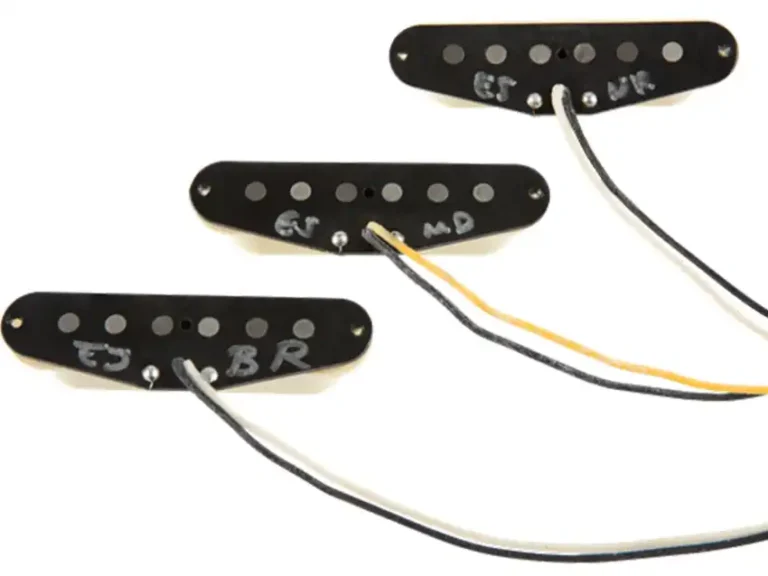
The pickups were typically hand-marked on the bottom flatwork with the inscription “EJ” followed by “NK,” “MD,” or “BR,” identifying the neck, middle, and bridge positions, respectively. These markings were generally applied with a white marker pen. More rarely, however, examples can be found with red markings or with no markings at all.
NECK
Magnet: AlNiCo 3
DC Resistance: 5.8-6 kΩ
Inductance: 2.5-2.7 H
Wires: Black and White
MIDDLE (RWRP)
Magnet: AlNiCo 3
DC Resistance: 6.3-6.5 kΩ
Inductance: 2.5-2.7 H
Wires: Black and Yellow
BRIDGE
Magnet: AlNiCo 5
DC Resistance: 6.7-6.9 kΩ
Inductance: 2.9-3.1 H
Wires: Black and White

From First Production to Later Refinements
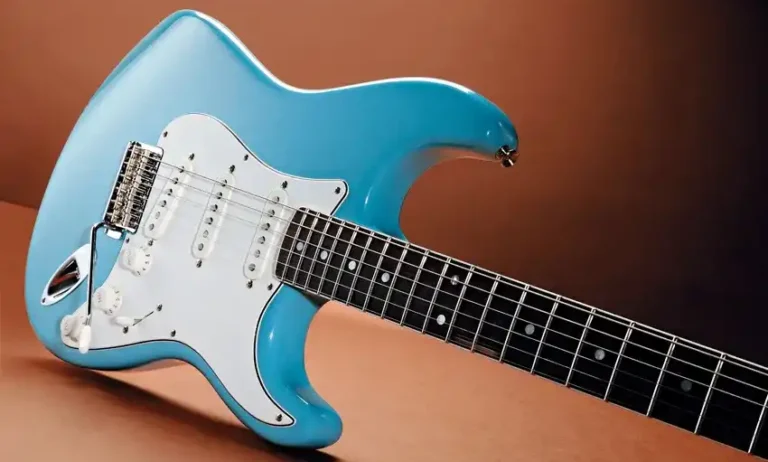
After two years of research and refinement, the Eric Johnson signature model was completed in 2005. One of the earliest production examples, bearing serial number EJ00001, holds a particularly significant place in the model’s initial development. Finished in Candy Apple Red and featuring a striking flame maple neck, the instrument was delivered to Eric Johnson for promotional photography.
It was used by Johnson in early promotional material and remained part of his working instruments for several years before eventually being sold.
Over time, Fender introduced a few incremental modifications. Beyond the available finishes, the number of tremolo springs was increased to five in 2010.
More significantly, in 2009, the catalog was expanded to include a version with a round-laminated bound rosewood fingerboard.
Advertisements
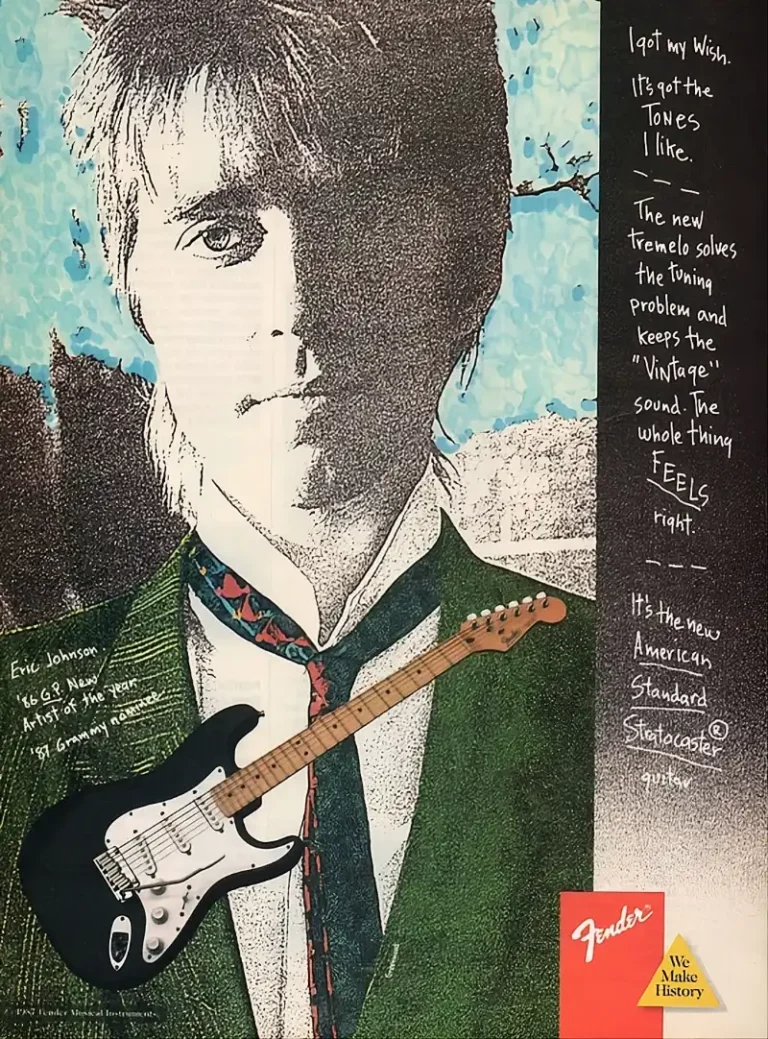
In 1987, Fender used Johnson in a promotional campaign for the newly redesigned American Standard Stratocaster, the model that represented Fender’s modernized U.S. production line under FMIC. One of the ads prominently featured Eric Johnson alongside a black American Standard Stratocaster and included a testimonial attributed to him:
“I got my wish. It’s got the tones I like. The new tremolo solves the tuning problem and keeps the vintage sound. The whole thing FEELS right. It’s the new American Standard Stratocaster guitar.”
The advertisement is particularly interesting in retrospect because many of the issues Johnson praised—or later criticized and refined—would eventually reappear during the development of his own signature Stratocaster nearly twenty years later. His obsession with tremolo stability, vintage tone, bridge construction, resonance, and feel became central aspects of the EJ Strat project.
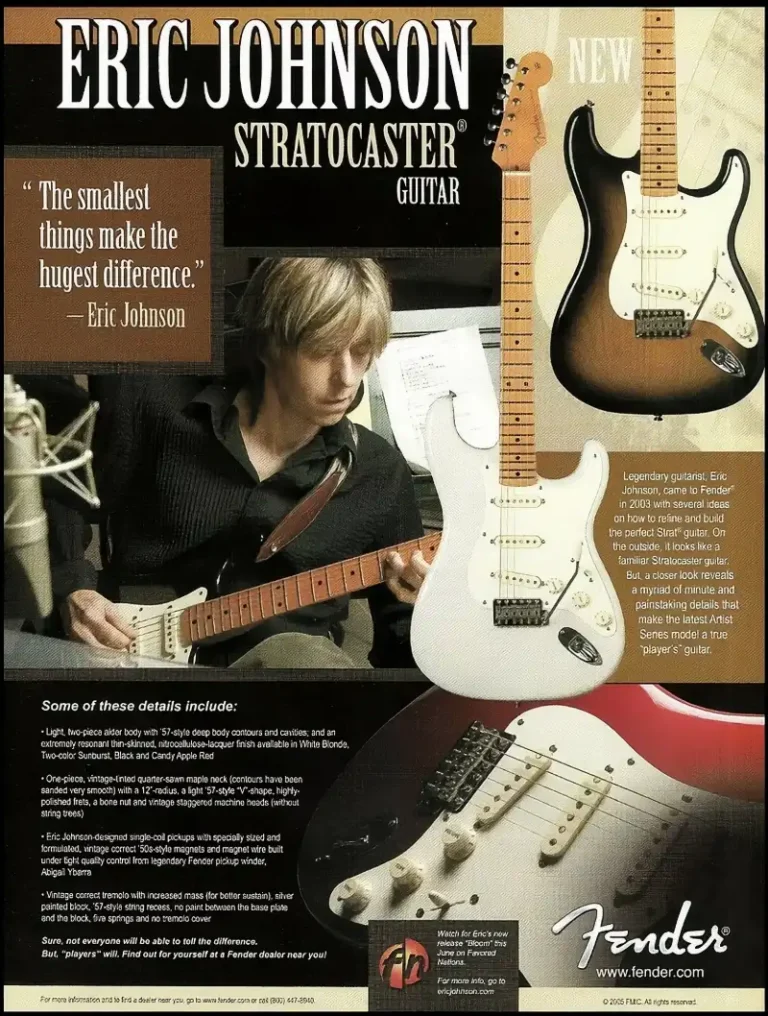
When Fender introduced the Fender Eric Johnson Stratocaster, the company faced a unique challenge. Eric Johnson was not simply another high-profile guitarist lending his name to a signature instrument; he had built a reputation as one of the most meticulous tone seekers in modern electric guitar history. Fender’s advertising campaigns for the model, therefore, focused less on celebrity endorsement and more on the obsessive level of detail behind the guitar’s development.
Two slogans in particular became closely associated with the launch of the instrument: “The Smallest Things Make the Hugest Difference” and “The Alchemy of the Sum of Its Parts.” Together, they encapsulated both Johnson’s philosophy and Fender’s broader marketing strategy for the model.
The first one directly reflected Johnson’s belief that even the smallest construction details could influence an instrument’s tone, feel, and resonance.
Rather than presenting the instrument as a conventional artist model, Fender positioned the Eric Johnson Stratocaster as the product of exhaustive vintage-oriented research and continuous refinement.
The slogan also aligned perfectly with Johnson’s public image at the time. Among guitar players, he had become almost legendary for his sensitivity to tonal nuance and for his conviction that seemingly insignificant modifications could dramatically affect an instrument’s response.
Fender successfully transformed this reputation into a central component of the model’s identity.
While the first campaign emphasized technical detail, “The Alchemy of the Sum of Its Parts” adopted a more conceptual and sophisticated tone. Fender used the phrase to suggest that the instrument’s character did not depend on one revolutionary feature, but rather on the interaction of numerous carefully calibrated elements.

The use of the word “alchemy” was particularly significant. It evoked the almost mystical vocabulary often associated with Johnson’s pursuit of tone and reinforced the idea that the guitar’s final character emerged from the complex interaction of many subtle factors.
One of the campaign’s underlying messages was that the Eric Johnson Stratocaster could not be reduced to a checklist of features. Its tonal identity resulted from the cumulative effect of countless small decisions, each contributing to the instrument’s final response and playing experience.

The Eric Johnson Stratocaster Thinline
In 2015, Eric Johnson approached Fender with the idea of adding an “F-hole” to his signature Stratocaster to capture some of the tonal character he associated with his preferred semi-hollow body guitars.
The guitar was Fender’s first custom-chambered semi-hollow Stratocaster to retain the instrument’s traditional arm and body contours.
After three years of development, the Eric Johnson Stratocaster Thinline was introduced in 2018. Throughout the development process, Eric worked closely with Fender as a co-designer, refining the model to meet his highly specific requirements.
After experimenting with several configurations, he ultimately settled on a lightweight semi-hollow alder body with a carved top and F-hole. “Well, we experimented with different types of wood and settled on alder,” Johnson recalled. “At first, we had a thin, solid piece that went from the neck pocket to behind the bridge. But we realized that was not enough ‘solid’; it was a bit too airy sounding. So, we continued the block back to the strap button like on a 335. It was better, but we were still losing a bit of mid punch, so at that point I just widened the block – we added about an inch of width, so it’s four to five inches wide and goes straight from the neck pocket to the strap button.”
Together with Fender’s R&D engineers, Eric developed a custom neck profile that resulted in a one-piece quartersawn maple neck with a custom “‘57 Soft V” shape, designed to soften the sharper edges typically associated with traditional V-profile necks.

The Virginia Stratocaster
In 2020, Fender unveiled a new series, the Stories Collection, to propose replicas of some instruments, modified to meet the needs of artists who had made music history.
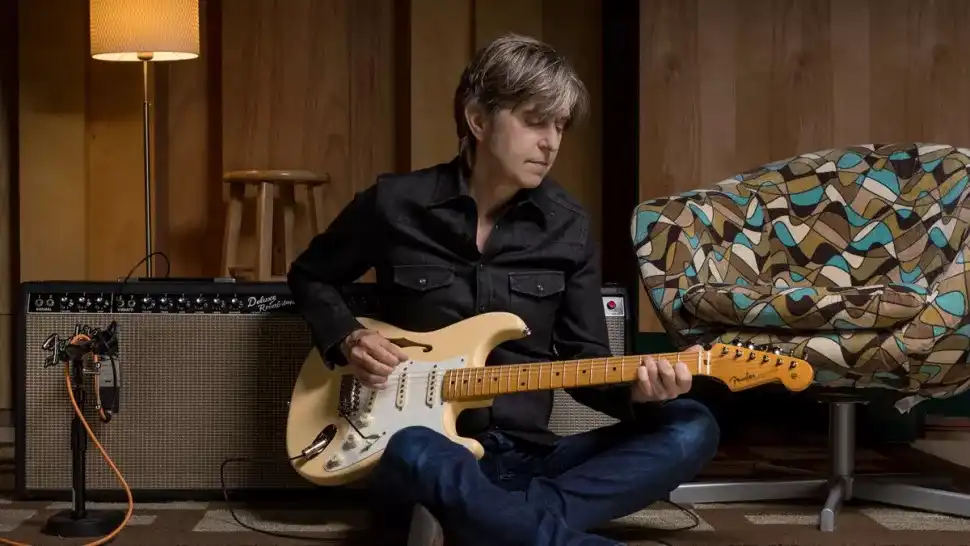
The guitar chosen to launch this series was the 1954 Stratocaster that Eric Johnson named “Virginia,” inspired by a piece of masking tape he found inside the instrument, beneath the pickguard. The tape bore the date and the name of the woman who had wound the pickups. “There was that piece of tape in there,” recalled Eric, and it said ‘Virginia, June’—I can’t remember—1954. And when I saw that, I went: ‘Ah, okay. I’ll just call it Virginia.’”
Eric Johnson bought this guitar when he was about 20. He was at J.R. Reed’s shop in Austin, Texas, to repair an amplifier speaker when his attention was drawn to a ’54 Stratocaster left in the corner without a case. It had been brought into the shop as a pickup did not work well. It was love at first sight.
Eric wanted to buy it and obtained the owner’s phone number. The owner initially seemed hesitant to sell it because it had been a gift from his grandfather, but eventually agreed to exchange it for a Gibson.
Johnson played the Virginia Stratocaster for many years. He used it on the recordings of Ah Via Musicom and Venus Isle, and regularly took it on tour. Unfortunately, one day Eric fell and broke the guitar. He attempted to repair it, but it seemed to have lost the sound he loved so much, and he eventually decided to put it up for sale.
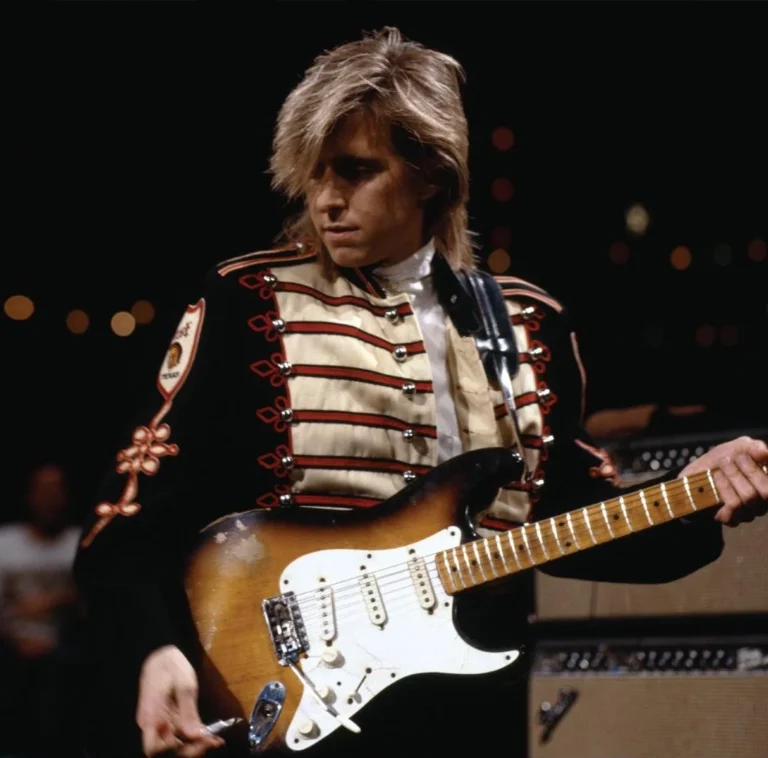
He tested many other ’54 Stratocasters to replace it, but he could not understand why none of them had that particular sound.
It was Master Builder Michael Stevens who suggested to him that the secret lay in its sassafras body. “Evidently, in ’53 and ’54 Leo got a little bit of sassafras, and he built some Teles and Strats with it,” Eric recalled.
This Stratocaster had undergone many modifications and was therefore quite different from a stock ’54 model.
The fingerboard had been flattened and fitted with larger frets by Austin-based luthier Zack Barry, who regularly repaired guitars for Eric.
To achieve a more balanced response on the treble E string, Johnson first replaced the original saddle with a die-cast unit from the 1970s, which resulted in an overly sharp tone, and ultimately settled on a Graph Tech “block saddle.”
He replaced the middle and neck pickups with late-’50s Fender units featuring AlNiCo 5 pole pieces, and the bridge pickup with a DiMarzio HS-2. However, he disconnected the lower coil and used a 500k volume pot to restore some high-frequency response. While the two Fender single-coil pickups shared the same polarity, the DiMarzio had reverse polarity, resulting in a “subtle” sound in the middle/bridge position, which the guitarist preferred. He therefore decided not to make further modifications to the electronics.
Eric Johnson replaced the circular string tree with a late-’50s butterfly-style version fitted with a nylon spacer.
In conclusion, for Eric, many small details—even the smallest and seemingly insignificant ones—contributed to the guitar’s overall sound, and for this reason, he continued to refine his 1954 Stratocaster.
When Fender contacted him about making a replica, he was very enthusiastic: “Wow, could we possibly make a replica of one of my favorite guitars I’ve ever owned?” was his immediate reaction.
He was very enthusiastic about the idea: “This is awesome, because I was able to get a brand-new guitar that has a lot of the soul and magic that my original Virginia had.”
Fender produced two versions of the model: one from the standard production line and one from the Custom Shop, the latter built under the supervision of Master Builder Alex Perez.
The Fender Custom Shop Eric Johnson Virginia Stratocaster differed from the regular Fender Stories Collection Eric Johnson 1954 Virginia Stratocaster mainly in its electronics and hardware specifications.
The Custom Shop version featured hand-wound EJ Virginia single-coil pickups in the neck and middle positions, while both models retained a DiMarzio HS-2 in the bridge position. It also used various electronic components, including a 390–450k volume potentiometer and 250k 10% taper split tone potentiometers.
Another notable feature of the Custom Shop model was its figured maple neck. In both versions, the saddles were vintage-style, with the exception of the treble E saddle: the Custom Shop version used a Graph Tech String Saver saddle, while the factory model featured a standard block-style saddle similar to those on American Standard models.
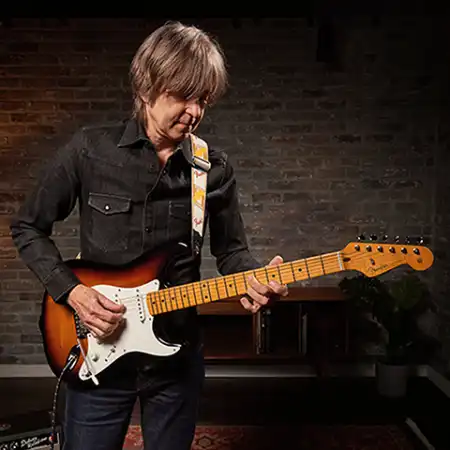
“Wow, it’s got this tone I’ve been looking for, like my original one.
The neck on these US production models is strikingly similar to every single ’54 I’ve ever played. And that was by design and by purpose. It’s a little thicker than some Strat necks, but not super wide. It’s wide enough to be comfortable. It’s easier to get around. And I particularly like this kind of neck; it’s really my favorite neck.”Eric Johnson
