Fender Japan Part #3
Domestic Models and Series Overview (1984 Onward)
DECODING MIJ STRATOCASTER MODEL CODES
Table of Contents
ToggleDomestic Stratocasters and Series Overview
To protect Fender’s reputation without oversaturating the market, the company limited Japanese export reissues between 1982 and 1984 to Squier-branded models. This marked the acclaimed JV and SQ era, which ended in 1984.
From then on, Fender Japan continued shipping Stratocasters overseas, now marked with a new serial number system—beginning with the “E series,” followed by the “A,” “B,” and “C” series, and eventually expanding further.
These instruments proved crucial to Fender’s survival during a turbulent period, especially after the closure of the Fullerton factory.
The lineup was divided into Standard and Contemporary models—offered under both Fender and Squier brands—and a series of faithful Reissues, which would later earn the name “Collectables” (or “Collectibles”) in 1992.
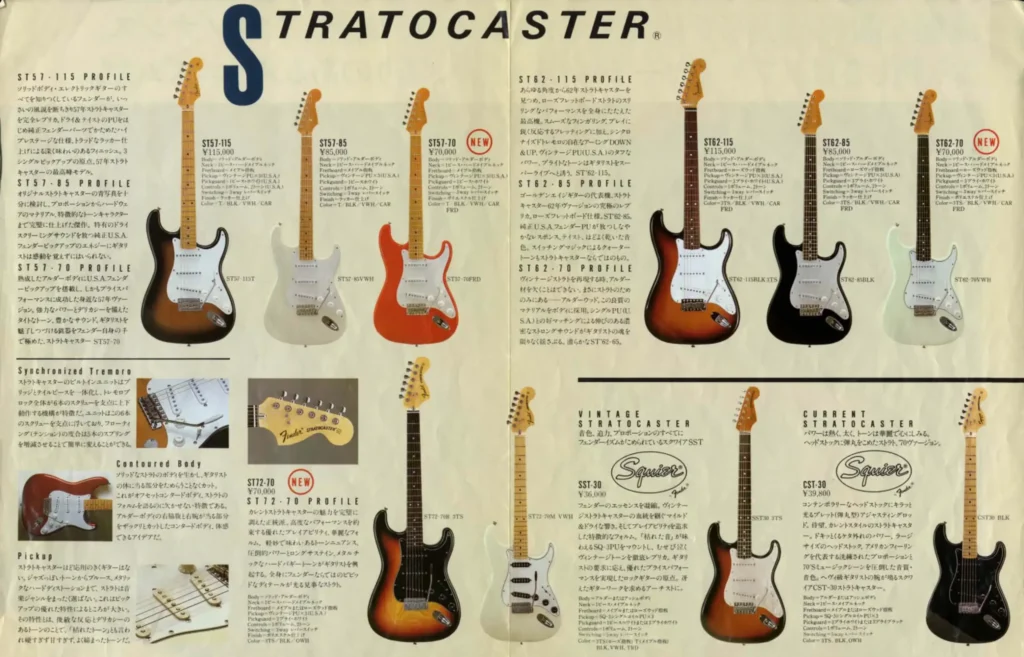
It soon became clear that after the JV and SQ series, Fender kept its best guitars for the domestic market, exporting only the lower-tier models to avoid competing with itself. In Japan, the ST, SST, and CST Stratocasters continued to come off the production lines—carefully crafted and marked with serial numbers different from the JV series—and were intended solely for Japanese players.
Initially, there was little difference in quality between the Japanese reissues and their American counterparts. In fact, high-end JVs are often considered superior to U.S.-made Stratocasters of the same era. However, over time, export models from Japan started to change. Adjustments to tonewoods, pickups, and electronics gradually caused a noticeable decline in quality.
Meanwhile, by 1987, the Squier brand had expanded beyond Japan, with production moving to Korea, India, China, Indonesia, Mexico, and even briefly back to the United States. However, this global growth came with a cost: as quality declined, interest in these once-popular guitars began to fade.
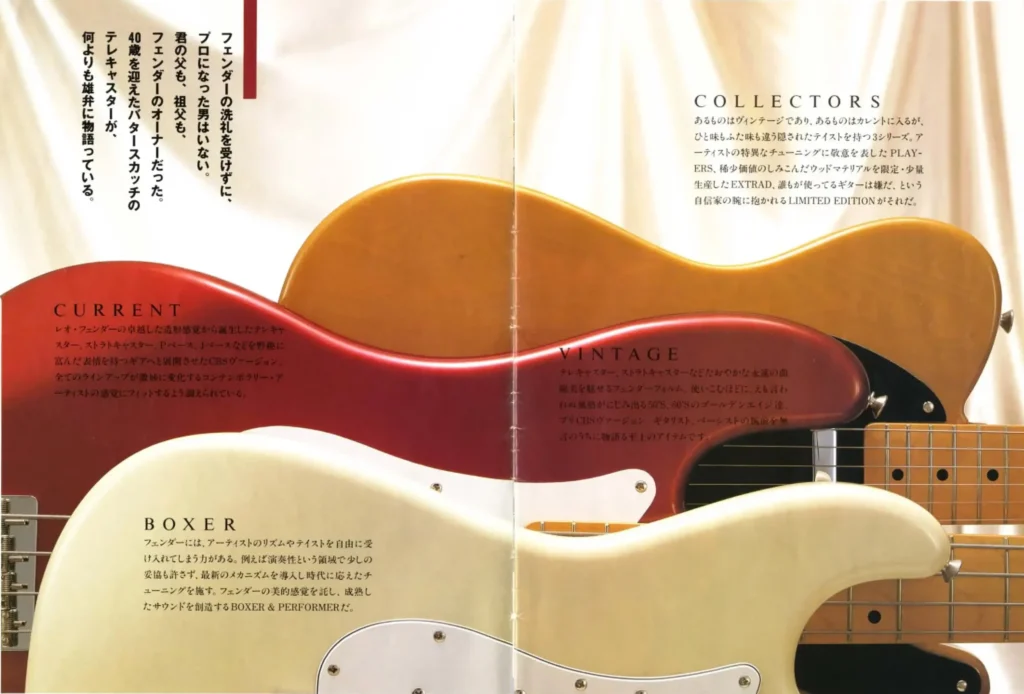
In 1985, the Made in Japan (MIJ) domestic Stratocaster lineup was divided into the Fender Vintage Series, Current Series, Collectors Series, and Boxer Series.
Many of these domestic Stratocasters—often with specifications that differed significantly from export models—have since reached Europe and the USA through the second-hand market, making it difficult to distinguish them from models originally intended for export.
The Vintage Series initially comprised reissues of the 1954, 1957, 1962, and 1972 Stratocasters. A wide range of models was produced: some were outfitted with U.S.-made pickups and electronics, carefully selected woods, and lacquer finishes, while others were more affordable, featuring Japanese electronics, ceramic pickups, and polyester finishes. In the spring of 1987, all of the 1970s-style reissue models that had previously been part of the Vintage Series were combined into a single lineup called the Current Series. A typical Current Series model featured a large headstock with a CBS logo, a bullet truss rod, and a three-bolt neck plate with Micro-Tilt adjustment. These Current Series Stratocasters should not be confused with the CST models of the 1983 Squier-branded Current Series.
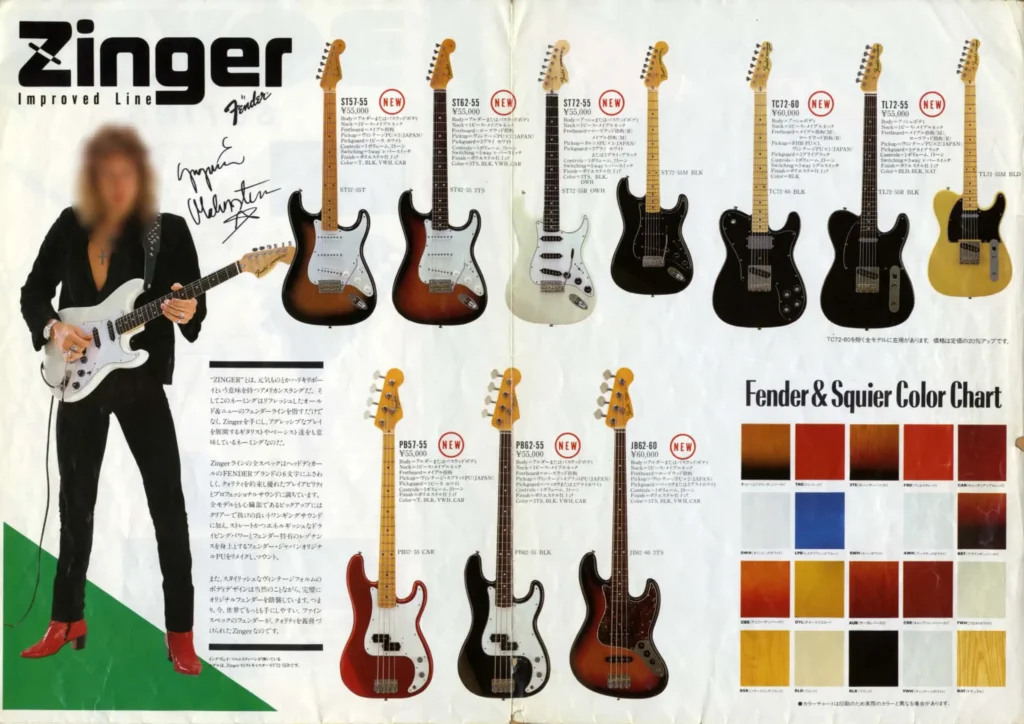
In 1984, the entry-level Zinger Series was introduced, offering guitars at a lower price point, including models such as the ST57-55, ST62-55, and ST72-55. The “Zinger Series” name soon disappeared, as the models were absorbed into the Fender Current Series.
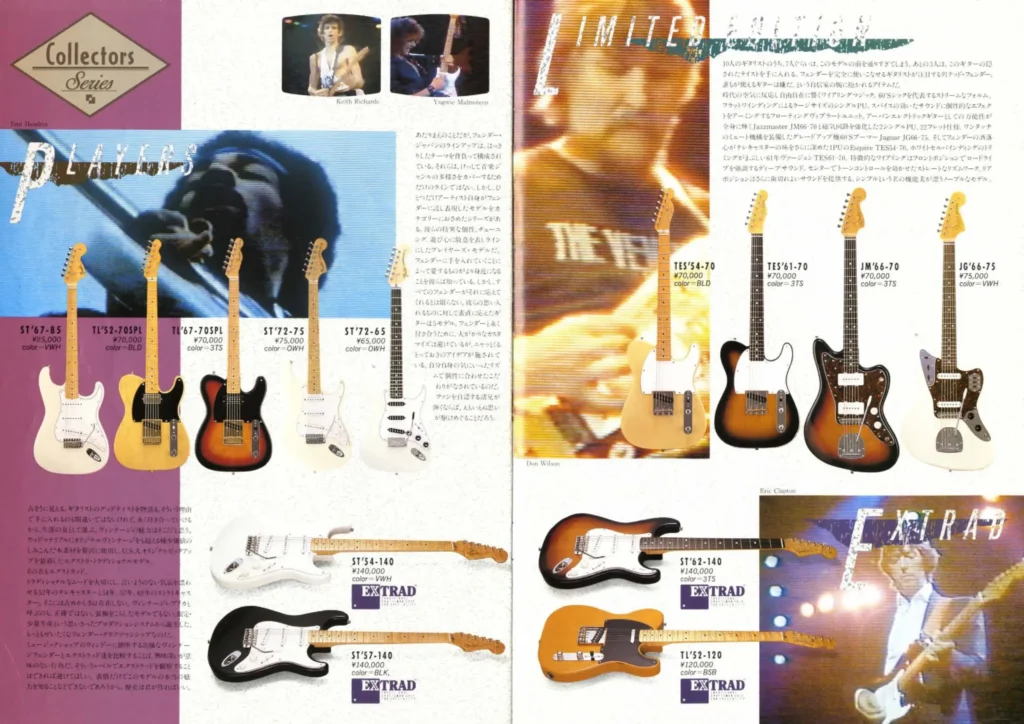
The Collectors Series, developed separately from the regular lineup from around 1985, offered more specialized instruments. By 1986, it included Players models, inspired by the Stratocasters of famous musicians—for example, the ST72-65 with a rosewood scalloped fingerboard, reportedly released at the request of Yngwie Malmsteen; ExTrad models (see next chapter), a luxury line representing the pinnacle of Japanese lutherie; and Limited Edition guitars, such as the 12-string STXII or the Paisley Stratocaster.
A Guide to Domestic Stratocaster Model Codes
One of the first things that catches the eye of anyone browsing the Japanese Fender “Twang” catalog is the sheer number of often confusing acronyms used to identify the instruments. The code for Stratocasters was “ST.” For the Vintage and Current Series, “ST” was followed by two numbers indicating the year the model reissued. Additional numbers were used to denote the retail price, which was also displayed on a blue circular sticker. Other letters indicated specific features, such as LS (Lace Sensor), US (U.S. Vintage Pickups), TX (Texas Special), RV (Real Vintage), VSP (Vintage Special Project), DMC (DiMarzio Collection), G (Gold Hardware), B (Bound Fretboard), L or LH (Left-Handed), M (Medium Scale), and SC (Scalloped), to name just a few.
However, it is important to note that Fender Japan was never entirely consistent, and not every guitar that rolled off the assembly line matched the specifications listed in the catalog.
Neck heel and neck pocket stamps
A common question concerns the meaning of the letters and numbers stamped on the neck heel and neck pocket of MIJ and CIJ Fender instruments. These markings are internal Fujigen or Dyna codes.
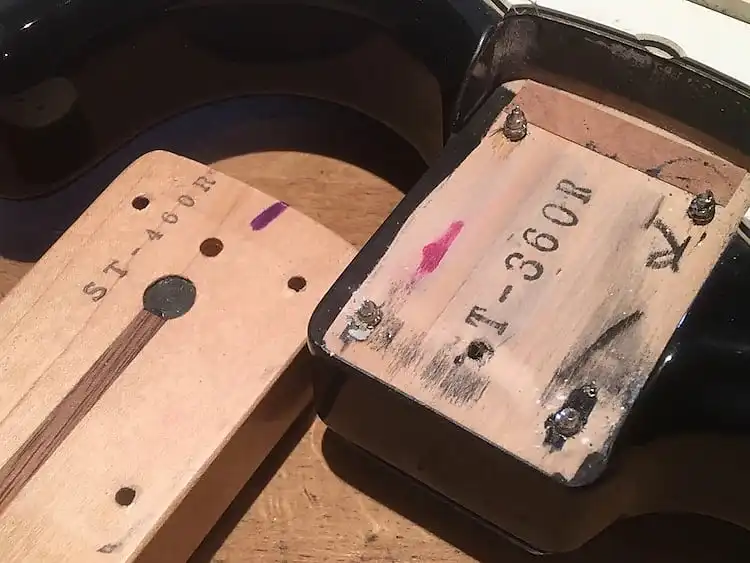
To streamline production, a complex coding system was developed, enabling the manufacture of many different models with interchangeable necks and bodies as needed.
By using this system, determining which neck or body could be used across multiple models saved time, reduced costs, and minimized confusion.
Speculating about the meanings of the codes can be fun, but it is ultimately pointless. For example, necks marked “ST-362” and “ST-357” were used on different types of Stratocasters and do not correspond to a single model or name. Moreover, the Fender ST-357 and ST-362 models were never featured in official catalogs, though they were documented on dealer specification sheets that detailed components and part numbers.
From 1982 to 1997, Fujigen produced hundreds—if not thousands—of models, most of which were sold exclusively in Japan. As a Japanese factory where workers generally did not speak English, the letters stamped on parts do not necessarily correspond to obvious abbreviations: “L” does not automatically mean lacquer, “P” does not mean polyester, “D” does not mean domestic, and “EX” does not mean export.
Sometimes the code stamped on the neck heel differs from the code in the body neck pocket and does not correspond to the model name. This does not mean the guitar is fake; the same neck and body codes were often used for multiple instruments.
Domestic vs. Export: Identifying Japanese Stratocasters Abroad
One more point: if you come across a Japanese Stratocaster in Europe or the U.S., it’s more likely to be an “export” model than a “domestic” one. The Fender “Twang” catalogs can be confusing because they only list models intended for the Japanese market. It’s usually easier to identify the guitar in the Frontline or in catalogs aimed at Western markets. Still, there’s a small chance a “domestic” guitar made its way overseas through private sales, so it’s worth checking the Stratocaster’s origin whenever possible.
