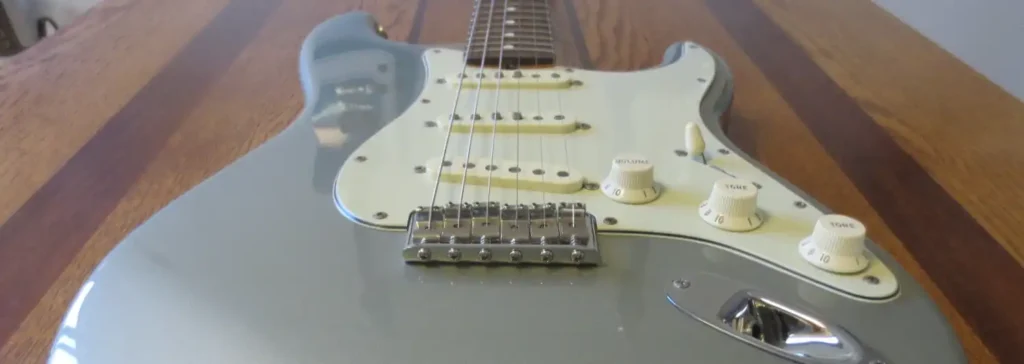
Signature & Iconic Strats
The Robert Cray Stratocaster
THE STORY BEHIND THE SIGNATURE MODEL


The Fender Robert Cray Stratocaster is one of those signature instruments that reveals a great deal about the artist’s underlying musical philosophy. Robert Cray is defined by a distinctly understated, refined approach—entirely free of gimmicks—and his signature model reflects this ethos, not as a relic-style guitar, but as a polished, modern blues instrument.
In the late 1980s, Fender’s Artist Relations and Marketing Division identified Robert Cray as a strong candidate for a signature model, recognizing him as a key figure in a modern, clean, and uncompromising Stratocaster-driven blues sound.
The Robert Cray Strat was developed and engineered by Fender’s U.S. Custom Shop in close collaboration with the artist, with the objective of replicating his primary working Stratocasters as faithfully as possible. It was not conceived as a “design-from-scratch” signature guitar.
Cray worked directly with Master Builder Michael Stevens, drawing inspiration from two of his main instruments: a 1958 Stratocaster and a 1964 Inca Silver Strat he had purchased in 1979 and used on his earliest recordings. As Cray himself explained: “I wanted to make my Signature a combination of that ’64 Strat and a ’58. I wanted the neck to have that kind of feel. It comes out a little wider than the ’58 oval neck, which is how I like it.”
Stevens also recalled that Cray was particularly attentive to preserving the setup philosophy of his own instruments, especially regarding pickup height. The pickups, he noted, were set unusually low—close to the level of the pickguard—mirroring the configuration of Cray’s personal Strats.
“If you had the pickup a long way from the string, you’d get less attack and much more an acoustic sound. You’d have to turn the amp a little bit, and that’s where a lot of Cray’s tone comes from – his fingers, and the real low pickups.”
Michael Stevens
The musician also requested a hardtail bridge to minimize tuning instability and ensure maximum consistency in live performance. “I don’t use a whammy bar, so there’s no reason to have one. I get the vibrato from my hands,” he said.
The Master Builder also crafted a personal Stratocaster for him featuring a subtle, intentional asymmetry in string alignment, with the treble E given slightly more lateral “room” than the bass side to accommodate Cray’s vibrato technique. The detail initially prompted concern from Cray’s roadie, who remarked, “The strings aren’t straight down the middle of the neck.” Once it was explained that this was intentional, the instrument was handed to Cray for evaluation. His response was immediate and enthusiastic—he returned satisfied, stating, “This is great!”
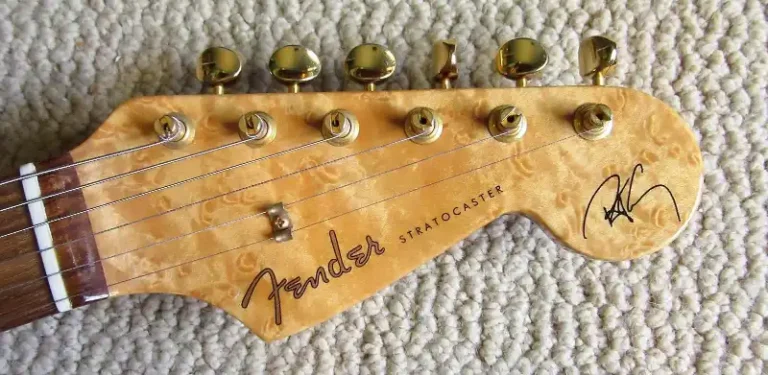
The Fender Robert Cray Signature Stratocaster was introduced by the Fender Custom Shop in late 1990, initially available only as a custom-order model. It featured a figured maple neck with an oval profile reminiscent of early-1960s instruments. The rosewood fretboard and vintage-style frets reflected the artist’s preferences.
The custom-wound, staggered-pole single-coil pickups were designed to deliver the sharp, biting tone often associated with Robert Cray’s style—although the guitarist noted in an interview that his personal Signature model was fitted with a set of Texas Specials.
The fretboard radius was increased from 9.5” to 12” in the mid-1990s, while the original chrome hardware was replaced with gold in mid-1998. Early finishes included Violet, Inca Silver, and Three-Color Sunburst, the latter of which remained available until 2010.
In 2003, production of the Made-in-Mexico Robert Cray Standard Stratocaster, later renamed the Robert Cray Stratocaster, also began. It was offered in Violet, Inca Silver, and, at an additional cost, 3-Color Sunburst.
It featured custom vintage-style pickups with staggered pole pieces in the neck and middle positions, while the bridge pickup employed flat pole pieces.