Signature and Iconic Strats
Jimi Hendrix's Stratocasters
FROM THE MONTEREY AND WOODSTOCK STRATS TO HENDRIX TRIBUTE AND SIGNATURE MODELS


Table of Contents
ToggleJimi Hendrix and the Stratocaster Legacy
Of all the guitarists who made the Stratocaster an essential part of their music, Jimi Hendrix had perhaps the greatest impact on the instrument’s history. At a time when the Stratocaster was going through one of its least-celebrated periods during the CBS era, Hendrix brought it to the forefront of rock music and introduced its sound and visual identity to a generation of players worldwide. Few musicians are more closely associated with the Stratocaster than Hendrix, and it is therefore fitting that Fender has honored his legacy with a series of tribute and signature models.
Jack Shelton, Senior Vice President of Marketing at Fender: “For almost 30 years, Jimi has been unofficially associated with Fender Stratocasters and has influenced countless thousands of guitar players. I think nearly every electric guitar player thinks of Jimi whenever they see a white Strat. He’s made a huge impact on our company and on the world. We’re very honored and excited to be able, after all these years, to officially recognize Jimi’s contributions.”
This article explores the most notable Stratocasters associated with Jimi Hendrix, from the instruments used at Woodstock and the Monterey Pop Festival to the many tribute and signature models Fender produced in his honor.

The 1980 Hendrix Stratocaster and the 2005 replica
The 1980 Hendrix Stratocaster “Prototype”
Long before Fender introduced the Signature Series and years before the creation of the Custom Shop, the company made an early attempt to pay tribute to Jimi Hendrix’s legacy with one of its most intriguing and least documented projects: the Hendrix Stratocaster.
Neither a production model in the conventional sense nor a signature guitar as the term would later be understood, it remains one of the most mysterious Stratocasters ever developed during the CBS era.
Long before Fender introduced the Signature Series and years before the creation of the Custom Shop, the company made an early attempt to pay tribute to Jimi Hendrix’s legacy with one of its most intriguing and least documented projects: the Hendrix Stratocaster.
Neither a production model in the conventional sense nor a signature guitar as the term would later be understood, it remains one of the most mysterious Stratocasters ever developed during the CBS era.
The project took shape during a transitional moment for Fender, when the company was actively seeking to reconnect the Stratocaster with its cultural identity and historical legacy.
Strongly championed by Mudge Miller, then Fender’s Vice President of Sales and Marketing, the project originated within Fender’s Research & Development department.
Much of the work was carried out by John Page, who was heavily involved in the project.
He later recalled that Miller had initially pushed for an additional headstock decal—ultimately never applied—a circled “M” intended to stand for “modified” (or, as some more cynically suggested, “Miller”).

Rather than functioning as a replica of one of Hendrix’s specific instruments, the model appears to have been conceived as a broader tribute—capturing Hendrix’s image, style, and association with the Stratocaster rather than reproducing a single historical guitar.
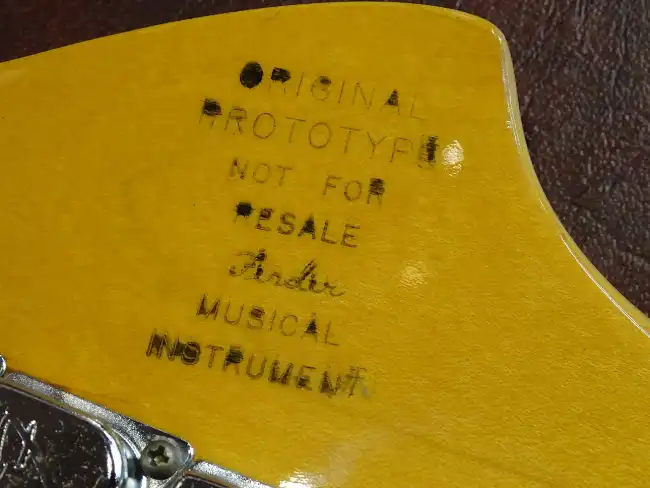
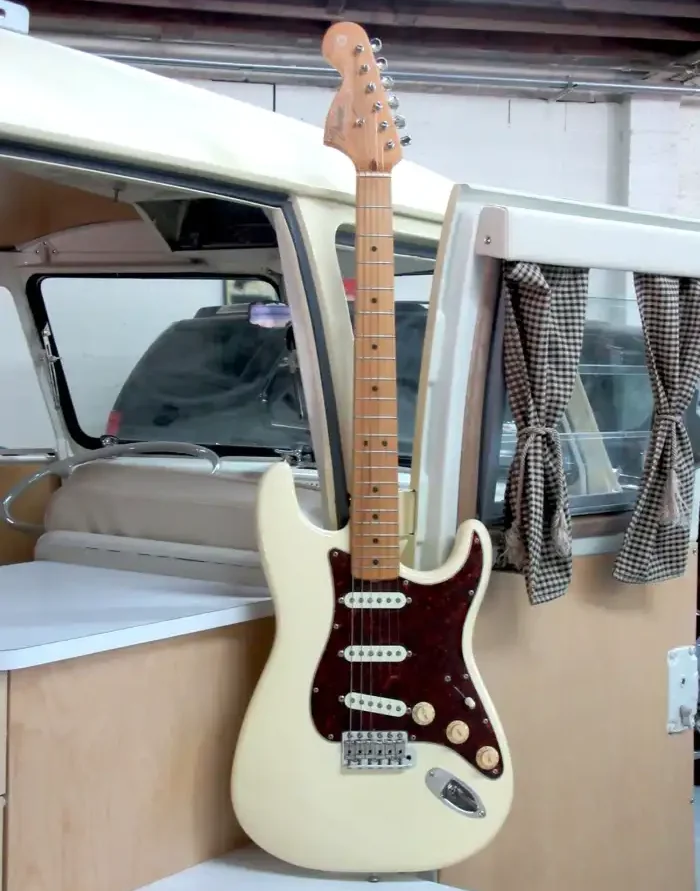
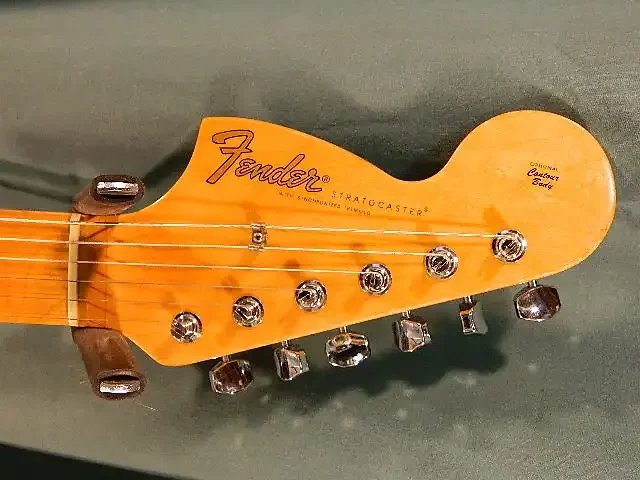
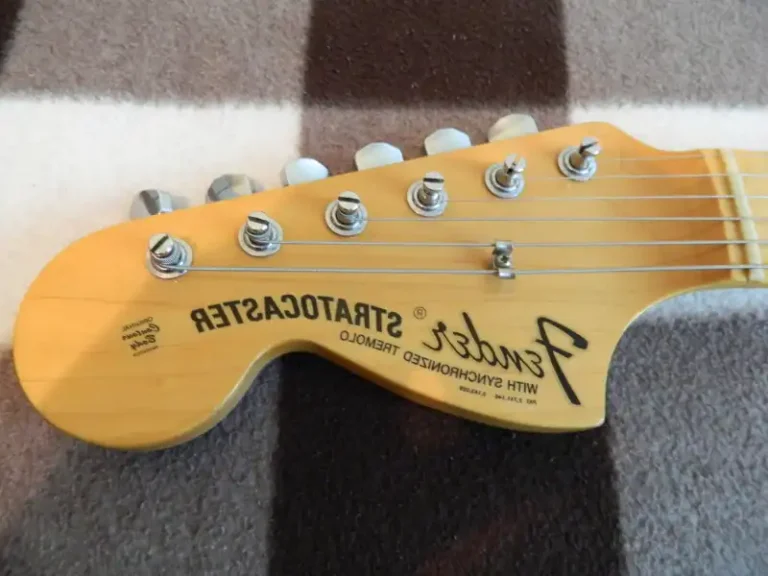
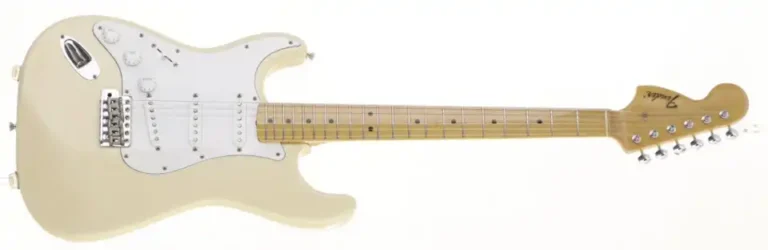
Its most recognizable feature was the reverse headstock, a visual reference to Hendrix’s famously inverted right-handed Stratocasters played left-handed, along with an additional front upper body contour and a four-bolt neck construction. It also carried the stamp “ORIGINAL PROTOTYPE NOT FOR RESALE Fender MUSICAL INSTRUMENT” on the back of the headstock.
A closer examination of the instrument revealed several unusual construction details that distinguished it from standard Fender production models of the period. The transition between the neck and headstock differed noticeably from later Fender practice, while the walnut plug was positioned unusually low and elongated. According to Fender Custom Shop Master Builder Dennis Galuszka, this may indicate that the neck was originally drilled for a bullet truss rod before being completed as a one-piece maple neck using the earlier heel-adjust truss rod design.

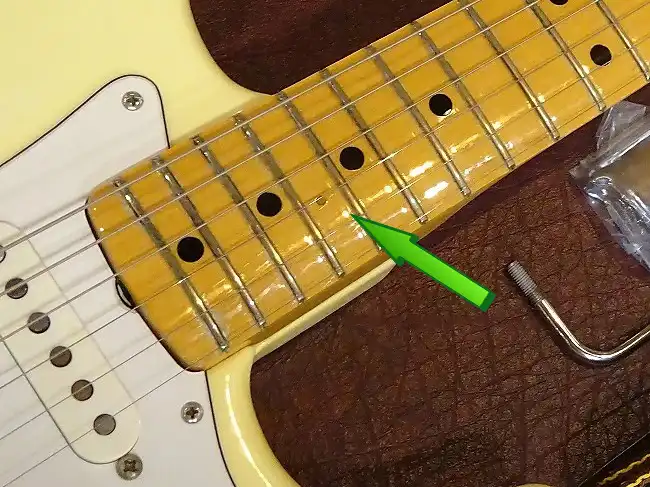
Another unusual detail was a tooling hole located between the 17th and 19th frets, an original manufacturing feature associated with the production of the left-handed necks used for the project.
Another peculiarity was the headstock itself, which measured approximately one-eighth of an inch longer than expected from the nut to the tip. Galuszka attributed such variations to the pin-routing methods employed by John Page at the time, long before the precision offered by modern CNC machinery.
Despite often being described otherwise, the body was constructed from alder rather than ash. Equally noteworthy was its lacquer finish. At a time when most Fender production instruments were finished in polyester or urethane for greater manufacturing efficiency, lacquer was a less common and considerably more labor-intensive finish.

Fender never officially linked the model to Jimi Hendrix, although it is widely regarded as being inspired by him. According to the most commonly accepted account, the project was intended as a tribute model, but a licensing agreement with the Hendrix estate was never finalized, leaving the instrument in a semi-official state within Fender’s internal development history.
As a result, the Hendrix Stratocaster was never formally cataloged as a standard production instrument, and surviving documentation remains scarce, leaving its exact production history the subject of long-standing debate.
In 2004, John Page said he believed 25 examples were made in 1980 at the request of a group of Texas-based dealers, although this figure has never been definitively confirmed by official factory records, and other researchers continue to describe it as a prototype-only project with only a small number of verified instruments.
The picture becomes even more complex when considering that, over the years, additional Hendrix Stratocasters with differing specifications have surfaced—some featuring rosewood fingerboards, others finished in alternative colors or constructed from different woods. These examples were likely not original Hendrix Stratocasters, but rather custom-built instruments assembled using parts originally intended for the project.
What remains certain is that the model never entered regular production, making surviving examples exceptionally rare and highly collectible.
Whether viewed as a prototype, a concept model, or a limited internal run, the 1980 Hendrix Stratocaster remains historically significant, as it represents Fender’s earliest known attempt to reinterpret Jimi Hendrix through the Stratocaster as a dedicated project.
In many ways, it anticipated what would later become standard practice at Fender: Artist Series instruments, Custom Shop tributes, limited editions, and officially licensed Hendrix signature models.

The Replica: The Reverse Proto Strat
The story of the Reverse Proto Stratocaster began when John Mayer acquired one of the rare 1980 Hendrix Stratocaster prototypes and submitted it to Fender’s Custom Shop to verify its authenticity.
After examining the instrument, Mike Eldred, then head of the Fender Custom Shop, proposed recreating the forgotten model as a limited-production run. Fender approved the project and commissioned Master Builder Dennis Galuszka to document and reproduce the guitar in meticulous detail.
Introduced in 2005, the Reverse Proto Stratocaster was based directly on Mayer’s original prototype.
Galuszka disassembled the instrument piece by piece before rebuilding it from the ground up, resulting in a limited run of approximately 100 guitars over the following two years.
The Reverse Proto Stratocaster faithfully replicated the construction details of the original prototype, featuring a two-piece alder body with a distinctive additional front contour, a one-piece maple neck, left-handed “F” tuners, dual string trees, and even the small plastic spacers mounted beneath them. Dennis also reproduced other original details, including the neck plate gasket found on the original instrument.
“It has the same front contour, same back contour, same headstock blends, and same crazy decal. […] It has the same bridge and the same cast saddles. We even reproduced the tooling hole. […] The bridge is another interesting detail. At the time, CBS was using this type of bridge. We don’t necessarily use them much anymore. We do on the Ritchie Blackmore model, but we’re trying to copy a CBS guitar.”
Dennis Galuszka

Dennis equipped the guitar with gray-bobbin single-coil pickups and carefully matched the knobs’ appearance, aging them to a similar greenish tint. He also reproduced the small dings and the patina around the hardware. The result was remarkably close to the original.
The guitar was finished in Closet Classic Vintage White lacquer. Dennis Galuszka intentionally used a lighter tint on the body, applied through Fender’s relic process, a decision meant to allow the finish to naturally age toward the appearance of the original prototype. As he explained, “Mine isn’t quite as dark, but it will darken over time, which is exactly what I planned for. If I made it as dark as the original now, it would look terrible in a week. So, it’s going to blend naturally with the look of the original over time. That comes from years and years of expertise by the talented staff at the Fender Custom Shop.”
Fender Custom Shop 1967 Stratocaster
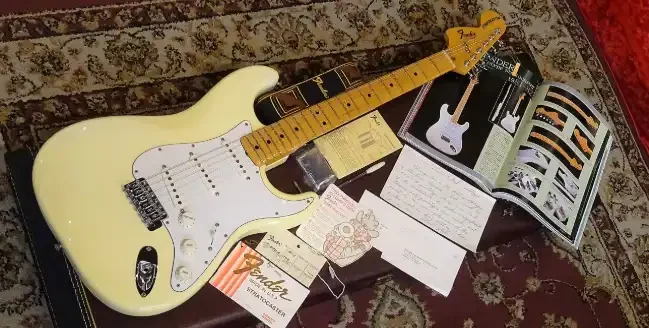
Built by the Fender Custom Shop in 1991, this model was referred to as the Jimi Hendrix ’67 Reissue Stratocaster, although it was neither developed in collaboration with the Hendrix family nor intended as a strict historical reissue.
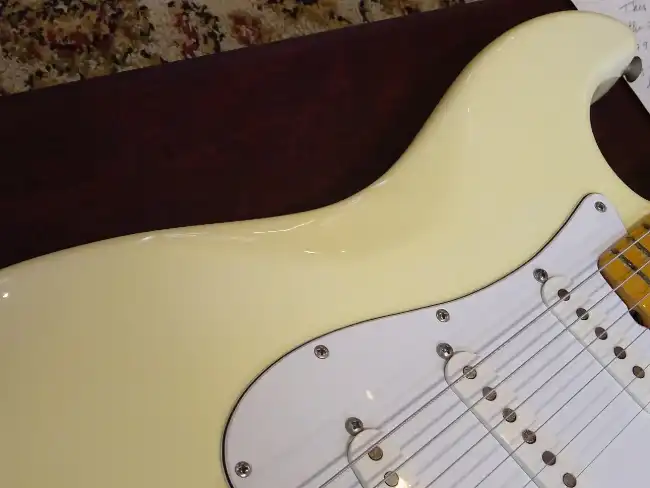
As with the 1980 Hendrix-inspired Stratocaster, neither Jimi Hendrix’s name nor image appeared on the instrument or on the accompanying Certificate of Authenticity. The visual references to Hendrix were subtle, consisting primarily of the Olympic White finish and the reverse headstock. Unlike the 1980 model, however, it featured the Transition Logo, while the back of the headstock carried the Fender Custom Shop oval logo. The limited run used original 1960s Fender nitrocellulose tortoiseshell pickguard material.
The serial number was stamped on the neck plate. The earliest known example bears the number 9101, while the remaining instruments appear to have followed sequentially.
Production numbers remain uncertain. According to Scott Grant, then Custom Shop Supervisor at Fender, approximately 15 examples were made, each accompanied by a Certificate of Authenticity signed by John Page. Some dealer accounts, however, suggest that only 10 were produced. Those same accounts also claim that the first example was presented to Buddy Guy by Fender, though this detail has not been verified in Fender’s official documentation.

Jimi Hendrix Tribute Stratocaster
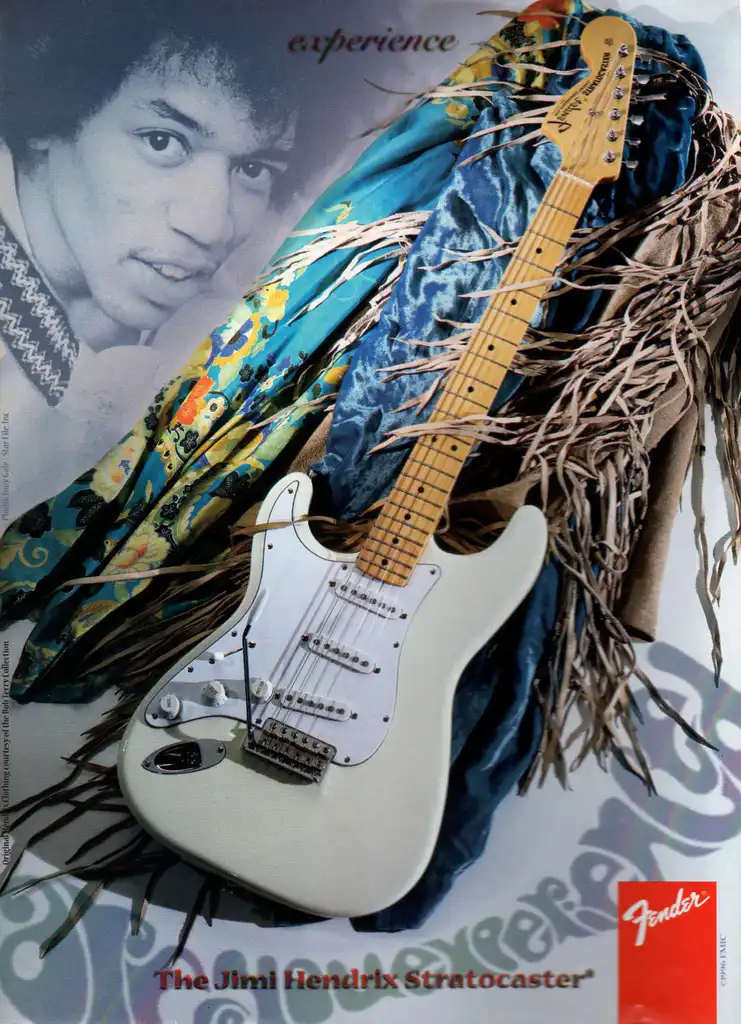
In a press release dated January 19, 1997, Fender announced the Jimi Hendrix Tribute Stratocaster in collaboration with Experience Hendrix, LLC, the Hendrix estate. Often referred to simply as the Jimi Hendrix Stratocaster, it was released thirty years after Hendrix’s debut with Are You Experienced? and remained in production until 2000.
“Modeled after the same Strat that Jimi played at his historic performance at the Woodstock Music Festival of August 1969, the instrument is bound to delight generations of guitar players and music history enthusiasts for years and years,” noted Jack Shelton, Senior Vice President of Sales at Fender.
The Jimi Hendrix Tribute Stratocaster marked another important step in Fender’s tribute to the Stratocasters most closely associated with Jimi Hendrix. By combining distinctive visual and functional elements, Fender created a dedicated tribute instrument that anticipated the officially licensed Hendrix signature Stratocasters that would follow in later years.
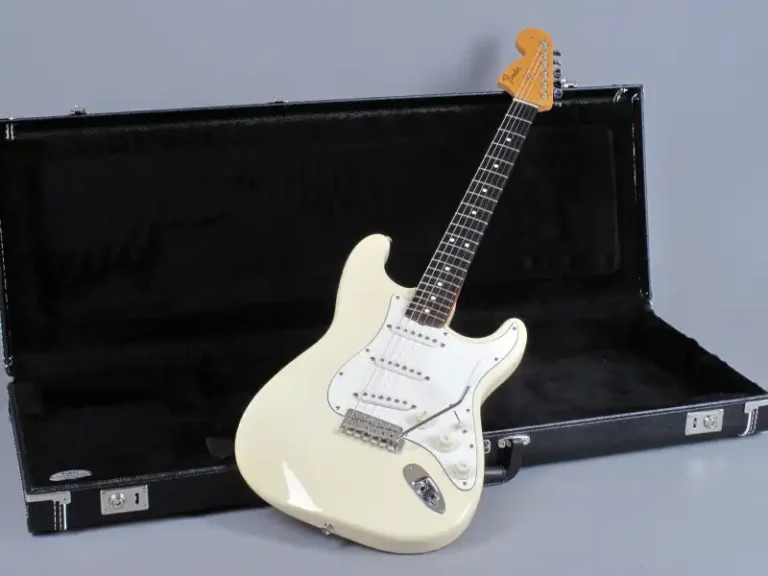
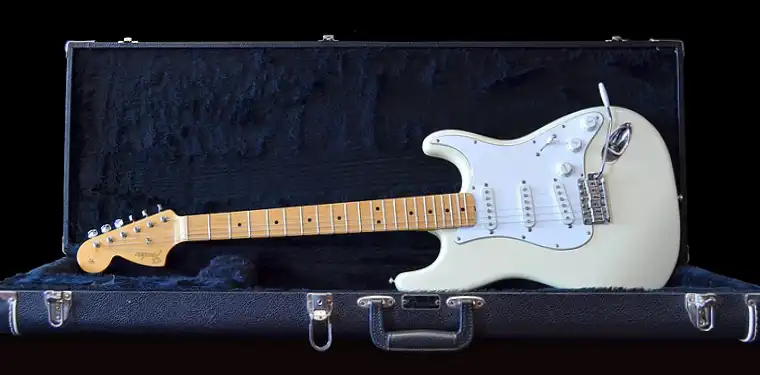
It was essentially a left-handed maple-cap Stratocaster, typically finished in Olympic White, reverse-strung for right-handed players in a mirrored configuration—echoing the inverted right-handed Stratocasters Jimi Hendrix played left-handed.
The Jimi Hendrix Tribute Stratocaster took the “mirror image” concept a step further, featuring a CBS-style decal applied in reverse so that it can only be read when viewed in a mirror.
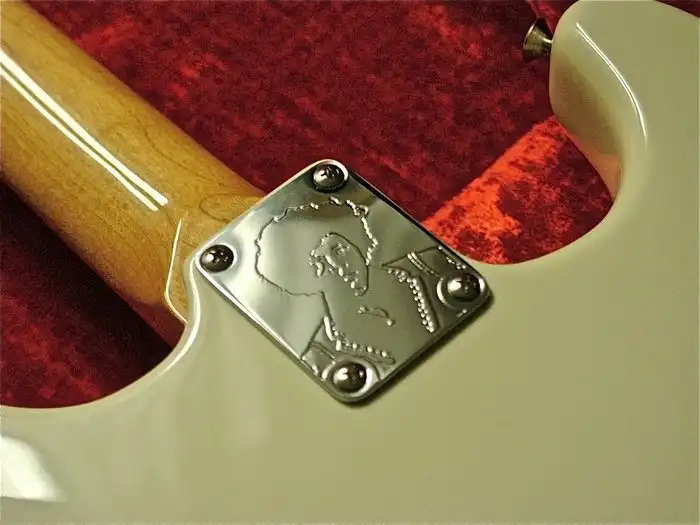
The neck plate featured an engraved Special Hendrix Silhouette, serving as an additional commemorative detail unique to this model.
The serial number, stamped on the back of the headstock, typically began with the prefix “TN7”.
It also featured three reverse-staggered Vintage ’69 AlNiCo pickups and a reverse-angled bridge pickup, replicating the orientation created when Hendrix played a right-handed Stratocaster upside down.
This reversed the conventional relationship between string vibration and pickup pole alignment: the low E string, for example, sits over a pole piece that would normally correspond to the high E string position, and vice versa. The result is a different magnetic interaction across the string set, which some players and historians believe contributes to a subtly altered tonal response—often described as a slightly brighter low end and a warmer treble. This configuration is sometimes cited as one of the factors associated with the so-called “Hendrix tone”.
This feature would later reappear on both the 1998 Voodoo Stratocaster and the 2000 ’68 Reverse Strat Special.

Jimi Hendrix Monterey Stratocaster
The Burned Stratocaster: Jimi Hendrix’s Monterey Pop Guitar
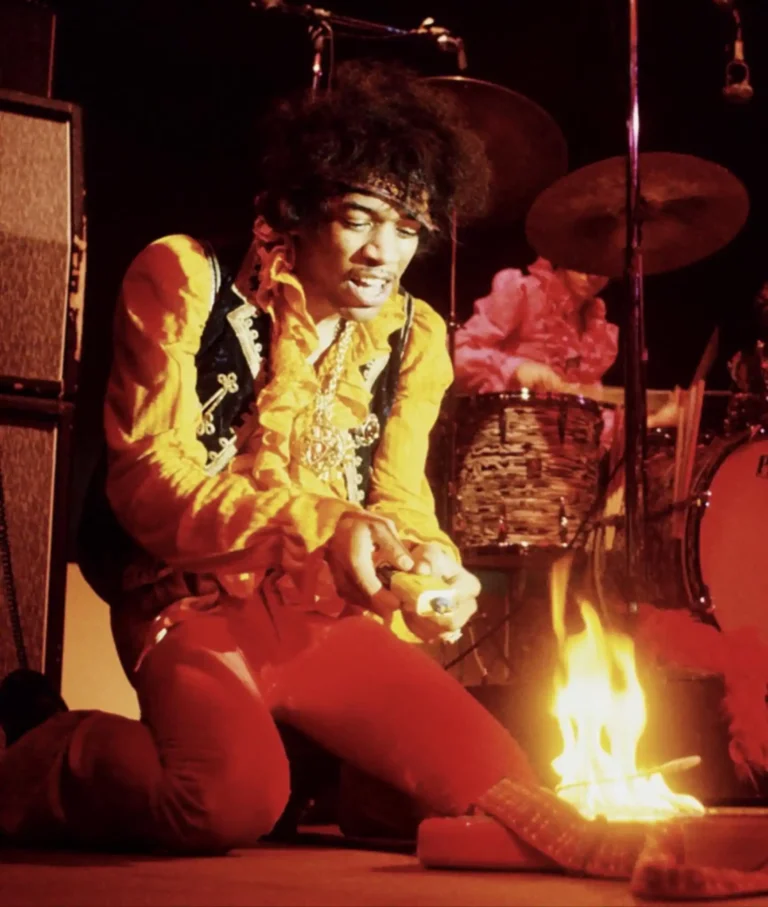
Jimi Hendrix’s burning of the Stratocaster at the Monterey International Pop Music Festival on June 18, 1967, remains one of the most iconic images in rock history. Conceived as a dramatic stage gesture intended to surpass the instrument-smashing performances associated with Pete Townshend, the act quickly became central to Hendrix’s mythology.
Years later, Pete Townshend reflected on their onstage rivalry, stating, “For me, it was an act. For him, it was something else. It was an extension of what he was doing.”
Hendrix is known to have performed the guitar-burning stunt on at least two occasions.
The first took place on March 31, 1967, at London’s Astoria Theatre—three months before Monterey—when the flames reportedly burned so intensely that he suffered injuries to both hands.
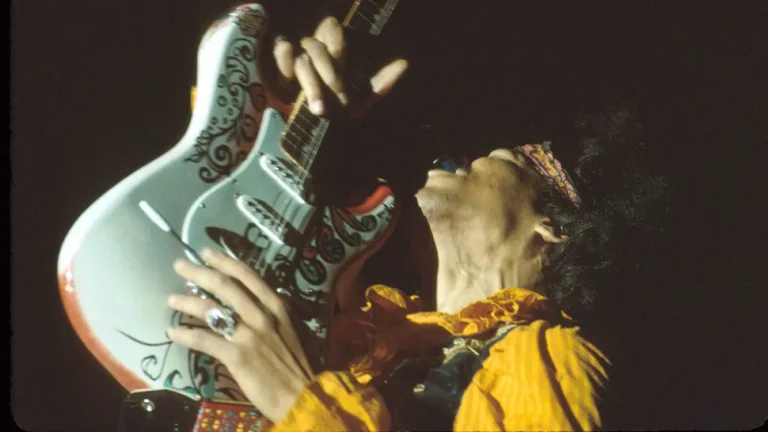
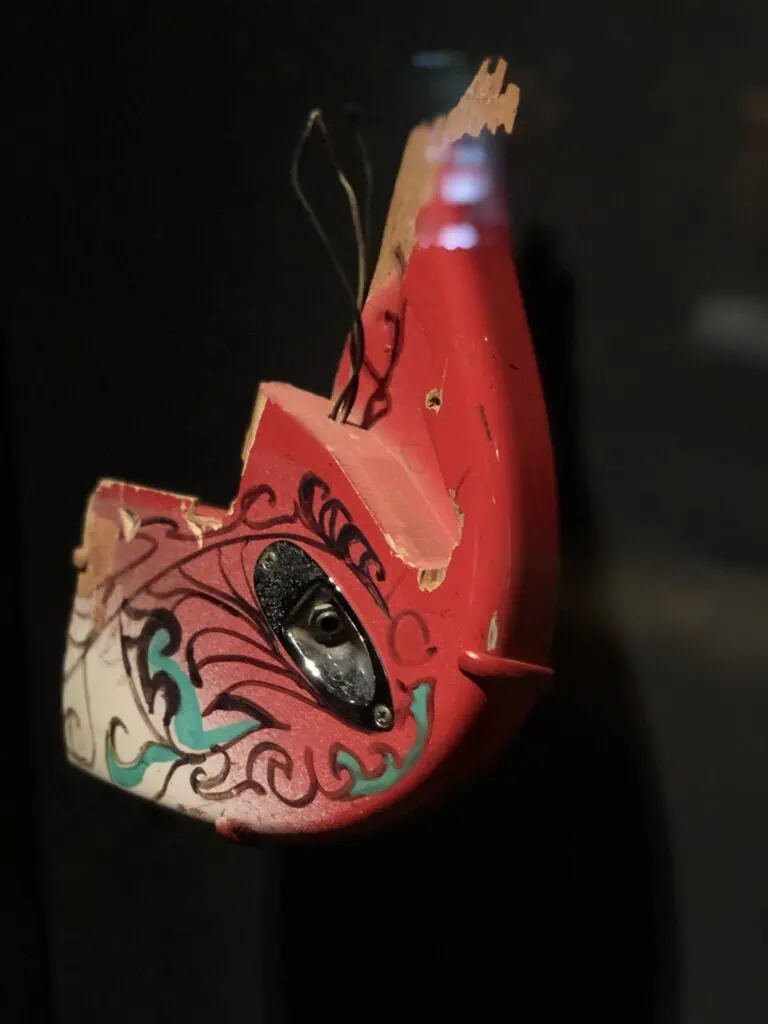
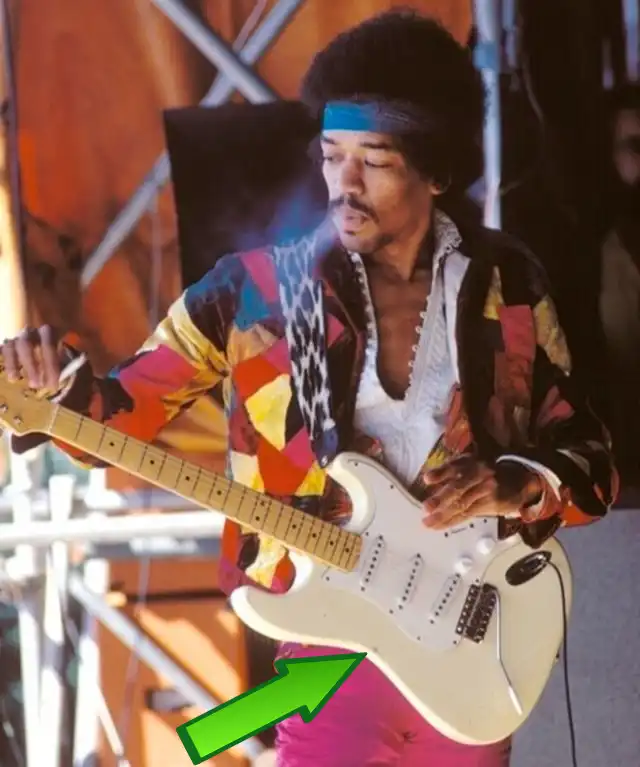
At Monterey, Hendrix used two Stratocasters: a black Stratocaster—famously played during Hey Joe and widely regarded as one of his favorites—and a hand-painted red Stratocaster, which he set on fire during the climactic finale of Wild Thing. Shortly before taking the stage, Hendrix painted the guitar himself, partially covering it in white and decorating it with vivid floral and psychedelic motifs.

Before Wild Thing, the closing song of the performance, Hendrix addressed the audience and explained that he was about to sacrifice something he deeply loved:
“I’m going to sacrifice something that I really love. Today I think it’s the right thing, all right, so I’m not losing my mind. This is this, for everybody here, man. This is the only way I can do it. So, we’re going to do the English and American combined anthem together, okay?”
Jimi Hendrix
During the performance, Hendrix pushed both the song and the instrument to their limits, transforming a straightforward rock anthem into something entirely his own through feedback, distortion, and theatrical intensity. After the final verse, he knelt before the guitar, laid it on the stage, set it alight, and watched as flames rose around it—turning the closing moments of Wild Thing into one of the defining images of rock history.
The burned guitar was later sold at auction in November 2012 for £237,000.

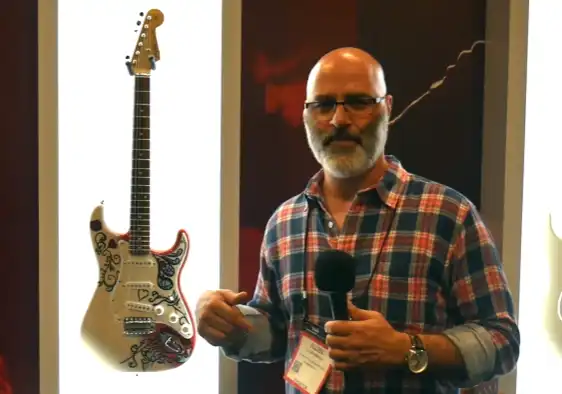
Jimi Hendrix Monterey Pop Stratocaster: Fender’s 1997 Tribute to Hendrix’s Burned Strat
The 1997 Jimi Hendrix Monterey Pop Stratocaster marked a shift in Fender’s approach to Hendrix-related instruments, moving away from abstract tribute concepts toward the direct reconstruction of a specific historical moment. Based on the Stratocaster famously burned by Jimi Hendrix at the Monterey Pop Festival in 1967, it served less as a performance instrument and more as a visual and symbolic recreation of one of rock history’s most iconic moments.
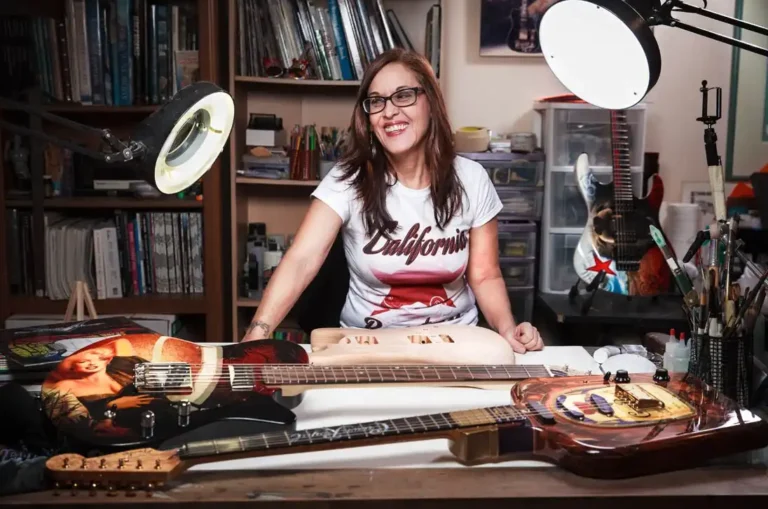
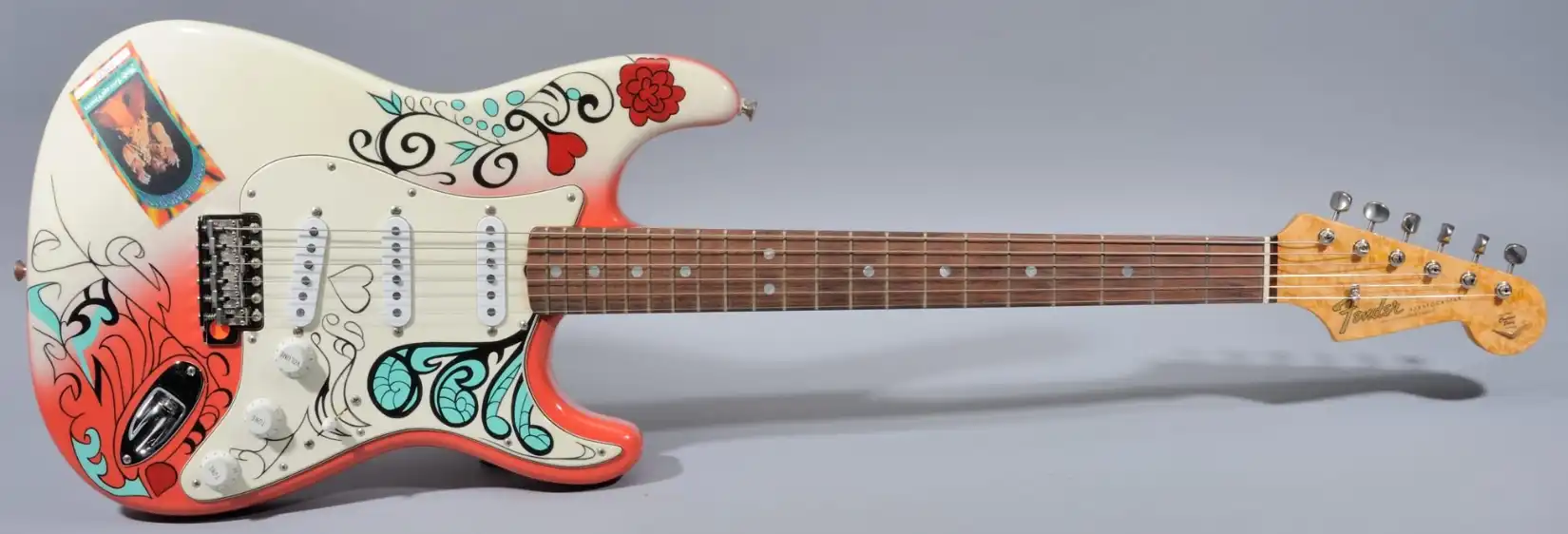
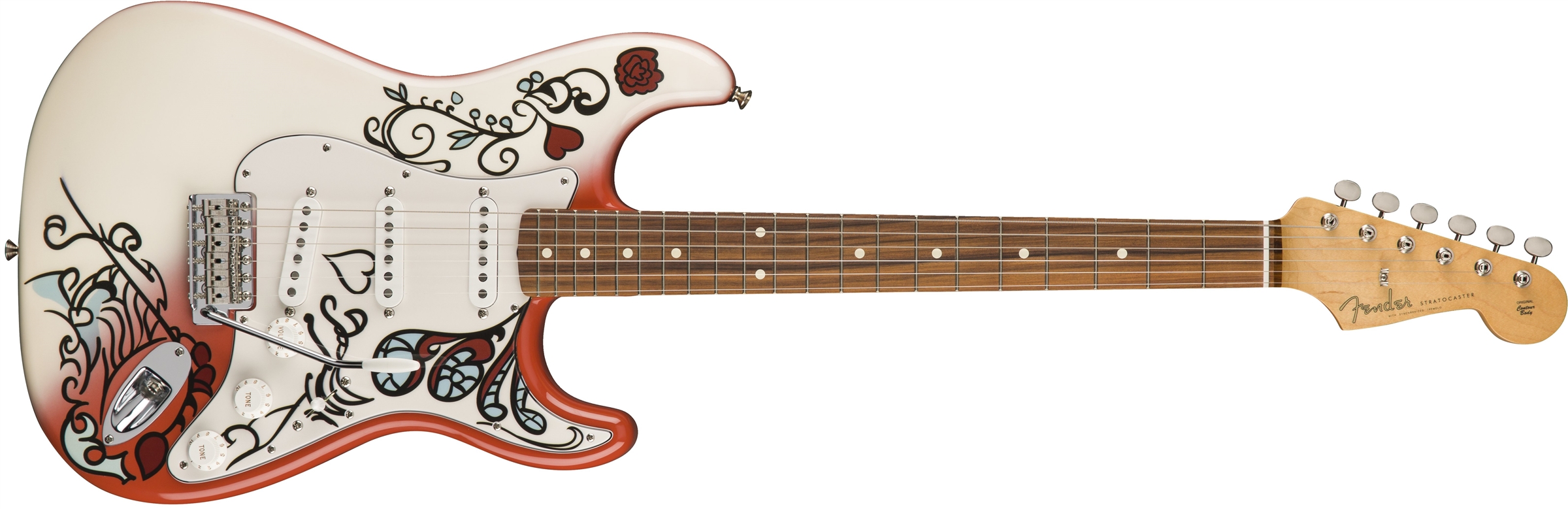
The Fender Custom Shop released only 210 examples, all hand-painted by Pamelina Hovnatanian. Some were designated as Diamond Dealer instruments and were available exclusively through select retailers. These Monterey Pop Stratocasters can be identified by a Custom Shop logo featuring a raised diamond on the headstock.
The 1997 Fender Custom Shop Monterey Stratocaster was conceived as an artistic interpretation rather than a strict replica.
To recreate the Monterey Stratocaster, Pamelina carefully studied D.A. Pennebaker’s documentary film and Ed Caraeff’s photographs, which together form the primary visual record of Hendrix’s performance.
Her initial concept remained very close to Hendrix’s original hand-painted guitar. Fender, however, encouraged her to bring more of her own artistic voice to the project.
As a result, Pamelina introduced several interpretive changes, including replacing the pink and yellow flower on the upper horn with a red rose and modifying the color palette of the swirling motifs near the pickguard by removing red tones.
She also added Hendrix’s backstage pass motif to the front of the body, incorporating Ed Caraeff’s iconic photograph of Hendrix setting the guitar ablaze, along with a back plate engraved with the words “MONTEREY INTERNATIONAL POP FESTIVAL JUNE 16-17-18-1967.”
And that was not the only departure from the original. The Stratocaster Hendrix burned at Monterey was a 1964 model, featuring clay dot inlays and a Spaghetti logo. The Custom Shop tribute Stratocaster instead featured a Transition logo and pearl dot inlays.
It also featured strap buttons on both the upper and lower horns, making it a right-handed guitar strung for left-handed playing—just like Hendrix’s guitars.
The completed design was approved by Janie Hendrix on behalf of the Hendrix estate, with additional guidance and support from Lou Adler and Howard Frank of the Monterey International Pop Festival Foundation.

The Mexican-Made Jimi Hendrix Monterey Stratocaster
Introduced in 2017 to mark the 50th anniversary of the Monterey Pop Festival, the Fender Jimi Hendrix Monterey Stratocaster occupied a distinctive place within the brand’s long-running series of Hendrix-inspired instruments. Unlike the Custom Shop model, the Mexican-made Jimi Hendrix Monterey Stratocaster was conceived as a production-level tribute, designed to translate one of rock history’s most iconic visual moments into an accessible instrument.
It was not a forensic recreation of the Stratocaster Jimi Hendrix burned at the 1967 festival. Instead, it represented Fender’s interpretation of the idea of Hendrix at Monterey. The 2017 model sought to capture that aesthetic legacy rather than reproduce a specific instrument.
“It’s an honor to celebrate such an iconic musical moment and Jimi Hendrix’s legacy on the eve of the 50th anniversary of the Monterey Pop Festival,” Justin Norvell, Fender Vice President, said at the 2017 launch of the Mexican Monterey Stratocaster.
“The Stratocaster was at the heart of countless iconic Hendrix performances, but Monterey marked his arrival in the United States as a musical force—and Fender was proud to have been a part of that moment. The fiery culmination of Hendrix’s set became one of the most iconic images of the 20th century. Although little of the guitar remained afterward, a detailed examination of photos and video from the performance helped Fender develop its version of the original guitar, down to the detailed nail-polish artistry.”
In accordance with the 2017 CITES regulations restricting the use of rosewood, the instrument featured a pau ferro fingerboard. Unlike the Custom Shop model, it carried the Spaghetti Logo on the headstock. However, it did not replicate the exact design details of the Stratocaster Jimi Hendrix burned at the 1967 festival, nor did it feature the correct fret markers.
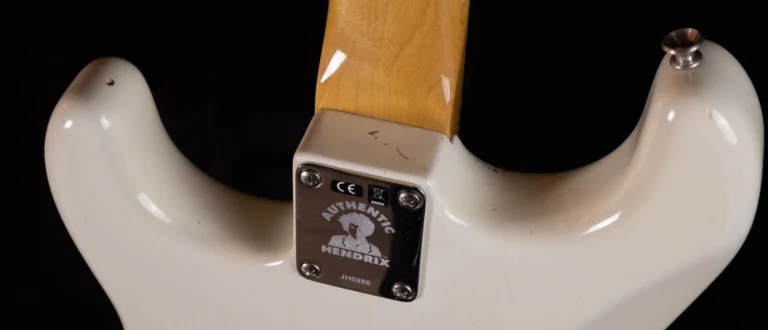
It was fitted with vintage-style single-coil pickups with staggered pole pieces, and featured Hendrix’s signature on the back of the headstock, along with a neck plate engraved with the musician’s portrait and the words “AUTHENTIC HENDRIX.”


One of the defining characteristics of the 2017 Monterey Stratocaster was its position within Fender’s Mexican production line. This approach reflected a broader strategy of democratizing iconic designs. By manufacturing the guitar in Mexico, Fender was able to offer a Hendrix signature model at a significantly more accessible price point while maintaining period-inspired specifications. In this sense, the Monterey Stratocaster was less about exclusivity and more about cultural diffusion—bringing a historically loaded design language into everyday circulation.
Within this framework, player reception was divided. Many saw the Mexican Monterey Stratocaster as a democratized reinterpretation of a previously elite concept. Others, particularly collectors accustomed to Custom Shop standards, viewed it as a simplification—an instrument that captured the surface of the myth rather than its reconstructed material depth.
An equally significant chapter in the Monterey MIM story unfolded after its production run ended. Once Fender discontinued the model, the guitar experienced a noticeable, sometimes abrupt, increase in its second-hand market value. As availability tightened, the instrument gradually shifted from a mid-tier production signature into a speculative collector’s item.
Voodoo Stratocaster
Introduced in 1998, the Fender Voodoo Stratocaster was conceived as a tribute to Jimi Hendrix and to the distinctive tonal character of his upside-down Stratocasters. Rather than replicating a specific Hendrix instrument, Fender approached the Voodoo Strat as a functional reinterpretation—designed to capture the sonic response associated with Hendrix’s setup while remaining comfortable for right-handed players.
The model appeared in Fender Frontline Vol. 24 in the summer of 1998, where Fender described it as “a tribute to the voodoo master himself—Jimi Hendrix.” The catalog noted that “for years, players have been putting left-handed necks on their Strats in search of that elusive sound. This only got them halfway there. The Voodoo Stratocaster completes the equation with its completely left-handed string path.”
Although inspired by Jimi Hendrix, the Voodoo Stratocaster was not released as a formal signature model, but as part of Fender’s Special Series.
The Voodoo Stratocaster featured a reverse headstock with Fender’s Transition logo and a right-handed alder body, combining Hendrix-inspired styling with a familiar playing orientation. It was offered in three finishes—3-Color Sunburst, Olympic White, and Black—and was available with either a rosewood fingerboard or a maple cap neck.

The neck plate was engraved with a portrait of Jimi Hendrix, giving the instrument a dedicated commemorative identity. The guitar also carried the “TN7” serial prefix, a detail shared with the earlier Jimi Hendrix Tribute Stratocaster and later with the ’68 Reverse Strat Special, the model that replaced the Voodoo Stratocaster in Fender’s catalog in 2001.
Its defining feature was the reverse-angled bridge pickup, designed to recreate the tonal effect of Hendrix’s upside-down Stratocasters. Fender paired it with vintage-style pickups featuring reversed staggered pole pieces and a reverse headstock, resulting in brighter, more articulate bass strings, warmer trebles, and a dynamic response closely associated with Hendrix’s signature tone.
Fender’s intention was practical as much as historical. While Hendrix’s upside-down Stratocasters became central to his image and sound, playing one in that configuration can be uncomfortable for a right-handed player, as the controls and hardware are placed in unconventional positions. The Voodoo Stratocaster translated those sonic characteristics into a familiar right-handed format, allowing players to access much of that tonal vocabulary without adapting to an inverted instrument.

’68 Reverse Stratocaster Special
Introduced in 2001, the ’68 Reverse Strat Special effectively succeeded the Voodoo Stratocaster in Fender’s catalog, retaining its core design—including the reverse headstock, reverse-angled bridge pickup, and reversed staggered pole pieces.
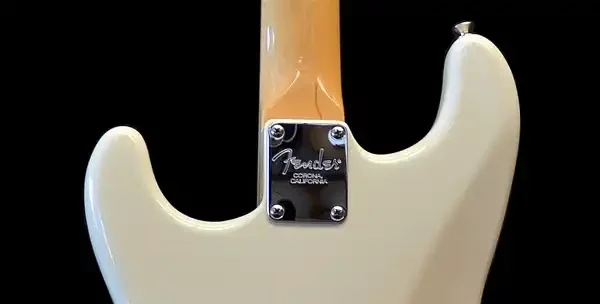
The most notable difference was not in the instrument’s construction, but in the removal of the Hendrix silhouette neck plate featured on the Voodoo Stratocaster, replaced by a standard neck plate engraved “Fender CORONA CALIFORNIA.” Production of the Voodoo Stratocaster appears to have ended following objections from the Hendrix estate, reportedly related to Fender’s use of Hendrix-associated imagery, including the engraved neck plate silhouette.
Significantly, Fender’s own Frontline catalog description avoided mentioning Hendrix by name, referring instead to “a left-handed guitar player who played a right-handed Strat upside down”—a clear but deliberately indirect nod to the player whose sound inspired the model.
Fender is believed to have retained a stock of previously produced parts, some of which may have later been used on the ’68 Reverse Strat Special, this time without explicit Hendrix branding. Supporting this theory is the fact that the model carried the same “TN7” serial number prefix previously used on the Voodoo Stratocaster.
Unlike the Voodoo, which was offered in 1998 and 1999 with either a maple cap or optional rosewood fingerboard, the ’68 Reverse Strat Special was available exclusively with a maple cap fingerboard.
Like its predecessor, it was not part of Fender’s Signature or Artist Series, but was instead included in the American Special Series lineup.

The Woodstock Stratocaster
The Story of Izabella: Jimi Hendrix’s Woodstock Stratocaster
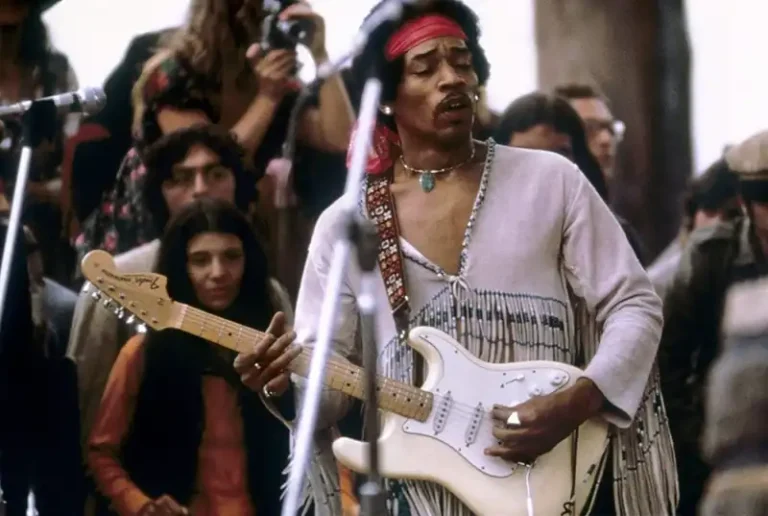
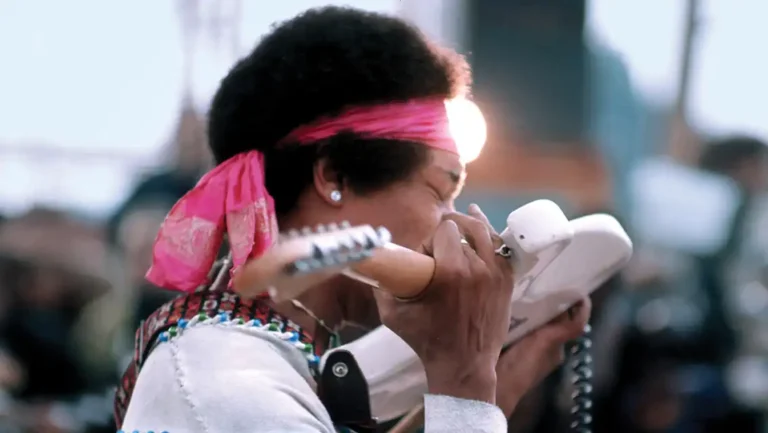
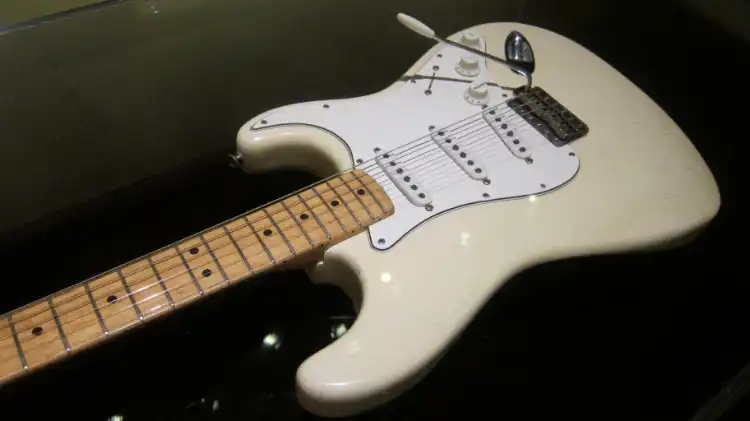
Jimi Hendrix owned and played several Stratocasters throughout his illustrious career, but the most famous was the 1968 Olympic White Stratocaster, known worldwide as the “Woodstock Stratocaster.” The instrument earned its nickname after appearing in Hendrix’s landmark performance at the Woodstock Music & Art Fair on August 18, 1969. Seen in footage and photographs from Hendrix’s legendary Woodstock performance, including his celebrated rendition of The Star-Spangled Banner, the instrument became one of the most recognizable guitars ever played.
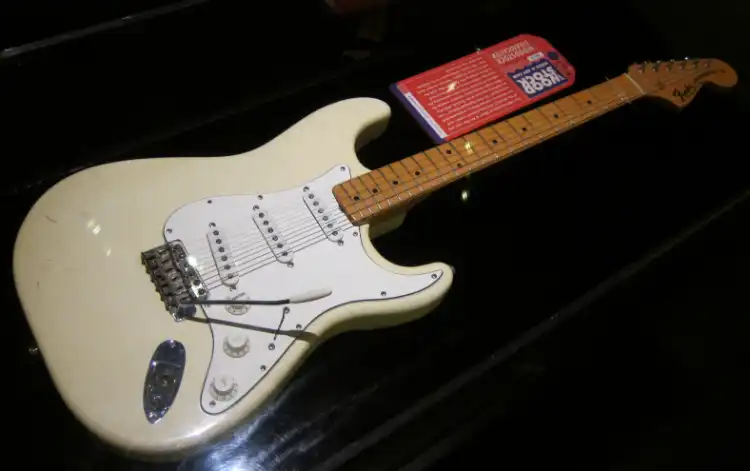
It is preserved today at Seattle’s Museum of Pop Culture (formerly known as Experience Music Project, or EMP). It remains one of the best-documented and most historically significant guitars associated with Hendrix.
Today, the instrument is widely known as “Izabella,” a nickname commonly used by collectors, Fender, and the Museum of Pop Culture in Seattle. The precise origin of the name remains unclear, although it is generally associated with the Hendrix composition of the same title.
According to Mitch Mitchell, the guitar later known as the Woodstock Stratocaster was acquired from Manny’s Music on West 48th Street in New York City.
The instrument was a right-handed 1968 Olympic White Stratocaster that had been adapted for Hendrix’s left-handed playing style by modifying the nut and strap button placement.
It featured an alder body paired with a maple-cap neck, lacking the rear skunk stripe, and incorporating a heel-adjust truss rod.
The neck plate carried serial number 240981, while the large Stratocaster headstock displayed the distinctive Fender black logo and bold arched “Stratocaster” script introduced during the CBS era.
Izabella appears to have been Hendrix’s primary instrument throughout much of the 1969 North American tour, including his historic appearance at the Woodstock Festival. It was likely still in use during 1970, although this is where the instrument’s history becomes considerably more complex.
Numerous books and articles have stated that the Woodstock Stratocaster was also played at the final concert of the original Jimi Hendrix Experience, held at the Open Air Love & Peace Festival in Fehmarn, Germany, on September 6, 1970. However, photographic evidence suggests otherwise.
Images from approximately April 1970 onward show Hendrix with an Olympic White Stratocaster featuring a small scratch in the body, a detail that stands out clearly against the instrument’s white finish. No such scratch is visible on the guitar used at Woodstock. This seemingly minor difference led some researchers and collectors to propose that Hendrix may have owned two nearly identical Olympic White maple-cap Stratocasters rather than a single instrument.
The Woodstock Stratocaster preserved at Seattle’s Museum of Pop Culture does not display the body scratch visible on the Olympic White Stratocaster seen in photographs from 1970. This distinction led some researchers and collectors to question the guitar on display at the museum, suggesting it might not have been the original Stratocaster Jimi Hendrix played at Woodstock.
Determined to settle the matter, museum curator Peter Blecha undertook a detailed verification process. As he recalled:
“I arranged for digital close-ups of the neck, so we could look at the grain on the fretboard or on the back of the neck or on the headstock. We got the highest quality Woodstock video footage we could and took stills of certain frames. Then we got the guitar out, lined them up, and they matched. We never had any doubt the guitar was real, but at that point we proved it, based on the wood-grain fingerprints.”
Peter Blecha

The comparison confirmed that the museum instrument was indeed the Stratocaster used at Woodstock. As a result, the evidence strongly suggests that Hendrix had two remarkably similar Olympic White Stratocasters in circulation during 1970.
If this interpretation is correct, the original Woodstock Stratocaster may not have been used on stage after the early months of 1970. Significantly, every known photograph from the Fehmarn performance shows Hendrix playing the white Stratocaster with the body scratch, indicating that the guitar used at his final Experience concert was likely not the Woodstock instrument.

Four Guitars, One Legend: The Story of the Woodstock Stratocaster Replicas
To mark what would have been Jimi Hendrix’s 60th birthday, Mike Eldred began work in 2002 on four exact replicas of the Stratocaster Hendrix played at Woodstock.
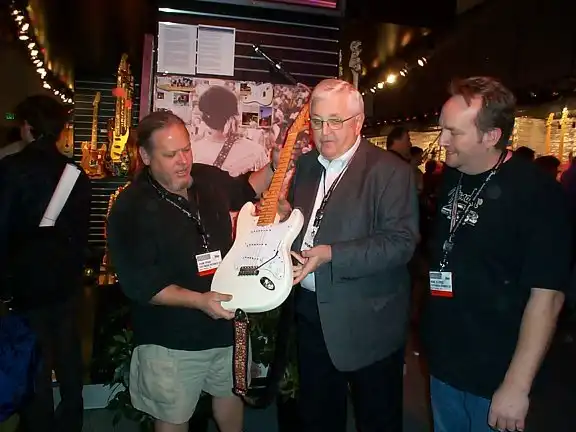
The project represented a significant milestone for Fender, marking the first time the company committed the resources necessary to create meticulously accurate replicas. To reproduce the Woodstock Stratocaster, George Blanda and Mike Eldred traveled to Seattle’s Experience Music Project, where the original guitar was on permanent display, to examine and document the instrument in detail.
As Eldred recalled:
“We measured the output of the pickups, the neck shape, everything. In my 24 years in this business, I have never experienced any guitar with that much vibe. It was really intense when they were taking it out of the display! Everyone was just watching, waiting, not saying a word, and they were filming the whole thing. And when they were putting it back, I felt this overwhelming sadness because no one would ever do that again.”
Mike Eldred
Discussing the accuracy of the replicas, he added: “These five guitars—the original plus the four clones—are indistinguishable from each other, and I do not say lightly. The colors were correctly aged, and the output of the pickups and the neck dimensions were matched. This is why all that deep research was necessary. Like the separate components on each guitar, a particular part would not only look exactly the same, it would weigh the same!”
The four Woodstock Stratocasters were distributed among several recipients. One was presented to the Hendrix family, one was given to Paul Allen on behalf of Seattle’s Experience Music Project, one was retained for the Fender Museum, and the fourth was sold for charity at Cooper Owen’s Rock Legends Auction in February 2003, where it realized $11,000.
The guitar sold at auction had previously been displayed at the Cité de la Musique in Paris as part of the Jimi Hendrix Exhibition, which ran from October 19, 2002, to January 19, 2003.

Limited Edition Jimi Hendrix Stratocaster
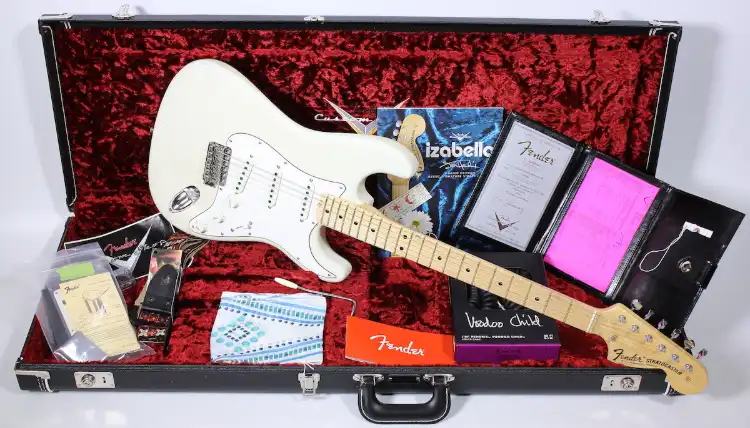
On August 18, 2019, to commemorate the 50th anniversary of Jimi Hendrix’s performance at Woodstock, the Fender Custom Shop unveiled the Limited Edition Jimi Hendrix Stratocaster, also known as the “Izabella” Stratocaster.
The reverse-engineering process extended far beyond specifications and vintage-correct components, encompassing Hendrix’s individual wear patterns down to every “nick, scratch, gouge, and bump.” This distinguished the Izabella from the Monterey Stratocaster. In the case of the Monterey, Fender had relied primarily on photographs and film footage of a guitar that no longer existed. With Izabella, however, the team was able to examine the original instrument directly.
Introducing the guitar, Mike Lewis explained that the team felt a particular sense of responsibility in recreating Izabella: “Jimi Hendrix playing Star-Spangled Banner at Woodstock was a cultural moment heard around the world. We’re especially excited about this release because not only is the Izabella one of the most iconic instruments of our time, it represents a moment in history that will forever be woven in our cultural make-up. The Fender Custom Shop has done tributes to many extremely meaningful artist guitars through the years, but there was an extra sense of awe and privilege in the air in recreating the Izabella.”
The official statement from the Hendrix Estate emphasized how inseparable the image of Hendrix with that Stratocaster had become from the collective memory of Woodstock: “The unforgettable image of Jimi with his Strat on that Woodstock stage is embodied in this guitar.”
Limited to 250 examples, the replica retailed of $6,900.

The Jimi Hendrix Stratocaster Made in Mexico
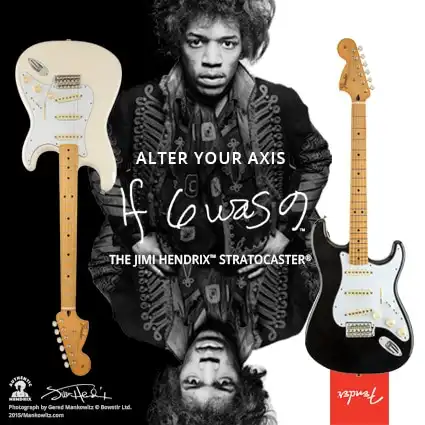
Introduced in 2015, the Mexican-made Jimi Hendrix Stratocaster represented a new interpretation of the design concepts long associated with Hendrix’s upside-down Stratocasters.
Unlike the Monterey Pop Stratocaster, the Woodstock replicas, or the Reverse Proto Strat, it was not intended to recreate a specific historical instrument. Instead, Fender combined a number of features that had appeared on earlier Hendrix-inspired models into a single production guitar.
The instrument featured a reverse headstock, a reverse-angled bridge pickup, and reverse-staggered Pure Vintage ’65 pickups, design elements intended to emulate some of the tonal characteristics associated with Hendrix’s inverted right-handed Stratocasters.
It also incorporated commemorative details, including Hendrix’s signature on the back of the headstock and a specially engraved neck plate featuring a portrait of Hendrix alongside the words “AUTHENTIC HENDRIX.”

Unlike Fender’s previous Hendrix-inspired Custom Shop projects and limited-edition tributes, the 2017 model was conceived as a standard production instrument. Rather than targeting collectors, it sought to make many of the design features associated with Hendrix’s guitars available to a broader audience at a more accessible price point.
In many respects, the guitar brought together ideas previously explored through the Jimi Hendrix Tribute Stratocaster, the Voodoo Stratocaster, and the ’68 Reverse Strat Special, continuing Fender’s long-running effort to interpret Hendrix’s unique relationship with the Stratocaster for new generations of players.
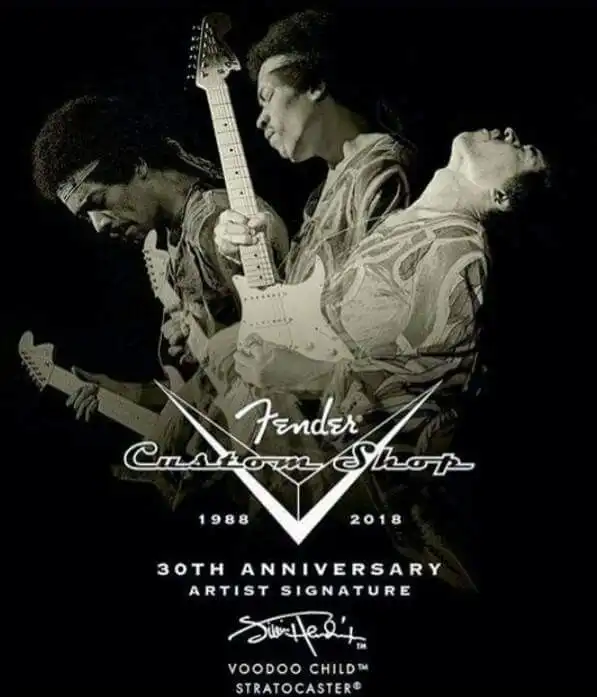
Jimi Hendrix Voodoo Child Signature Stratocaster
The Jimi Hendrix Voodoo Child Signature Stratocaster was introduced in 2018, the same year Fender celebrated the 30th anniversary of its first Custom Shop signature models.
Unlike earlier Fender Custom Shop Hendrix tribute instruments, which commemorated specific guitars or performances such as Monterey and Woodstock, the Voodoo Child Signature Stratocaster was designed to recreate the physical and tonal conditions that shaped Hendrix’s playing experience.
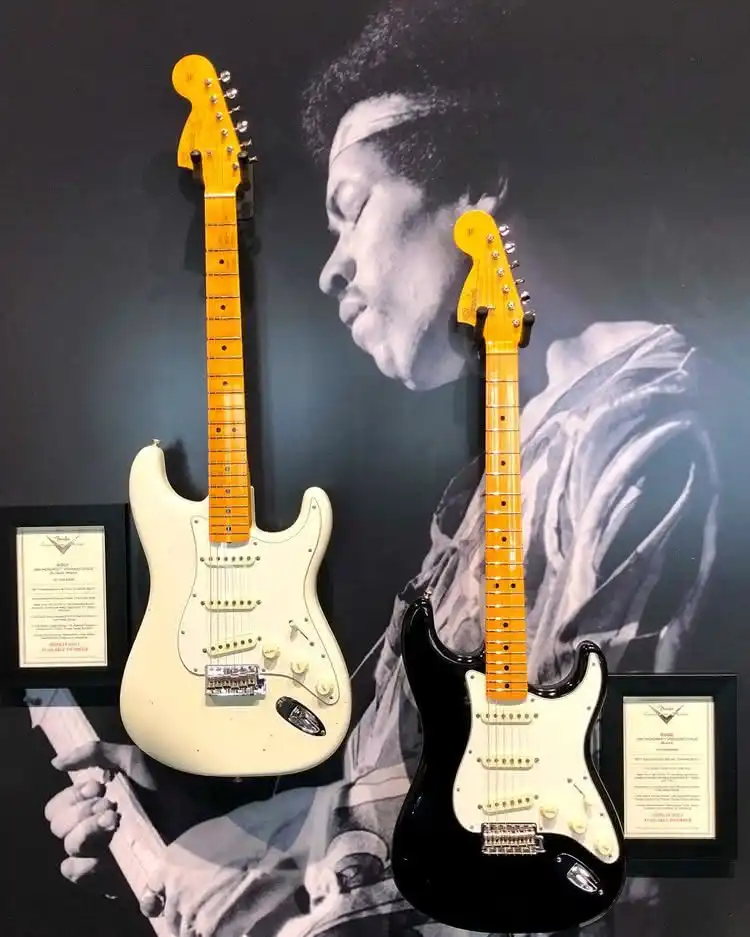
The concept revolved around three key elements: a large reverse headstock featuring the Transition Logo, Custom Shop Hand-Wound ’69 pickups with reverse-staggered pole pieces, and a reverse-angled bridge pickup. Together, these features were intended to capture some of the characteristics associated with Hendrix’s famously inverted Stratocasters.
The instrument was offered in Black and Olympic White finishes, both available in NOS and Journeyman Relic versions. It featured a two-piece selected alder body and a 1966 Oval “C” neck profile paired with a 9.5-inch-radius fingerboard. Hendrix’s signature appeared on the back of the headstock, while the commemorative neck plate featured the guitarist’s silhouette alongside the words “AUTHENTIC HENDRIX.”


Hendrix-Inspired Stratocasters from Fender Japan
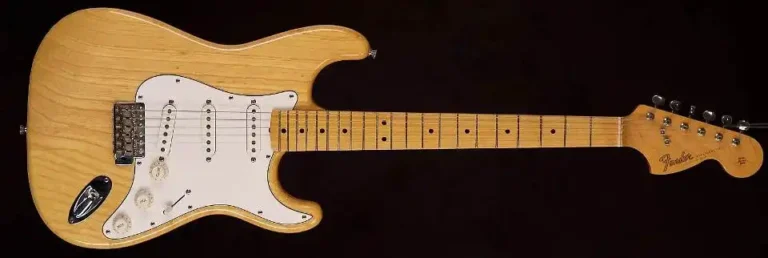
The ’68 Stratocaster was introduced in Japan in late 1987 for export to the U.S. and other Western markets. Although Fender never explicitly associated the model with Jimi Hendrix, it later became informally known as the “Hendrix Stratocaster.”
Unlike the Japanese ’72 Stratocasters, it featured a maple-cap neck and a large headstock with the Transition Logo—characteristics commonly associated with the Stratocasters Hendrix played during the late 1960s.
The guitar was equipped with Gotoh Kluson-style tuning machines and two butterfly string trees. While early examples featured basswood bodies, ash became the preferred body wood from 1996 onward.
Between 2005 and 2006, Fender Japan produced another Hendrix-inspired maple-cap Stratocaster, the ST68-JH. Intended exclusively for the Japanese domestic market, it was offered as a special-order model through Kanda Shokai.
Available in Vintage White and Black finishes, the guitar was conceived as a left-handed Stratocaster adapted for right-handed players. As a result, it featured a reverse large headstock with an upside-down Black Logo, Schaller “F” tuning machines, and a reverse-mounted vintage-style tremolo fitted with a left-handed tremolo arm.