Signature & Iconic Strats
The Jimmie Vaughan Tex-Mex Stratocaster
THE HISTORY BEHIND THE JIMMIE VAUGHAN WHITE STRAT AND THE CUSTOM SHOP MODELS

Table of Contents
ToggleThe Tex-Mex Stratocaster and the origin of the Jimmie Vaughan Stratocaster
From the Tex-Mex Stratocaster to the Jimmie Vaughan model
When Jimmie Vaughan first encountered Fender’s Tex-Mex Stratocaster in the mid-1990s, there was no talk of a signature model. The instrument itself was part of Fender’s effort to expand its Mexican production line with affordable, performance-oriented Stratocasters—something that would soon catch Vaughan’s attention.
Already a key figure in Texas blues, both through his work with the Fabulous Thunderbirds and in parallel to his brother Stevie Ray Vaughan, Vaughan had always maintained a pragmatic approach to gear.
What impressed him about the Tex-Mex Strat was not its price point or positioning, but its immediacy: it was a straightforward, responsive guitar that simply worked.
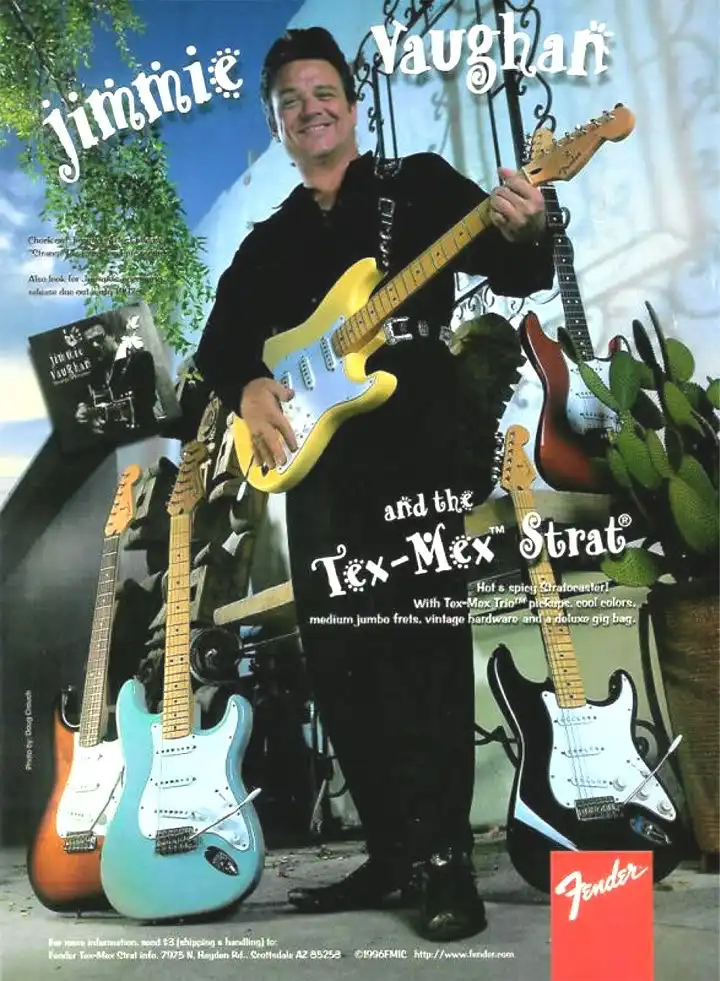
A 1996 Fender advertisement featuring Jimmie Vaughan with a Tex-Mex Stratocaster—still not yet a signature model—captures this transitional moment. Rather than promoting a dedicated artist instrument, Fender was already associating Vaughan with the Tex-Mex platform itself, effectively positioning the guitar as a working musician’s tool endorsed through use rather than design.
As Fender began developing artist collaborations around its Ensenada-built instruments—following earlier initiatives such as the Mexican-made signature model introduced for Richie Sambora in 1994—conversations with Vaughan naturally followed.
“I thought it would be a great idea to have one that was really affordable and a good guitar at the same time. Since my friends and I are fans of the Mexican strats, I asked about the possibility of having a model from Mexico,” Jimmie recalls.
Rather than driving the idea of a signature himself, Vaughan responded to the opportunity by shaping the instrument around his preferences—keeping it simple, affordable, and musically effective.
In interviews, he consistently emphasized the same principle: a guitar didn’t need to be expensive or overly refined to be great.

The Jimmie Vaughan Tex-Mex Stratocaster
That philosophy became the foundation of the Jimmie Vaughan Tex-Mex Stratocaster, introduced in 1997 under the direction of Mike Lewis and built around the Tex-Mex Stratocaster. Only a few, carefully considered changes distinguished it from its Tex-Mex predecessor: the modern “C”-shaped neck was replaced with a “special” profile—later refined into a soft “V”—while it featured an alder body and a one-piece maple fretboard.
Like the original model, it retained Tex-Mex single-coil pickups, although the bridge unit specified for the Jimmie Vaughan version was slightly hotter than the standard Tex-Mex bridge pickup.
“When we did the Tex-Mex,” Jimmie explained in an interview with Johnny Zapp for Vintage Guitar Magazine, “Mike Lewis at Fender said, ‘What do you change on your guitars?’
And I said, ‘Put the Tone control on the treble pickup because I can get either all the way treble, full bright, or I can get a Telecaster sound by backing it down a little bit. It’s what we used to do on my guitars in the T-Birds—René [Martinez, Editor’s Note] figured that out. I never turn my guitar volume all the way up; I keep the amp up and the guitar down, and it works good with the pickup, it’s a little overdriven.’
So, he said, ‘We’ll experiment with this and put a few more windings on the treble pickup so that when you do turn the tone down, it’s a little bit louder.’ So, the treble pickup has a little more horsepower.”

These adjustments, though subtle on paper, were central to Vaughan’s playing feel, reinforcing the instrument’s identity as a working musician’s Strat—simple, direct, and built for real-world performance.
It is said that Jimmie, pleased with the quality of his signature model, asked Fender if he could visit the Ensenada factory, where he was impressed by the passion with which the Mexican employees built their instruments. To thank them, he later decided to perform a concert exclusively for the factory workers.
He liked his signature model so much that he typically traveled with two Jimmie Vaughan Signature Stratocasters, reliced to resemble the original guitar he played with the Thunderbirds.
The Jimmie Vaughan Stratocaster Serial Numbers and Fender Production Anomalies
The Jimmie Vaughan Tex-Mex Stratocasters carried “MSN” or “MSZ” serial number prefixes when produced in the 1990s and from 2000 to 2009, respectively.
Interestingly, some instruments bear “MSN6” or “MSN7” prefixes despite not having been manufactured in 1996 or 1997. In such cases, the instrument’s correct dating must be determined by examining additional markings on the body, neck, or pickguard, as well as any commemorative medallions, stickers, or anniversary neck plates associated with the 1996, 2004, and 2006 editions.

The Custom Artist Model and the JLV pickups
In July 2018, Fender unveiled the Custom Artist Jimmie Vaughan Signature Stratocaster. Developed in close collaboration with the Custom Shop.
Rather than revisiting his earlier Tex-Mex signature, the 2018 Custom Shop model represented a more refined interpretation of Jimmie Vaughan’s playing preferences.
It featured a Jimmie Vaughan Custom “C”-shaped rift-sawn maple neck, reflecting his established playing feel, along with 57110 jumbo frets. The two-piece alder body and neck were finished in a Closet Classic nitrocellulose lacquer, giving the instrument a subtly aged aesthetic, while the electronics were upgraded to Custom Shop JLV single coil pickups.
In practical terms, the difference between the two systems is significant: Tex-Mex pickups are hotter, with higher output, stronger midrange presence, and a more compressed, aggressive response that pushes the amplifier more directly. The Custom Shop JLV single-coils, by contrast, are lower in output, more open and dynamic, with greater headroom, clearer note separation, and a more vintage-accurate response to picking nuance. Where Tex-Mex pickups tend to shape the tone at the source, the JLV set preserves a more transparent signal, allowing the amplifier and the player’s technique to define the final sound.
The evolution from Tex-Mex pickups to Custom Shop JLV single-coils is best understood not as a technical upgrade path, but as a refinement of intent. Over time, Vaughan moved closer to a pure signal path: less compression at the guitar, more interaction with the amplifier, and maximum reliance on touch.
In that sense, his preference for lower-output pickups is not a stylistic choice—it is a structural one. It ensures that nothing stands between the player, the amp, and the immediacy of the performance.
The Vaughan Brothers Stratocasters
The original Jimmie’s White Strat
One of the main guitars in Jimmie Vaughan’s collection was a 1963 white Stratocaster, which he acquired in the late 1970s from Bill Campbell, a notable figure on the Austin blues scene.
“The body is from a ’63 Strat, but the neck is one Bill gave to me [with a late-’50s maple neck featuring a thin profile and larger frets, Editor’s Note], so I guess it’s kind of a ‘parts’ guitar,” Vaughan recalls.
This white Strat was assembled with the help of Charley’s Guitar Shop in Dallas and Vaughan’s longtime technician, René Martinez. For Vaughan, it was a dream come true. “I’d wanted a white Strat for years,” he said. “The whole thing started when I was a kid. I wanted one of those blonde ’57s that looked like a Mary Kaye. Gene Vincent played it in a black-and-white movie in the ’50s. To me, it’s the most beautiful thing; it’s a Stratocaster, it’s white, and it just looks cool.”
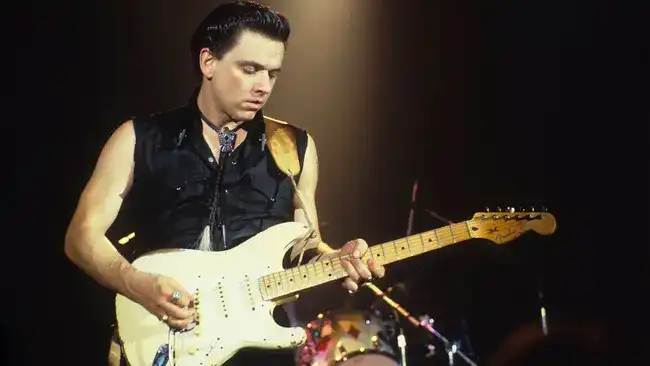
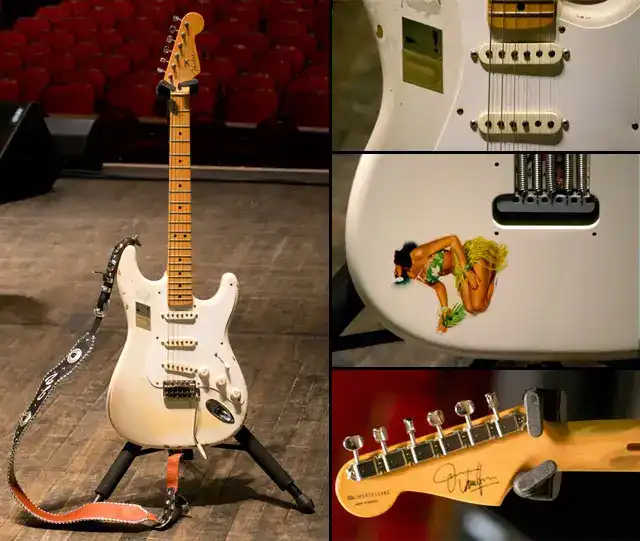
Over the years, Vaughan made a cosmetic modification that would make it one of the most recognizable Stratocasters of its time—an upside-down photo of a pin-up girl, which appeared right-side up when he played the guitar behind his head during his live shows.
“I used to play behind my neck a lot, and people loved it,” he said. “So, I found these pictures of these pretty girls in Denmark, and I thought when I flipped my guitar behind my head, there could be a girl there. It was just something to do.”
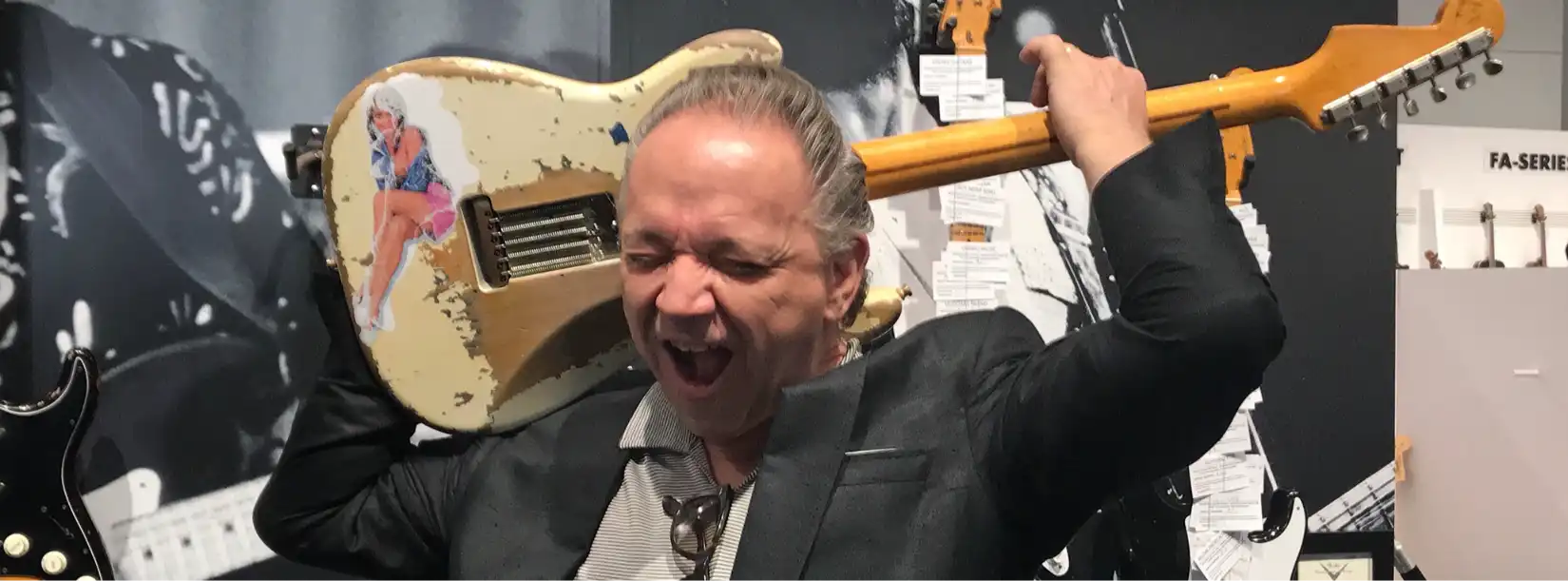


This guitar became Vaughan’s go-to instrument on the road and was used on every album by the Fabulous Thunderbirds following their debut. René Martinez, who also worked with Stevie Ray Vaughan, maintained both brothers’ guitars while they toured together.
At the time of writing (2018), the Strat is on display in the Grammy Museum’s touring exhibition, alongside Stevie Ray Vaughan’s iconic “Number One” Stratocaster. “I hope they’re taking good care of it,” Vaughan laughed.
The Custom Shop Replica
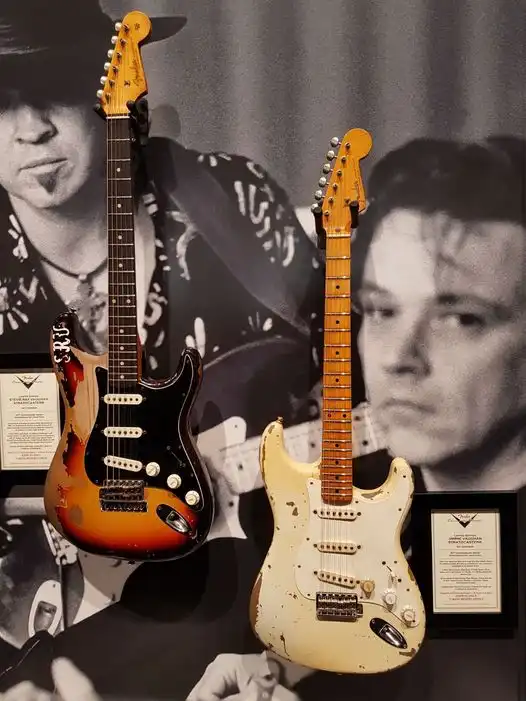
In 2018, the Fender Custom Shop honored Jimmie Vaughan and Stevie Ray Vaughan with 30 limited-edition Stratocasters each.
All instruments were crafted by John Cruz and drew inspiration from the guitars used by the two Texas bluesmen.
“They’re so accurate that I can’t tell them apart, even down to the pin-up girl on the back.”
Jimmie Vaughan
John Cruz’s replica featured a two-piece alder body with an asymmetrical seam and a heavy relic finish, complemented by a single-ply parchment pickguard and a ’57-style “C”-shaped maple neck with a 9.5” radius fretboard fitted with 6100 frets.
Jimmie Vaughan’s Setup

Back in 1998, Guitar Player spoke with Jimmie Vaughan shortly after the recording of his solo album Out There. When Art Thompson asked about his tone, Vaughan explained:
“I like the treble pickup because it has a pure tone without a lot of overtones. It almost sounds like a steel guitar, you know? That’s what my tone is—it’s always the treble pickup.”
Vaughan also noted that while he had experimented with different pickups over the years, he always returned to stock configurations:
“I like my guitars to be pretty much stock—there’s nothing on my guitars that’s not pretty regular. You’re going to think I’m kidding, but I used my Fender Tex Mex Strat on this record. The only difference is that its treble pickup is a little hotter than standard. I guess they put more winding on it, but I don’t know. They all come that way. I used my old Strat on Kinky Woman—my old white one—and I used a ’54 reissue Strat on Astral Projection Blues. But the rest of it is the Tex-Mex.”
He also described his approach to setup in detail: “I raise up my treble side and lower the bass side. It just seems more balanced that way—you know, the ratio of the volume between the treble strings and the bass strings. But I really just want the treble to just blow the shit out of it. Now, if you get the pickup too close, it’ll start making a beating sound. One thing I do that I don’t think nobody else does is raise my action up real high. I don’t necessarily use big strings, but I have the action up pretty high so that my strings really ring.”
At the time, Vaughan typically set the bridge flat against the body with all springs installed when using his Tex-Mex Strat and his old white Stratocaster, although he occasionally worked with a floating bridge configuration.
At the core of his approach, however, Vaughan consistently minimized the role of gear in shaping his tone. Rather than relying on complex signal chains or modifications, he simply turned his amplifier up and used his fingers to achieve the sound he wanted, allowing touch and dynamics to define the character of his playing.
