Signature & Iconic Strats
The Fender John Mayer Stratocaster
AND THE STORY BEHIND THE BLACK ONE AND MAYER’S 1996 SRV STRATOCASTER

Table of Contents
ToggleJohn Mayer
Although John Mayer is now closely associated with PRS Guitars and his highly successful PRS Silver Sky signature model, he originally established his reputation as a Fender Stratocaster player.
Born on October 16, 1977, in Bridgeport, Mayer began playing guitar after watching Michael J. Fox, as Marty McFly, play in Back to the Future.
From the very beginning, his musical identity was deeply shaped by Stevie Ray Vaughan. It is therefore no coincidence that many of his early live performances prominently featured Fender Stratocasters.

Mayer’s 1996 SRV Stratocaster
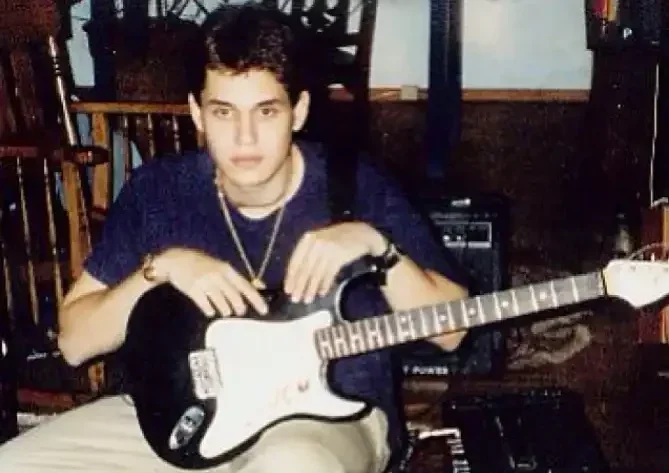
His 1996 Fender Stevie Ray Vaughan Stratocaster accompanied John Mayer throughout the formative years of his career, particularly during his time at Berklee College of Music, giving the instrument enormous sentimental value. The guitar remained one of his primary instruments until around 2003.
Mayer purchased the guitar in 1996, at the age of nineteen, using money he had earned working at a gas station. To help finance the purchase, he traded in a Takamine 12-string acoustic guitar along with a Mesa Boogie distortion pedal.
John Mayer replaced the original engraved black SRV pickguard on his Fender Stevie Ray Vaughan Stratocaster with a tortoiseshell guard. The modification appears to have been made very early on, as virtually every known photograph of Mayer using the instrument already shows it fitted with the tortoiseshell pickguard rather than the stock SRV one.
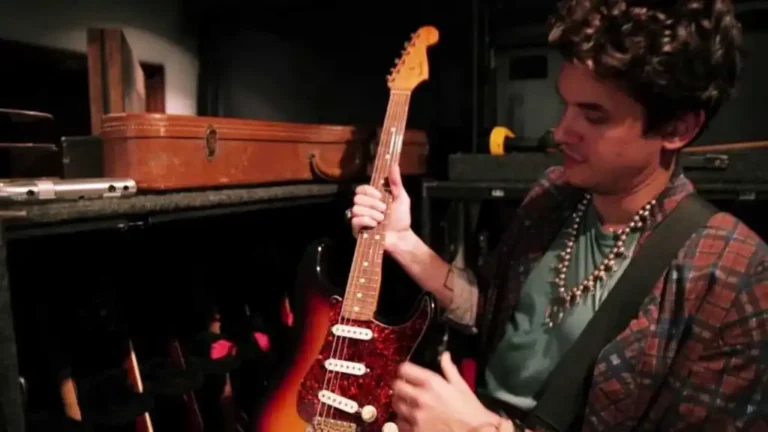
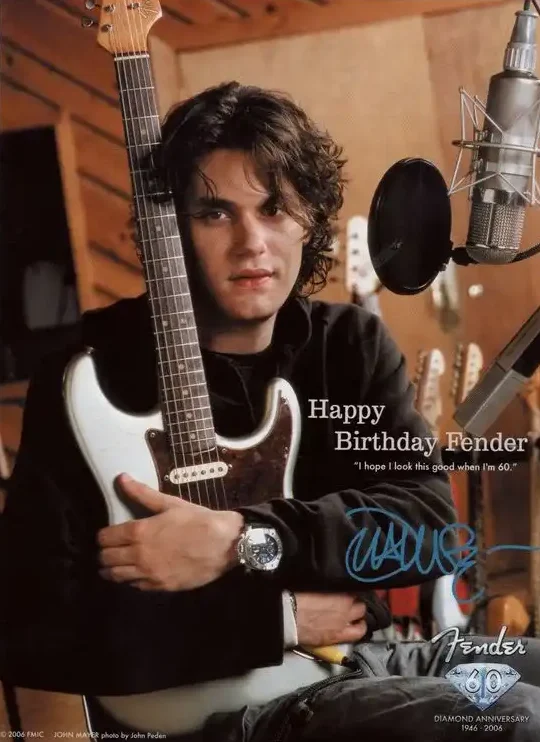
The combination of the 3-Color Sunburst finish and tortoiseshell pickguard would later become one of Mayer’s preferred Stratocaster aesthetics and likely influenced several of his later instruments. It also explains why this SRV Stratocaster is frequently mistaken for his famous 1964 Stratocaster, as the two guitars share a remarkably similar visual identity.
There are, however, several notable differences. Mayer’s vintage ’64 Stratocaster features a brighter, more heavily yellowed pickguard, along with significantly more pronounced and naturally aged wear patterns across the body finish.
Despite these similarities, the SRV Signature Stratocaster maintained a distinct identity of its own and ultimately became one of the most historically significant guitars of Mayer’s early career.
Over the years, John Mayer further modified and personalized the instrument. In the Paradise Valley Studio Sessions (2013), he pointed out several modifications and wear marks accumulated over time, each tied to a specific memory.
Mayer recalled that the tremolo assembly required a replacement after the vibrato arm snapped inside the bridge block.
The scratches and wear on the ball end of the headstock were attributed to another early habit: striking drum cymbals with the guitar during performances, something Mayer later admitted he thought was “really cool” at the time.
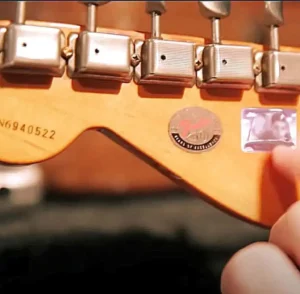
On the back of the headstock, Mayer also attached a sticker featuring himself and his Berklee roommate, Matt Mangano, taken at a sticker booth in Stone Mountain in 1998.
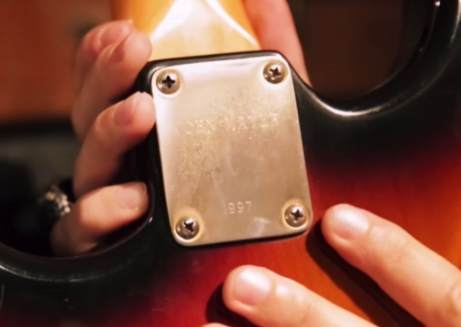

Mayer also described a series of early personal alterations that gradually turned the instrument into a deeply individualized object. One of the first occurred while he was still in high school, when he had the neck plate engraved at a shopping mall, adding the inscription “JOHN MAYER 1997” before leaving for Berklee College of Music.
Later, during his time at Berklee, he used an engraving tool in the dorms to add another personal mark directly on the guitar’s body, near the tremolo cavity, etching his name into the wood.
The worn finish visible on the instrument was not entirely due to years of playing. Mayer acknowledged that a significant portion resulted from deliberately distressing the finish, including sanding it with 400-grit sandpaper and, at times, picking away at the lacquer.
Another key detail concerns the pickups. According to Chris Fleming, the Texas Special pickups installed in Mayer’s SRV Stratocaster may have exhibited manufacturing variance relative to standard production specifications and may have been underwound. As a result, the pickups are described as producing a tone with a more pronounced mid-scooped response than typical SRV Signature models.
This specific tonal behavior would later serve as a reference point in the development of the “Big Dipper” pickups used in the Fender John Mayer Signature Stratocaster, translating that EQ profile into a deliberate design choice.
By late 2004, however, the guitar took a secondary role after Mayer acquired what would become his most famous instrument, the Black One. Around the same period, he also began incorporating other instruments into his rotation, including the Monterey Stratocaster, the Gold Leaf Strat, and various Custom Shop builds.
As a result, the SRV Stratocaster appeared less frequently during the John Mayer Trio and Continuum eras, though it still surfaced on occasion.
The last known performance featuring the SRV Stratocaster appears to have taken place on August 22, 2017, in Syracuse, during a rendition of “Covered in Rain.” Since then, the guitar has not been seen in Mayer’s documented live rotation.
Even so, its legacy remains immense. More than almost any other instrument in his collection, the 1996 SRV Stratocaster represents a direct bridge between the teenage blues enthusiast practicing in his bedroom and the internationally recognized guitarist Mayer would eventually become.
The Fender John Mayer Signature Stratocaster
From Prototypes to Production Model
The idea of a signature Stratocaster bearing the name of the young, promising guitarist began circulating at Fender in the early 2000s.
In June 2004, Fender Master Builder Chris Fleming crafted two prototypes of the Fender John Mayer Signature Stratocaster and entrusted them to John Mayer for use during his 2004 and 2005 tours. The instruments carried the serial numbers “JM001” and “JM002,” and both featured a “Proto” stamp positioned above Chris Fleming’s signature.
At the conclusion of the tours, Mayer retained the guitar bearing the serial number JM001, while JM002 was returned to Fleming in recognition of his work on the project.
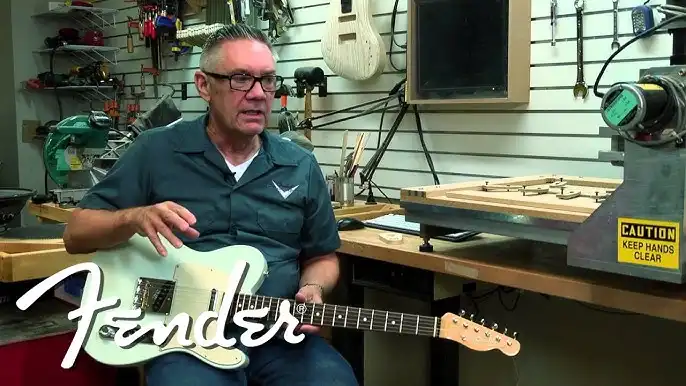
Chris Fleming also built two additional prototypes. Both guitars featured the handwritten inscriptions “Proto 1” and “Proto 2” above Fleming’s decal on the back of the headstock.
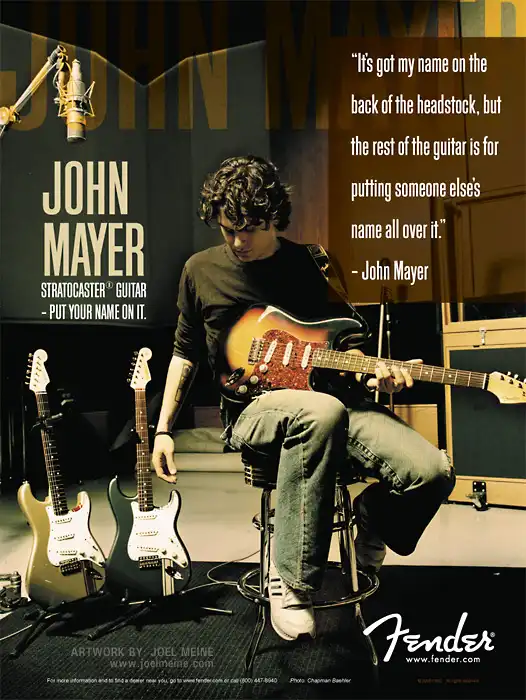
The production version of the John Mayer Stratocaster was based on the 1996 Stevie Ray Vaughan Signature Stratocaster, the model Mayer had relied on for much of his career up to that point, although it incorporated several notable departures from the SRV specification.
These included a conventionally oriented right-handed tremolo bridge, a thick “C”-shaped neck paired with an African rosewood fingerboard featuring a more curved 9.5” radius, and different pickguards: a 4-ply tortoiseshell pickguard on the 3-Color Sunburst and a 3-ply mint green pickguard on the Olympic White version.
Another subtle distinguishing feature was the placement of the string tree, which was farther from the nut than on standard Stratocaster models.
In addition to the 3-Color Sunburst and Olympic White finishes, the guitar was also produced for short periods in limited runs in Charcoal Frost Metallic (2005) and Shoreline Gold (2007), both featuring competition stripes.
There were also several special variants, including the 2007 Cypress Mica model and the 2010 Special Edition Black1—a more affordable version of the limited Custom Shop model unveiled that year.
The Big Dipper Pickups
One of the defining elements of the Fender John Mayer Signature Stratocaster was its pickups, developed with Mayer’s direct involvement. These pickups later became known as the “Big Dipper Pickups” and were available exclusively on Mayer’s signature instruments, never as a separate retail set.
As previously noted, the Texas Special pickups installed in Mayer’s 1996 SRV Stratocaster are described by Chris Fleming as potentially exhibiting manufacturing variance relative to standard production specifications and may have been underwound. The exact winding characteristics are not documented, but the resulting tonal response is consistently described as having a more pronounced mid-scooped character than typical SRV Texas Special pickups.
This tonal profile would later inform the development of the “Big Dipper” pickups used in the Fender John Mayer Signature Stratocaster, functioning as a reference point in shaping their EQ contour rather than a direct technical replication.
However, across multiple interviews and gear discussions, Mayer consistently expressed a preference for low-output, vintage-style pickups that do not compress the signal, prioritizing dynamic response and interaction with the amplifier over raw output. This later became the conceptual basis for the Fender “Big Dipper” pickup set.
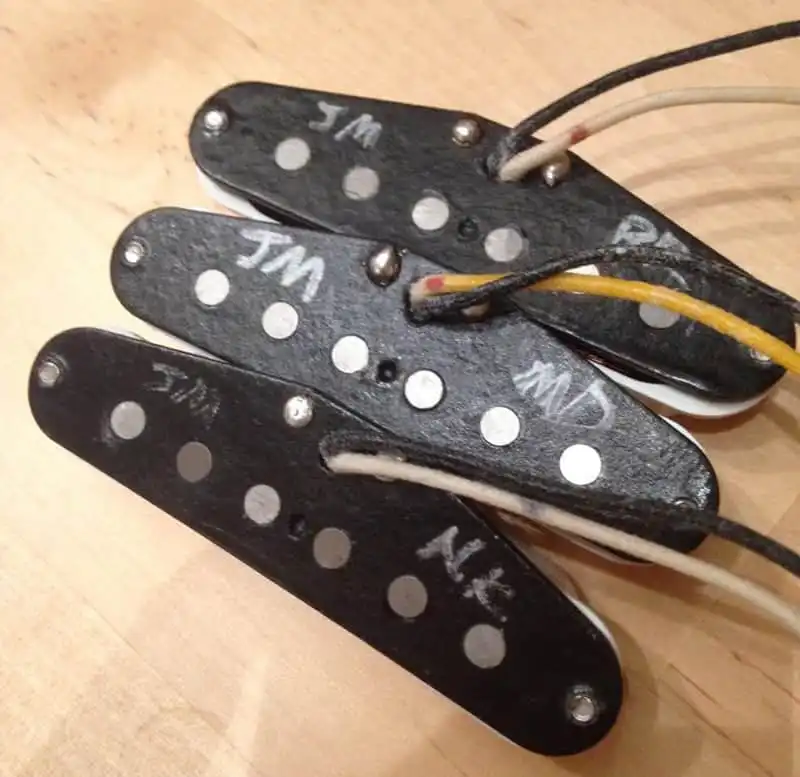
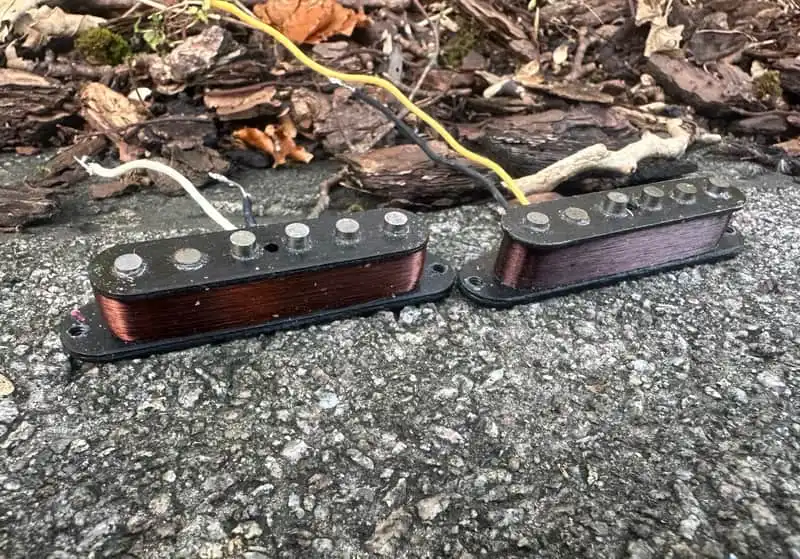
The Big Dipper pickups were AlNiCo single-coils featuring staggered pole pieces, black vulcanized fiber top and bottom flatwork, and plain enamel insulation wire.
Compared to many contemporary Stratocaster pickups, the Big Dippers were relatively low-output units, emphasizing clarity, dynamic response, and a pronounced scooped-mid character. DC resistance values measured approximately 5.68 kΩ at the neck, 5.89 kΩ at the middle, and 6.37 kΩ at the bridge.
Each unit was individually marked by hand with a white marker, with a consistent “JM” inscription across all three pickups. In addition, position-specific identifiers were present: “NC” on the neck pickup, “MD” on the middle pickup, and “BR” on the bridge pickup.
The pickups also featured cloth-covered lead wires, with black-and-white leads for the neck and bridge positions and black-and-yellow leads for the middle position.

The Black One
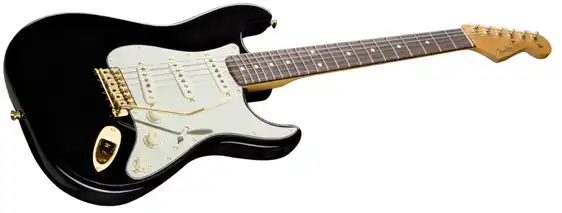
Before becoming an endorser for PRS Guitars, John Mayer’s main guitar was the “Black One,” a Black Fender Stratocaster with gold hardware and vintage-style bridge built at the Fender Custom Shop by Master Builder John Cruz with the involvement of Mayer himself.
Mayer initially wanted a guitar with virtually no finish at all, convinced that the instruments played by Stevie Ray Vaughan, Bonnie Raitt, and Rory Gallagher sounded exceptional because bodies with very little paint resonated more freely.
For him, the relic treatment was never simply about aesthetics or making a guitar “look old.”
It was a technical concept: he wanted as little paint on the body as possible, without making the instrument appear stripped or unfinished.

“Vintage guitars are great because they only had a couple of layers of paint and maybe one thin layer of lacquer. So, the idea became, ‘I’d like a guitar that doesn’t have any paint on it.’ But when I started thinking about it, the idea of a guitar with no paint at all felt a little too rustic for me.”
John Mayer
Mayer visited the Fender Custom Shop in October 2004 and personally took part in the construction of the Black One. During his first day there, he toured the facility and met all of the Master Builders. He later recalled picking up the prototype of the recently released Stevie Ray Vaughan Number One tribute model, built by John Cruz, and being immediately struck by the neck profile: “Man, I kind of like this neck.”
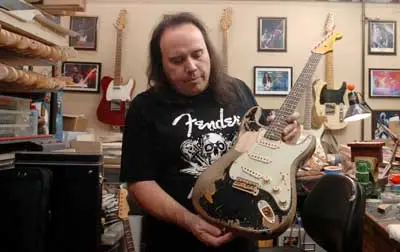
At that point, John Cruz told him he had several other necks with round-lam rosewood fingerboards carved to the same specifications.
After selecting the neck, John Mayer was taken to the body-building area. Mike Eldred, then head of the Fender Custom Shop, handed him a pair of safety glasses, led him to the alder stock, and invited him to choose a suitable body blank. With John Cruz’s assistance, Mayer personally selected the piece of wood that would become the body of the Black One.
“I picked out a piece of wood and knocked on it as if I actually knew what I was doing,” Mayer later joked.
Mayer was then brought to the CNC router, where Eldred showed him how the body was shaped, how the Plexiglas templates were aligned, how knots in the wood were avoided, and how the body contours and radiused edges were cut and refined.
Although Mayer participated directly in the work, it was carried out under the careful supervision of the Custom Shop staff. Still, the experience was enough to make him feel genuinely involved in building the instrument.
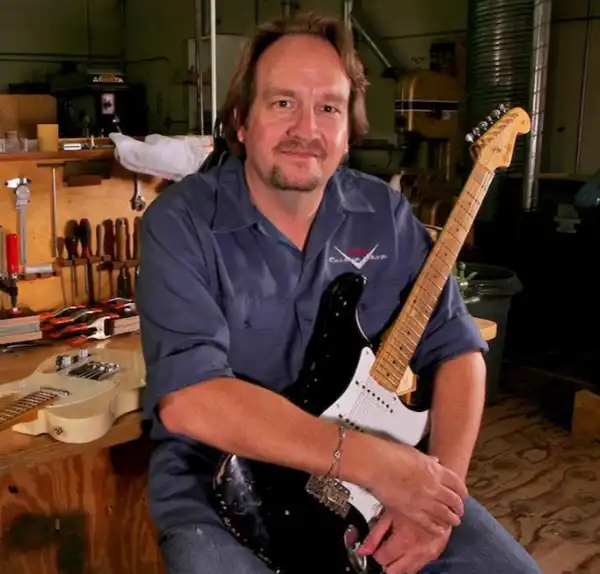
“He did the sanding, and then I took him into paint. He did this horrible paint job, with runs in it and everything, and I said, ‘Okay, this is your guitar.’ John Cruz relic’d it up for him.”
Mike Eldred

Mayer also remembered walking around the workshop asking everyone who had contributed to the instrument to sign the inside of the guitar.
At the end of the second day, Mayer signed the back of the headstock with “John Mayer 04,” the “04” referring to the year 2004. He then sprayed the body black himself and tinted the neck. “It’s proof positive that I was there before the lacquer went on.”
One particularly interesting detail is that the headstock had originally been drilled for vintage-style tuners. Those holes were later plugged and fitted with Schaller-style tuners with pearl buttons, intentionally giving the impression of aftermarket replacement keys.
John Cruz had also applied one of Norm’s Rare Guitars’ iconic “Have a Nice Day” stickers to the body, relicing it together with the finish.
Mayer left the guitar at the Custom Shop to be assembled with custom-wound, ‘60s-style single coil pickups and distressed by John Cruz, who later sent it to Mayer.
The Black One arrived at his apartment in November 2004 while he was away for the weekend. As soon as he received confirmation from FedEx that it had been delivered, he rushed home to open the case.
“As a guitar player, when you know there’s something really special inside a case you’re about to open, you take that extra moment. You undo all the latches, but before opening it, there’s almost this feeling like birth. You pause for one second and think, ‘Alright, here we go. What are you going to be like? Are you going to be any good?’ Then I opened the case—and there it was. It was distressed, but beautiful.”
However, when Mayer first plugged in the guitar, he immediately realized something was wrong.
He left the instrument in the freezer overnight.
“I was honestly heartbroken. I knew the guitar could be something special, but it just wasn’t responding properly. I got so desperate that I literally put the guitar in the freezer overnight because I felt like something molecular had to happen to it. The next day I took it out, started playing it, and it still wasn’t there—it was just cold.”
John Mayer
Fortunately, after disassembling the guitar, he eventually discovered that part of the guitar’s grounding circuit had not been connected properly. As soon as the issue was fixed, the instrument “suddenly came alive.”
Around that same period, Mayer began working on Continuum. The Black One was used to record songs such as Bold as Love and I Don’t Trust Myself (With Loving You). Mayer also used it on an unreleased track titled Over and Over, which ultimately did not make the album.
“For me, this guitar almost became a voice. Even without effects, there’s something in the way it sustains and reacts that lets me hold notes exactly the way I want to. It shaped the way I wrote those songs. And beyond the sound, it’s the only guitar I own that almost seems to have developed its own identity—its own fame.”
He later reflected: “Part of having a voice as a guitar player is obviously your phrasing and style, but another part is the tone itself. This guitar gave me a voice that felt distinctly my own. And over time, you learn every detail of an instrument: the string tension, the spacing between the strings, the fret height, exactly how far you need to push a bend. Everything becomes incredibly articulate and natural.”
The original neck later warped severely enough that John Cruz built a replacement in May 2014. In 2017, however, John Mayer ultimately decided to reinstall the original neck on the guitar.
The Black1 Reissue Project
Following a meeting between John Mayer, Mike Eldred, and Justin Norvell, Fender approved the development and commercial release of a limited run of Black One-inspired guitars. Although the project had already been discussed for approximately two years, Mayer’s touring and recording commitments postponed it until 2010.
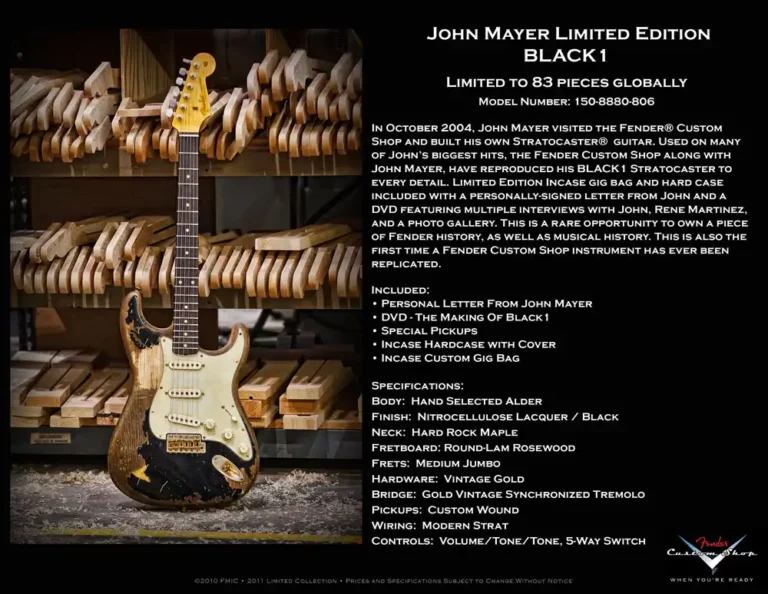
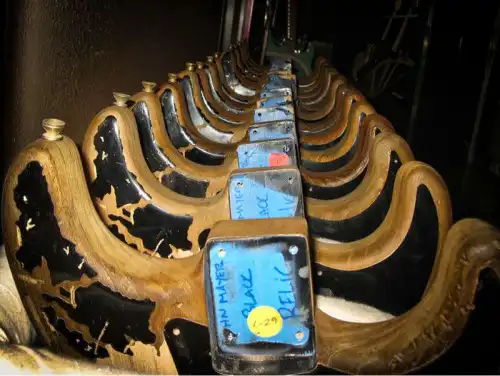
The Custom Shop introduced a highly limited master-built run of 83 Black One Replica Stratocasters, officially marketed as the John Mayer Limited Edition Black1. In the same year, Fender also released 500 Special Edition Black1 Stratocasters, representing a more accessible production-line version of the master-built model.
The 83 John Mayer Limited Edition Black1 Stratocasters, all crafted by John Cruz, represented the most exclusive tier of the 2010 Black1 recreation and were quickly allocated upon release.
The instruments featured custom-wound ’60s-style pickups, standard wiring, and a gold vintage-style tremolo. The headstock was drilled for vintage-style tuners; the original holes were subsequently filled, and Schaller-style tuners with pearl buttons were installed to replicate the modified hardware configuration of Mayer’s original Black One.
“I’m selecting the wood very carefully, so the weight and the grain are similar to John’s own guitar, and I’m tone-tapping each body for tonality,” recalled John Cruz.


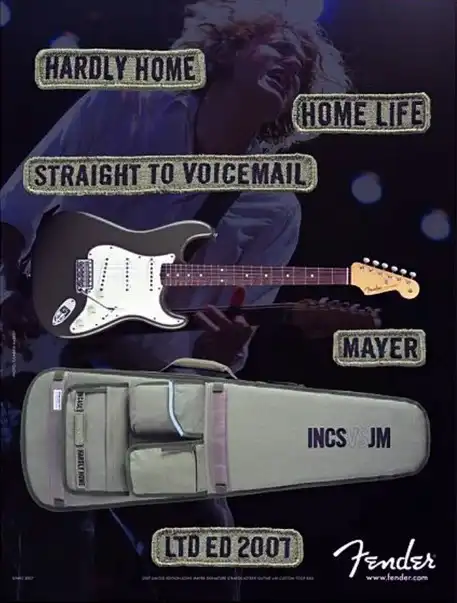
The Special Edition Black1 Stratocaster shared several core specifications with the Fender John Mayer Signature Stratocaster, including Big Dipper pickups, the neck profile, and the electronic configuration. It also featured gold hardware, Schaller die-cast tuning machines with white pearloid buttons, and an exclusive Incase gig bag equipped with modular accessory pouches and patches.
Unlike Mayer’s personal Black One, the Black1 was not artificially relic’d and was left in a pristine factory condition.
However, Mayer’s intention behind this approach was to allow “everyone to make their own trouble on it,” letting the instrument naturally accumulate wear over time.