Fender Japan Part #9
Paisley and Blue Flower Stratocasters
THE STORY OF THE FINISHES THAT DEFINED AN ERA
Table of Contents
ToggleWhat is Paisley?
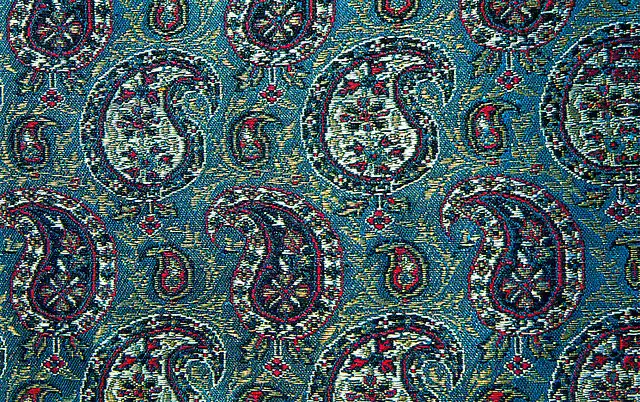
Paisley is a decorative pattern derived from boteh or buta, a droplet-shaped plant motif of Persian origin. It became popular again in the 1960s because it resembled the psychedelic designs associated with LSD culture.
Between 1968 and 1969, Fender released a Paisley version of the Telecaster, which became famous thanks to James Burton, Elvis Presley’s legendary guitarist.
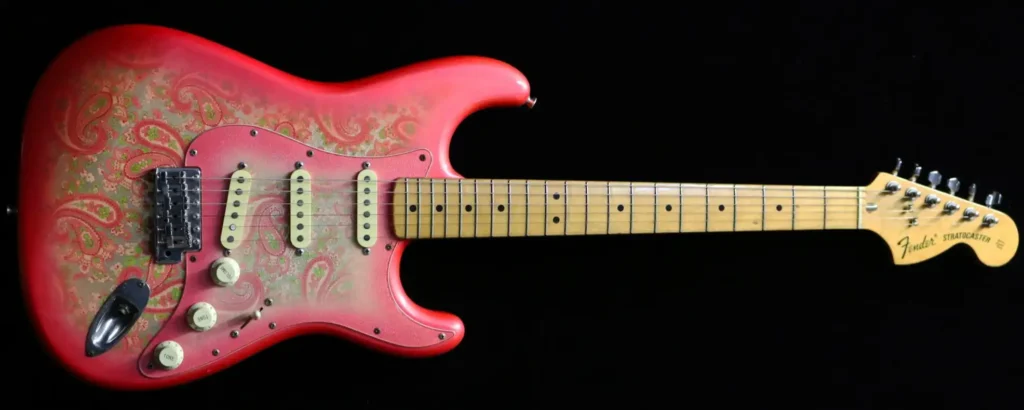
In the 1980s, Fender Japan expanded this distinctive finish to the Stratocaster.
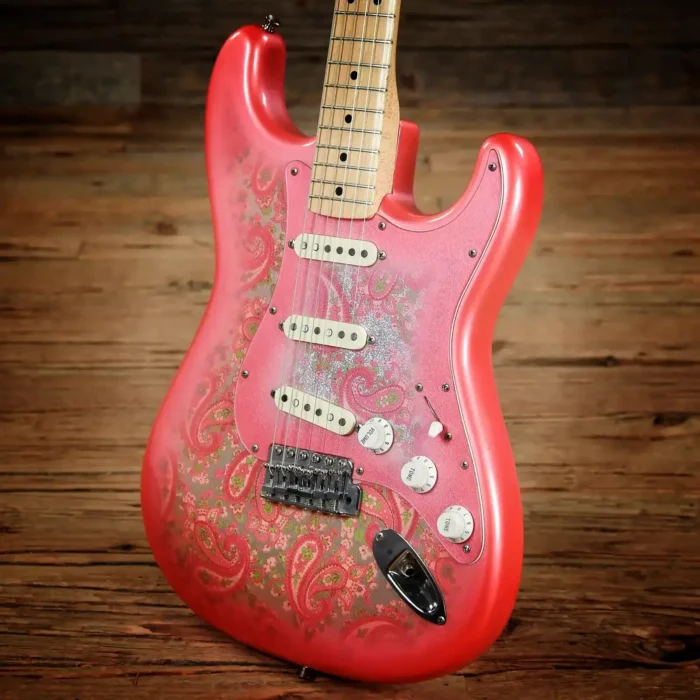
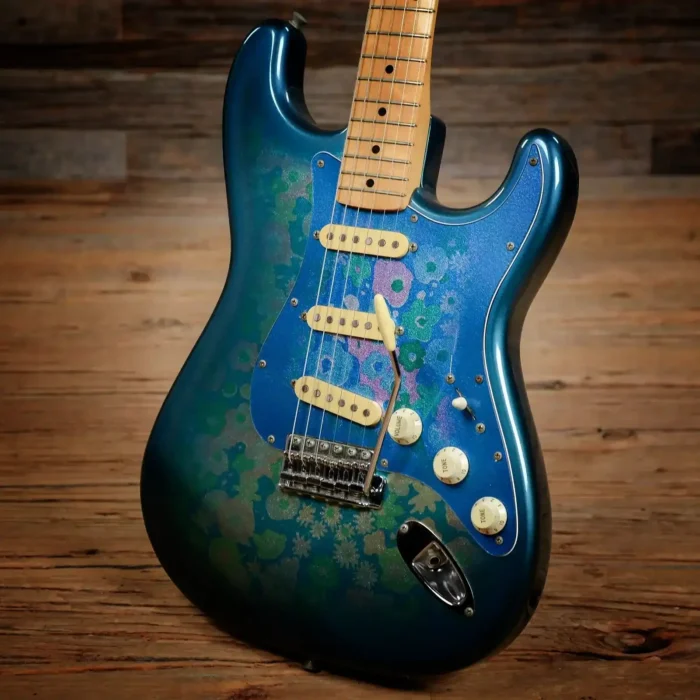
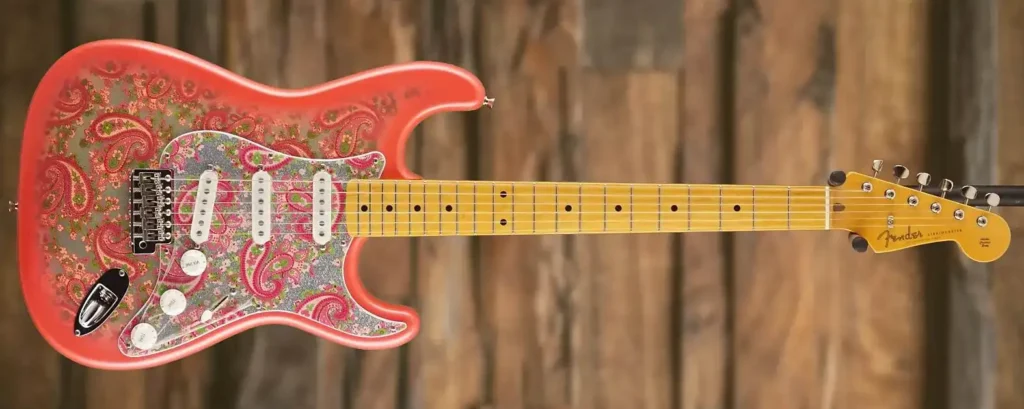
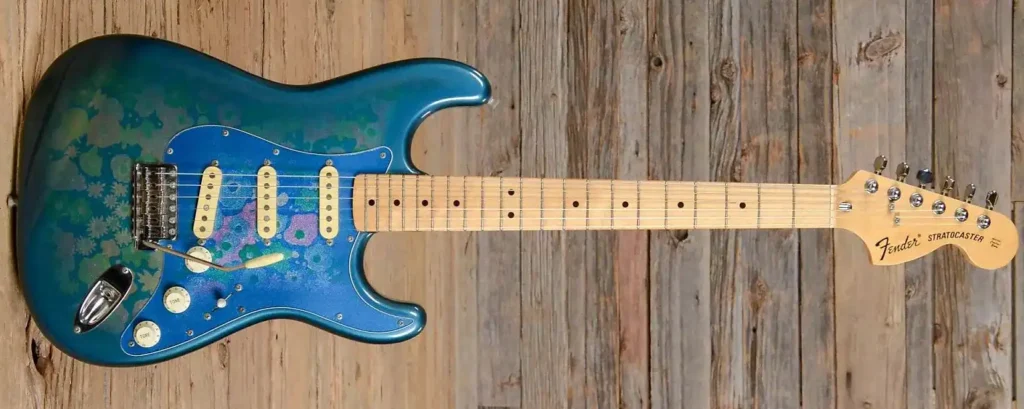
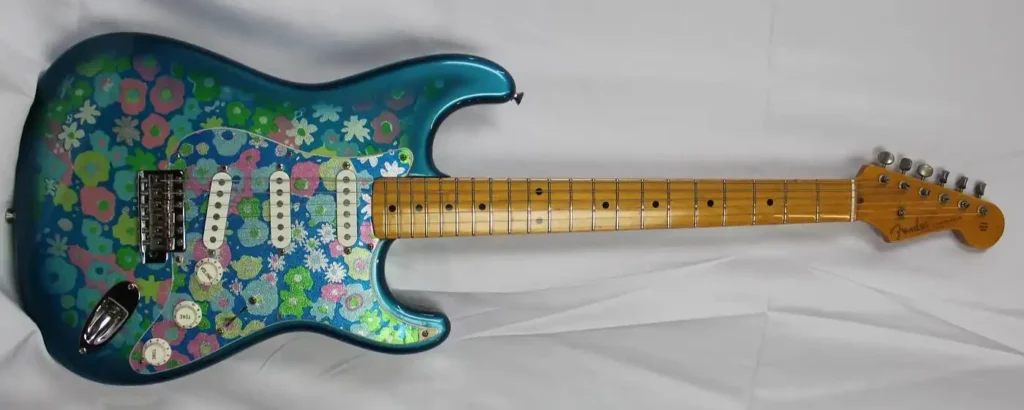
The Paisley Stratocaster and the Blue Flower Stratocaster (featuring floral patterns instead of Persian drops) were produced straightforwardly: the designs were printed on thin, high-quality paper sheets and then glued to the front, back, and pickguard of the body.
A pink burst finish was applied to the edges of the Paisley model, while a blue burst finish was used on the Blue Flower. Finally, the entire body was sealed with a clear coat for protection.
Paisley Strat Prototypes
In late 1986, Dan Smith contacted Makoto Sugimoto at the Fujigen factory. Dan explained that he was curious to see if there was interest in reissuing the Paisley instruments of the late ‘60s and asked if a couple of samples could be prepared for the upcoming NAMM show.
Makoto replied that he could probably get the guitars ready in time, but it would be impossible to source the exact Paisley paper used on the originals at such short notice. Dan understood and emphasized that the guitars didn’t need to be perfect reissues at this stage, since he wasn’t yet sure there would be enough interest in them.
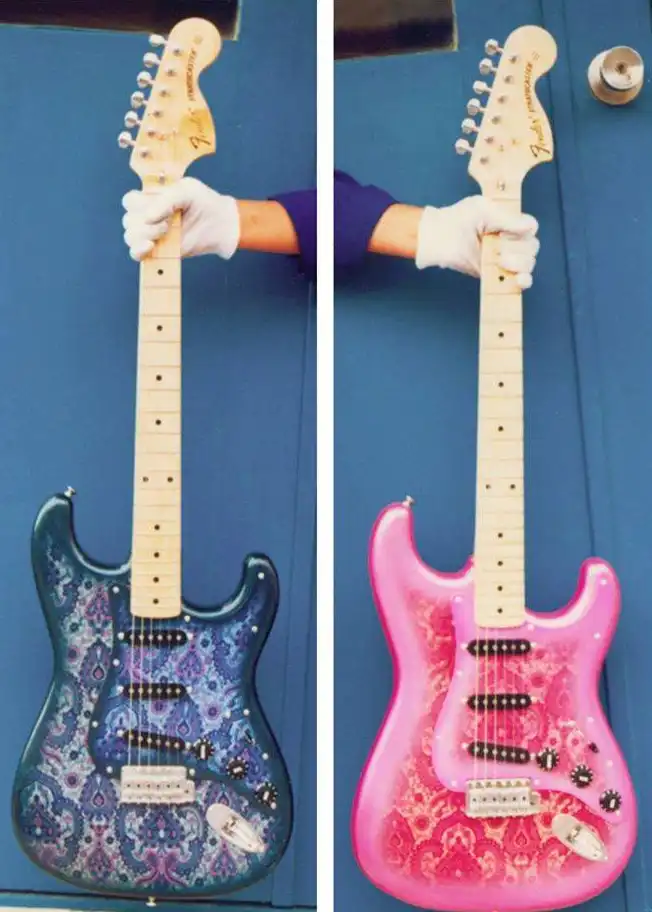
Nick visited a local Indian curio import shop in Matsumoto, where he found some shirts with Paisley-like patterns. Studying them closely, he realized they could work for his project. He bought two pink and two blue shirts, cut out the backs, and glued the fabric onto the front and back of two Stratocaster body blanks. With the help of a Japanese painter, he then developed the exact shades of pink he needed and eventually completed two prototypes.
The response was positive. Dan placed an order with Fujigen and provided Nick Sugimoto with one of the two original pieces of pink Paisley foil-embossed paper he had located at Fender. Nick then took the paper to a company in Tokyo, which made an exact replica.
The first paisley and blue flower reissues
The first production instruments were, of course, Telecasters, but the large-head Paisley Stratocaster ST72-125PRD was soon added to the lineup. This model was produced exclusively for the Japanese domestic market between 1987 and 1989. It featured a white ash body with a nitrocellulose clear coat and US flat-pole pickups. Over time, the finish tended to yellow, significantly altering the guitar’s original color. In 1988, the blue Flower ST72-75BFL was also introduced.
Limited edition export Paisley Stratocasters and Blue Flower Stratocasters appeared in Fender catalogs in late 1987 and 1988, respectively, and remained listed for several years. Unlike the ST72-125PRD, these models featured a basswood body with a polyester finish and were fitted with different pickups. Fender produced them again as limited editions in 2002–2003 and 2008.
There were notable differences between the export Paisley and Blue Flower Stratocasters of the 1980s and 1990s and the later reissues. The original models featured a ’70s-style large headstock with a bullet truss rod and CBS black logo, a 3-bolt neck plate with micro-tilt, an 11-hole pickguard, Gotoh cast/sealed tuning machines, and a die-cast bridge. In contrast, the 2002–2003 and 2008 reissues had a small headstock with a Spaghetti logo, a 4-bolt neck plate, an 8-hole pickguard, Kluson-style tuning machines, and a vintage-style bridge.