Fender Custom Shop #4
Relic Guitar: The Cunetto Era
HOW FENDER’S ANTIQUING EXPERIMENT BECAME A REVOLUTION

Table of Contents
ToggleThe first “unofficial” Fender relic guitars
One of Fender’s most significant achievements in the second half of the 1990s was the introduction of relic instruments: brand-new guitars crafted to appear heavily used, long-played, and, in some cases, even mistreated.
The concept itself was not entirely new when the Fender Custom Shop began offering aged guitars. For years, many luthiers had artificially aged instruments—either to blend repairs seamlessly into valuable vintage originals or, less ethically, to produce convincing replicas.
The first aged Fender guitars probably date back to the late 1970s, when Gregg Wilson asked John Page to build a UV aging box from an old Rogers bass drum shell with a sun lamp inside to try to age the finishes. He also tried to age some plastic parts by soaking them in coffee.
In the 1980s, Dan Smith and John Hill, Artist Relations and Brand Directors for Europe, relied on trusted outside specialists to remove finishes from necks and replicate the worn feel of historic instruments for some of the era’s most influential players.
At the time, the process was not yet called “relicing” but “antiquing,” as Smith and Hill described it. What would later become a defining production feature actually originated as a customization service developed within Fender’s Artist Relations program.
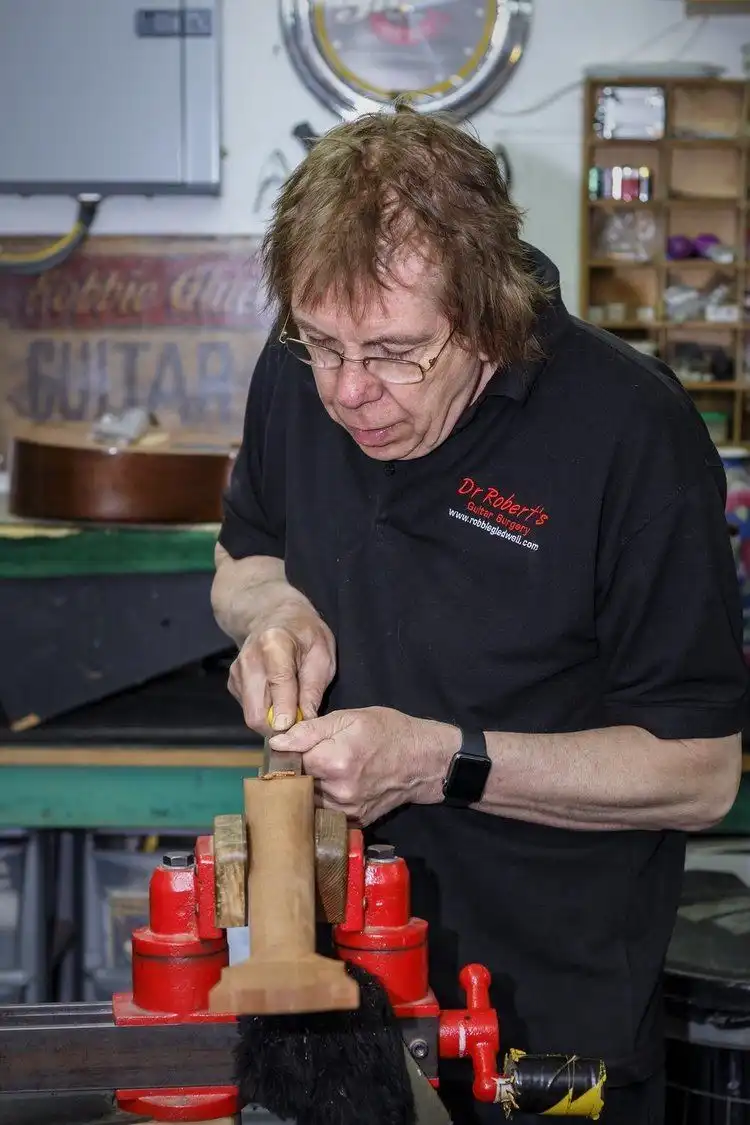
The term reportedly stemmed from Robbie Gladwell’s workshop in England, where John brought a neck built for Eric Clapton to age, since Clapton did not want to play a guitar that looked or felt new.
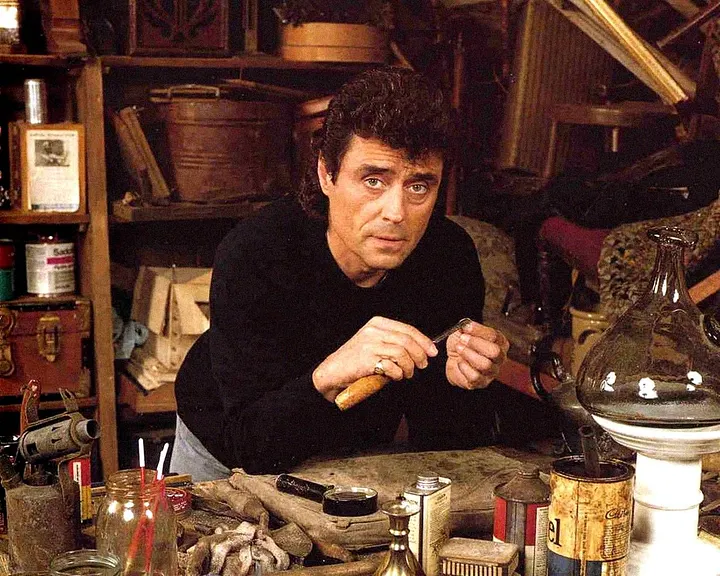
Smith and Hill referred to the procedure as “antiquing” because Gladwell’s workshop resembled that of a traditional antiques dealer—much like the character portrayed by Ian McShane in the British TV series Lovejoy—where objects were carefully treated to appear older than they truly were.
However, many other prominent artists soon requested aged instruments, including David Gilmour, Jeff Beck, Jimmy Page, Keith Richards, Ritchie Blackmore, George Harrison, Mick Ralphs, Andy Summers, Dave Murray, and Sting.
Despite growing demand from high-profile players, Dan Smith and John Hill faced significant internal resistance. They engaged in repeated corporate disputes with Bill Schultz, who regarded the idea of factory-aged instruments as a form of “forgery.”
As a result, reliced guitars were not approved for broader production until the 1990s, when figures such as J.W. Black, Vince Cunetto, and John Page became directly involved, helping formalize and scale the aging process within Fender’s production framework.

Vince Cunetto
Jay W. Black was hired by John Page as a master builder at the Fender Custom Shop in 1989. Black had no opportunity to apply relicing techniques at Fender until the early 1990s, when Don Was—preparing to perform with Bonnie Raitt at the Grammys—requested a new bass that looked more “played-in.”
This request sparked Black’s creativity, prompting him to consider whether launching a line of guitars with artificially aged finishes could be a successful idea—or merely something that would make people laugh at him.
Black then decided to reach out to Vince Cunetto, who at the time had not yet worked professionally as a guitar maker, though he already had a long-standing passion for crafting vintage-style electric guitars.
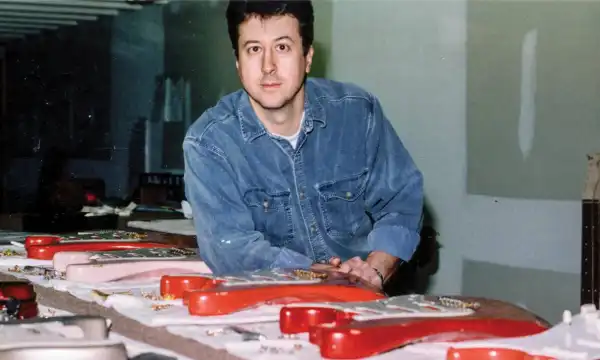
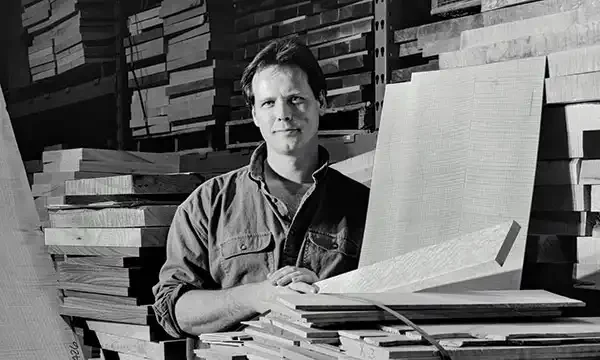

“I started trading, buying and selling vintage guitars on the side in about 1984 or 1985,” Cunetto recalled in an interview with Dave Hunter (Guitar Magazine). “I got hit with the bug to have a vintage Telecaster of my own, but I couldn’t afford any of the ones I was trading myself, so I started farting around with trying to age guitars in the mid ‘80s—doing a lot of research into Teles and blueprinting them. I’d borrow Telecasters from Jim Colclasure [a famed vintage guitar dealer in Kansas City, Editor’s Note], and I’d machine pin-router templates, and I’d buy the wood, and I’d take it to a company that had a nice old pin-routing machine, and I started making Tele bodies. Then I started finishing them. When I was a kid, I had worked in this body shop, and that’s how I learned to spray lacquer.”
Vince Cunetto figured out how to duplicate old decals from actual photographs, scale them accurately, and produce truly authentic reproductions. He began selling them at guitar shows, which caught the attention of J.W. Black, already working at the Fender Custom Shop.
“We know you’re the guy making these decals, and it’s not cool, but if you quit doing that and you make them for the Custom Shop the way you made them for everybody else, it will be cool!” the Master Builder reportedly told him.
Cunetto then began working for the Fender Custom Shop, producing period-correct logo decals for one-off instruments and short runs, as well as aged components—such as the distressed pickguard used by J.W. Black to restore Ron Wood’s vintage Broadcaster.
From there, it was only a small step from creating decals and aged parts to applying the aging process to complete instruments.

Distressed Jackets, Why Not Guitars?
Vince Cunetto decided to show John Page, head of the Fender Custom Shop, a Stratocaster in Shoreline Gold that he had already aged, aiming to convince him to launch a line of relic instruments. Persuading Page, however, proved to be fairly straightforward.
“If people bought distressed leather jackets, jeans, and reproduction antiques, why not guitars?”
John Page
“All the parts and finish on the guitar were aged and patina’d to look like an authentic vintage instrument. It was very convincing,” J.W. Black added.
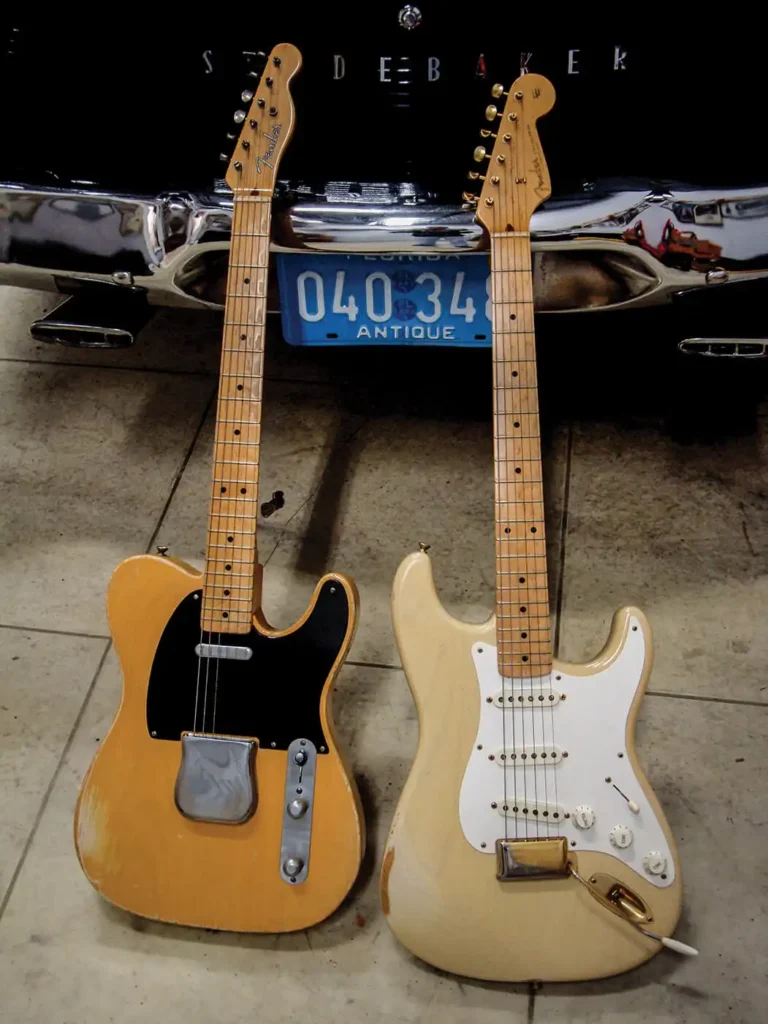
John then decided to proceed quietly, without informing anyone, both to gauge reactions and because he was unsure whether Fender’s leadership would embrace the idea. He asked Vince to age a couple of prototypes for the 1995 Winter NAMM Show: a ’50s Butterscotch Blonde Nocaster and a ’57 Stratocaster in Two-Tone Sunburst.
By the end of 1994, however, Black and Page decided to change the ’57 prototype to a Mary Kaye model with gold hardware. Vince then completed several prototypes showing varying levels of wear. Black and Page ultimately selected one Butterscotch Blonde Nocaster and one Mary Kaye Strat.
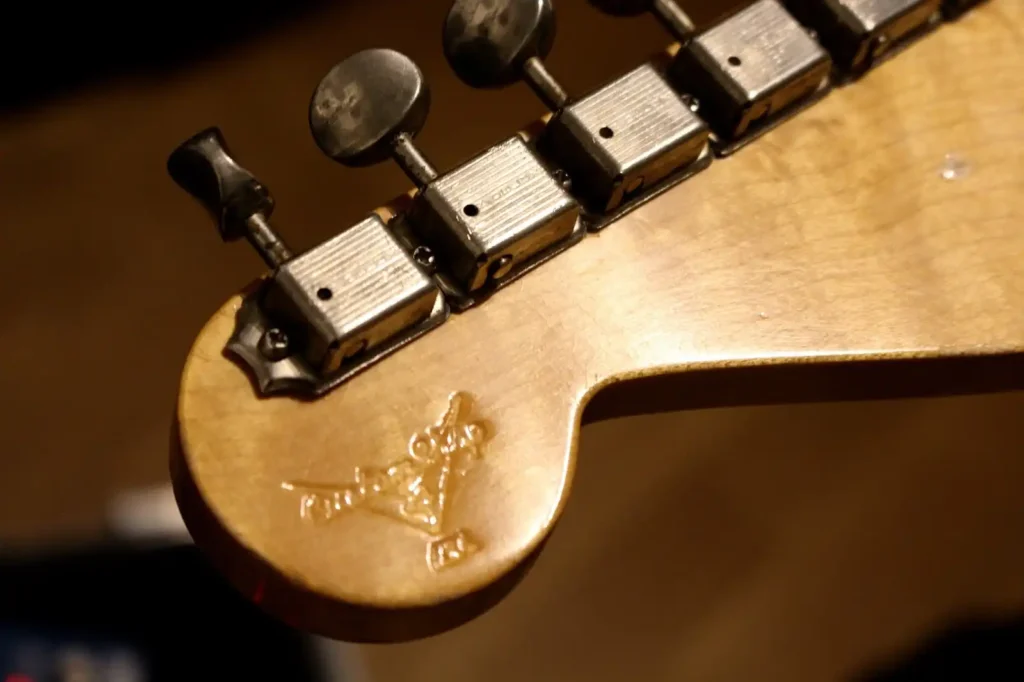
To prevent counterfeiting or confusion among the public, Page used steel stamps to mark the word “Relic” into the bodies and the Custom Shop logo on the backs of the headstocks.
These instruments were displayed in a showcase at NAMM, creating the impression that they were genuinely two vintage collectible guitars. No one suspected the ruse, and when the true nature of the instruments was revealed, Fender received hundreds of orders.
Mike Lewis, then head of Fender’s marketing department, remarked, “Hell yeah, we’re going to do this! Who wouldn’t want to play this?”
The Cunetto Creative Resources
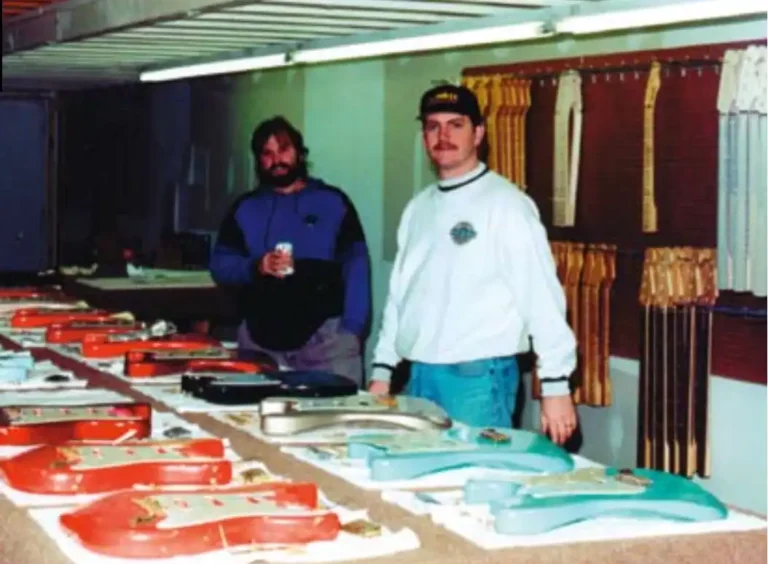

In the spring of 1995, with Page’s agreement, Cunetto began working with two assistants, Tony Morford and Terri Shaw, in his Bolivar, Missouri, workshop, Cunetto Creative Resources. Each week, Fender sent boxes containing parts for 20 guitars—bodies, necks, and all components that needed to be aged. On June 27 of the same year, Cunetto shipped the first batch of aged “kits” to Fender, comprising twenty relic Nocasters ready for assembly.
Sales grew steadily, and the Relic Series quickly became a firmly established, mainstream production line in the Custom Shop catalogue.
In 1996, Cunetto established a larger facility, where he and his team were sending 40 kits of aged instrument parts to Fender each week.
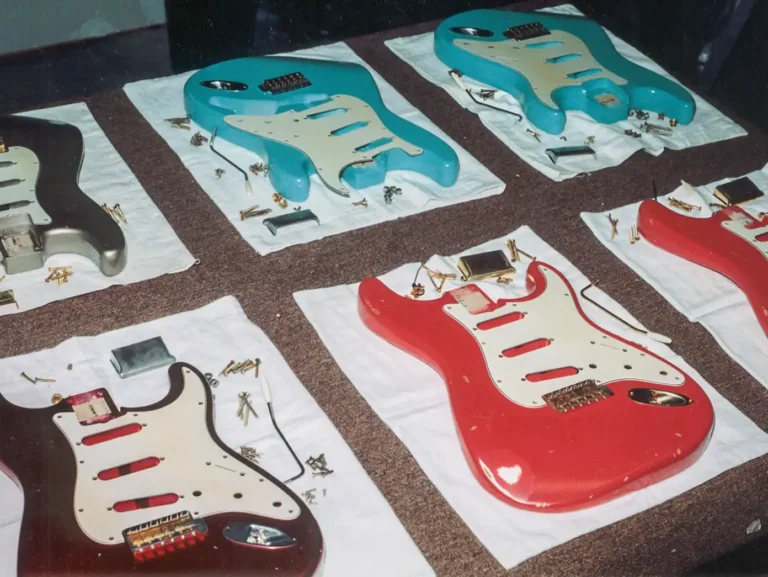
Vince worked the wood much as it had been done in Leo Fender’s era, sanding everything by hand. He applied a slightly yellowed clear coat to simulate the natural aging of the finish and developed techniques to reproduce the cracks often seen on vintage guitars as authentically as possible. Vince approached the old Fenders like an archaeologist. He investigated many old instruments to examine their patterns of neck wear, body wear, scratches, and even rust.
“For each guitar we aged,” recalled Vince, “We would actually imagine an individual player with his own style and approach, and everything was done in keeping with that player. Maybe he was a country rhythm guy, so all the finger wear would be in the first positions, with strum wear around the upper frets and pickguard wear consistent with that. There’s a real art to it.”
Vince remained skeptical that aging had any real impact on an instrument’s sound, and he questioned the common belief that nitrocellulose lacquers improved quality. For him, the true factor was the thickness of the finish. Still, he valued nitrocellulose for the unique visual character it gave the guitar and took care to preserve all of Fender’s original color formulas, ensuring that every relic instrument retained the look and spirit of its vintage predecessors.
The last batch
Things began to change in 1998, when part of the Custom Shop was relocated to the facility that would become the new Cessna Circle factory in Corona, and when John Page—who later became the first Executive Director of the Fender Museum of Music and Arts—resigned in November 1998, succeeded by Mike Eldred. During this period, Fender made significant investments in new paints and in methods for applying nitrocellulose lacquers that complied with California’s strict environmental regulations. At the same time, they began studying and developing their own techniques for aging instruments.
The collaboration between Fender and Vince Cunetto continued until 1999. Fender then began producing relic guitars at the Corona plant, following a roughly six-month transition period during which instruments were aged at both locations. Between May and June 1999, the final batch of relics from the Cunetto era was sent to Fender.
Vince Cunetto struck out on his own in 2003 by founding Vinetto Guitars. Meanwhile, J.W. Black left FMIC in 2002 and relocated to Oregon, where he specialized in repairing vintage Fenders and other guitars and creating his own line of F-style instruments, JW Black Guitars.
It is noteworthy that none of Vince Cunetto’s techniques were shared with the Custom Shop, making Cunetto Stratocasters especially sought-after by collectors.


How to Spot a Cunetto-Era Fender Relic Guitar
To distinguish a Cunetto-era Stratocaster Relic from those produced later by the Custom Shop, simply examine the back of the headstock: on Cunetto guitars, the Custom Shop logo was stamped into the wood, whereas on later Custom Shop models it was a decal.
Additionally, Cunetto and his assistants stamped the components with a code indicating the year, day of the year, and lot (Y-DDD-LL). For example, the code 714219 meant “the 142nd day of 1997, lot 19.”
Toward the end of the Cunetto era, some parts were also dated using a month/day/year format (MM/DD/YY).