Squier Made in China and Indonesia #2
The first Chinese Squiers
THE AFFINITY SERIES, THE SQUIER STRAT, AND THE SQUIER PACKS


Table of Contents
ToggleThe first Squiers made in China
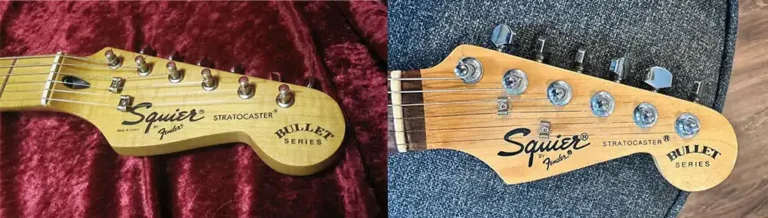
The first Chinese Squier guitars were produced in late 1994 at the Yako factory and appeared in the 1995 price list under the name Squier Bullet SRS Stratocaster. These guitars closely resembled the earlier Korean-made Bullets, sharing low-quality hardware, and some units even had plywood bodies. They featured a neck plate stamped with “MADE IN CHINA” and a serial number starting with the prefix “NC” followed by a six-digit number.
Shortly after the SRS Bullet, an unusual Squier Strat was released. This model wasn’t even listed in any catalog or price list, which added to the confusion in the Squier lineup.
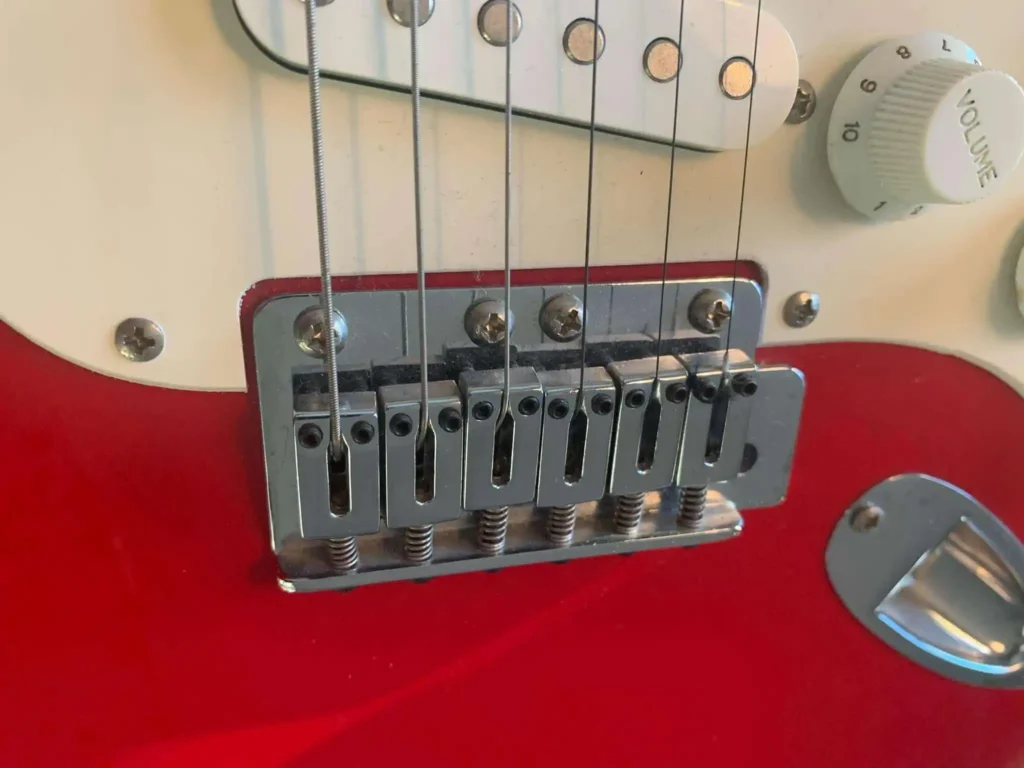
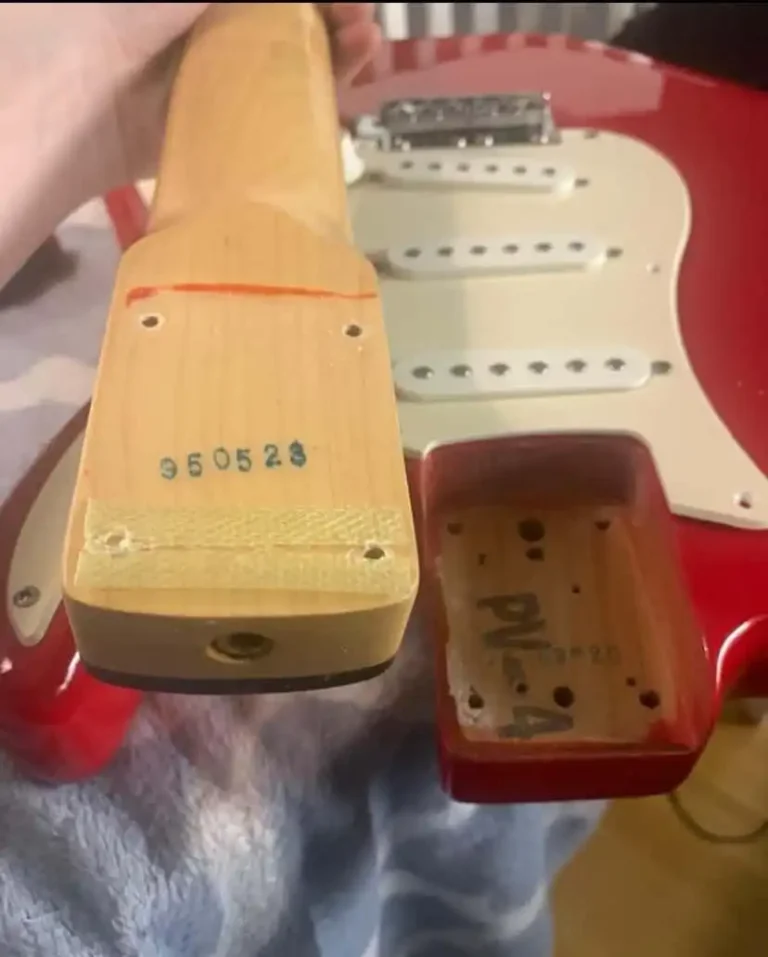
This quirky Strat had a 4-screw bridge similar to those on Peavey or Encore guitars from the ‘90s. The body featured a “PV-4” stamp in the neck pocket, along with a 6-digit date stamp on both the neck pocket and the heel of the neck. Its body closely resembled that of the 1990s Peavey Predator, with identical stamps and bridge. The only difference was that this Squier Strat lacked the micro-tilt hardware usually found in the neck pocket.
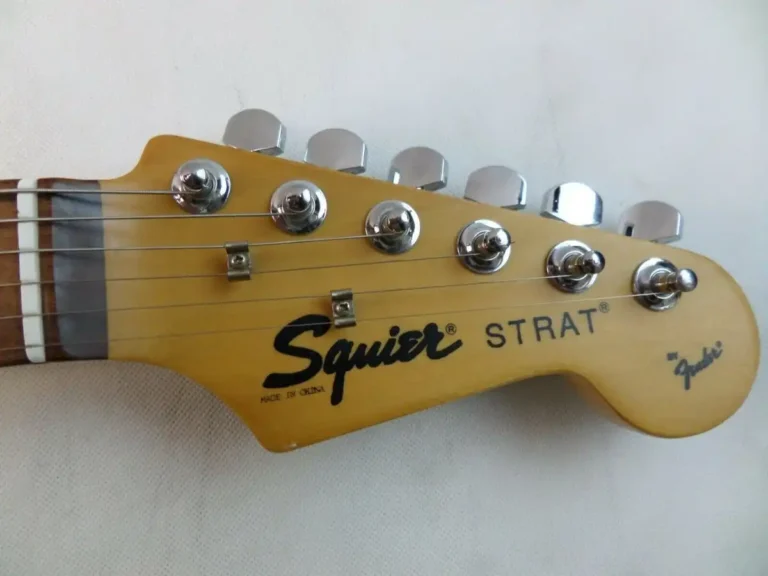
The headstock displayed the black Squier logo, along with the words “STRAT,” “BY Fender,” and “MADE IN CHINA.” However, some units didn’t even have “MADE IN CHINA” on the headstock or anywhere else on the guitar. Additionally, these guitars lacked serial numbers entirely!

This Squier Strat started appearing at dealers in 1995. At first, only small quantities were shipped, but enough for each store to have a few. Dealers who ordered the SRS Bullet in 1995 sometimes received these unusual Squier Strats or a mix of both models.
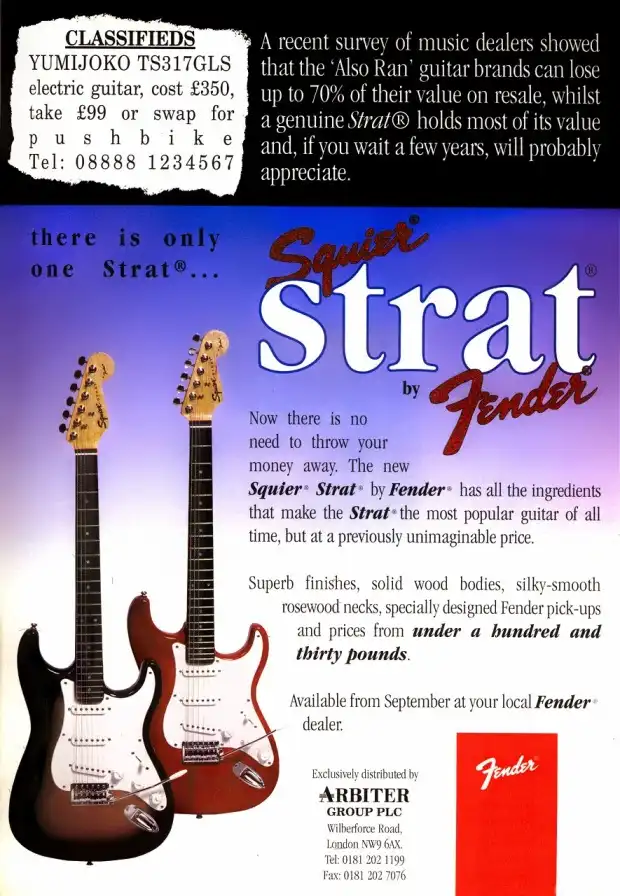
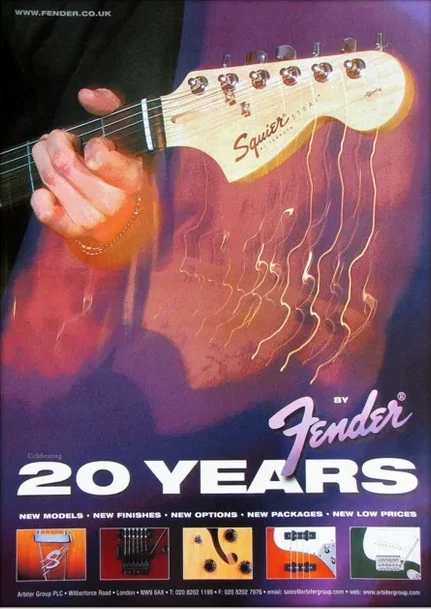
By mid-1995, the Squier Strat was first advertised in the UK. However, it looked slightly different from the odd “PV-4” model, with a standard 6-screw bridge and 22 frets, though the truss rod nut adjustment remained at the neck heel, as on the PV-4.

The Squier Tradition Series
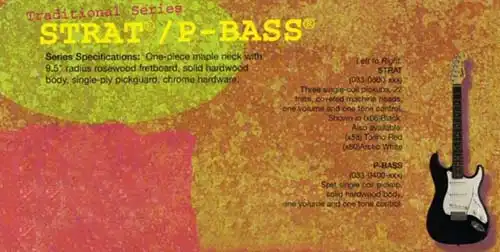
Finally, in 1996, the Squier Strat was added to the catalog and appeared in the July 1996 price list under the Tradition Series at just $239.99.
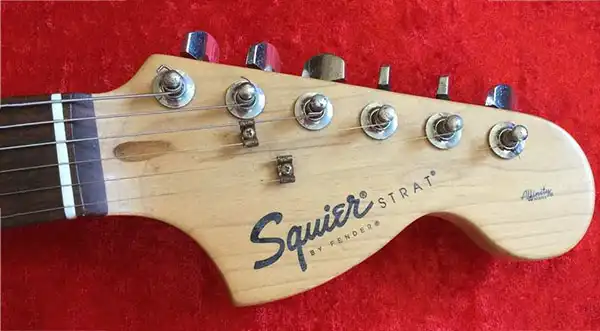
However, the Squier “Tradition” Strat differed from the PV-4 model. It had the serial number stamped on the neck plate, and the truss rod nut moved to the headstock, making it different from both the PV-4 model and the version shown in the 1995 UK advertisement.
Fender never specified the type of wood used for the bodies of these guitars, only mentioning solid hardwood in its specs. They were only available with a maple neck, without the skunk stripe, and a twenty-two-fret rosewood fingerboard.
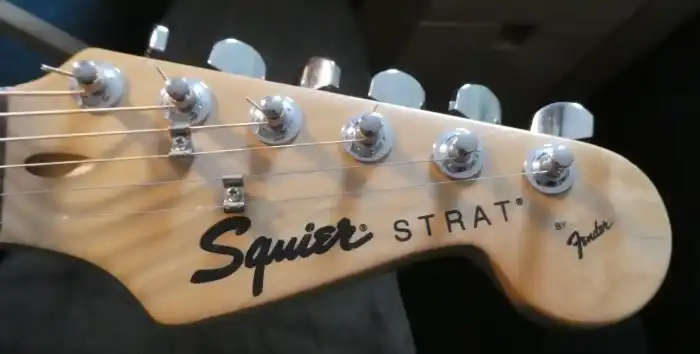
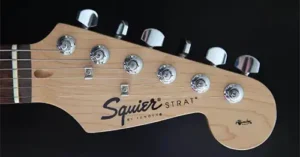
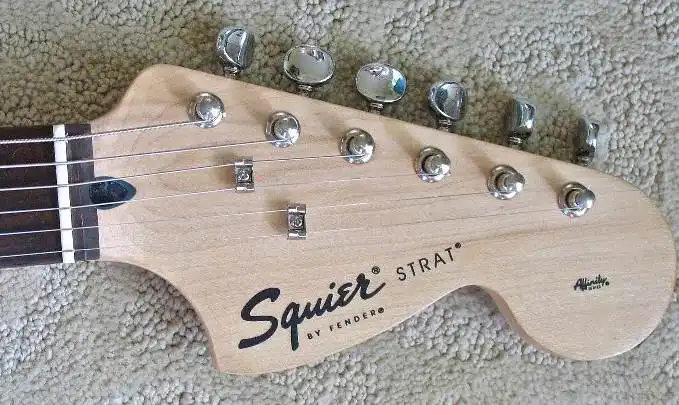
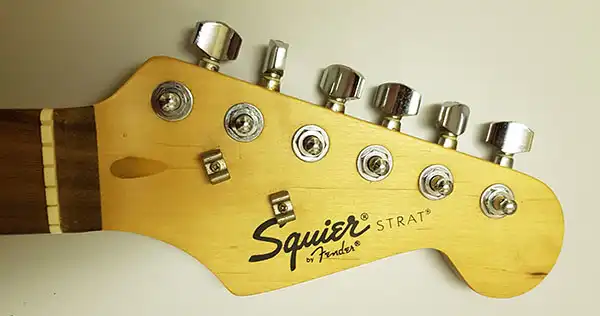
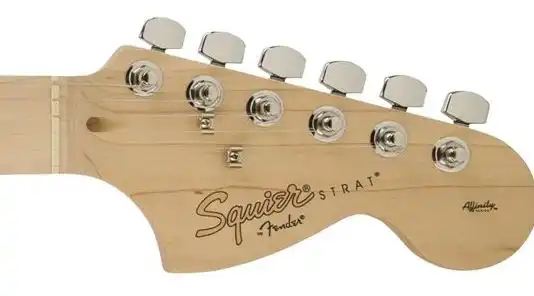
The Squier Strats featured a small headstock with a black silkscreen logo and truss rod access, but without the black insert. On the back of the headstock, the 1996 anniversary logo was always present.
The pickups were ceramic, the tuners were the “trapezoid” or “half-trap” type, and the six-screw Synchronous Tremolo had a thin inertia bar and thin block saddles.
The serial number, which started with NC or YN (meaning “Yako Nineties” because they were made at the Yako factory), was engraved on the neck plate along with the words “MADE IN CHINA,” just like the Bullets made in China from 1994 to 1996. Also, those with the NC serial number had “MADE IN CHINA” written on the headstock below the Squier logo.
They were available in Black, Torino Red, and Arctic White finishes, as well as the Brown Sunburst finish, which was only available in the European market.
These Squiers were low-quality guitars because of the materials used, but their structural standards had improved. The price was ridiculously low, even lower than the highly criticized Korean Squiers, so much so that they thrived in the fiercely competitive budget market.

The first Affinity Strats
As early as 1997, the Tradition Series was renamed the Affinity Series. However, the Squier Affinity Strat was still very similar to the earlier Tradition Strat, to the extent that it kept the same model number.
The lettering on the headstock, as small as the lettering on the Tradition, was slightly different. Specifically, the Fender logo on the ball of the headstock was replaced with the words “Affinity SERIES.”
Early Affinity Strats had serial numbers beginning with NC or YN stamped on the neck plate. Still, as early as 1998, a new serial number, starting with CY (standing for “China Yako”), was stamped on the back of the headstock, replacing the one engraved on the neck plate.

The Pack and the new Affinity Strats
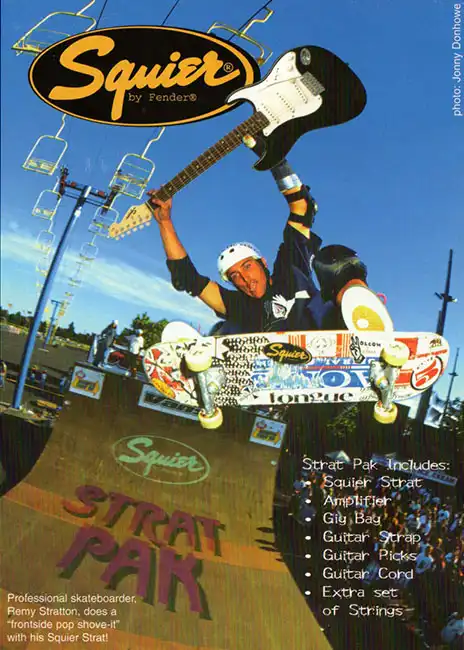
Thanks to an idea by Joe Carducci, then the Marketing Manager for Squier, in 1997 Squier began selling packages, or, as it was called in Fender-speak, Paks. This might seem obvious now, but it was a very innovative idea: include an affordable guitar, a small amp, a cord, a strap, a gig bag, strings, picks, and a how-to guide, all in a box, and sell it to parents wanting to buy their kid an electric guitar but who have little knowledge of the instrument. Everything was offered at bargain prices.
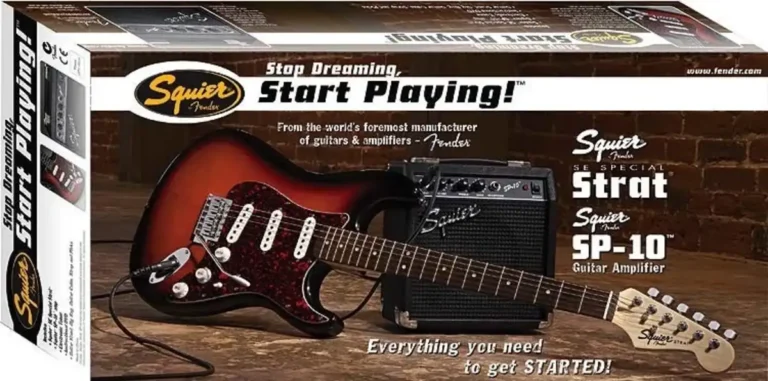
In 2004, the slogan “Stop dreaming, start playing” was successfully used to describe the Squier Strat Pack.
The first Squier Stratocasters included in the 1997 Squier Starter Pack were the same Affinity Strats that could be bought separately and featured a thick body like all other Stratocasters.
However, as of November 1998, Squier began distinguishing between the Affinity models included in the Pak and those available separately. More importantly, all Affinity guitars’ bodies became slightly smaller, about 40mm thick. The small headstock was replaced with the large headstock, the fretboard was changed from twenty-two to twenty-one frets, the nut width was reduced to 1.61”, die-cast saddles similar to CBS saddles replaced the block ones, and the new Baltic Blue finish was introduced.

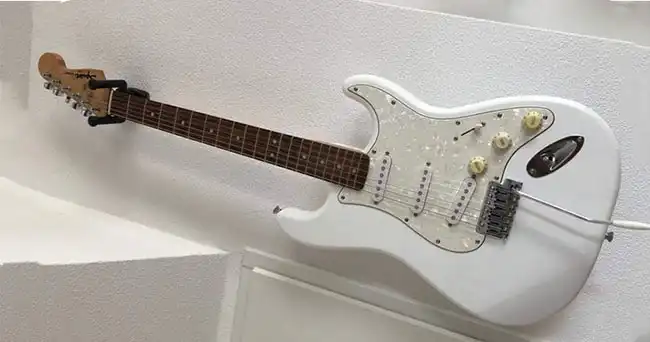
The “regular” Affinity Strats were made in China and had a serial number starting with CY, a rosewood fingerboard, and a single-ply white eight-hole pickguard. They lacked the skunk stripe and a black insert for truss rod access.
Pak’s Affinity Strats were manufactured at the Indonesian Cor-Tek factory. They featured a maple fretboard, a serial number starting with IC, a single-ply white eleven-hole pickguard, a skunk stripe, and a black insert for truss rod access.
Both had the “AFFINITY Series” logo on the ball of the headstock, and the words “Crafted in” took the place of “MADE IN” on the back side of the headstock, along with the serial number.
Both were unveiled at the 1999 NAMM. At the same time, the Affinity series was expanded with the short-scale (22.7”) Squier Mini, which featured twenty frets, only two knobs (volume and tone), and a hard-tail bridge. The Mini was manufactured in Indonesia at the PT Samick plant and, at least initially, had serial numbers beginning with IS (standing for “Indonesia Samick”).

April 2000-7/2012
In April 2000, things changed again. The distinction remained between Chinese Squiers, sold separately from the Squier Beginner Pack, and Indonesian Squiers, included in the Pak.
However, new finishes and limited editions were added, standard tuners replaced the cheaper “trapezoid” ones, but most importantly, the new Squiers had a thinner neck, whose shape was called “fast action.” They were strongly wanted by Keith Brawley, Squier’s Marketing Manager since 2000, so that these guitars would have a completely different profile from all Fenders on the market.
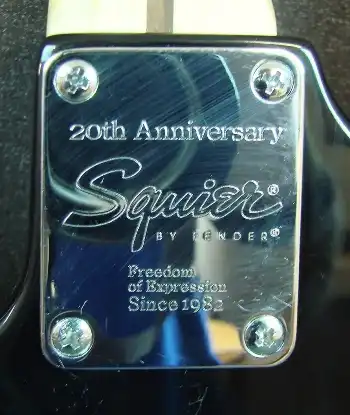
Interestingly, the neck plate of all Squier guitars built in 2002 bore the inscription “20th anniversary Squier BY FENDER Freedom of Expression Since 1982,” leading many to mistakenly believe that they were dealing with a special model.
Although the Affinity body was always thinner than that of other Stratocasters, Squier began to standardize the woods used: Indonesian Affinity Strats had agathis bodies, while Chinese ones (therefore excluded from the Pak) had either alder (for the U.S. market) or agathis bodies. Also available since 2004 has been the Chinese Squier Strat with maple cap fretboards.
Special versions of the Chinese Affinity were produced between 2002 and 2004, including a Butterscotch Blonde finish with a maple fingerboard, black pickguard, and plastics (2002); an Aztec Gold finish with a maple cap fingerboard (2003); and a 2-Tone Sunburst finish with a maple cap fingerboard (8/2003-2005).

Squier SE Models
Squier SE-100
From 2002 to 2012, Squier also produced Squier “SE” Stratocasters (not Affinity), which could only be purchased in the pak.
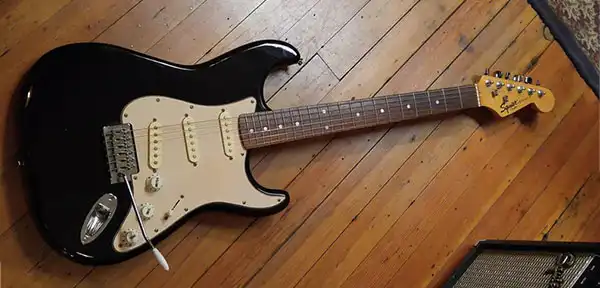
The first was the Squier SE-100, listed in the catalog between August 2002 and March 2007, sold with the Squier SP-10 amplifier. For the first few years, both Indonesian SE-100 paks from Samick and Chinese SE-100 paks from AXL were available. The Indonesian guitars were thinner (40mm) and mostly made between 2002 and 2004, whilst the Chinese SE-100s had a full-size body and were made between 2002 and 2007.
Interestingly, the Squier SE-100 was very similar to the Tradition Strat, but it had 21 frets and an 11-hole pickguard, while the Tradition Strat had 22 frets and an 8-hole pickguard.
The Squier SE-100 headstock was identical to that of the Tradition Strat; therefore, it featured a Squier Black Silkscreen logo but lacked the Fender logo on the ball of the headstock. Additionally, it lacked the 1996 anniversary logo and had Standard tuners, whereas the Tradition Strat had trapezoid tuners.

A few SE-100s manufactured for the European market featured 22 frets, the skunk stripe, and were also available in Brown Sunburst and Torino Red, in addition to the more common Black finish.
A common mistake made when dating Chinese SE-100s is to assume that their serial number, printed on a sticker attached to the back of the headstock and beginning with CAE, indicates the year 2000. However, in 2000, the SE-100 Stratocaster had not yet been introduced. Additionally, before 2002, the Stratocasters included in the Squier Pak were entirely different models, as catalog listings from that period make clear.

The confusion stems from the fact that the CAE serial numbers on SE-100s have an extra leading zero before the year. The first stickers displayed a CAE-001 serial number, and they could have been used on Squier SE-100 Stratocasters manufactured in late 2001 or 2002, not in 2000. Most of the time, the serial number was between CAE-001 and CAE-005.
Serial numbers beginning with 006 or 007, without a CAE letter prefix, were also used in 2006 and 2007.
Most of the CAE-001 Squier SE-100 packs were early runs produced for Europe, especially the 22-fret models, which often included pickup covers with the Squier logo.
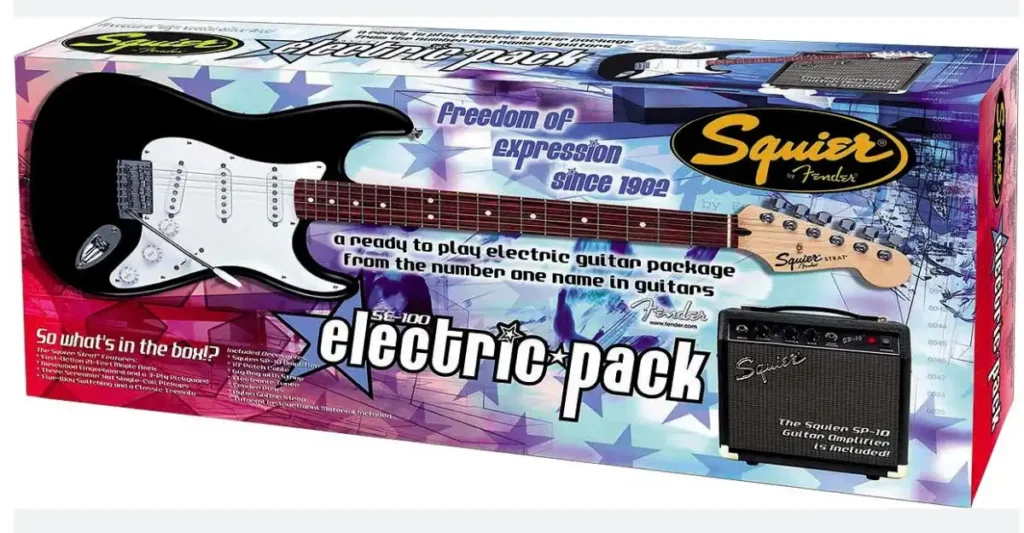
Strangely, upon closer inspection of the SE-100 package, the guitar shown on the box does not seem to be made by the Chinese AXL or the Indonesian Samick, even though it looks Indonesian. The guitar featured a black plastic insert and only one string tree, whereas both SE-100 models, whether made by Samick or the Chinese AXL, had two string trees and did not have a black plastic insert. Therefore, it’s unclear which type of guitar was pictured on the box—it appears to be an Indonesian guitar made at the Cort factory.
Fender never really mentioned the country of origin for SE-100 packs in their paperwork or catalogs, nor did they bother to update the graphic on the box.


Squier SE-Special
In April 2007, the Squier Strat SE-100 was replaced by another full-body Stratocaster: the Squier SE Special Strat. This model was also sold with the Squier SP-10 amplifier. It is one of the most sought-after Stratocasters among Squier enthusiasts. The reason is its full-width agathis body, which is not as thin as that of the Affinity guitars of the same period. However, it’s worth noting that this is an entry-level guitar with ceramic pickups, which makes it inferior to the Classic Vibe or Standard models. Nevertheless, it remains a good starting point for those who enjoy modifying their guitars.
Dealers knew as early as 2005 that SE Special pak would soon replace SE-100 pak. They learned about the new pack at Summer NAMM 2005 and Winter NAMM 2006. However, Fender continued shipping SE-100 packs through 2006, and dealers began ordering SE Special packs in 2006-2007.
Their serial number, with the CXS prefix or a numerical code beginning with 007 (for 2007), was located on the back of the headstock with the words “Crafted in China.”
Squier SE Special Strats are often dated incorrectly, as many guitarists believe the first two digits of the 10-digit serial number indicate the year of production.
However, the serial number format CXS 01 to CXS 12 does not follow this rule, since the SE Special Stratocaster was not available in 2001. Instead, the first and second numbers most likely represent the month (01 to 12), while the third and fourth numbers represent the year (08 to 12). Additionally, dating can be cross-checked with quality control stickers found on the Pak amps included in SE packs.
Note, however, that AXL did not produce these amps; they were bundled with the guitars and received AXL QC stickers, so the date may not match the guitar’s production date.
Built at the Shanghai Axl factory, these instruments featured a Squier Black Silkscreen logo and were available in Black and Arctic White with a White Moto pickguard, or Sunburst with a Brown Shell pickguard.

Squier Fat Strat
Production of the Chinese Squier Strat HSS, not included in the Pak bundle, began in 2001. The Indonesian ‘fat’ version, sold in Pak, was introduced in August 2005.
The two instruments were very similar: both featured a thin body (alder or agathis for Chinese models, agathis for Indonesian), a fast, slim “C” neck 1.61” wide at the nut, and a 21-fret rosewood fingerboard. Additional shared features included a thin-block bridge, CBS-style die-cast saddles, and a headstock with the Squier Black Silkscreen logo and “Affinity SERIES” lettering on the ball of the headstock.
Apart from a few special models, both had white pickguards: 8-hole on the Chinese, 11-hole on the Indonesian.
Other aesthetic differences included a skunk stripe and a black insert at the headstock on the Indonesian Squier Strat HSS, whereas the Chinese model didn’t have them.
The serial number began with CY for Chinese guitars and with IC or ICS for Indonesian ones.
The Gold Logo
In mid-2012, the Affinity series was revamped but retained a slim body and a 1.61” wide neck at the nut. The new models were recognizable by a gold Squier logo.
For the first time in the Affinity Series, poplar was used for the body on the special 2-Color Sunburst version, while alder or agathis were used for the other colors.

The Chinese Affinity, not part of the Pak, came with CBS-style saddles and lacked a skunk stripe or a black insert at the headstock. In contrast, the Indonesian Affinity, included in the Pak, featured thin-block saddles, a skunk stripe, and a black insert at the headstock.
Aesthetically, the Chinese HSS version had a white or platinum sparkle pickguard, whereas the Indonesian HSS featured a black pickguard.
From 2018 on
In mid-2018, there were further changes: poplar became the only wood used for the bodies of both the Chinese and Indonesian Affinity Stratocasters (although they had begun using it for the pak models in mid-2017), and Indian laurel replaced rosewood due to new CITES regulations on its use.
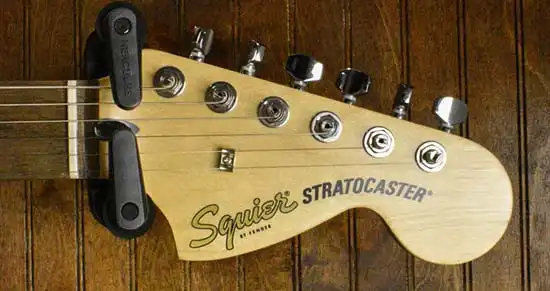
Around 2020, the headstock aesthetics also changed. The black insert was now also found on the Chinese models, and a new, more modern-style gold Squier logo appeared on the headstock, along with the word “STRATOCASTER,” first in small black letters, then, from 2021, in a curved and bold style like that of the CBS Stratocasters.
Starting in 2021, the pak’s Squier Affinity Stratocaster HSS models were made exclusively in Indonesia. That same year, the Affinity HH and SSS models in Lake Placid Blue were also produced in Indonesia and could be sold either as part of a Pak or separately. Meanwhile, the three single-coil models in 3-Color Sunburst, Olympic White, and Black finishes, as well as the HSS FMT version, were made in China.