Signature & Iconic Strats
The Dick Dale Stratocaster, the Beauty, and The Beast
FROM “THE BEAST” TO THE SHOWMAN AND REVERB UNIT

Table of Contents
ToggleDick Dale and Leo Fender
Dick Dale stands as one of the most iconic guitarists in rock history, widely known as the “King of Surf Guitar.” His musical vision was deeply tied to his passion for surfing: he aimed to translate the raw power of the ocean into sound, recreating through his guitar the crash of waves against the shore. A defining example is Misirlou (1962), later reintroduced to a wider audience through Quentin Tarantino’s Pulp Fiction.
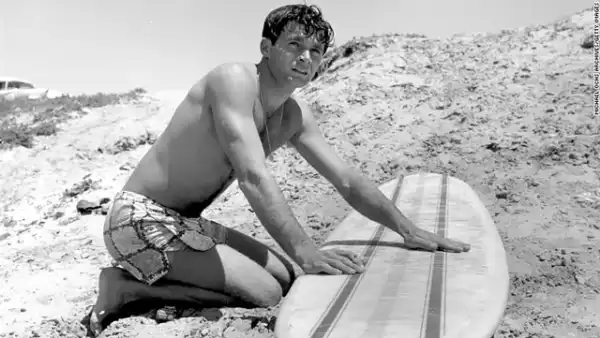
Dale met Leo Fender in 1955. He was just 18 years old and performing around Balboa, California. In several interviews, Dale recalled approaching Fender with a simple request: “Mr. Fender, my name’s Dick Dale, I’m a surfer, I got no money, can you help me?”
Fender reportedly replied, “Here, I just made this guitar. It’s a Stratocaster, go ahead and play it, tell me what you think.”
Being left-handed, Dale played the guitar upside down without restringing it, keeping the original string order, with the bass strings at the bottom. “I grabbed it, and when I turned it around, held it upside-down backwards and started playing ukulele chords, Leo almost fell off his chair laughing,” Dale recalled.
Beyond the storytelling, it is well established that Dick Dale and Leo Fender developed a meaningful working relationship. In later interviews, Dick Dale frequently referred to Leo Fender as a “second father,” reflecting the close personal and creative relationship they developed.

Dick Dale’s “The Beast” Stratocaster
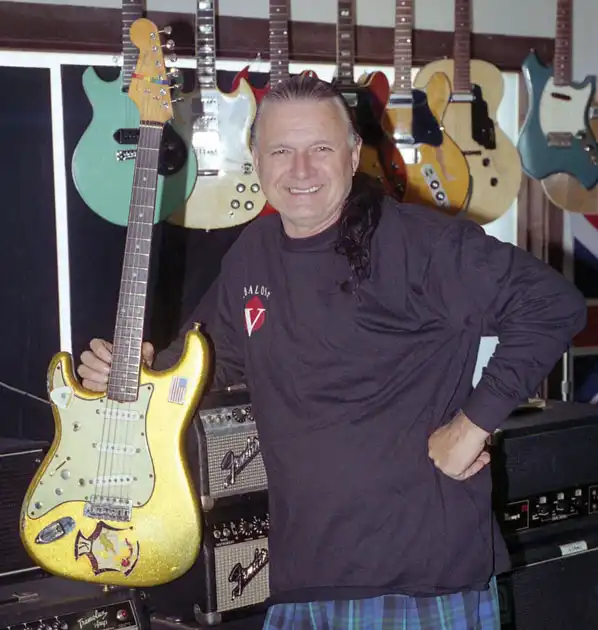
In the early 1960s, Dale’s primary instrument was a left-handed Stratocaster with a rosewood fretboard, built for him by Leo Fender, which Dick Dale referred to as “The Beast.” It served as his main performance guitar during the early surf period and was progressively modified over time to accommodate his extremely powerful playing style.
“The Beast” was heavily rewired from standard Stratocaster specifications, with the tone controls removed and the circuit simplified to a master volume–driven layout. Dale also experimented with a toggle switch that allowed him to access non-standard pickup combinations, particularly enabling the simultaneous use of the neck and bridge pickups—a key element of his signature surf tone.
To further increase sustain and output, Dale immobilized the tremolo system by inserting a wooden block into the cavity, effectively converting the vibrato bridge into a fixed unit. He then tightened the assembly against the body using all five springs and relied on extremely heavy string gauges (often cited around .016–.060), all of which contributed to his dense, percussive attack and high-volume sound.
Since “The Beast” was a left-handed Stratocaster, Dick Dale adapted it to match his established playing approach. Having developed his technique on right-handed guitars played upside down, he reversed the string order on this instrument, positioning the bass strings along the lower edge of the body. This configuration replicated the response and picking dynamics of his earlier setup. The orientation of the bridge pickup relative to the reversed string layout contributed to a sharper high-end response on the bass side and a warmer character on the treble strings—an unconventional arrangement that became a defining element of his aggressive, staccato picking style.
Those who had the opportunity to attend Dick Dale’s early concerts may recall him appearing with Stratocasters in different colors. According to Dale himself, it was often the same guitar, repeatedly refinished with new layers of paint over time.
He also recounted that, during that period, an imitator was performing shows while closely copying his appearance and stage persona. In Dale’s telling, whenever he appeared with a guitar in a specific color, the imitator would replicate the same finish, prompting further repainting.
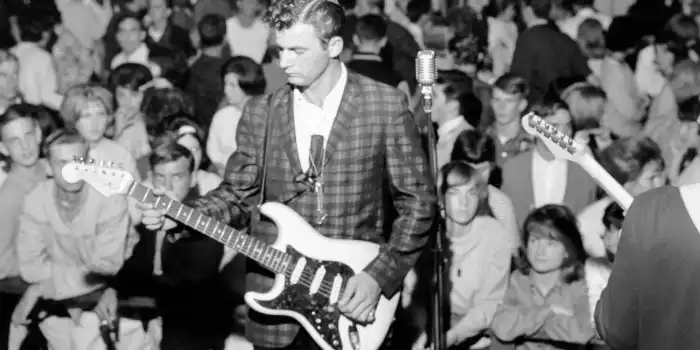
This cycle reportedly continued for some time, until Dale eventually settled on a Gold Sparkle finish: “Finally, my buddy, who used to paint cars, painted it the first metal-gold-flake.”
Dale also added two decals to the body: an American flag on the upper horn and a Kempo Karate symbol, which he said he received from his martial arts instructor—whom he also claimed had connections to Elvis Presley’s security circle.


The Custom Shop Dick Dale Signature Stratocaster: The Beauty
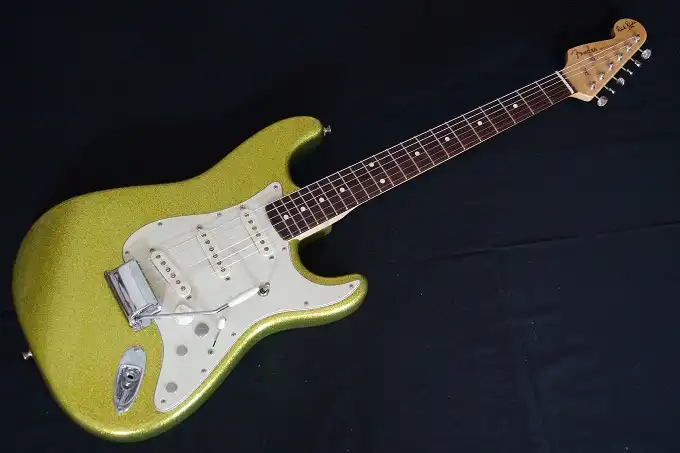
The Fender Custom Shop Dick Dale Stratocaster, developed in the early 1990s under the supervision of master builder John English, was launched in 1994.
It was conceived as an interpretation of Dick Dale’s heavily modified Stratocaster, The Beast. The model retained several key functional ideas from Dale’s instrument, including simplified controls, a reverse headstock, and a dedicated toggle switch that bypasses the 3-position blade switch to activate the neck and middle pickups simultaneously.
Dale referred to his signature model as “The Beauty,” in contrast to his original instrument, The Beast.
The pickups were initially a set of Custom ’50s-style single coils, with a reverse-angled bridge pickup, later replaced by Fat ’50s pickups.
“The first pickup gives me a real fat sound,” Dale stated. “While the second pickup drops the volume down somewhat, and the saddle pickup gives me a treble bite.”
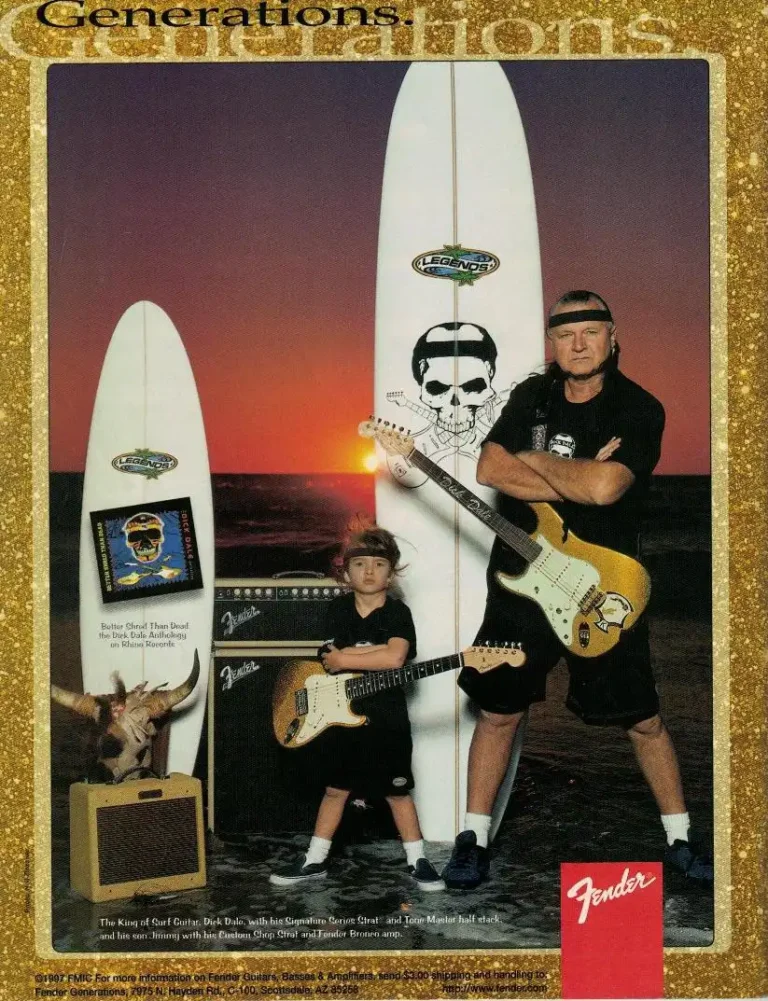
In 1997, Fender captured its legacy in a single, quietly powerful image. Titled “Generations,” the ad features Dick Dale with his legendary Stratocaster, The Beast, beside a young player holding a miniature gold Strat, with a surfboard completing the scene.
The message is simple but effective: Dale represents the origin, the child the future, and the Stratocaster the link between them — an instrument not tied to one era, but passed from one generation to the next.
Dick Dale and the Fender Showman
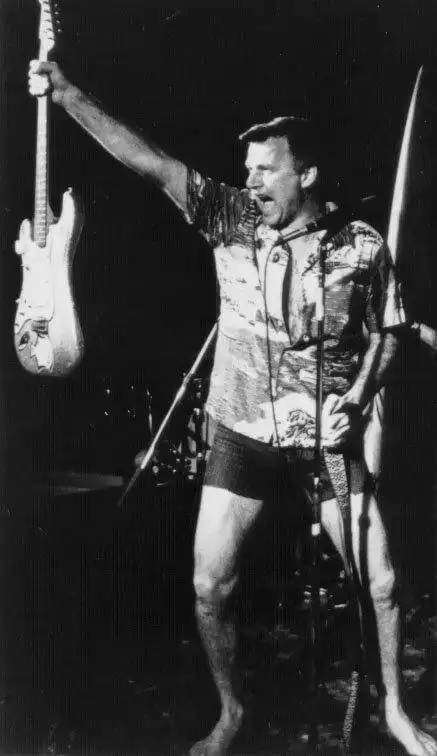
Dick Dale’s performances were known for their extreme volume, to the point where speakers and transformers were frequently pushed beyond their limits and would fail under the load. It is often reported that he went through dozens of amplifiers during his early career.
On one occasion, he recalled Leo Fender asking him, “Why do you have to play so loud?” Dale’s response reflected his approach to live performance in large venues: “When you have 100 people come in to see me, it’s okay. But when a theater fills up to 4,000 people, their bodies soak up the bass sound of the guitar coming through the amplifier.”

In most historical accounts, this period is also defined by the unusually close working relationship between Dale and Fender. Rather than a distant artist–manufacturer dynamic, Fender is often portrayed as directly responsive to Dale’s practical problems on stage. Dale’s extreme volume requirements and performance conditions are frequently cited as one of the real-world pressures that influenced Fender’s thinking on higher-powered amplification systems.
To help Dale, Leo Fender, working with engineer Freddie Tavares, developed a high-power amplifier equipped with a transformer rated at around 85 watts, capable of handling peak power approaching 100 watts. Instead of the standard Jensen speakers typically used in Fender amplifiers, Fender, Tavares, and Dale sought a more robust alternative and turned to James B. Lansing (JBL), selecting the 15-inch D130 speaker for its higher power handling and cleaner response at extreme volumes.
The JBL D130 became particularly important for surf guitar because of its unusually wide frequency response and high headroom. Unlike earlier guitar speakers that compressed and broke up at high volumes, the D130 remained articulate and extended in the high end while delivering tight, controlled low frequencies. This combination allowed Dale’s aggressive attack, heavy strings, and extreme amplification levels to remain clear and percussive, forming a key part of the early surf guitar sound.
The amplifier was named “Showman” by Leo Fender, who reportedly chose the name in reference to Dick Dale’s powerful and theatrical stage presence, which embodied the idea of a true “showman” performer.
However, even this configuration was not sufficient to meet Dale’s requirements: as his audience sizes grew, he continued to demand greater volume and headroom.
To meet these needs, Leo Fender and engineer Freddie Tavares developed an upgraded version using a 100-watt Triad transformer—often associated with Dale’s high-power setup—and paired it with two JBL D130F speakers. This configuration led to the development of the Dual Showman amplifier, designed to deliver significantly higher output and improved reliability under extreme performance conditions.


Dick Dale and the Fender Reverb Unit
Dick Dale also played a role in the early conceptual development of Fender’s standalone spring reverb unit, commonly referred to as the Fender Reverb Unit or “Reverb Tank.” In the early 1960s, echo effects were not new in popular music, but they were typically achieved in recording studios rather than in live performances.
In interviews—including one published in Planet Magazine and later cited in retrospective accounts—Dale explained that he was dissatisfied with the dry quality of his sound and his vocal delivery, which he felt lacked natural vibrato and sustain. He became interested in achieving a more resonant and spatial character, influenced in part by the reverberant sound of Hammond organs.
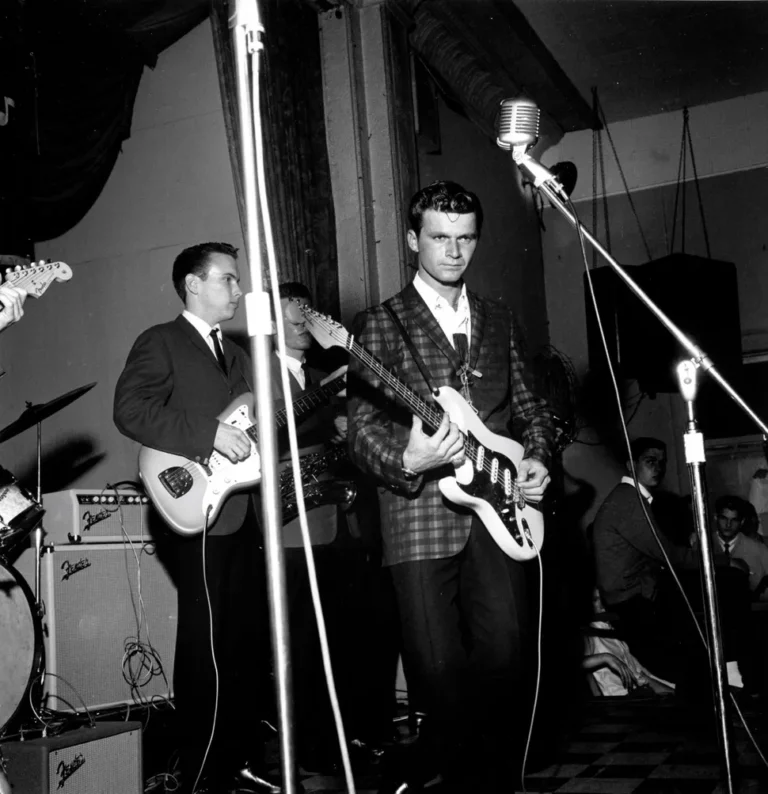
Dale discussed this concept with Leo Fender, contributing to Fender’s development of a standalone spring reverb system: an external, tube-driven device that generates artificial reverberation using a mechanical spring tank, designed for stage use with electric instruments.
According to Dale’s account, early experimentation included routing a microphone signal through the unit during the development phase to test its effect on vocal sound, before later applying the same system to his Fender Stratocaster. This transition helped define the extended sustain and “wet” spatial quality that became associated with his guitar tone.
The production Fender Reverb Unit (6G15) introduced controls such as dwell, which adjusts the intensity and decay of the reverb signal, and mix, which balances the dry and processed signal. Housed in a compact, amplifier-style cabinet, it quickly became a defining component of early surf music production.
Dale adopted the system early and integrated it into his high-volume performance environment, where it contributed to the spacious, saturated sound closely associated with surf guitar and instrumental rock in the early 1960s.
