Signature & Iconic Strats
History of the Yngwie Malmsteen Stratocaster
AND THE PLAY LOUD


Table of Contents
ToggleThe origin of the YJM Stratocaster and the first Series
The Story Behind the Yngwie Malmsteen Signature Guitar
The Fender Yngwie Malmsteen Stratocaster—commonly known as the YJM Stratocaster—was the second signature Stratocaster produced by Fender.
Work on the project began in November 1986, roughly two months before John Page and Michael Stevens established the Fender Custom Shop. By that time, the development of the American Standard Stratocaster and the Fender Eric Clapton Stratocaster was already well advanced.
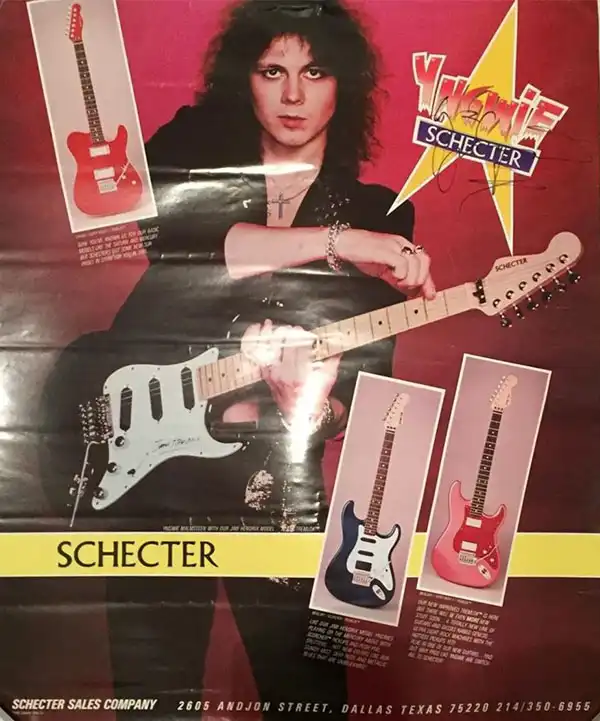
Interestingly, this was not the first signature instrument associated with Yngwie Malmsteen. In 1986, Schecter built a pair of custom guitars for him featuring contoured bodies, scalloped fretboards, and reverse headstocks, and introduced a production model, the Schecter YM-1.
George Blanda later recalled that he and Dan Smith met Yngwie Malmsteen after a concert at the Long Beach Arena to discuss the concept of a signature guitar. “I didn’t even know what a signature model was,” Malmsteen admitted.

“Let me show you something you’ve obviously forgotten!” he added, pointing out the contours of his vintage Fender Stratocaster body to the two Fender men.
In fact, the guitarist asked them to modify the Stratocaster’s body contour, which at the time still reflected the softer lines of the last instruments produced during the Fender Fullerton era. Malmsteen preferred a more squared profile—one that Fender would later adopt for the American Standard models produced at the Fender Corona Factory.
George Blanda and Dan Smith had brought along several Fender American Standard Stratocaster guitars, which Yngwie Malmsteen liked very much. In particular, he appreciated the new two-point tremolo system and decided to adopt it for his signature model.

In January 1987, all of George Blanda’s and Dan Smith’s notes arrived at John Page’s and Michael Stevens’s Custom Shop—which had not yet been officially announced—for the construction of the new prototype. However, production of the signature Stratocaster would not begin until the end of the year.
Given Yngwie Malmsteen’s virtuosic technique, one might have expected a guitar inspired by the Superstrat designs that were popular among ‘80s shredders. Instead, the foundation of his signature model remained firmly rooted in classic Stratocaster design.
“Yngwie is a traditionalist in many ways. It was important to him that all the Strat body contours matched those of his ’50s Strats. But the neck was something else. Scalloped fingerboards are an integral part of his techniques. So, for him, it had to have the vintage look with his special neck.”
George Blanda
Malmsteen recalled, “In the early ’70s, the lacquer on the fretboard was really thick. I used to sand it off, and eventually started carving it out to get a better grip on the strings.”
He also explained, “The idea of a scalloped fretboard is that, because you’re not pressing all the way down to the wood when fretting, you can play with a lighter touch. This means less effort for each note and less tension. It also reduces friction when bending notes, since the string moves only along the smooth fret and not the wood of the fretboard.”
Fender was initially hesitant to incorporate the guitarist’s scalloped fretboard modifications—an element Yngwie Malmsteen regarded as fundamental to the concept of a true artist signature model.
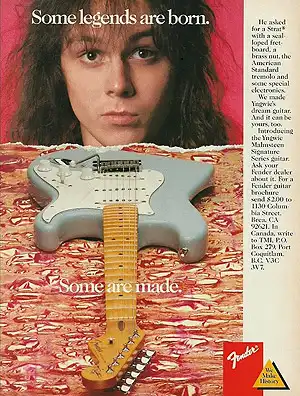
Ultimately, however, the company relented, and in a famous 1988 advertisement—the year the signature model was introduced—Fender wrote: “He asked for a Strat with a scalloped fretboard […]. We made Yngwie’s dream guitar. And it can be yours, too.”
Yngwie Malmsteen was so excited that he recorded the solo for Heaven Tonight, from his 1988 album Odyssey, immediately after taking delivery of his first signature model—“without even changing the strings,” as the guitarist later recalled.
At its launch, Fender described the Yngwie Malmsteen Stratocaster as follows: “Swedish guitarist Yngwie Malmsteen first hit the U.S. music scene through a Guitar Player Spotlight column and from there hit the ground running. From his days in the ’80s rock scene to sold-out performances showcasing his classical influences and prodigious technique, Yngwie has remained truly one of a kind.”


The DiMarzio HS-3 Pickups
The first run of his signature model was equipped with DiMarzio HS-3 pickups at the neck and bridge positions, while the middle pickup was an American Standard Stratocaster single coil, reverse-wound and reverse-polarity. Since he never used it, Malmsteen lowered the central pickup on his own guitars to the level of the pickguard, taking inspiration from his guitar hero Ritchie Blackmore, who had also used a scalloped fretboard.
As a result, the Yngwie Malmsteen Signature Stratocaster also featured a middle pickup lowered to the pickguard level.
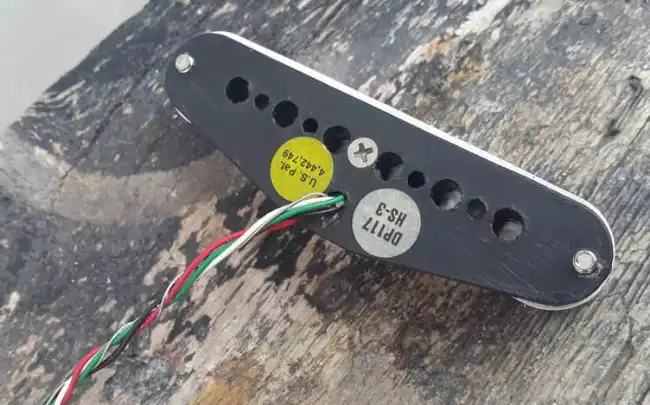
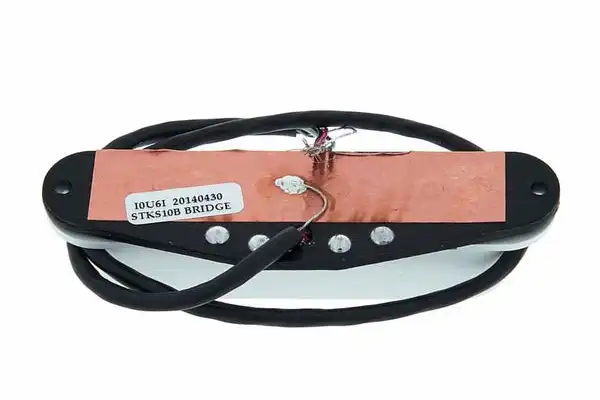
The DiMarzio HS-3 pickups employed a stacked-coil design, with the two coils arranged one above the other rather than side by side, as in traditional humbuckers. Like humbuckers, they were hum-cancelling, yet retained the bright, articulate tone characteristic of single-coil pickups.
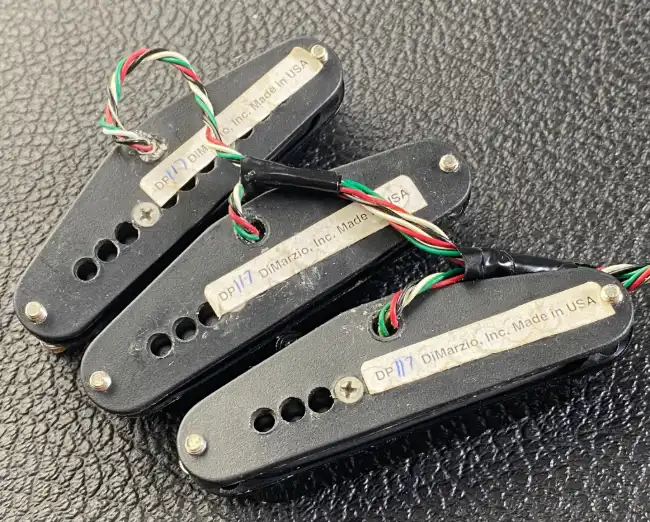
DiMarzio’s naming system can be confusing for collectors: HS‑3 was the commercial model name, while DP117 served as the internal product code (DP = DiMarzio, 117 = model number). On original 1980s units, DiMarzio typically printed “DP117” or both codes on a small sticker affixed to the black plastic bottom plate.
These HS‑3 pickups were equipped with four-conductor plastic-insulated wiring (red, white, green, black) and Alnico‑5 staggered poles.
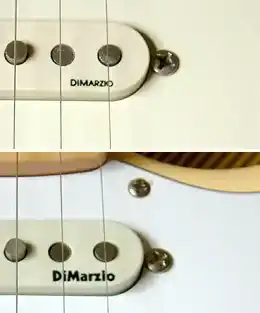
The first units did not carry any logo on the cover. In 1988, DiMarzio began printing its logo on the pickup cover, which was later enlarged around 1997–1998.

Other Features
Other distinctive features of the guitar included a special “U”-shaped neck with a vintage-style truss rod, a small ’50s style headstock, and a TBX tone control. The Swedish guitarist also requested a brass nut, which helped brighten the sound slightly and made string slides smoother. Initially, Fender considered the request too costly, but the final signature model included the brass nut as he had specified.
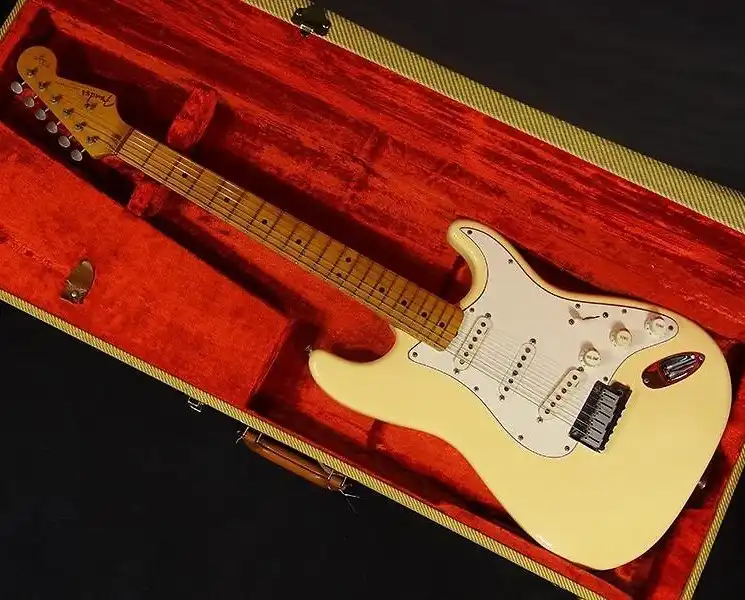
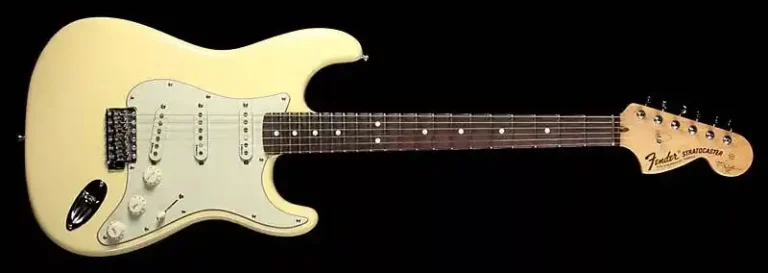
The instrument was offered with either a maple or rosewood fretboard, and the available finishes were Sonic Blue, Candy Apple Red, and Vintage White—the latter appearing noticeably more yellow than expected.
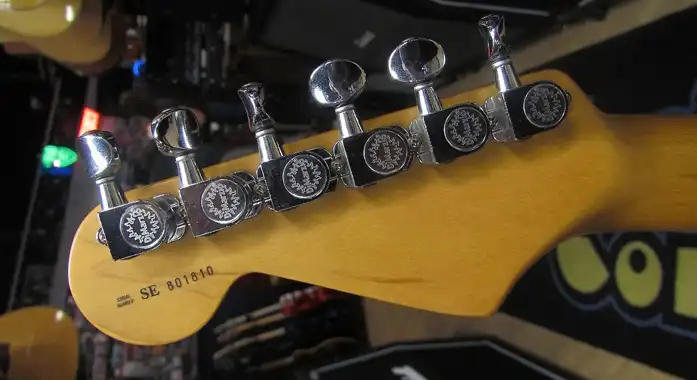
It is interesting to note that the photos of the prototypes used to introduce the new signature model showed an 11-hole pickguard, including one screw above the central pickup. However, the Malmsteen Stratocasters that reached the market retained an 11-hole pickguard in the pre-1963 configuration. Additionally, the first production guitars were equipped with DiMarzio-branded tuning machines, which were replaced by Kluson-style tuners in 1989.

Malmsteen Stratocasters made in Japan
Export Models
Between 1990 and 1994, Fender Japan exported the Yngwie Malmsteen Standard Stratocaster, which differed from the American version in several ways: a ’70s-style large headstock with Gotoh cast/sealed tuning machines, a basswood body, a differently scalloped fretboard, a “U”-shaped gloss-finished neck, custom pickups, and black pickup covers, switch tip, tremolo arm tip, and knobs. The Japanese model did not feature the TBX tone control.
In 1990, the bridge was a two-point American Standard tremolo, which was replaced by a CBS-style bridge from 1991 to 1994.
A few models were finished in Surf Green (rather than the faded Sonic Blue), although this color was never advertised in Fender catalogs.

Domestic models
In 1994, additional Yngwie Malmsteen signature models made in Japan and intended for the Japanese market only were introduced. They featured basswood bodies, scalloped fretboards, vintage-style tuning machines, and a single string tree, and remained in production for many years.
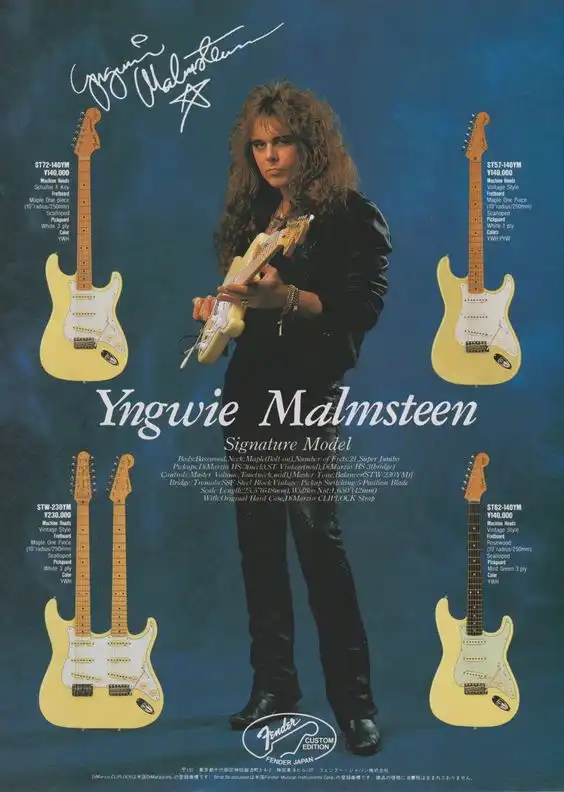
The ST57-140YM, ST62-140YM, and ST72-140YM were high-end instruments crafted by the Japanese Custom Edition Team, bearing the logo on the back of the headstock. The ’57 and ’62 models featured the ’50s-style small headstock, while the ’72 had the larger CBS-style headstock. Notably, the ’62 was the only Malmsteen signature made in Japan with a rosewood fingerboard.
The ST68-185YM (later also known as the ST68-YJM) and the ST71-140YM (also referred to as the ST71-150YM or ST71-YJM, depending on the production year) were produced between the late ’90s and 2010. The ’68 was the first Japanese Malmsteen Stratocaster to experiment with the new anchor-mounted neck joint—even preceding the American signature models—and was also the only one to feature a maple cap fingerboard.
The last Yngwie Malmsteen Stratocasters produced for the Japanese market were the ST-YJM, which replaced the ’68 and ’71 models between 2011 and 2014, and the Yngwie Malmsteen Strat, introduced in 2015.
Other Yngwie Malmsteen signature models produced in the ’90s and intended solely for the Japanese domestic market included a nylon-string Stratocaster, the STCL-140YM, and a double-neck model, the STW-230YM.
Interestingly, in Japan, additional domestic Stratocasters with scalloped fretboards—but without Malmsteen’s signature on the headstock—were also produced. These are commonly referred to as YJM pre-signature Stratocasters.

Second, Third, and Fourth Series made in USA
Main Updates
Fender updated the Yngwie Malmsteen Stratocaster three times: in 1998, 2007, and 2011.
Some distinctive features—such as the scalloped fretboard, whose scalloping became more pronounced in the upper register after 2007, and the brass nut, which was lowered that same year to improve string action—were retained. However, the newer series differed significantly from the original 1988 model.
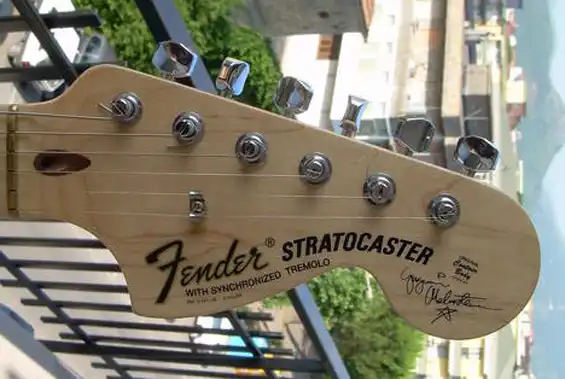
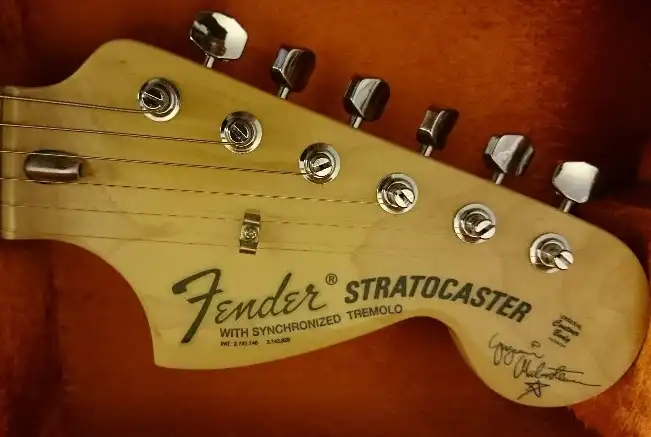
In 1998, the CBS-style large headstock requested by Yngwie Malmsteen—who believed it would increase sustain—was introduced, along with much larger frets.
New DiMarzio YJM pickups were installed in the neck and middle positions, while the DiMarzio HS-3 was retained at the bridge.
The butterfly string tree replaced the Ezy Glider version, while the six-point Synchronized Tremolo replaced the earlier two-point system.
The vintage-style truss rod was replaced by the Bi-Flex truss rod in 1998, and in 2007, the Bullet truss rod replaced the Bi-Flex design.
The pickup selector was changed from a five-way to a three-way switch, the TBX tone control was removed, and, at Yngwie Malmsteen’s request, a No-Load tone control was introduced. The no-load potentiometer functioned like a standard 250k tone control up to position 10, at which point it effectively removed itself from the circuit, allowing for a more open, unfiltered treble response. Malmsteen believed that the no-load control could slightly increase the pickups’ output.
Unveiled in 1998, the second series featured a Mint Green pickguard and an updated screw pattern in the modern configuration. In 2007, the third series introduced a lighter aged-white pickguard and a Vintage White finish, with a more pronounced yellow tint than the previous version.
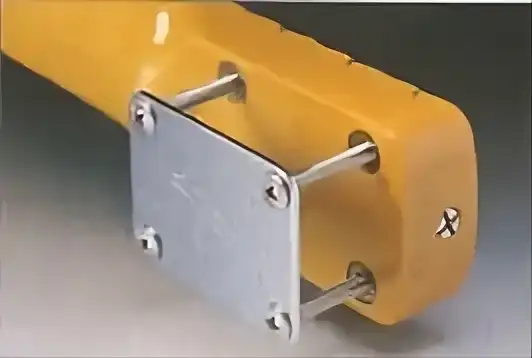
Moreover, since 2007, the Malmsteen Stratocaster has featured Machine Screw Neck Mounting Inserts to improve tone transfer and structural integrity. This system, already in use by Fender Japan since 1999 on the ST68-185YM model, uses steel threaded inserts installed in the maple neck, allowing greater tightening torque without risking wood stripping, typically with 10-24 or similar stainless steel screws for a more secure bolt-on connection.

The Seymour Duncan YJM Fury pickups
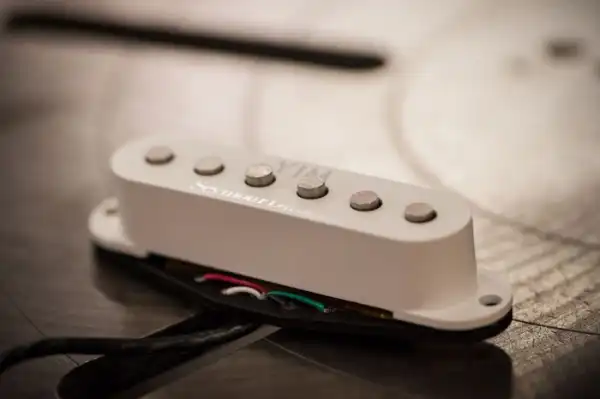
In 2011, stacked-coil Seymour Duncan YJM Fury pickups replaced the DiMarzio pickups. These pickups were designed in collaboration with Yngwie Malmsteen, who, after testing around twenty prototypes, achieved the sound he was seeking.
Malmsteen had often emphasized that note separation under gain and violin-like sustain were non-negotiable targets, which influenced the final voicing.
YJM Fury pickups featured custom AlNiCo 5 rod magnets, 4-conductor lead wire, and wax potting for squeal-free performance.
These pickups are typically used with 250k potentiometers—consistent with their single-coil-style voicing—and Seymour Duncan even developed a dedicated 250k “YJM” high-speed volume pot as part of the system.


Headstock Comparison
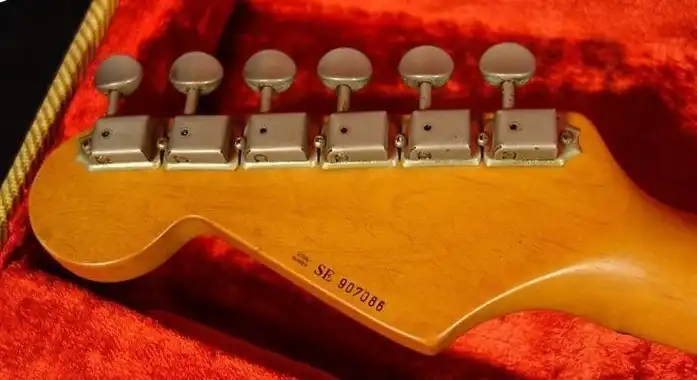
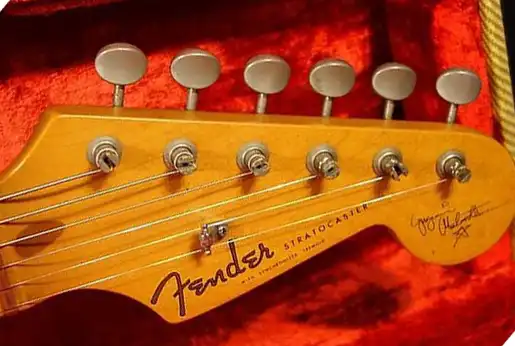
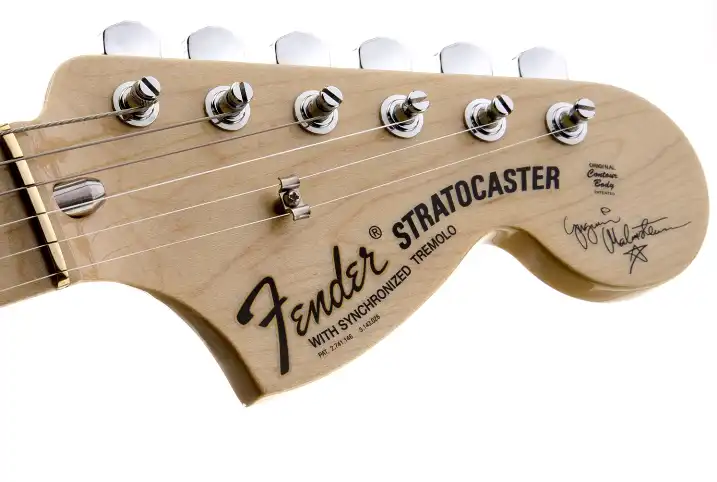
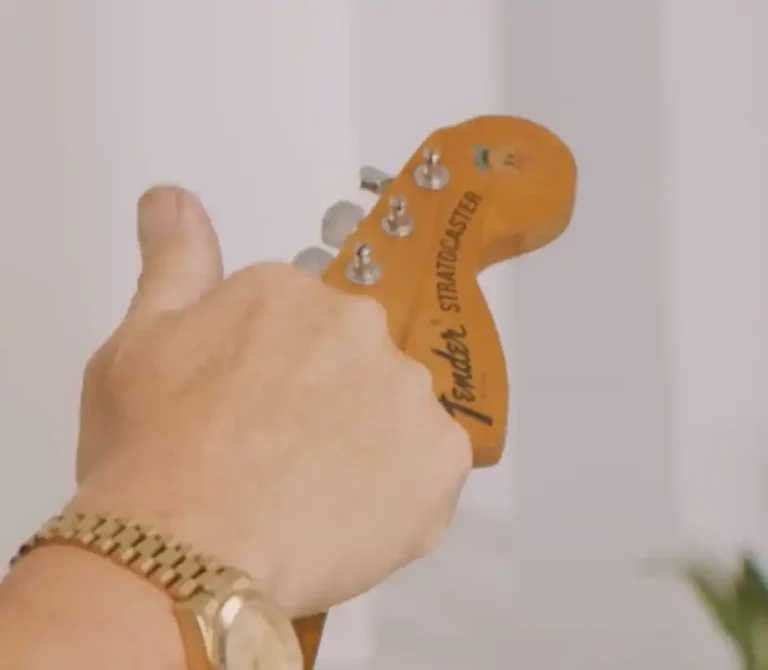
Only the third and fourth U.S. models featured the bullet truss rod. The first series retained the vintage-style headstock-adjust truss rod, while the second series introduced the Bi-Flex truss rod system. The first series also stood out for its “Spaghetti” logo, Kluson-style tuners (with the exception of the earliest units, which were fitted with DiMarzio tuning machines), and the Ezy Glider string tree, which was replaced by a butterfly-style version starting with the second series.
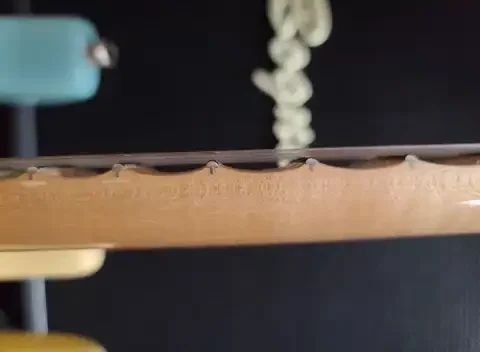
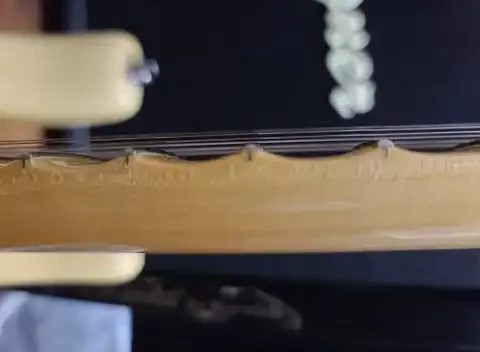
Scalloped Fretboard Comparison
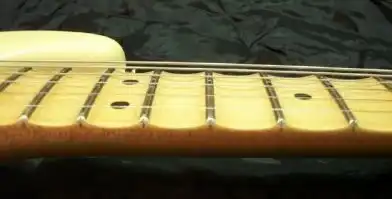
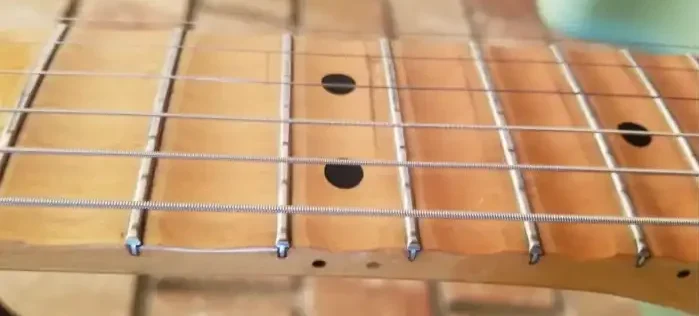
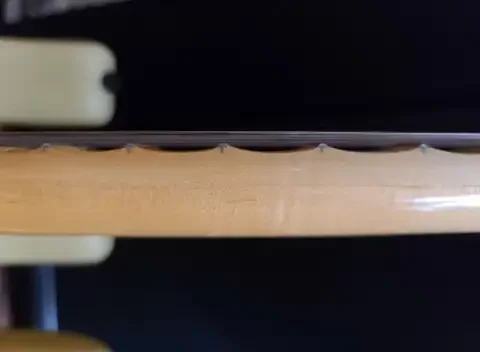
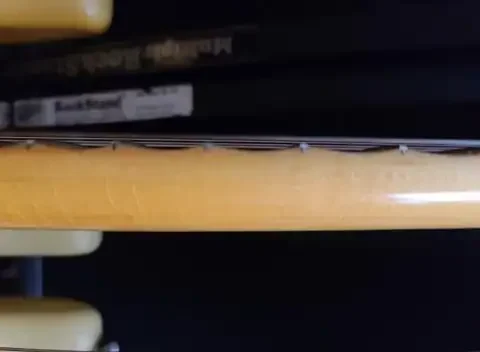
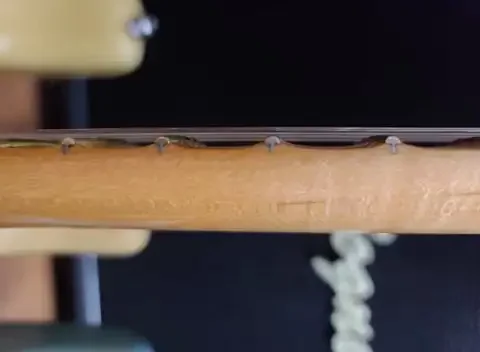
This comparison, conducted by Brandon Breeze, owner of the Yngwie Malmsteen Guitar Enthusiasts Facebook group, examines the fretboard scalloping on U.S.-made Yngwie Malmsteen Stratocasters. The depth of the scallops increased progressively with each successive version: the earliest U.S. model featured the shallowest scalloping and smaller frets.
U.S. models
Version 1: evenly shaped, shallow scallops
Version 2: deeper scallops with a different profile, becoming deep quickly before flattening out
Version 3: evenly shaped deep scallops, similar to Version 1 but deeper
Version 4: the deepest scallops, closer in profile to Version 2 but more pronounced
MIJ (Made in Japan) models
’57/’62/’71/’72: evenly shaped scallops similar to U.S. Version 1, but with jumbo frets, giving the impression of greater depth
’68: scallop depth similar to U.S. Version 1, but with a more pronounced V-shaped profile, especially in the upper register
“Standard” Export models: relatively shallow scalloping with noticeable ledges on many frets and vintage-style fret wire, resulting in a less effective implementation

The Custom Artist Model
In 2019, the Fender Custom Shop unveiled its Custom Artist Malmsteen model, the Yngwie Malmsteen Signature Stratocaster.
This version differed from the production model in its select alder body with a nitrocellulose finish over a WLS (Worn Lacquer System) undercoat—a Custom Shop finishing specification associated with thin, vintage-style lacquer finishes designed to age naturally over time.
It also featured a scalloped maple-cap fingerboard, a Custom “C”-profile neck, and a wing string tree with metal spacer.
The Play Loud
The Original “Play Loud” and the Tribute Replica
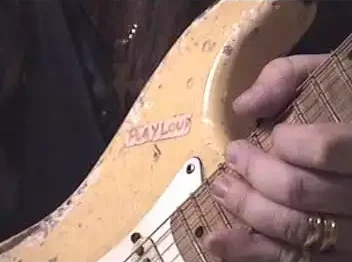
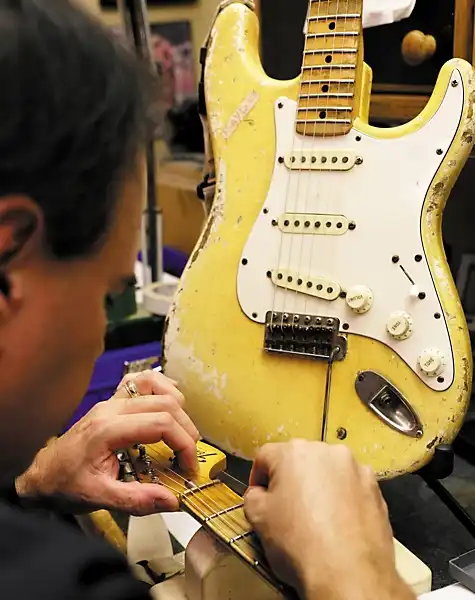
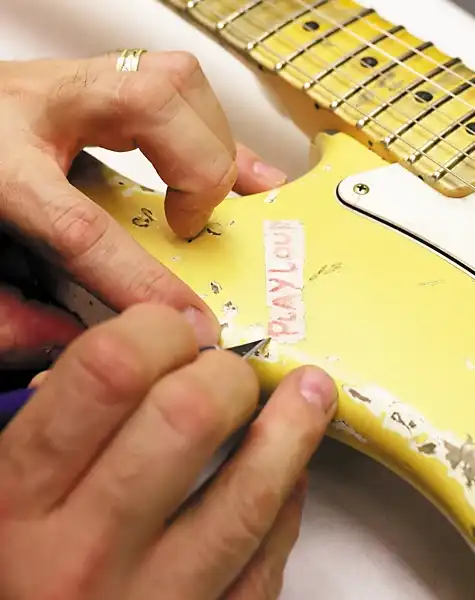
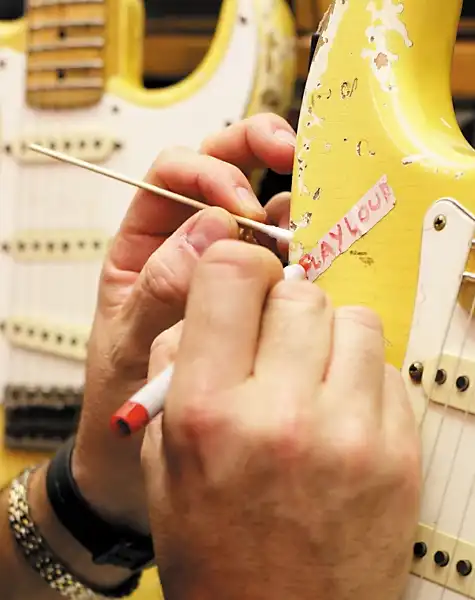
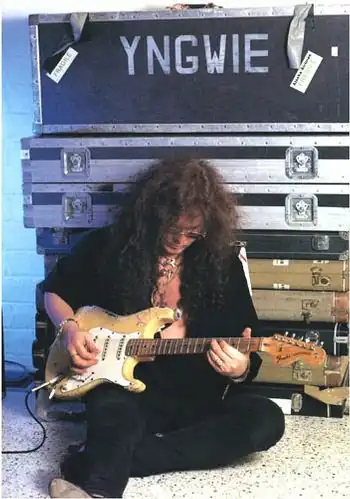
In November 2008, coinciding with the release of Perpetual Flame, Fender Custom Shop Master Builders released 100 Yngwie Malmsteen Tribute Stratocasters, modeled after Yngwie Malmsteen’s 1971 Stratocaster—famously nicknamed “The Duck” for its yellow finish and the Donald Duck sticker on the headstock, or “Play Loud” after the sticker bearing those words, applied to the upper horn by Malmsteen’s drummer Anders Johansson at Rockshire Studios in 1984.

Over the years, additional stickers were applied to—and sometimes removed from—the original instrument, including a worn Ferrari logo on the back of the body.
The original Play Loud initially featured an Olympic White finish, which over time had yellowed and accumulated extensive wear from years of recording and live performances, until it was retired in 1992.
Master Builder Jason Smith described it as “one of the most beat-to-crap guitars I’ve ever seen in my life. That thing had seen a lot of abuse.”
The fretboard had been scalloped by Yngwie himself at the age of fifteen, though the result was far from perfect; John Cruz called it “crude, not too pretty.”
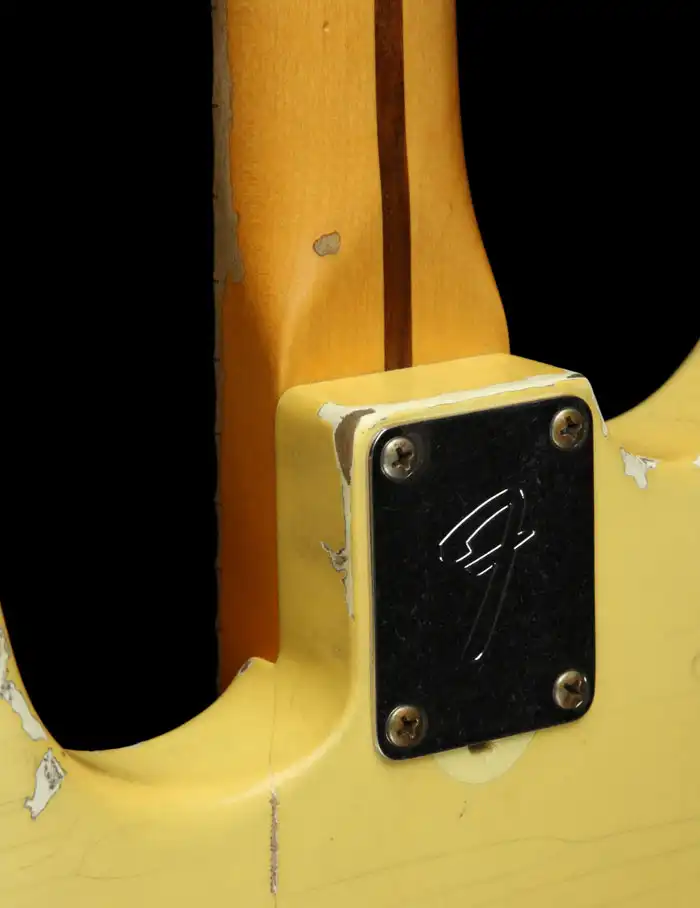
The 4-bolt neck plate became a distinctive feature of Play Loud, even though the guitar was originally built with a 3-bolt neck.
At the base of the plate, the original Micro-Tilt hole remained visible, but the neck pocket no longer contained the metal disc used to adjust its angle, and the hole had been professionally filled with wood.
The electronics were highly unusual.
Play Loud featured prototype DiMarzio HS3 pickups at the neck and bridge, though it had previously been equipped with other pickups, such as the DiMarzio FS1.
In the middle position, the guitar retained a ’70s stock pickup that Yngwie had completely disconnected.
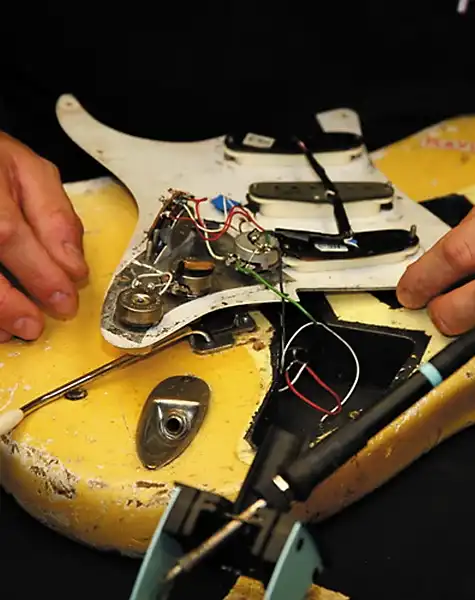
The tone controls had been bypassed in the circuit, leaving “basically the neck and the bridge pickups, a volume control, the output, and that’s it,” as John Cruz explained in an interview with Guitar World.
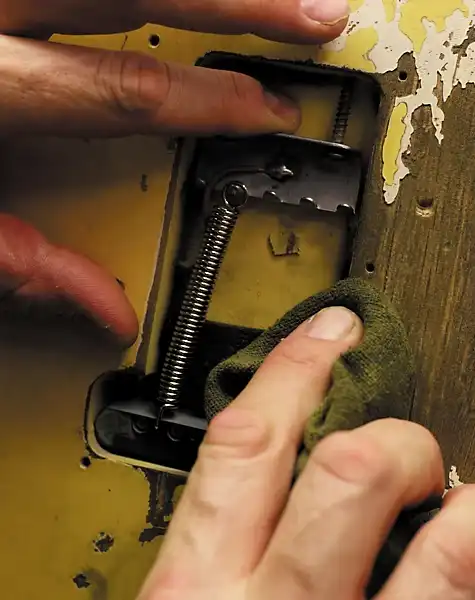
Yngwie Malmsteen also switched to Wilkinson springs for his guitar’s tremolo, improving tuning stability and allowing him to perform dive bombs without the instrument going out of tune.
Other subtle changes to the “Play Loud” included replacing the original nut with a brass one and removing the middle string tree.
The instrument bore clear signs of extensive use and mistreatment accumulated over time. A significant portion of this wear could be attributed to Malmsteen’s stage behavior—particularly his habit of throwing the guitar into the air and not always catching it on the way down. He also recalled that the headstock had been broken and replaced at least six times, and admitted to occasionally stubbing out cigarettes on its surface.
In 1987, during a concert in Anchorage, Alaska, an audience member hurled a bottle of Jack Daniel’s onto the stage, striking the guitar at the 17th fret and causing it to lift. The instrument was later repaired and refretted with Dunlop 6000 jumbo frets.
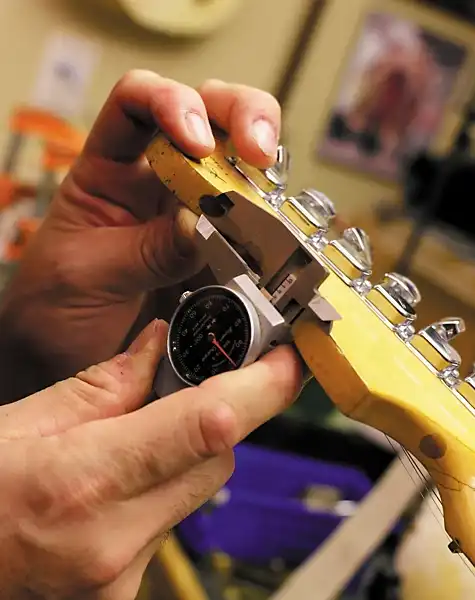
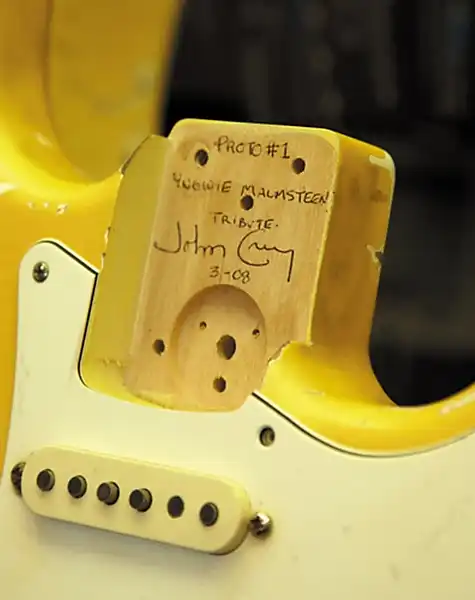
John Cruz working on the prototype of the “Play Loud” Tribute Replica Stratocaster