Fender Japan Part #5

Collectables and HRR Stratocasters

TIME TRAVELERS

Reissues and Collectables

When Fender moved Squier production from Japan to Korea, Fender Japan continued to export reissue guitars. Initially, these appeared under the Reissue Series or Limited Edition Series, but in 1996, they were grouped into the Collectables Series (sometimes called Collectibles). These guitars weren’t JVs — not by a long shot — but they carried the Fender name proudly.
Typically built with basswood bodies and equipped with Reissue Strat pickups featuring staggered AlNiCo 5 poles, they also stood apart from the first American Vintage Stratocasters by ditching the nitro finish.
They should never be mistaken for the wide variety of vintage Japanese domestic models, which came in many different variations and specifications.
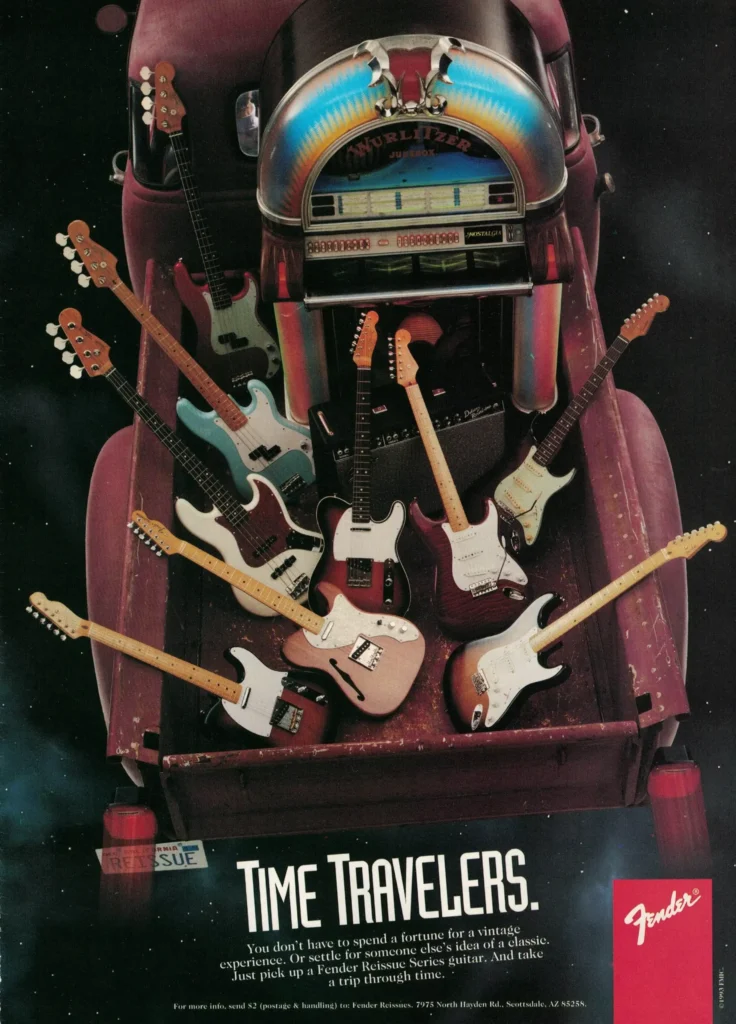
The “Time Travelers” advertisement, featured in U.S. and European catalogs around 1995, presented the Reissue Series as a ticket back to the golden age of rock ’n’ roll. A jukebox glowing in the back of a pickup truck sets the scene, surrounded by faithful recreations of classic instruments: 50’s and 60’s Stratocaster reissues, vintage-style Telecasters, and Precision and Jazz Bass reissues, alongside a period-correct Twin Reverb amp.
With the slogan “Time Travelers”, Fender promised players the feel and tone of vintage originals without the prohibitive cost, reinforcing the idea that its reissues offered not just instruments, but a direct connection to history.

1995 Japanese Reissues Advertisement - Time Travelers

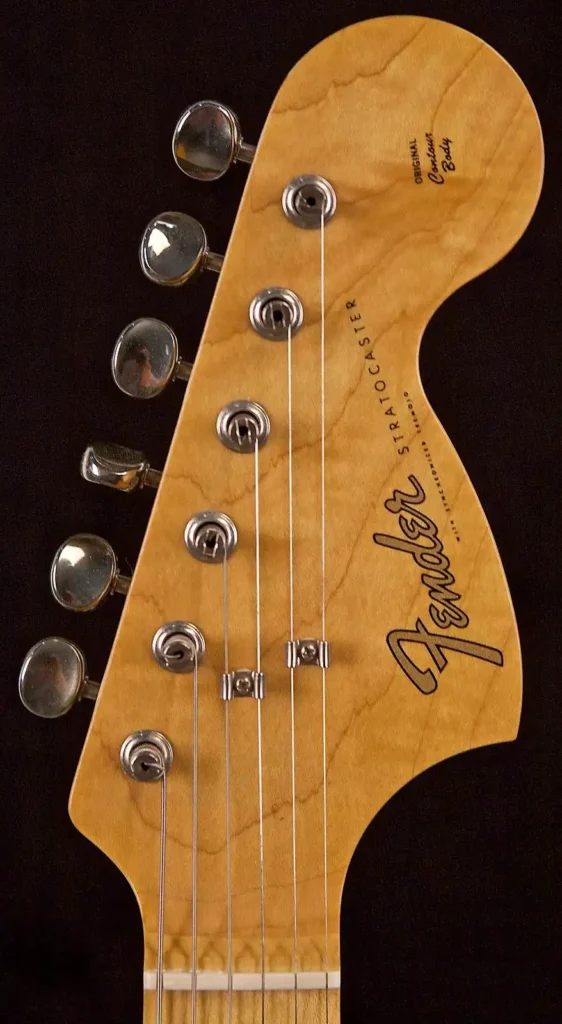
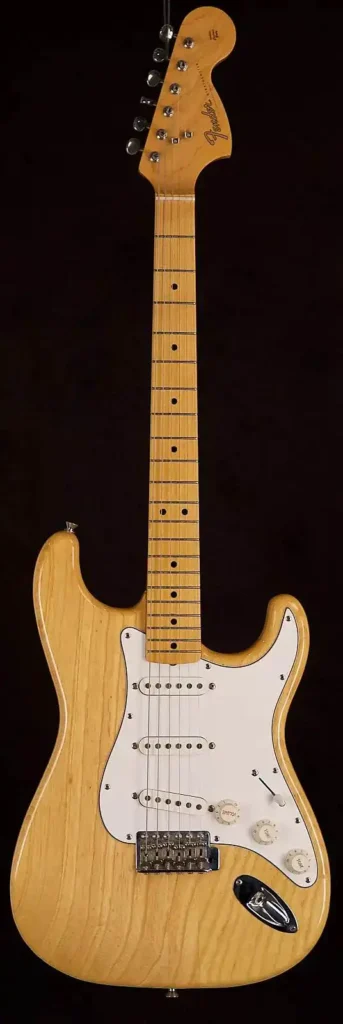
The ’68 Stratocaster was sometimes nicknamed the “Hendrix Stratocaster.” With its maple cap, large headstock, and Transition logo, it resembled the guitars Hendrix played. Equipped with Gotoh Kluson-style slotted tuners and two wing string trees, it originally came with a basswood body, although ash became the standard after 1996.
Collectors and players often confuse the export ‘68 Stratocaster with the domestic ST68-85TX. However, that model was a completely different guitar: alder body, Texas Special pickups, Vintage “F” tuners, a black CBS logo, and only one string tree.
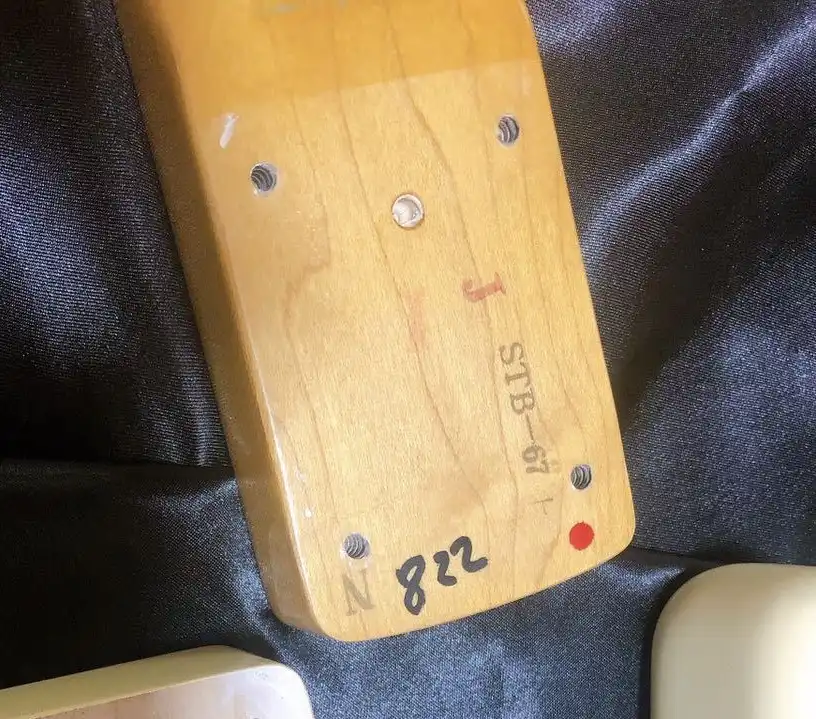
The export ’68 Stratocaster used the same neck as the domestic ST-67, stamped “STB-67” with a large headstock and Transition logo. In contrast, the domestic ST-68 had the black CBS logo instead of the Transition logo.

'68 Stratocaster headstock
Japanese Fender '68 Stratocaster
The export ’68 Stratocaster and the domestic ST-67 featured the same neck

The 50s and 60s Stratocasters, in production between 1989 and 1998, both featured basswood bodies. They captured the era’s typical features: the ’50s had an 8-hole pickguard and one-piece maple neck, while the ’60s had an 11-hole pickguard and rosewood fingerboard.

The ’72 Stratocaster, made between 1992 and 1996, featured a large headstock with a black CBS logo along with a bold “STRATOCASTER” decal in large lettering, a bullet truss rod, two butterfly string trees, Gotoh Standard tuners, and an “F”-stamped 3-bolt neck plate with Micro-Tilt. It was available in Natural and Vintage White.

Hot Rodded Reissue Series

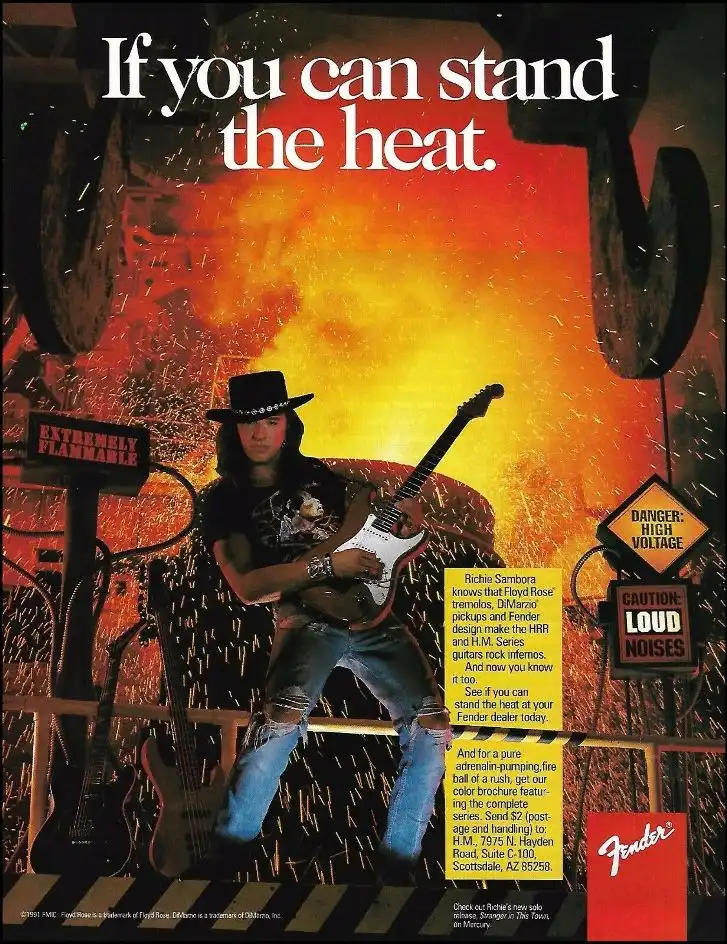
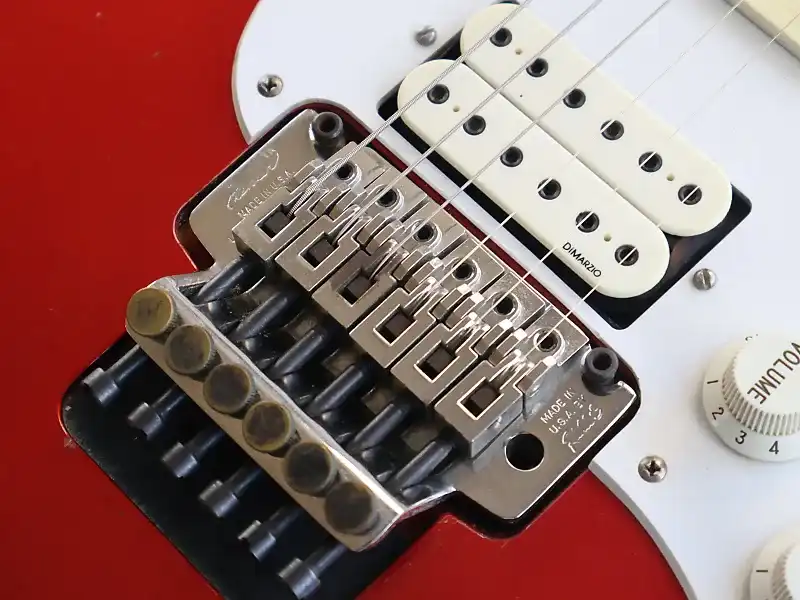
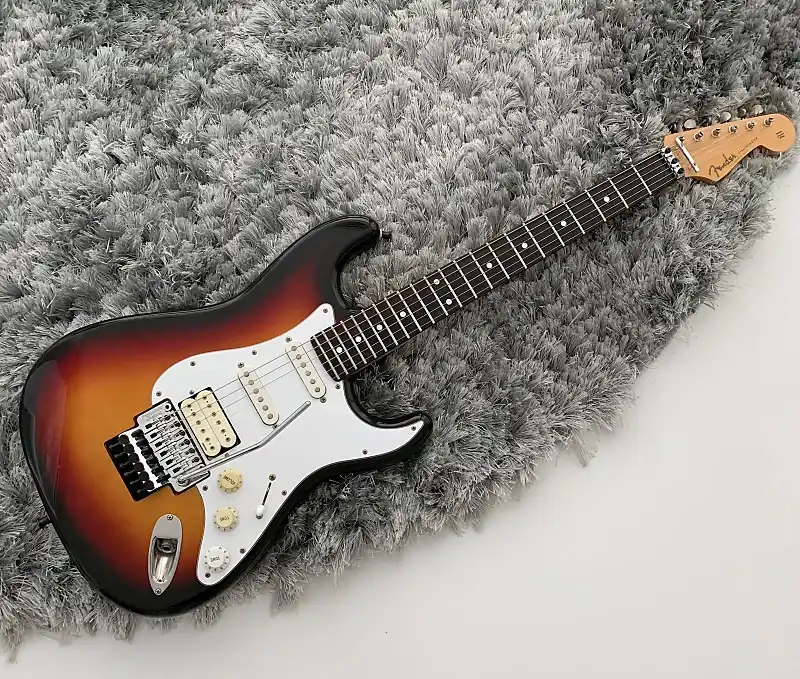
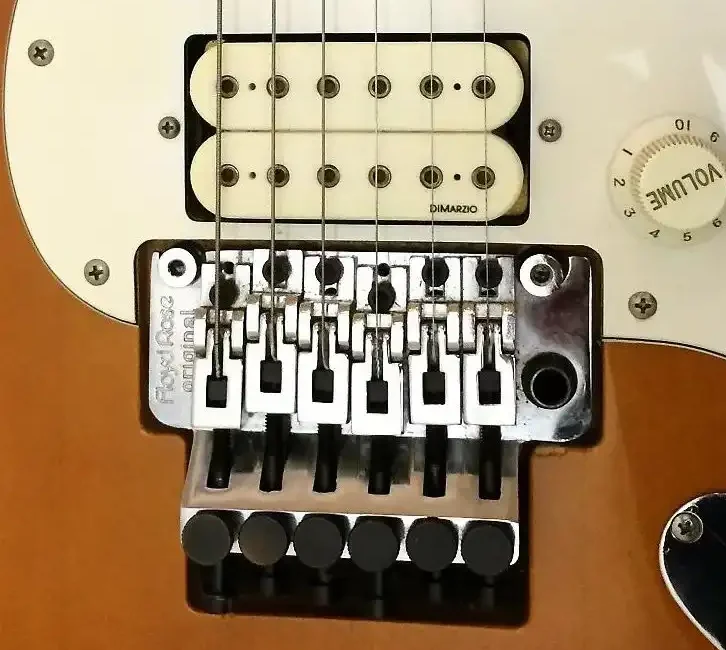
In 1990, riding the wave of demand for heavier, more aggressive tones, Fender introduced a new line of Stratocasters from Japan that kept the familiar shapes but added a hotter edge. Known as the Hot-Rodded Reissue Series (or HRR) and brought into the spotlight by Richie Sambora, these models featured a DiMarzio humbucker with coil-tap at the bridge, 22 frets, and an asymmetric neck plate curiously engraved “FENDER U.S.A.” They also came with a double-locking tremolo—initially the Kahler Steeler, later replaced by the Floyd Rose Original—giving players the right instrument for the heavier styles of the era, from hard rock to glam metal.
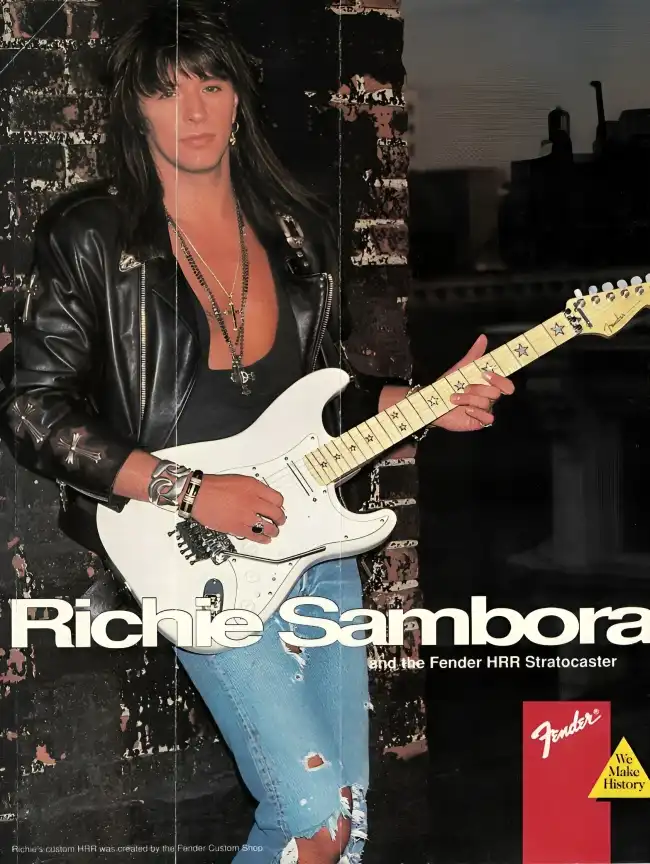
An intriguing case of Fender’s marketing choices appeared in the 1991 Frontline catalog, where Richie Sambora was pictured with the caption ‘and the HRR Stratocaster.’ At first glance, the guitar looks like his signature model, largely due to the star-shaped fret marker. Yet closer inspection reveals it to be a heavily customized HRR Strat rather than his production signature—the neck and middle pickups were mini humbuckers, likely by Seymour Duncan.
Fender’s decision to showcase this modified HRR Stratocaster in their catalog, rather than a stock HRR or the eventual signature model, remains a point of curiosity. Fender may aim to highlight the customization options available to artists, showcasing how the HRR Stratocaster could be tailored to an artist’s personal preferences. Alternatively, it might have been a strategic move to generate interest and anticipation for the forthcoming signature model by associating Sambora with a guitar that closely resembled the final product.

“The hottest new achievement from the Kahler design team. This double-locking bridge has the popular feel and appearance of most Floyd Rose licensed bridge systems. But only Kahler’s all steel construction has a pre-stressed harmonically tuned plate, slotted string locks bolts for easy string change, and saddles which are far denser than industry standard. This creates a stabilized point for the strings to transmit their vibrations clearly through your guitar. The Steeler! Can your playing afford to live without it?”

Kahler Advertisement

Kahler Steeler on a 50s Strat

At the 1991 NAMM Show, Fender announced that Floyd Rose, the inventor of the locking tremolo system, had joined the company exclusively, and the Floyd Rose Original bridge replaced the Steeler. An old ad stated: “There’s a real difference between a tremolo designed by Floyd Rose himself, and the rest. The most popular tremolo bridge ever created. Its case-hardened steel construction delivers incredibly full tonal response.”  

The series, which included the HRR ‘50s Stratocaster (with a maple fretboard) and the HRR ‘60s Stratocaster (with a rosewood fretboard), remained in production until 1993.

Since 1992, both Collectables and HRR Stratocasters have been offered in the striking Foto Flame finish, described here.

HRR '60 Strat (photo credit: MarshallMod Music)
Floyd Rose and DiMarzio Pickup, HRR Strat
Antonio Calvosa
Antonio Calvosa
Antonio Calvosa is a pharmaceutical chemist with a deep passion for electric guitars. He is a former guitarist for Lost Property Office, with whom he won the Italian edition of Emergenza Rock in 2004 and performed at the Taubertal Festival in Rothenburg, Germany. In 2014, he founded Fuzzfaced, a valuable platform for electric guitar enthusiasts, and in 2022, he contributed to the book "Stratocaster: sei corde nella leggenda."
Antonio Calvosa
Antonio Calvosa
Antonio Calvosa is a pharmaceutical chemist with a deep passion for electric guitars. He is a former guitarist for Lost Property Office, with whom he won the Italian edition of Emergenza Rock in 2004 and performed at the Taubertal Festival in Rothenburg, Germany. In 2014, he founded Fuzzfaced, a valuable platform for electric guitar enthusiasts, and in 2022, he contributed to the book "Stratocaster: sei corde nella leggenda."