Fender Japan Part #6

Foto Flame Stratocasters

WHAT IS FOTO FLAME?

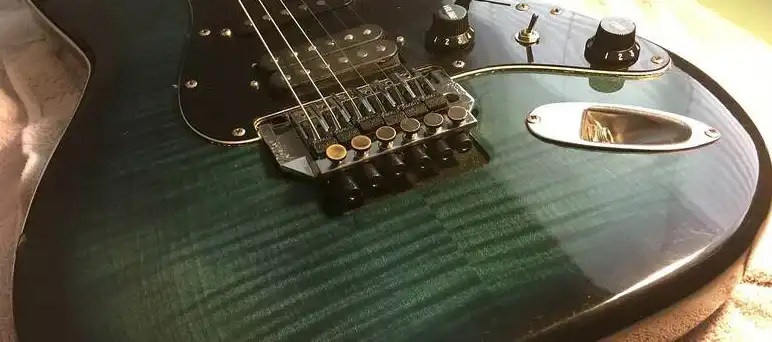
Between the late ‘80s and the ‘90s, new Foto Flame (and not Photo Flame, as sometimes reported!) finishes were available for Japanese Fender Stratocasters. They represented an attempt by Fender to compete with the highly figured maple tops that had become increasingly fashionable since the 1980s.
Despite many legends, Fender had nothing to do with the development of the Foto Flame process, and no film company, such as Kodak, Fujifilm, or Polaroid, was involved because this finish was not a photographic process! The only thing Fender did was choose the name Foto Flame for marketing.
This effect had indeed been developed and patented by Fujigen, which played Fender and Ibanez against each other to get both to order Foto Flame instruments, making the project a success and their investment worthwhile.
The Foto Flame image (and quilt image used by Ibanez, referred to as “gravure”) was created digitally and printed on a heat-activated plastic film using a special ink. A piece of this plastic film with the printed image was laid on top of a body, which was placed in an expensive heated vacuum press. Everything was vacuumed and heated. After the correct amount of time, the press was opened, and the film was removed and discarded. The only thing that remained was the microns-thick “ink” print of the flame figure transferred to the body. 
After that, it was clear-coated as usual. The result was impressive, and it was not always easy to distinguish a Foto Flame guitar from an instrument with a figured maple top.

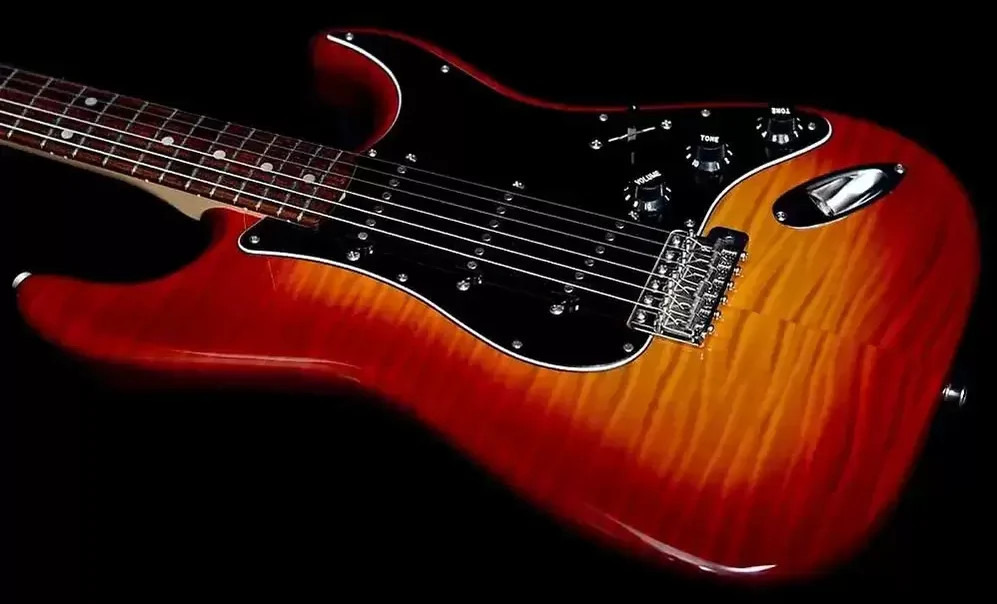
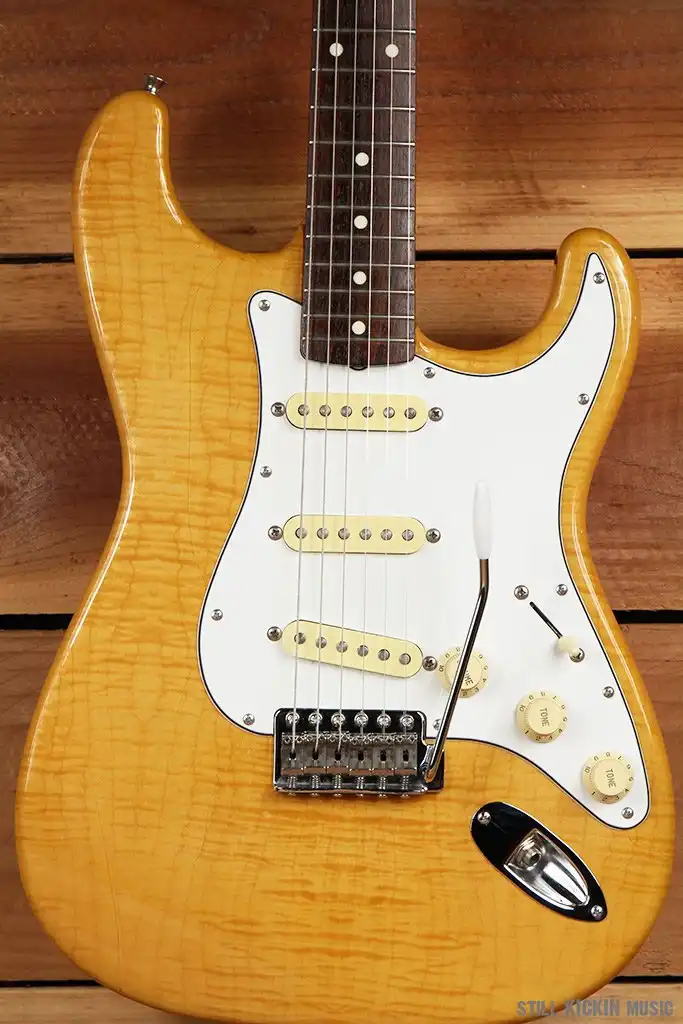
Foto Flame Strat (Courtesy of Stll Kickin Music)
Foto Flame Strat (photo credit: Still Kickin Music)

Fujigen was also a subcontractor for the automotive industry, producing the wood panels used inside Lexus and Toyota cars (again, cars!), so this process had multiple applications as well.

Foto Flame: a kind of finish or a model?

US Contemporary Strat body

There is a lot of confusion surrounding the Fender Stratocasters with the Flame finish because Fender didn’t manufacture only one model with this finish, but rather many different models.

The first Stratocaster with a Foto Flame body, designed for the Western market, was the 1989 US Contemporary Stratocaster, made in Japan and assembled in the USA. It was joined in 1992 by Collectable and HRR Stratocasters.

From 1994 to 1996, Fender Japan made another Foto Flame export model, called the Foto Flame Stratocaster, which was a ‘60s-style reissue featuring a rosewood fretboard, vintage tremolo, three single coils, and an alder body with a basswood top.
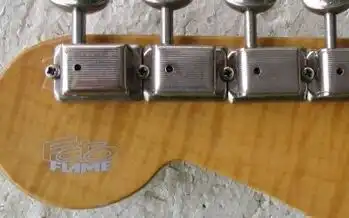
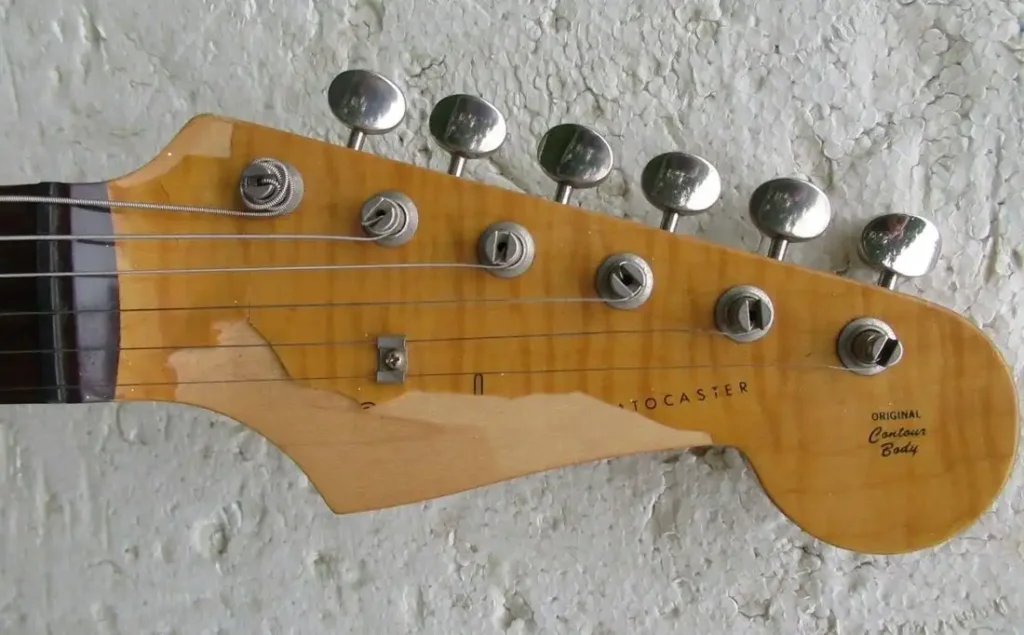
The Foto flame effect was imprinted on both the top of the body (but not on the back) and the neck. This guitar can be identified by the Foto Flame logo on the back of the headstock.
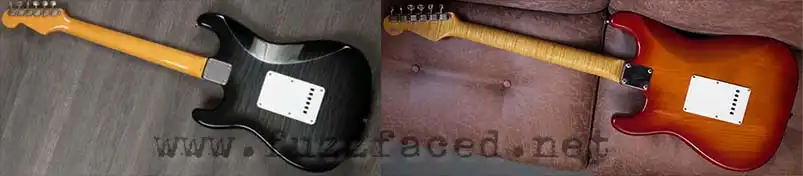
The Fender Foto Flame Stratocaster should not be confused with the 50’s and 60’s Collectable Stratocasters with the Foto Flame finish. In fact, these reissue models featured a basswood body, and the Foto Flame finish was also applied to the back of the body, but not to the neck.

Foto Flame Collectable Stratocaster vs Foto Flame Strat
Foto Flame Logo
Foto Flame Logo

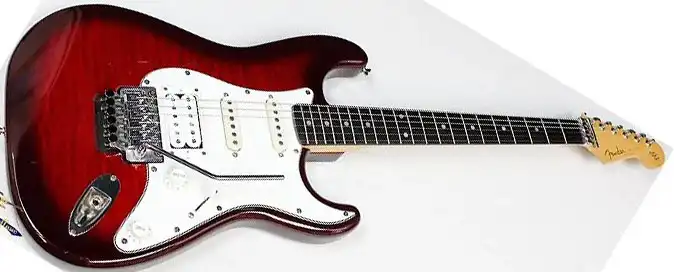
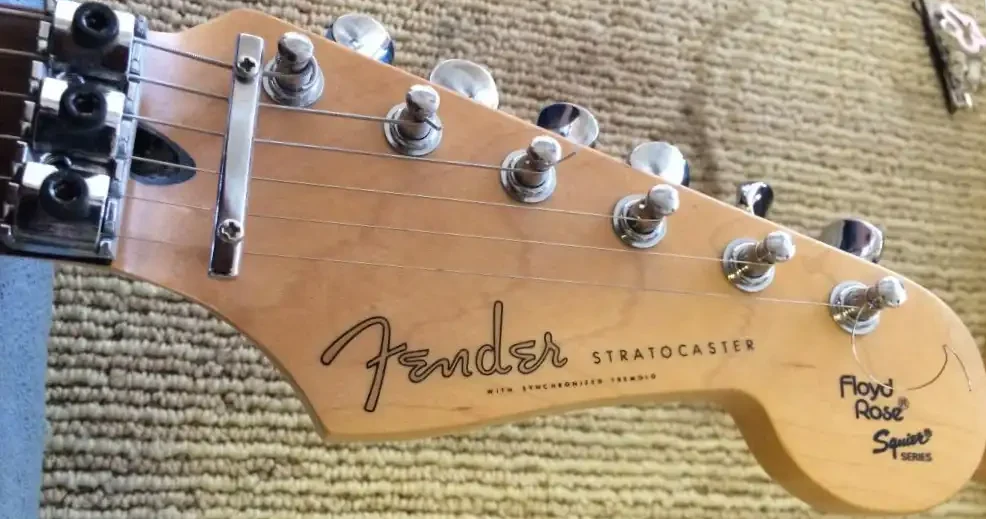
A locking tremolo version of the Fender Foto Flame Strat, the Floyd Rose Standard Stratocaster Foto Flame, was made between 1992 and 1996. It lacked the Foto Flame logo on the back of the headstock, and the Foto Flame effect was imprinted on both the top and back of the body, but not on the neck. It is often confused with the HRR Stratocasters. Still, it can be distinguished from them because it featured 21 frets, only two knobs (volume and tone), a rectangular neck plate (not asymmetric like the HRR models), the “Floyd Rose Squier Series” logo on the headstock, and the Floyd Rose II bridge.

Floyd Rose Standard Stratocaster Foto Flame
The Floyd Rose Standard Stratocaster featured the ‘Floyd Rose Squier Series’ logo on the headstock

Fender Japan also produced a few models with the Foto Flame finish, intended exclusively for the Japanese domestic market.
For example, the ST62-70NS, which had an alder body with a Foto Flame finished basswood cap, or the Anniversary Stratocasters ST54-70AS, ST57-65AS, and ST62-65AS, which featured Foto Flame necks with the Foto Flame logo.
Also, the Squier Silver Series SST-39 and a few Pro Feel Stratocasters (STR-130LS, STR-92LS) were available with a Foto Flame body.

The Squier Silver Series SST-39

Foto Flame Cracking Problem

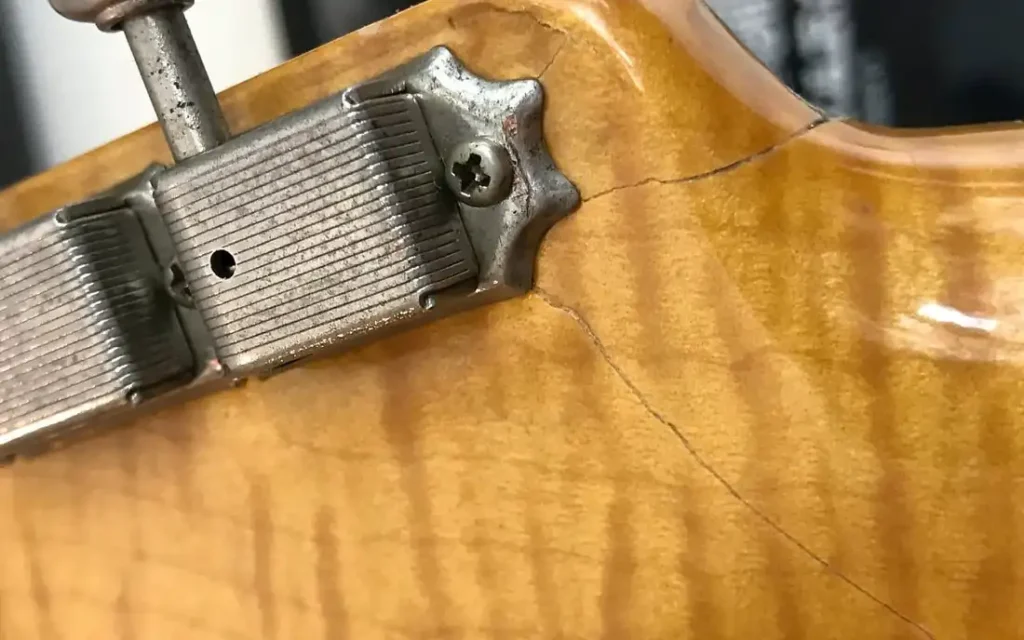
Unfortunately, Foto Flame finishes have experienced some problems over the years. Fujigen conducted extensive testing to verify everything, as this entire concept and process had never been attempted before, and there was no prior work to draw on. But time was an unknown factor. Some Foto Flame guitars today exhibit characteristic cracks in the finish, likely due to an ingredient in the ink print material not being fully compatible with the poly finish. Something that has taken years to show up. There is another problem as well: the beautiful blue sunburst color often turns a strange shade of green.

Foto Flame Headstock Cracking
Foto Flame Headstock Back Cracking
Antonio Calvosa
Antonio Calvosa
Antonio Calvosa is a pharmaceutical chemist with a deep passion for electric guitars. He is a former guitarist for Lost Property Office, with whom he won the Italian edition of Emergenza Rock in 2004 and performed at the Taubertal Festival in Rothenburg, Germany. In 2014, he founded Fuzzfaced, a valuable platform for electric guitar enthusiasts, and in 2022, he contributed to the book "Stratocaster: sei corde nella leggenda."
Antonio Calvosa
Antonio Calvosa
Antonio Calvosa is a pharmaceutical chemist with a deep passion for electric guitars. He is a former guitarist for Lost Property Office, with whom he won the Italian edition of Emergenza Rock in 2004 and performed at the Taubertal Festival in Rothenburg, Germany. In 2014, he founded Fuzzfaced, a valuable platform for electric guitar enthusiasts, and in 2022, he contributed to the book "Stratocaster: sei corde nella leggenda."