Fender Custom Shop #5
Fender Time Machine and Vintage Custom Series
FROM RELIC TO YEAR-SPECIFIC PERFECTION

Table of Contents
ToggleThe Time Machine Series
Crafting the Look and Feel of Classics
With the arrival of the Vintage Reissues and the Cunetto-era Relics, it became clear that the mystique surrounding old guitars—even those marked by heavy wear—was not fading but intensifying. The aura of history, of wood and lacquer shaped by time, began to exert an even stronger pull on guitarists.
For some players, choosing a worn-looking instrument was a matter of pragmatism: there was no anxiety about the first scratch or dent. For others, the attraction was more emotional than practical. It was, perhaps, a “sweet illusion”—the compelling sensation of holding a guitar that seemed to carry years of stages, studios, and songs within its scars. A relatively accessible instrument that visually and tactually echoed the defining traits of Fender’s golden age proved irresistible to a widening audience.
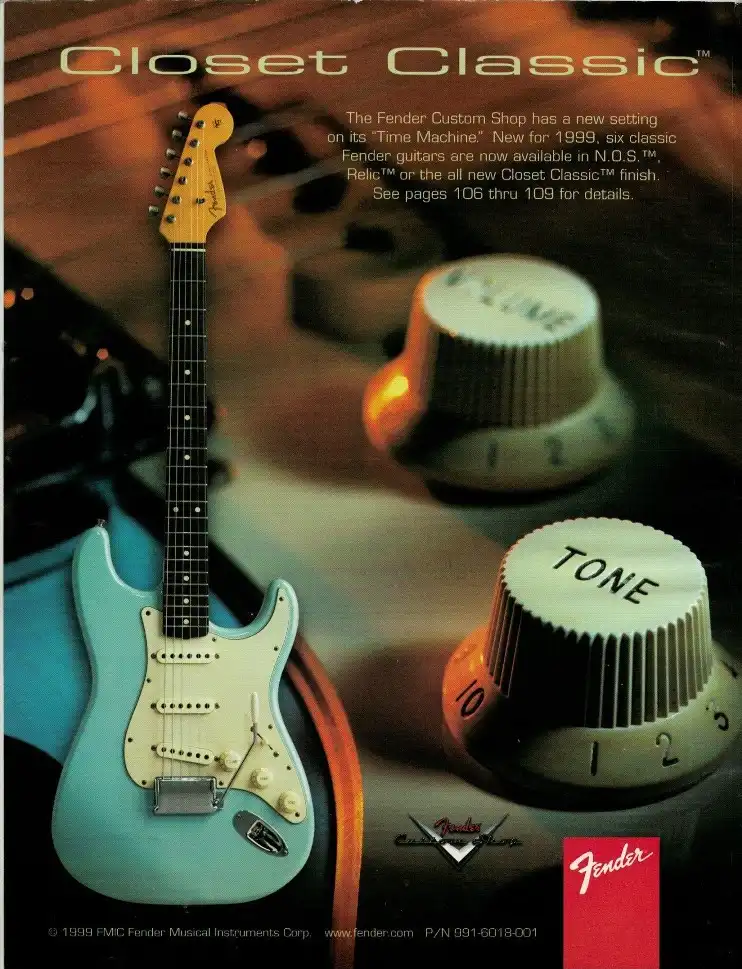

According to Mike Lewis, then Fender Marketing Director, the relic phenomenon has always divided opinion, sometimes sharply. Yet commercially, it marked a turning point. It allowed Fender to significantly expand its Custom Shop output, and the Time Machine Series, introduced in 1999, has since become one of the company’s primary revenue sources.
Fender not only aimed, whenever possible, to replicate the production techniques and materials of the original years, but also inspired Custom Shop luthiers to study vintage guitars from the ’50s, ’60s, and ’70s with extraordinary attention to detail. They examined body contours, neck shapes, headstocks, pickups, and hardware, tracing their evolution over time, while also scrutinizing subtler elements such as routing and wiring, all in pursuit of faithful reproduction.
The process had a ripple effect, raising standards across Fender’s factory production. For example, with the introduction of the Time Machine series, the headstock shapes on American Vintage Reissues and American Standard Stratocasters began to mirror those of the instruments from Leo Fender’s era, bringing the golden age of Fender guitars into the modern era.

From Relic to Time Machine
Between 1995 and 1997, the Relic ’50s Stratocaster and the Relic ’60s, both listed in the Relic Series, were the only Stratocasters offered with a worn appearance. In 1998, they were joined by the NOS Stratocaster from the Custom Classic Series, a model that, according to the catalog, retained the key features of mid-1960s Stratocasters.
By late 1997, a pivotal shift was underway. The move to the new Cessna Circle facility marked more than a change of address: it brought the Custom Shop into the heart of Fender’s main production operations. With this integration came the capability to spray thin, vintage-correct nitrocellulose finishes while remaining fully compliant with increasingly stringent environmental regulations. In that new framework, Vince Cunetto’s role had effectively run its course, and the Fender Custom Shop soon moved to establish its own in-house vision of the aging process.
Until then, no aged instrument had truly captured a guitar from a specific year—they were all generic, decade-style reproductions. Mike Lewis collaborated with John Page, and later with Mike Eldred, who succeeded Page at the Custom Shop, to develop year-specific relics.
The new Time Machine Series, launched in 1999, went further than ever, meticulously recreating Fender instruments from specific years, faithfully reproducing every contour, finish, and detail so that each guitar looked and felt as if it had genuinely rolled off Fender’s production line decades earlier.
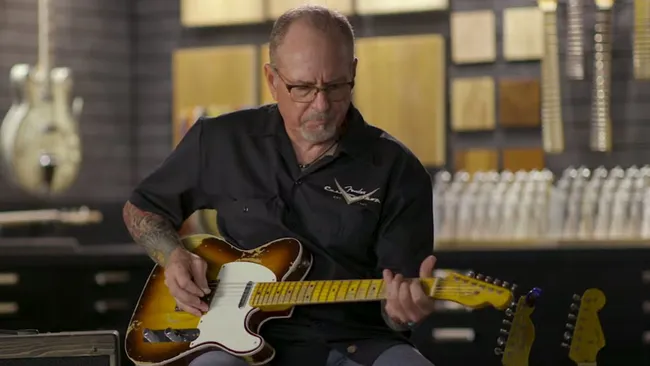
“The whole point of selecting a single year of production was to show just how specific and picky we could get. The 1960 Stratocaster is a great example. The original had a smaller truss rod. […] We got the dimensions from an original ’60 Strat and couldn’t find it from any of the suppliers, but we figured if we were to put a regular truss rod in that guitar the level of integrity would drop, so to this day we take regular truss rods and send them out to a guy who mills them down to the right thickness for that one year of production. This also means that we have to get a custom-made truss rod adjuster and a custom-made anchor.”
Mike Eldred
The Art of Aging: Fender’s N.O.S., Closet Classic, and Relic
Alongside the Time Machine Series, Fender expanded the concept of aging with three distinct finish packages: N.O.S., Closet Classic, and Relic.
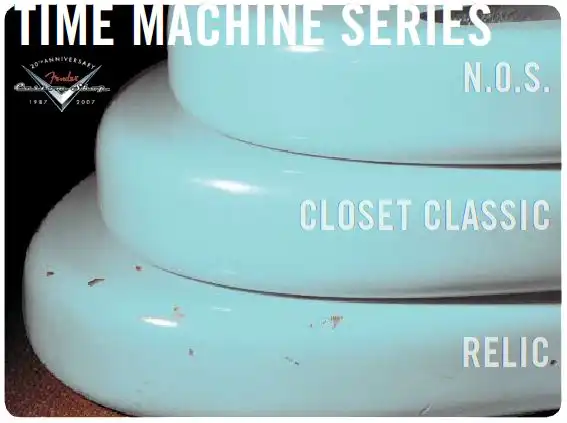
N.O.S.—short for New Old Stock—offered guitars that looked untouched, “like just taken from the warehouse, never played and without signs of wear or aging,” as the Fender catalog put it.
Closet Classics occupied the middle ground, appearing as if they had been played lightly over the years and then stored in a closet. Their finishes showed subtle checking, tiny splits, and gentle yellowing, while the plastics and hardware bore the faint patina of age—enough to suggest a life lived without ever looking deliberately worn.
Relics, by contrast, were unmistakably “used and abused.” Checking, scratches, missing patches of paint, yellowed plastics, and even a touch of rust created the impression of instruments that had truly survived decades of playing, travel, and stage life.
Dan Smith: “We use a different finishing material, depending on whether it’s N.O.S. or whatever. For the new Relics, we use a finish that’s more prone to cracking. On the N.O.S., the finish is softer, more flexible, so it won’t check too quickly. The whole process is similar to antiquing furniture. We can cold-check the paint by hitting it with freezing temperatures, and then the guitar is banged around with different implements. If you don’t know what you’re doing, you would get a guitar that looks brand new but dinged up, instead of truly old and worn—a big difference. It all has to be done in a certain way.”
Time Machine Series: Fender’s Vintage Catalog
At first, the Time Machine Series included the ’56 Stratocaster, the ’60 Stratocaster, the ’69 Stratocaster, the ’51 Nocaster, the ’63 Telecaster, and the Relic ’64 Jazz Bass. All of these instruments—including the Relic ’64 Jazz Bass, despite its name—were offered in all three aging levels.
By 2003, the Time Machine Series was beginning to take shape as a full tribute to Fender’s golden years. That year saw the arrival of the ’65 Stratocaster with its rosewood round-lam fretboard—already available outside the catalog since 2002—a ’59 Esquire, and a 1960 Tele Custom. In 2004, the ’66 Stratocaster joined the lineup, officially entering the catalog in 2005. Over time, the series continued to expand, gradually adding new models and solidifying its reputation as a meticulously crafted archive of Fender’s most iconic instruments.
“We spend a lot of time examining vintage instruments, and when we’re building a reissue, we approach each year a certain way. For example, if we’re relicing a Strat from 1969, we take into consideration that the original finish was done a little differently then, so it would have aged differently. The original necks were starting to be shot with polyester, so it might not have not worn through on the fingerboard. We can be very precise.”
Mike Eldred
Fender Relics Evolved: Heavy Relic, Journeyman Relic, and Lush Closet Classic packages
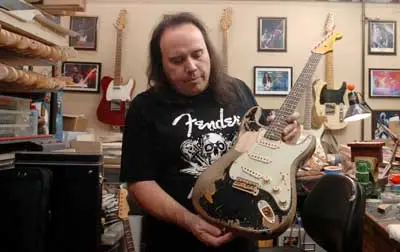
For some players, even the standard Relic treatment wasn’t enough—just look at the extreme wear on Stevie Ray Vaughan’s Number One or the even more battered condition of Rory Gallagher’s Stratocaster.
To meet this demand, Fender introduced, in 2010, an extreme aging level called Ultimate Relic or Heavy Relic.
First applied to select Master Built instruments crafted by John Cruz, these guitars were described in the catalog as having “been to hell and back,” capturing the look and feel of instruments that had truly lived a lifetime on stage and in the studio.
Heavy Relic instruments were worn far more aggressively than standard relic models, sometimes to the point of appearing almost exaggerated.
John Cruz came to Fender in 1987, joined the Custom Shop in 1993, and became a Master Builder in 2003. His meticulous work was essential to the initial Custom Shop Relic guitars and basses, and he initiated the Custom Shop’s quality assurance program.
He was the man behind several famous Custom Shop instruments, including the replica of famed Stratocasters, such as the Stevie Ray Vaughan’s Number One, the Jeff Beck Esquire Relic, the Rory Gallagher’s Stratocaster, the Yngwie Malmsteen’s “Duck” Stratocaster, the John Mayer Black 1 Stratocaster, and the Gary Moore 1961 Fiesta Red Stratocaster.
Finally, Fender introduced the Journeyman Relic (2016) and Lush Closet Classic (2017) finish packages.
The Journeyman Relic treatment struck a balance between Relics and Closet Classics. “Used but not abused,” as the Custom Shop described them. These were guitars that had clearly been played, mostly at home with the occasional gig, well cared for over the years. Their finishes showed moderate checking, a few small scratches, and hardware gently dulled by time.
The Lush Closet Classic package, by contrast, told a different story. Fender described them as guitars “owned with pride,” polished and meticulously maintained over the years. Their very light relic finish reflected careful, loving use, marked only by subtle checking and moderate oxidation, the hallmark of instruments cherished by devoted players.


Fender Vintage Custom Series
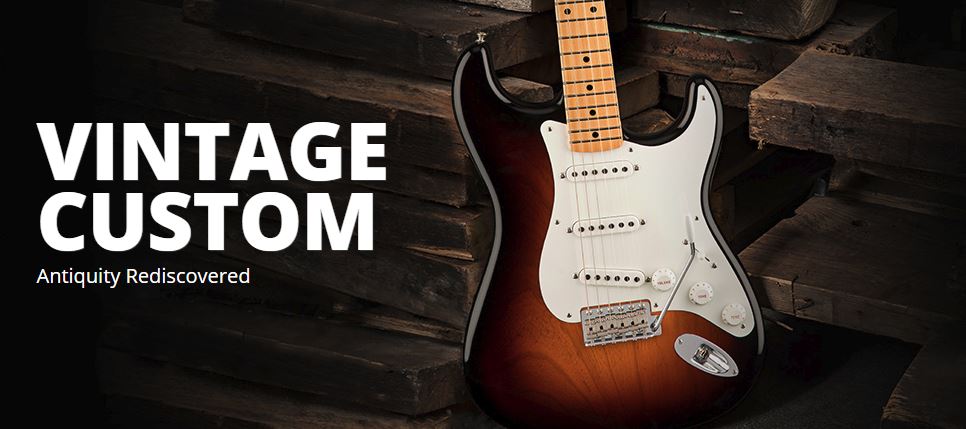
In 2018, the Fender Custom Shop launched the Vintage Custom Series, which embodied early and transitional versions of classic Fender models, predating their current forms. Some models featured rare prototype elements, while others showcased transitional combinations of components that might have been used during the guitars’ development. These Stratocasters also featured a few enhancements, such as a vintage compound radius, for superior playability.
Every Vintage Custom Stratocaster came with the new “Time Capsule” aging package, combining the Closet Classic hardware with the “No Buff” Flash Coat Lacquer finish — a term used by Fender referring specifically to the quickly applied thin and final “flash” of topcoat lacquer applied to their instruments: “the Time Capsule package grants these instruments the charming appearance, authentic sound and genuine mojo of an extremely lucky vintage find.” This finish is smooth and glossy with no lacquer checking or chips, but the hardware and subtle patina hint at age. It will intentionally wear down to a natural relic state much faster than other finishes.
However, it’s important to keep in mind that Flash Coat Lacquer refers only to the final coat, not to the entire finish, so many Flash Coat Lacquered Fender instruments may have a poly undercoat.
