Stratocaster Standard:
The Smith Strat and the 2-Knob Strat
THE STORY OF THE DAN SMITH ERA STRAT
Table of Contents
ToggleA New Era for Fender: The Smith Stratocaster
Dan Smith was the man chosen by Bill Shultz at the beginning of the 1980s to reinvent Stratocaster.
In August 1981, in agreement with CBS, the Fullerton industrial plant was restructured to produce significantly fewer guitars than the 250–300 made daily in the 1970s, thereby improving quality control.
Finally, at the end of 1981, Dan Smith redesigned the Stratocaster, definitively abandoning the three-bolt neck plate and tilt-neck system. These were replaced with a classic four-screw neck plate and a truss rod adjustment at the neck heel.
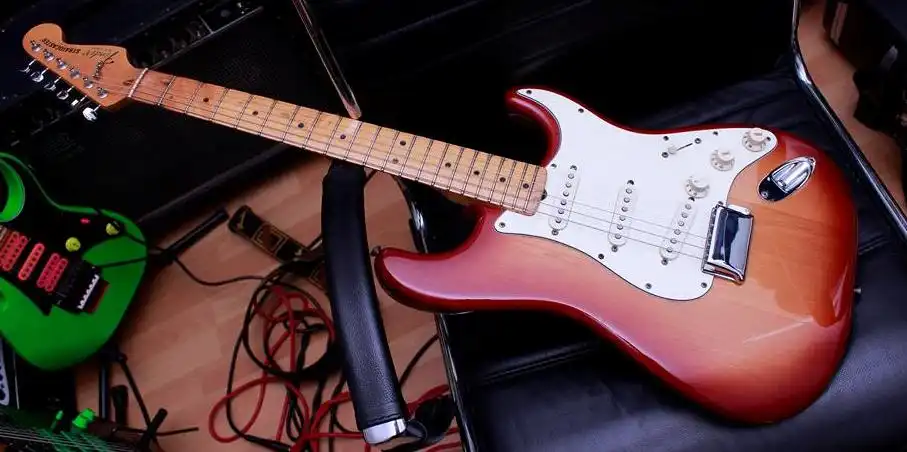
The design saw a return to a smaller headstock—though not identical to the pre-CBS version—known as the “Smith headstock,” with the word “STRATOCASTER” printed in large letters.
“With John Page’s help, one of the first things that I knew, coming from the outside as a player—and half the guys on the inside knew this, too—was nobody wanted to buy a three-bolt neck with a great big headstock and a bullet truss rod. So, one of the first things we did was to change the product back over to four-bolt. We had an incredible amount of inventory of bodies and parts that we had to work through, but we changed it back to the four-bolt neck and the right headstock”
Dan Smith
The tuning machines were the Schaller Fender keys, which featured the letter “F” printed on the shell. The pickups still had flush poles, but in the bridge position, the X-1 pickup—already present on the Strat—was used. The body, more contoured than those from the late 1970s, was coated with a clear coat of polyurethane. It was typically made of alder, but hackberry was preferred for its distinctive grain pattern for some transparent finishes.
The bridge was the same die-cast bridge used on the ’70s Strats, but Dan knew it was a temporary solution that would soon change.
Since the Stratocaster was no longer just a specific Fender guitar model but represented an entire line of Fender guitars with different names—including the Strat, the Gold Stratocaster, and the Walnut Strat—this regular version was named the Standard Stratocaster. Its first version, unofficially dubbed the Smith Strat, was marketed in December 1982 and should not be confused with the second version, released in June 1983. You won’t find “Smith Strat” on the headstock or in any catalogs, as it’s simply a nickname that Fender enthusiasts gave to the model in homage to the man who redesigned the Stratocaster.


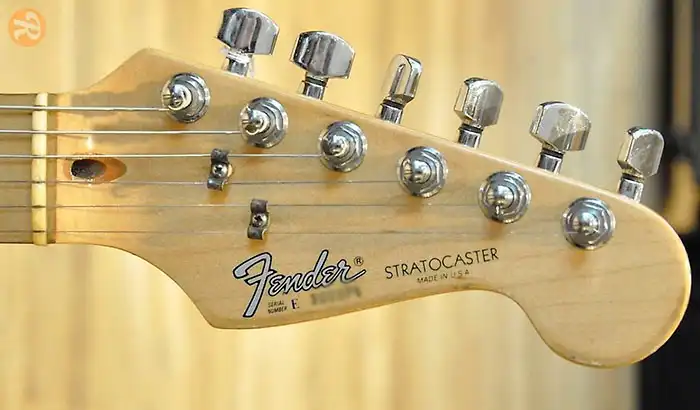
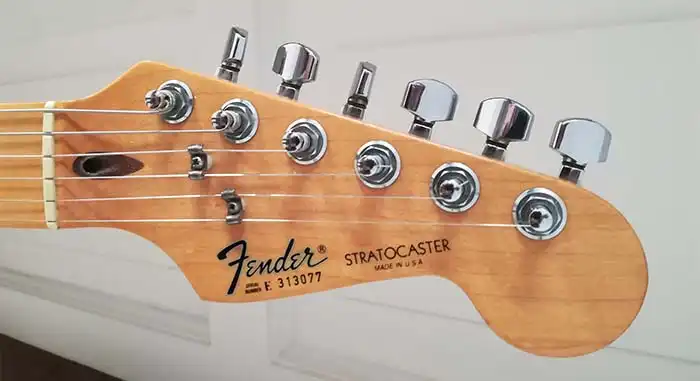
It’s interesting to note that two kinds of decals were used for the Smith Strath. Although the logo used was always the Black CBS Logo with gold trim, two different fonts were used for serial numbers (click the pictures to enlarge).
The 2-knob Stratocaster
In June 1983, to cover all price points and thereby sell more guitars, Fender significantly revised the Standard Stratocaster—while at the same time releasing the Elite Stratocaster.
The newly revised Standard Stratocaster became the budget model, while the Elite was the high-end option. To cut production costs, the jack socket of the Standard Strat was relocated to a single-ply, 12-hole pickguard, and only one tone control—rather than two—was offered, earning it the nickname “2-Knob Stratocaster.”
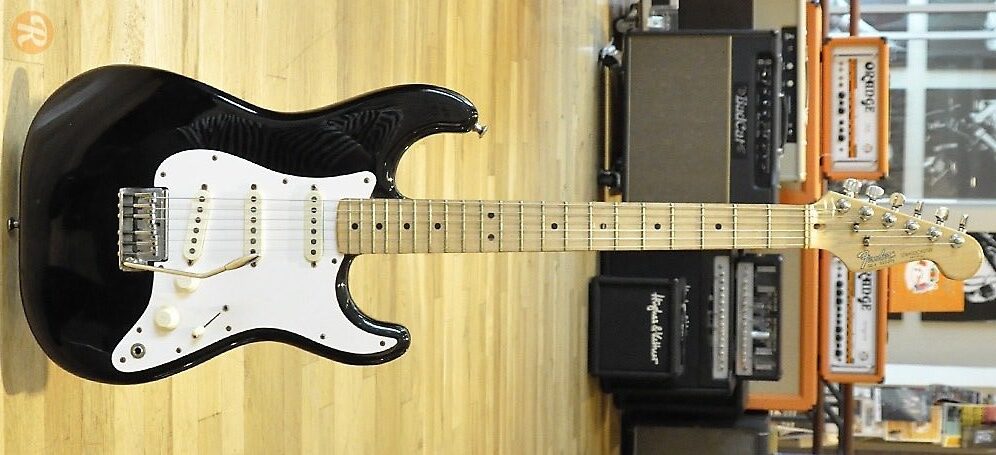
“The concept was mine and a part of it was all about cost. When I got here in 1981, regular Strats were almost a thousand bucks without a case. We had to compete with the stuff coming in from off-shore, so we were looking at ways to cut costs. One was to relocate the jack to the pickguard. That let us to remove a ferrule [the standard output jack], which was a chrome-plated part and cost us three or four bucks or whatever it was. […] The new wiring harness could be done in one piece and just dropped in so that cut the production time. We also reduced the knobs to one volume and one tone. So, you pull out three dollars of your cost here, and another five bucks there, and another couple of bucks somewhere else.”
Dan Smith
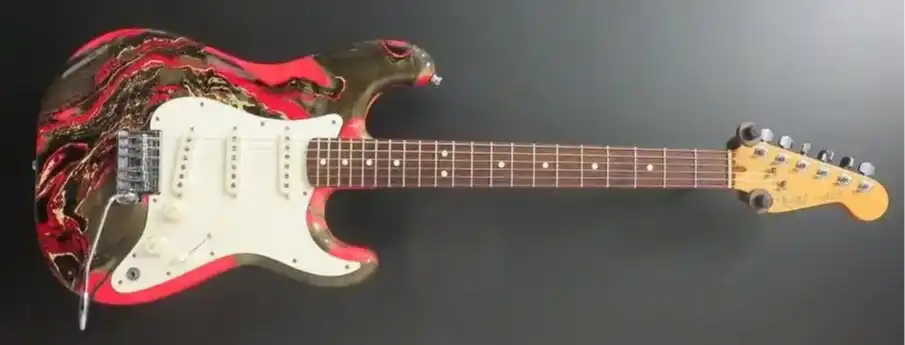
At the end of 1984, 225 2-knob Stratocasters were manufactured with a limited edition “Marble” finish (also known as the Bowling Ball finish), produced in three equal batches of different colors: red, blue, and gold. These bodies were not painted in Fullerton but by a company in New York, and they were sold in 1985.
Adjusting the Curve: BiFlex Truss Rod Innovation
It was a highly controversial instrument. This Strat featured a four-bolt (not three-bolt) neck plate with an access hole for Micro-Tilt neck adjustment and was equipped with the new Bi-Flex truss rod for the first time on a regular Stratocaster. Designed by Charlie Gressett and previously used on the Elite model, the Bi-Flex allows adjustments in both directions: it corrects concave neck bowing like a traditional single-action truss rod but can also be adjusted in the opposite direction to correct convex neck bowing. After some time in production, John Page slightly modified it by adding a lip to the anchor. This mod was necessary because excessive pressure on the tilt screw adjustment could push the anchor up through the fretboard. The addition of the lip prevented this issue. Despite this adjustment, the system proved so successful that it was later used on the American Standard and other U.S.-made Stratocasters. To further appeal to guitarists, Fender also introduced bigger frets and an almost flat fretboard with a less rounded neck profile.
Tremolo Revolution: The Freeflyte System
According to Bill Carson, the two-knob Stratocaster was the worst Strat ever made. Many players also reported that the guitar had significant tuning issues, largely due to the new Freeflyte Tremolo system with die-cast stretched saddles. This tremolo, designed by former Peavey engineer Chip Todd and produced using a mold, was often considered inferior to the classic Synchronized Tremolo at first glance. However, some argued that the bridge functioned well—as long as it was properly set up and tuned.
In this ‘inertia bar–free’ device, the springs’ tension was regulated from the front face of the body, eliminating the need for back cavities or a back plate. It featured a single knife edge pivot that went all the way across, so there were no base plate screws. Instead, there was a V-groove block that received the knife edge.
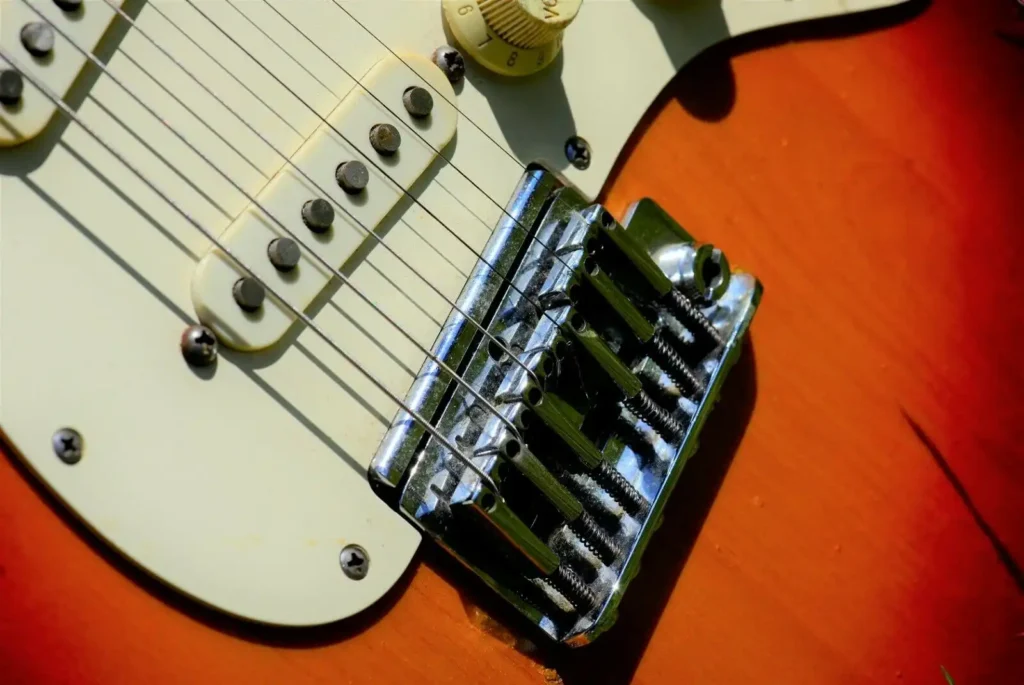

“We felt [the full-width pivot] was the best way to get the tremolo to move back to mechanical center, but it had problems. The balance was actually too good, so you’d get a lot of warble because it was always moving—the V groove was so sharp the tailpiece moved around too much. And we needed a place for the spring tension adjustment, which was something we added to the bridge shortly before we introduced it. We were messing with the geometry, changing the relationship between the pivot point of the string, and we didn’t get a chance to test it enough. We ended up giving a lot more power to the string, so when you tuned it up the bridge would pull up off the body further than a normal Stratocaster, and when you bent strings the bridge would move around more. It was impossible to keep in tune. We didn’t realize all that until after we tooled up. The bridge was a cast piece from Schaller. We tried to make it better than its predecessor, but at the end of the day the tremolo was a nightmare.”
Dan Smith
Senior Luthier Scott Zimmerman, who built the 2-Knob Strat samples, had to inform Fender management that the bridge didn’t work. Scott nearly got fired, but when Freddie Tavares played the samples Scott had made, he confirmed that the bridge was the issue—and that Scott was not at fault.
At the time, Schaller was producing thousands of the Freeflyte Tremolo bridges, and Fender ultimately lost hundreds of thousands of dollars. Chip Todd was removed from R&D, and his contract was not renewed when it came up for renewal.
Fender Marble Stratocaster
At the end of 1984, 225 2-knob Stratocasters were manufactured with a limited edition “Marble” finish (also known as the Bowling Ball finish), produced in three equal batches of different colors: red, blue, and gold. These bodies were not painted in Fullerton but by a company in New York, and they were sold in 1985.
The Japanese Version
It’s interesting to note that in 1983, Fender Japan produced its version of the Two-Knob Stratocaster, known as the ST83-80. Dan Smith visited the Fujigen factory several times, and on one occasion, he brought a U.S.-made Two-Knob Standard Stratocaster with him. The Japanese luthiers used it as a reference to create their version.
The main difference between the Japanese and U.S. models was the number of frets—the Japanese ST83-80 featured 22 frets, while the U.S. version had 21. Additionally, the ST83-80 had a vintage-correct headstock shape, a different body contour, different body routings, and a neck pocket without the enlarged corners found on the U.S. Two-Knob Stratocaster.
