Inside the story of a revolutionary guitar
The Elite Stratocaster
AHEAD OF ITS TIME OR TOO SOON?
Table of Contents
ToggleEnter the Elite: Fender’s High-Tech Answer to the ’80s
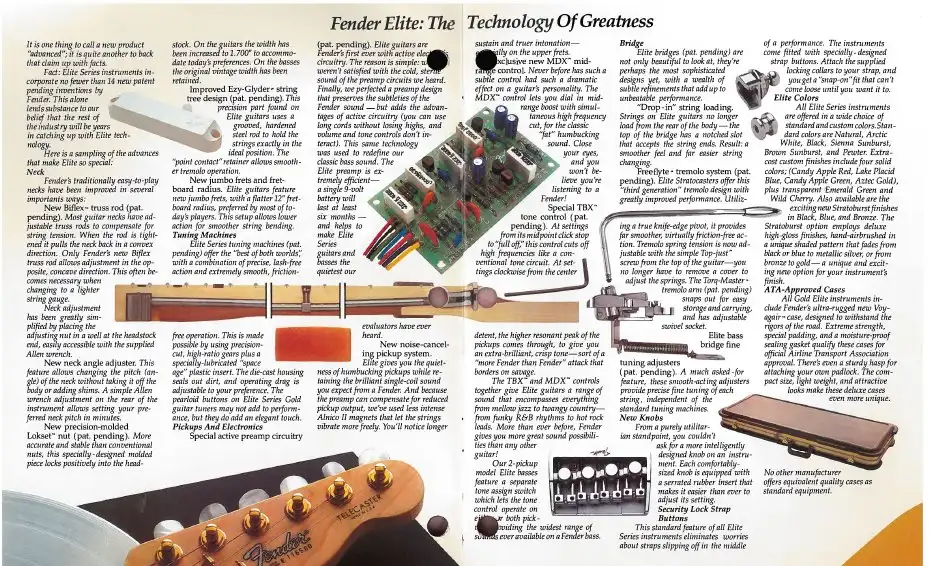
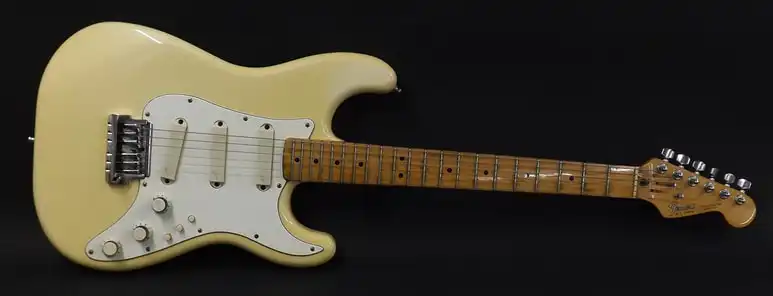
In May 1983, Fender released a new Stratocaster model—the Elite Stratocaster—featuring what was advertised as the most elaborate electronics ever offered on a production strat.
Developed under the supervision of Dan Smith, John Page, and Freddie Tavares, the Elite Stratocaster embraced the ‘modern Strat’ concept. At the time, EMG active pickups were gaining popularity, and guitarists were seeking alternatives to traditional single-coils, which were often considered too noisy.
The goal of the Elite Strat was to offer a broader tonal palette and the quiet operation of humbucking pickups, while still preserving the brilliance of single coils. Fender’s advertisements promised: “From the classic Fender sound to a fat humbucking sound,” “Best of both worlds,” and “Your favorite Fender—and non-Fender—sounds.”
This versatility was made possible by its advanced electronics, which included Alnico II pickups controlled via three push buttons, a battery-powered active MDX boost circuit, and the TBX tone control.
Sculpting Sound: Inside the MDX and TBX Systems
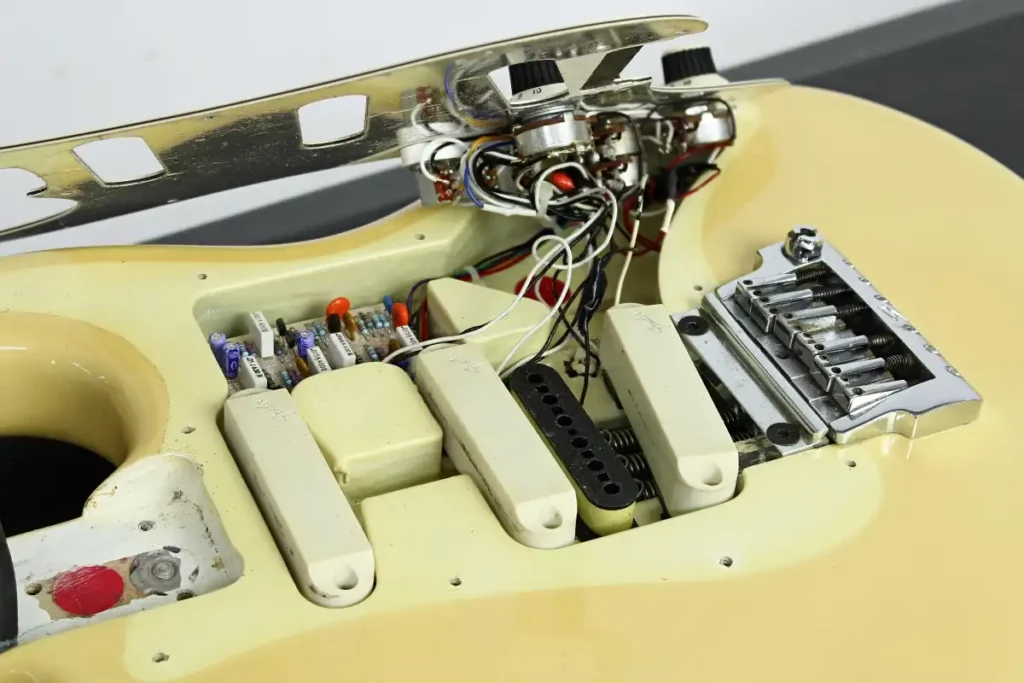
The MDX circuit, which targeted the midrange frequencies, allowed the guitar to produce tones ranging from the classic Fender sound to one that “‘should have’ imitated” a humbucker.
John Carruthers and James Demeter originally designed a circuit that used a dummy coil to cancel the hum of single-coil pickups while preserving their characteristic sound, along with a midrange boost system built into one of the tone controls.
They had hoped Fender would license their electronics, but instead, Fender engineers Roger Cox, Paul Gagon, and Bob Eggler developed their own version of the circuit, which became the MDX.
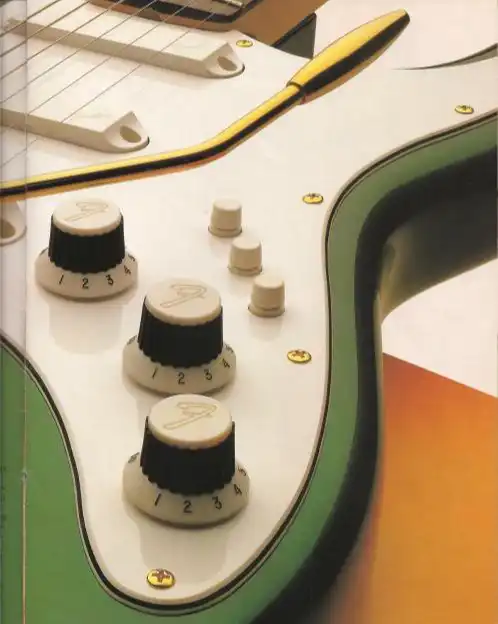
The TBX tone control “adjusts the damping of the pickup’s internal resonance for tones you’ve never heard before,” according to the catalog. This system consisted of two stacked potentiometers and allowed players to cut both treble and bass frequencies by turning the tone knob—unlike a traditional tone pot, which only cuts treble.
Many believed it was an active system, but in fact, it was passive, as it only cut frequencies rather than amplifying them.
It operated as follows:
- Counterclockwise from the center detent (the mid-point), the TBX functioned like a standard tone control, cutting high frequencies.
- Clockwise from the center detent, it cut low frequencies, thereby enhancing the pickup’s higher resonant peak.
At the mid-point setting—position 5—the TBX was equivalent to a regular tone control set to 10 (fully open).
The TBX was later applied to other models as well, including the American Standard, Strat Plus, and the Clapton Stratocaster.
BiFlex, Freeflyte, and Beyond: The Anatomy of an Elite
Other notable features included jumbo frets, a flatter fretboard radius, the new Ezy Glider string tree, a side-mounted jack socket, locking strap buttons, the infamous Freeflyte Tremolo (designed by Chip Todd, and more massive than those used on the standard Stratocaster), and—most importantly—the new BiFlex truss rod, conceived by Charlie Gressett.
The BiFlex’s adjustment point at the headstock allowed the neck’s curvature to be adjusted in either direction—concave or convex. After the system had been in production for a while, John Page made a subtle but significant improvement by adding a lip to the truss rod anchor. This modification addressed an issue where excessive pressure from the tilt adjustment screw could force the anchor upward through the fretboard. The lip acted as a safeguard, preventing this from happening.
It’s worth noting that the BiFlex truss rod featured a contrasting skunk stripe regardless of the fretboard material—whether rosewood or one-piece maple—indicating that it was always installed from the rear of the neck.
Fender’s Pricing Strategy and the Elite Stratocaster
Fender’s new strategy was clear. The Elite Stratocaster was positioned as a premium model, contrasting with the regular “2-knob” Standard Stratocaster. In fact, the “Smith” Standard Strat of mid-1981 was replaced not by a single model, but by two. The new “2-knob” Standard Stratocaster was priced $245 less than its predecessor, while the Elite Stratocaster came with a $100 premium!
The Elite Stratocaster: Premium Variants and Fender Japan's Take
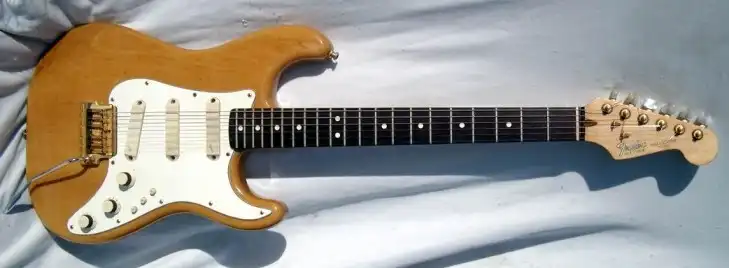
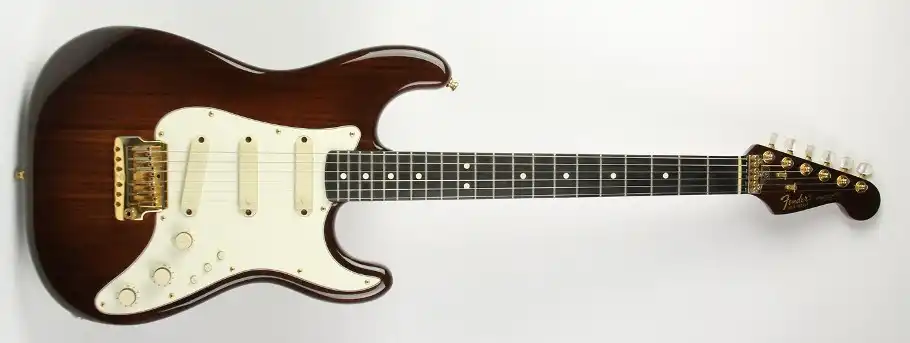
The Elite Strat was also available in fancier versions: the Gold Elite Stratocaster, which featured gold-plated hardware and pearloid tuning machine buttons, and the Walnut Elite Stratocaster, which differed from the Gold model with its walnut neck and body and ebony fretboard.
It’s worth noting that by the end of 1983, Fender Japan produced its version of the Elite Stratocaster, the EST83-110. This model, equipped with twenty-two frets, was intended exclusively for the Japanese domestic market.