Inside the Dream Factory
The Fender Custom Shop
CUSTOM SHOP EXPLAINED

The Fender Custom Shop opened on May 15, 1987. Its original purpose was to make special, or custom, instruments, mainly for famous artists or working musicians. It was a ‘best-of-the-best’ department where top luthiers crafted the finest versions of both traditional Fender models and new designs.
At that time, the concept of “custom” was not entirely new. Custom guitars, like Eldon Shamblin’s Gold Stratocaster or Bill Carson’s Cimarron Red Stratocaster, were also built in the ’50s.
However, the Custom Shop, as we know it, has its roots in the early to mid-1980s. During that period, the Fender Research and Development department included many talented minds and craftsmen who had proven themselves with the success of the Vintage Reissue project. John Page, Steve Boulanger, Scott Zimmerman, and John Cermenaro began discussing their desire to create custom instruments. Together, they laid the groundwork for the Custom Shop. John Page actually wrote up a formal proposal with all the details and presented it in writing to Bill Schultz in 1984. The specific structure they proposed was essentially the same as the early Fender Custom Shop, minus one crucial point: it should be independent of Fender. The idea was to establish a separate, independent entity specializing in the design and construction of prestigious instruments for prominent musicians. This would enhance the Fender brand’s value in the marketplace. Unfortunately, CBS rejected their original proposal.
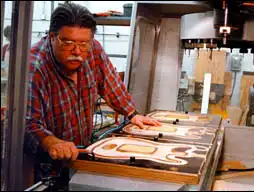
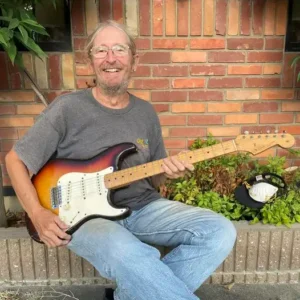
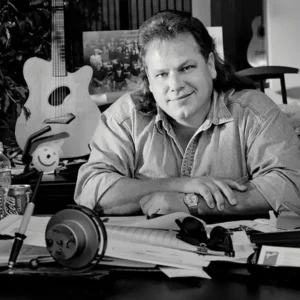

However, by then the Custom Shop seeds had been sown. Dan Smith said, “We were only going to make 10 Vintage pieces a day, so we were going to start a Custom Shop to build special projects for artists, to make certain that the prestige was still there for the company.” Dan didn’t really mind if the Custom Shop didn’t make money; it was all about promoting the prestige of the Fender brand.
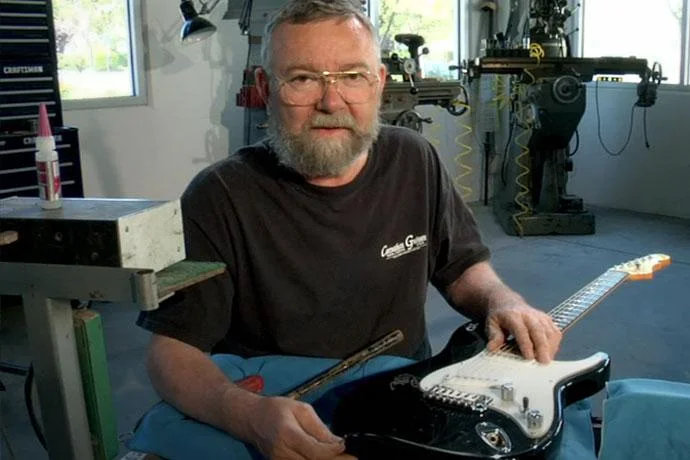
The first choice to head up the Custom Shop was John Carruthers, one of the first people hired as a consultant by Bill Schultz when he took over at CBS Fender.
John was a famous luthier who customized and repaired instruments for some of the most important musicians. Although he was a close friend of Dan Smith, he decided to reject the offer because he had established his own business with many professional clients.
Smith urged Bill Schultz to tap designer, engineer, and guitar builder George Blanda to head up a small Custom Shop and make artist guitars.
“I had a business building guitars,” said George. “Prior to that, I had a couple of years of experience working at Ax-In-Hand in DeKalb, Illinois, so I had seen a great many vintage guitars. Within a couple of months after the buyout, they weren’t really sure what they were going to do, but they had determined that they were going to start a Custom Shop, and that would be a good place for me.”
George joined Fender in October 1985, but the Custom Shop project was temporarily put on hold because Yen/US Dollar exchange rates began to favor exports, and demand for US-made products surged.
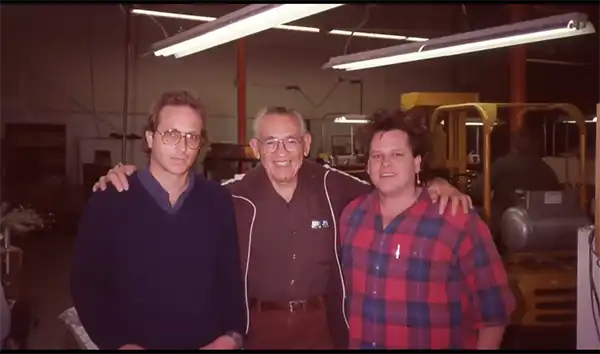
“When the yen dropped, prices of Japanese products went way up overnight,” George said. “So, importing them wasn’t going to save us as much money. Besides, everybody wanted to see some good old-fashioned US technology again.” As a result, Fender needed an R&D specialist to develop new models, and Blanda took on the job.
So, Dan Smith discussed the idea with guitar makers John Page, who had left the company a year earlier to concentrate on his music, and Michael Stevens.

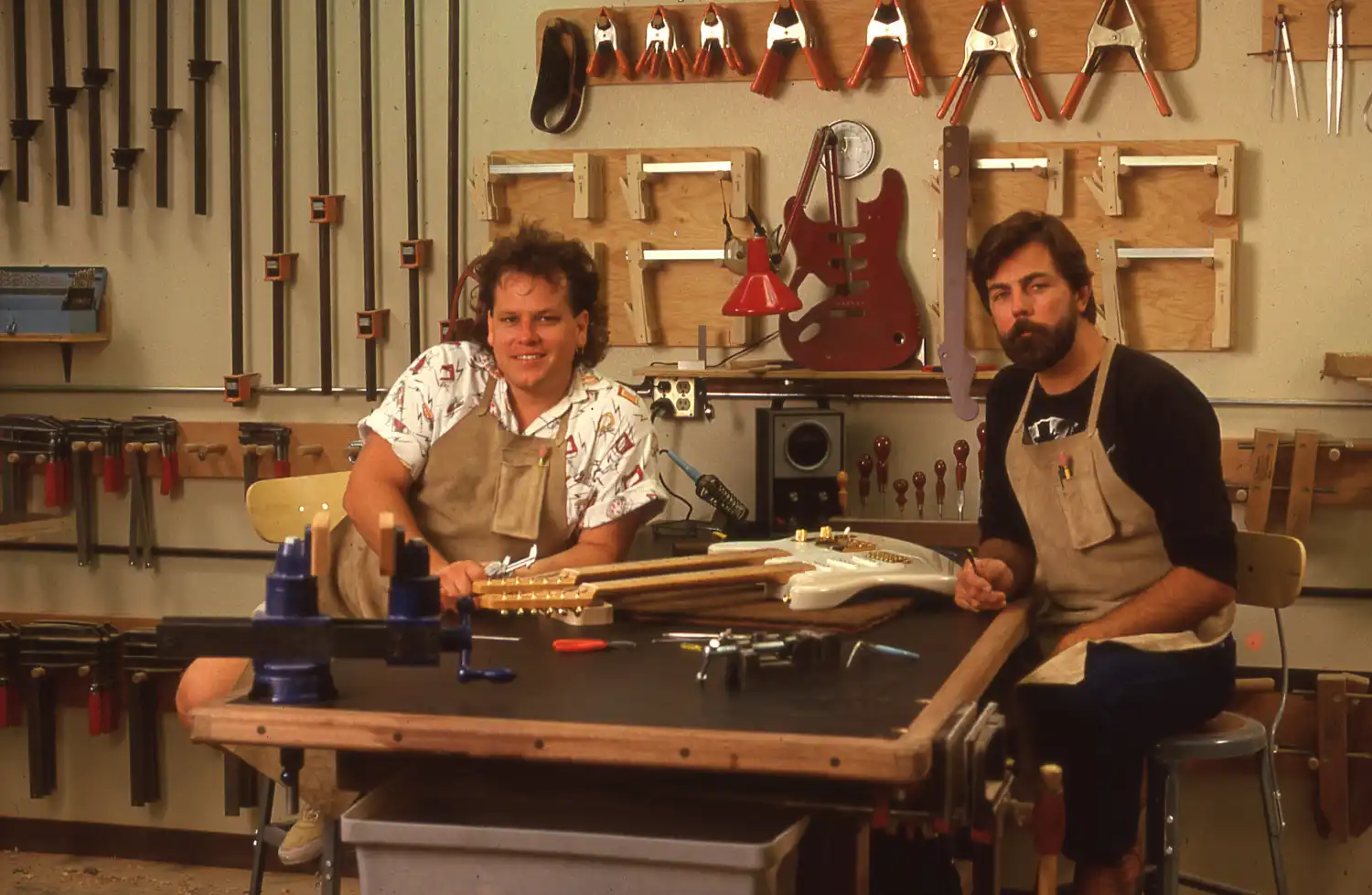
John Page and Michael Stevens
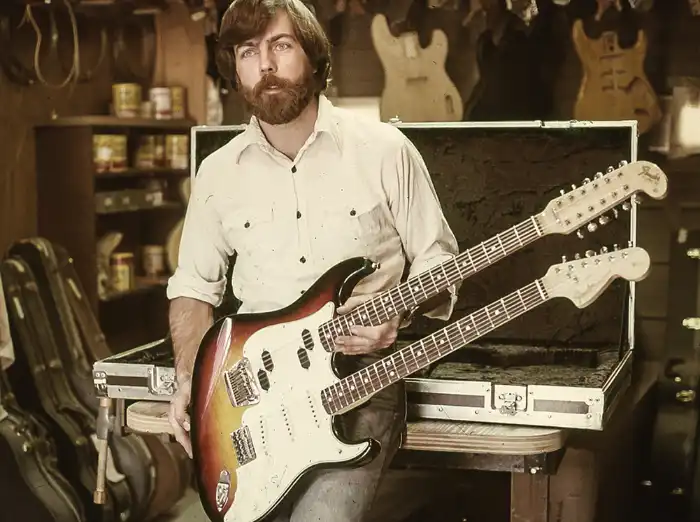

Michael Stevens began making guitars in 1967, working with the late Larry Jameson at the renowned Guitar Resurrection in San Francisco.
In 1978, he opened his own workshop in Austin, where he repaired and built guitars for many notable musicians, including the Vaughan brothers, Albert King, Eric Johnson, Otis Rush, and Lonnie Mack.
“I got the [Fender Custom Shop, Editor’s note] job because of my vintage affiliation with the Dallas guitar show,” Michael explained. In 1978, the Greater Southwest Vintage Guitar Show, as it was officially known, featured just ten exhibitors who rented booth space to showcase or sell their prized vintage instruments. The following year, Michael attended his first Dallas show and remembered, “There were thirteen booths, and I was the only non-retail vintage dealer.”
As the event grew in reputation, dealers from across the country began to participate, and international visitors soon followed. When Japanese media outlets took notice, a series of articles highlighting Michael and several other vintage guitar dealers and enthusiasts appeared in leading guitar magazines. It was through this media exposure that Michael’s work caught the attention of Fender. The skilled luthier, already building a strong reputation, was precisely the talent Fender needed, and in 1986, Michael recalls receiving an offer he simply couldn’t refuse.
Stevens worked for the Fender Custom Shop until 1990, when he moved to Alpine, West Texas, where he opened his own shop.
Unlike Michael Stevens, John Page had already worked at Fender by the time the Custom Shop was a vague concept.
He began working at Fender in 1978, at the age of 21. He spent nearly nine years in Guitar R&D—three as a model maker and six as a guitar design engineer under the guidance of Freddie Tavares.
He left Fender at the end of January 1986 to spend the year in the studio working on his music, while also continuing to do some design consulting for Fender. Still, after 11 months, he had returned.
“I called Dan Smith in December of 1986 to tell him I was going to get back in the guitar industry and asked him if they had any openings at Fender,” John declared. “He said that I could have my choice—get back into guitar R&D or get in on the ground floor of the Custom Shop. I really didn’t have any desire to get back into R&D (I didn’t get along very well with the guy in charge), but I liked the idea of the Custom Shop. Back when I was in the model shop, we made custom guitars for artists all the time. Fender just didn’t advertise it. In fact, John Cermenaro, Steve Boulanger, Scott Zimmerman, and I put together a proposal for us to start a Custom Shop as outside vendors back in 1984-1985. The proposal was rejected by CBS management.”
The first years
The Rise and Growth of the Custom Shop
The Custom Shop quickly became a key component of Fender’s success. The original idea was to promote the brand’s prestige, not just focus on profit. However, the Custom Shop’s rapid success led to the development of limited-edition guitars for the general public. It then shifted to custom series production, as outlined in the 1992 price list. This became a crucial source of income for Fender.
Initially, only Senior Design Engineer Michael Stevens, assisted by John Page, worked at the Shop. Soon, however, Michael and John required more support. In early 1989, Richard Syarto (who remained until April 20, 1989) and Fred Stuart joined, soon followed by Art Esparza, Scott Buehl, John English, J.W. Black, Jason Davis, Larry Brooks, Yasuhiko Iwanade, Steve Boulanger, Greg Fessler, and Pamelina Hovnatanian. Later additions included Todd Krause, Mark Kendrick, Mike Ponce, Alan Hamel, George Amicay, Stephen Stern, Gene Baker, Abigail Ybarra, John Cruz, and John Suhr. As the team expanded through the late 1980s and 1990s, the sheer volume of new Fender models made it impossible to catalog all the guitars produced since 1987.
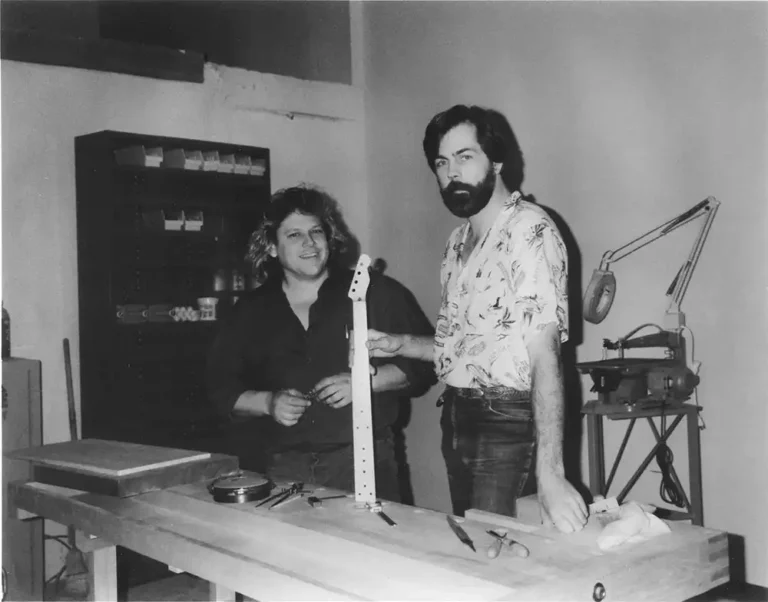
In the early years, many Custom Shop instruments were assembled from factory components carefully selected by Master Builders.
However, maple tops were not standard factory parts; instead, they came from Bill Redman. During the 1990s, the Custom Shop sourced boards from Westwood Lumber in Oregon. Figured maple neck woods, such as flame or bird’s eye, were supplied by Yankee Veneer Corp. in New Hampshire.
The collaboration between the Custom Shop and the factory extended to the production process itself. Some steps in the production process took place in the Custom Shop, while others were completed in the factory. Until the Custom Shop had its own finishing department, most early models were painted at the Fender factory.
J.W. Black remembers: “The Shop wasn’t a separate institution. It was a moving, flowing process, never set in stone. We worked with the factory people all the time, and they helped us all the time as well. If it weren’t for manufacturing, we could not have built one-offs.”
At the same time, Master Builders required more attention than the factory, as he explained in an interview: “I needed exact climate control, day and night. I also wanted our own separate wood stock and a very specific set of tools.”
The Custom Shop also served as Fender’s hub of research and innovation, where new production methods were developed and machinery was tested—improvements that were later integrated into factory production, raising overall quality. Many models introduced in the Custom Shop, such as signature editions, transitioned to factory production, and some factory models were revised and refined in the Shop. Michael Stevens stated the Custom Shop played another crucial role: “Preserve Fender History.”
After a few months in Michael’s garage, the two luthiers relocated to the Corona factory, establishing themselves in a narrow space they called the “bowling alley.” This area expanded when Richard Syarto and Fred Stuart joined the Shop.
By the following year, Fender added two buildings on Pomona Avenue, and the master builders moved into the fourth building.
On September 13, 1989, Fender appointed John Page to oversee both the Custom Shop and the research and development department, marking the beginning of a close collaboration with engineers like Steve Boulanger and George Blanda.
At the time, Fender announced: “By combining the computer and manufacturing capabilities of the R&D department with the artistry of the Custom Shop, John is heading Fender into the future with a bullet.”
In 1990, Fender acquired a building on Enterprise Court, an L-shaped street that connects to Pomona Road. Half of the new facility, located at 135 Enterprise Court, was dedicated to the Custom Shop’s rough-cut wood mill and lumber storage.
At this point, the Custom Shop occupied both the suites in the fourth Pomona Road building and the new space at 135 Enterprise Court.
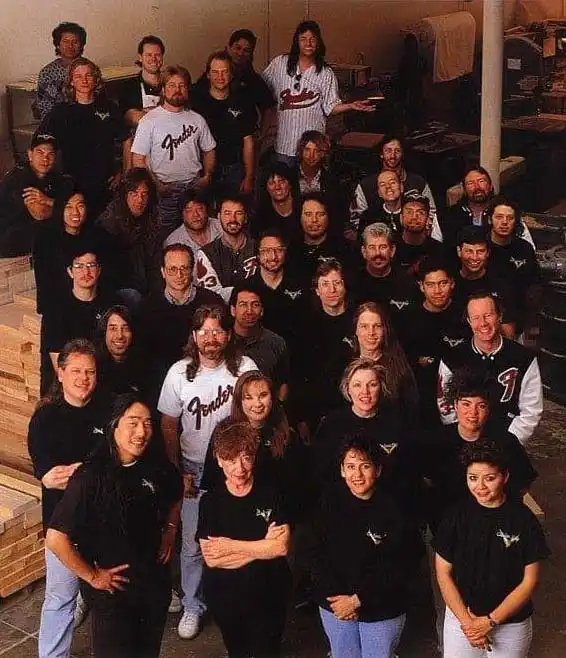
Soon after, the Custom Shop expanded into an additional building at 1233 Enterprise Court. Reflecting on this era, John Page stated: “We were all pretty much in the same building, with very few walls. We were also physically separated from the factory, albeit only by a block or so. It allowed us to create our own environment, our own mood. […] We got to the point where we brought in raw lumber, made our own bodies and necks, painted and buffed them, assembled them, made our own pickups, and even our own straps, all under the same roof.” For some time, the Custom Shop occupied both buildings on Enterprise Court, but soon left 135 for a new plant attached to 1233, which Fender had just purchased in Lewis Court.
As the Custom Shop increased in scale and production, additional staff were hired. Since the late 1990s, Louis Salgado, Dennis Galuszka, Yuriy Shishkov, and Chris Fleming joined Fender’s “dream factory.”
In 1998, the Shop moved to new facilities on Cessna Circle.
Mike Eldred Era
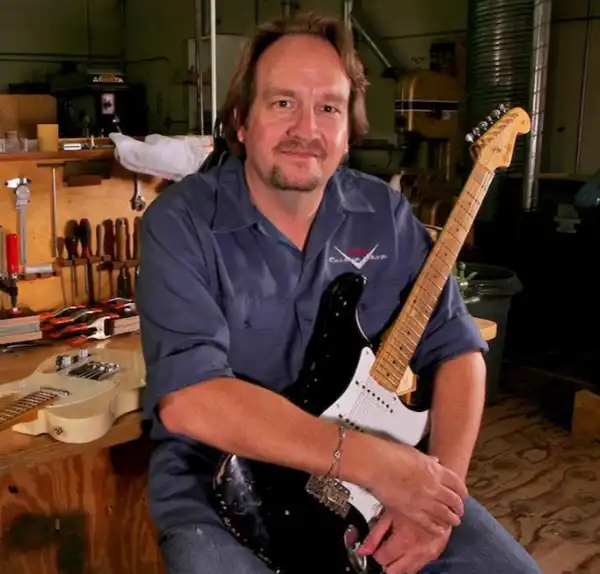
A year earlier, in 1997, Mike Eldred succeeded John Page as head of the Custom Shop after Page became Executive Director of the Fender Museum of Music and the Arts.
Eldred took up the guitar at age 14 after receiving his first instrument from his parents.
By 19, he was already crafting guitars, and in early 1979, he joined the Charvel. He remained there for nine years before joining Yamaha Corporation, where he worked until 1995.
Among the programs under his direction was the Tribute Series, which produced meticulous recreations of instruments associated with celebrated players such as Jimi Hendrix, Stevie Ray Vaughan, and Rory Gallagher.
Eldred departed Fender Musical Instruments Corporation in 2014 and was succeeded by Mike Lewis.
Mike Lewis Era
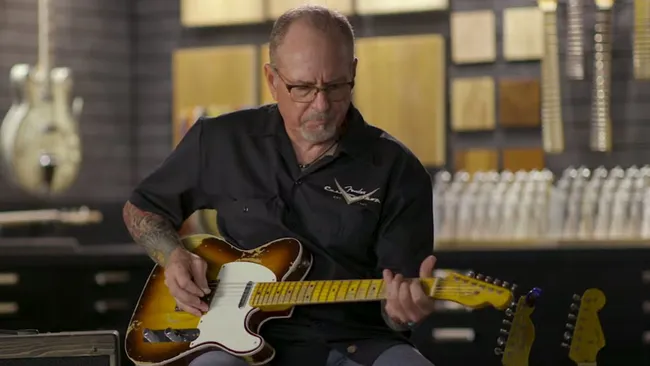
Before joining Fender Musical Instruments Corporation in 1991, Mike Lewis had already established himself as a guitarist and retail professional.
After relocating to Virginia, he opened his first guitar shop and made his initial contact with Fender. That same year, he joined the company in telephone sales at its new Scottsdale, Arizona headquarters, but was quickly reassigned to product development.
As Marketing Manager in 1992–93, he led the team behind the DeVille and Vibro-King amplifiers.
Following his move into guitar development, Lewis directed the design of the Lone Star Stratocaster, Fender’s first US-production model equipped with a humbucking pickup. When Fender assumed responsibility for the marketing, production, and distribution of Gretsch guitars in 2002, he worked to ensure the instruments remained faithful to their original character.
Through his role at the Custom Shop, Lewis also oversaw forward-looking developments within Fender’s premier division, guiding experimentation with tonewoods, finishing methods, pickup configurations, wiring schemes, and hardware.
“Mike Lewis didn’t merely oversee product lines; he possessed the rare ability to reimagine them—stripping them down to their essence and rebuilding them anew,” said Justin Norvell.

The first guitars
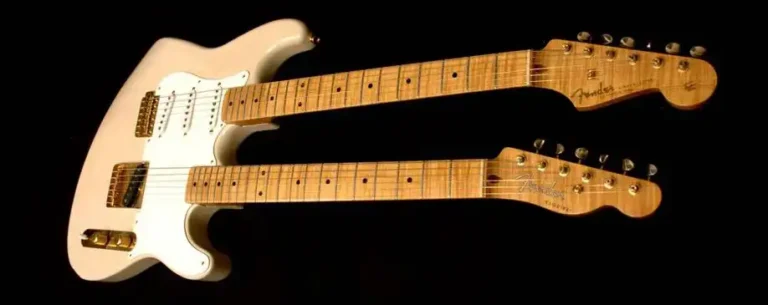
The first Custom Shop guitar Michael Stevens made was a Double-Neck Strat/Esquire. The Master Builder completed it in the summer of 1987 for his friend Jimmy Wallace.
This guitar was the first Fender double-neck ever made.
The neck plate of the Stratocaster’s neck exhibited the “0001” serial number, and the dates written in pencil (6/18/87 and 6/19/87) together with the “MS” initials on the heel.
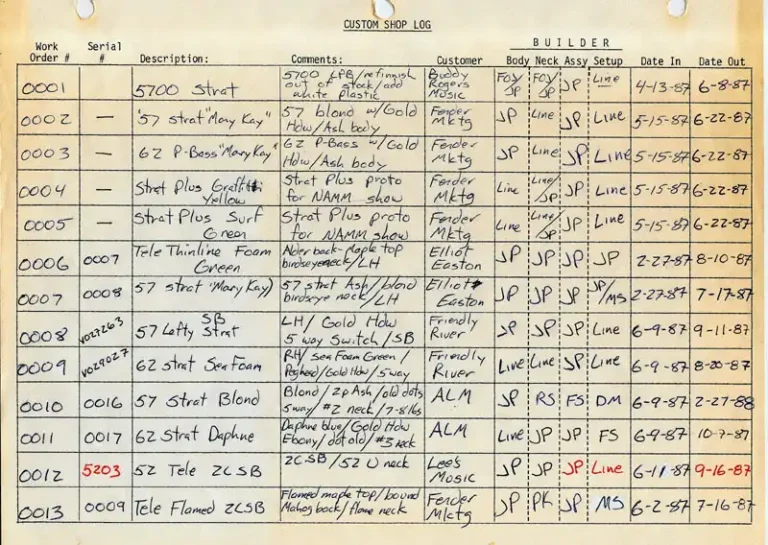
John Page considers his Mary Kaye Strat, built with help from Stevens for his friend Elliot Easton, the very first Custom Shop guitar, as it was the first to leave the factory. According to the master builder’s notes, the order was completed on February 27, 1987. The guitar was a 1957-style ash Stratocaster with a blonde finish and a bird’s-eye neck. It carried the serial number “0008” and was sent on July 17, 1987.
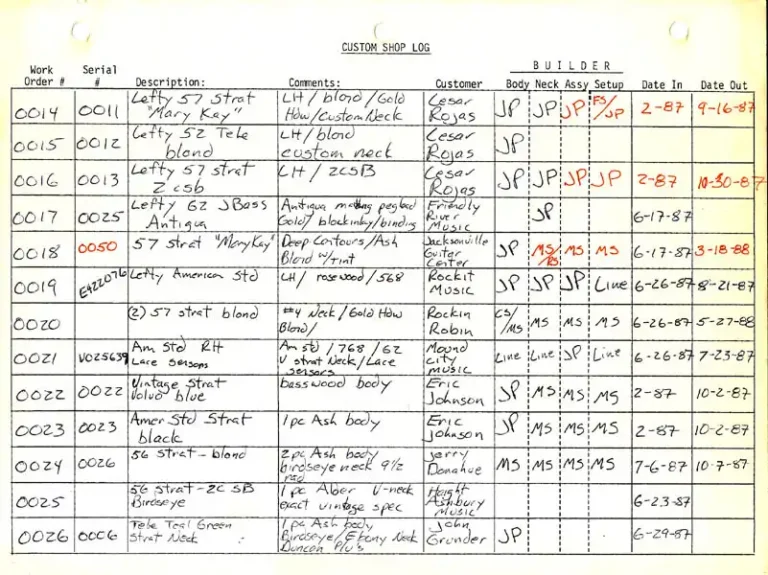
Actually, five other instruments had already left Fender, but John considered them to be “marketing’s mix-and-match kind of stuff we had to do for shows, or the Japanese re-paint.” By analyzing the John Page Custom Log Shop—a list the Master Builder kept for about a year and a half—we can deduce that the first Custom Shop guitars were Stratocasters required by Fender marketing to be promoted at NAMM. Additionally, a Stratocaster made in Japan was sent by Buddy Roger’s Music in Ohio for refinishing in Lake Placid Blue. The list also shows that famous musicians, such as Eric Johnson, Jerry Donahue, and Cesar Rosas, were among the Custom Shop’s early customers.
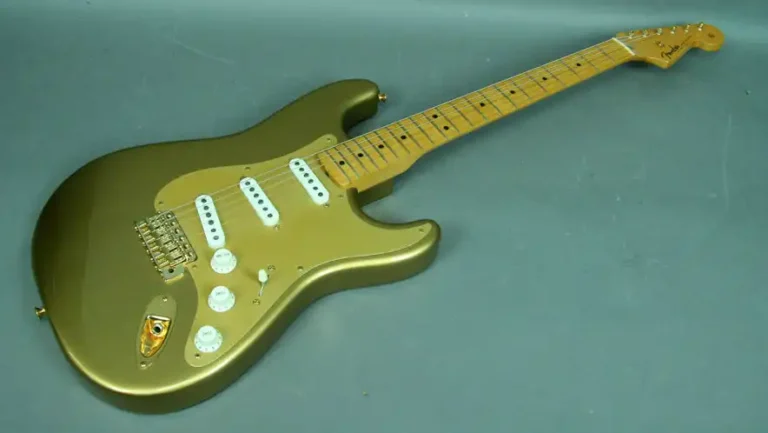
Many other instruments joined these early guitars. Among them were more Mary Kaye Strats and five hundred HLE Stratocasters (“HLE” stands for “Haynes Limited Edition”). These were inspired by the “tri-gold” Stratocaster (gold finish and hardware and an anodized brass pickguard), built in the late 1950s for Homer Haynes, a member of the Homer & Jethro duo. Five hundred 35th Anniversary Stratocasters were also produced.
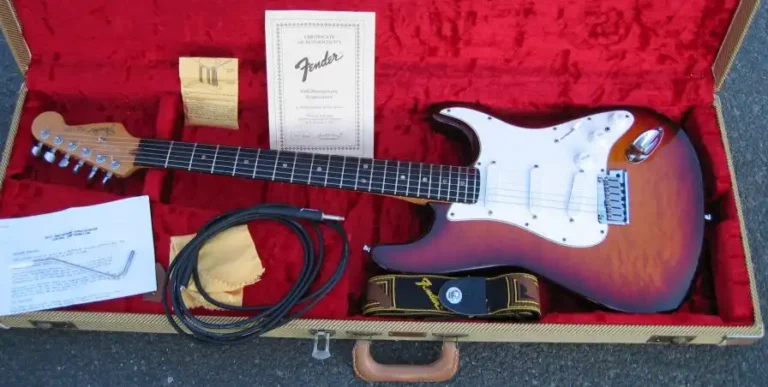
For a period, some guitars similar to the Stratocasters were also made. These were the Subsonics, with the characteristic BEADGB tuning, a fixed bridge, and a 27” scale.
However, most of the first instruments were reissues of vintage guitars. The factory reissues did not replicate the old Stratocasters’ specs too faithfully but commemorated them. Despite this, many musicians fascinated by vintage instruments requested more accurate replicas from the Custom Shop. For this reason, the contribution of Michael Stevens—a profound connoisseur and meticulous scholar of Leo’s guitars—was significant.
The Art Guitars and the Diamond Dealers
At the beginning of the 1990s, the Custom Shop began developing new one-off models, nicknamed Art Guitars, that elevated Fender into the realm of art. In this regard, the contributions of Pamelina Hovnatanian and master carver George Amicay were particularly significant, along with those of John Page, John English, Fred Stuart, Alan Hamel, and J.W. Black.
Thanks to these instruments, the Custom Shop became exactly what Bill Schultz envisioned: not simply a factory producing handmade guitars, but a true laboratory for custom-built and collectible Fender instruments — authentic works of art created alongside regular production models.
Anything could be created: Stratocasters with aluminum bodies; others featuring ebony fingerboards or maple tops; set-neck construction instead of bolt-on necks; different pickup configurations; diamond inlays; and anodized or engraved aluminum pickguards.
Whatever one could imagine could be built at the Corona Custom Shop—hence its nickname, the Dream Factory.
Among the first Art Guitars were the 109 Harley-Davidson 90th Anniversary Stratocasters, featuring a distinctive aluminum body, and the 175 40th Anniversary Playboy Stratocasters. Some of these instruments were sold through a limited number of dealers selected by Bill Schultz and Jack Shelton, Fender’s Senior Vice President of Sales, and could be identified by a small diamond set into the headstock. These retailers became known as Diamond Dealers.
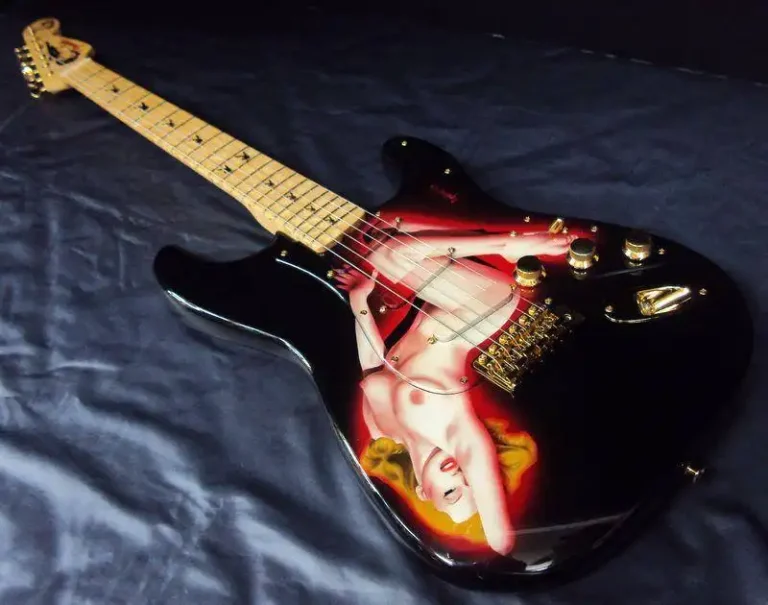
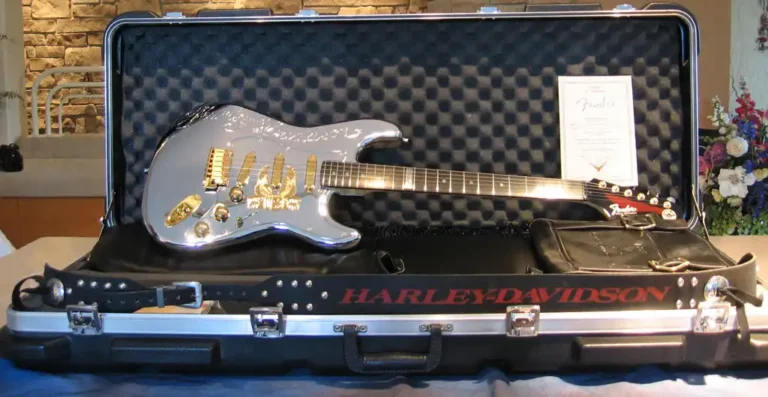
Although such instruments had been produced by the Custom Shop for years, the term “Art Guitars” first appeared in a Fender catalog in 2005.
In earlier years, Master Builders collaborated with graphic artists by assigning specific tasks to individual specialists—such as carving, inlay work, engraving, or painting. Later, Fender began entrusting artists with an entire body or neck to work on, sometimes granting complete creative freedom. The results were more complex, more elaborate, and more cohesive.
Artists involved in these creations included Dave Newman, Sara Ray, Nevena Christie, Kit Carson, Joe Wood, Dan Lawrence, Ron Thorn, Kid Ramos, Shag, Dennis McPhail, and Kristen Easthope, in addition to the ever-present Pamelina Hovnatanian and George Amicay.

The first Fender Custom Shop Series
In 1992, the first Fender Custom Shop series officially entered the market, a natural progression following their formal inclusion in the company’s price list. The initial lineup consisted of the Custom Classic Series, the Set-Neck Series, and a select group of Signature models—most notably the Robert Cray—which were consolidated only a few years later into the Custom Artist Series to clearly distinguish them from standard-production signature instruments.
These foundational lines were soon joined by the Contemporary Series and the Relic Series, the latter paving the way for the Time Machine series, introduced in 1999.
Master Built and Team Built
In the first half of the 1990s, the need to rethink the Custom Shop’s mission became increasingly urgent. The new vision differed from the original: at first, the Fender Custom Shop was conceived primarily to enhance Fender’s prestige rather than to generate profit, yet it could not survive indefinitely without financial sustainability. As a result, it became necessary to reach a broader market.
The introduction of a price list in 1992 marked the first step in this direction. Production also needed to increase. Mike Lewis, John Page, and Mike Eldred began working together to determine how to restructure the Custom Shop, whose output was divided into Team Built and Master Built instruments.
- Team Built guitars (sometimes referred to as Custom Built beginning in 2008) were produced by a select group of skilled apprentices under the supervision of a Master Builder—one of Fender’s principal luthiers—who also gave final approval. As Yuriy Shishkov explained, “They’re a small group of highly talented craftsmen who build some of the Custom Shop catalog guitars.” Indeed, Team Built instruments appeared in Fender Frontline catalogs as regular production models, built to the specifications most commonly requested by players.
- Master Built instruments were manufactured by a Master Builder and represented Fender’s flagship creations: unique guitars born either from a master builder’s imagination or from specific requests by artists or dealers.
“With a Master Built, you are getting the highest level of craftsmanship at Fender,” Jason Smith stated.
When a Master Builder was promoted to Senior Master Builder, he continued producing his own instruments while also assuming managerial responsibilities. These included maintaining relationships with Fender’s clients, overseeing production timelines, and proposing new ideas — in other words, taking on broader duties and strategic responsibilities.
Custom Shop Logo
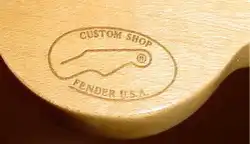
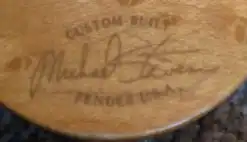
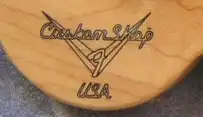
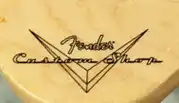
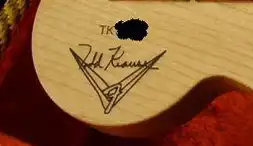
On the back of the headstock of Fender Stratocasters built by the Custom Shop, two types of logos were used. One was an oval decal featuring a stylized headstock and the wording “CUSTOM SHOP FENDER U.S.A.”; the other, intended to identify instruments built by a single luthier, included the builder’s signature along with the “CUSTOM-BUILT FENDER U.S.A.” decal.
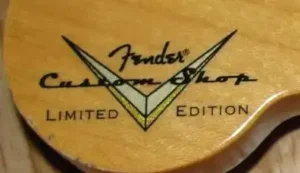
The oval logo was simple and elegant, but according to John Page, it was too similar to the logo already used by the Japanese Custom Shop. He therefore commissioned Pamelina Hovnatanian to design a new symbol. The result was a logo that, in true Fender spirit, echoed Chevrolet’s classic logo. Initially, the new V-shaped logo featured the letter “F”, but in the late 1990s, Bill Schultz decided to replace it with the full “Fender” name. As expected, when an instrument was built by a Master Builder, the builder’s signature accompanied the logo.
Over the years, several variations of the V logo appeared, including versions bearing the “LIMITED EDITION” or “WHEN YOU’RE READY” wording.
Custom and Limited Collections
The terms Limited Release Series and Limited Edition Series began appearing in Custom Shop catalogs in the early 2000s, alongside the already established Tribute, Master Design, Builder Select, and Art Guitars designations.
The Limited Release Series referred to Custom Shop instruments that, by virtue of their design and specifications, represented a turning point or an innovation for Fender. In many cases, these guitars functioned as prototypes or “test-market” models and, given their small production numbers, were intended to become collectible instruments.

The Limited Release designation was used for the 2004 ’54 Anniversary Stratocaster, but was later replaced by the term Limited Edition.
The Limited Edition Series included models produced by the Custom Shop for a limited period before being permanently discontinued. These instruments were likewise designed to appeal strongly to collectors.
Beginning in 2008, however, the terms Limited Edition and Limited Release were gradually superseded by Limited Collection. The underlying concept remained unchanged: the series encompassed very short-run Custom Shop guitars.
From a marketing and communication standpoint, however, this shift marked a new philosophy. “We don’t want a catalog,” Mike Eldred explained. “We have collections. We get ideas from artists, other players, Master Builders and dealers, and we put together guitars with the coolest, most versatile features.”
At the same time, at the beginning of each year, Fender also introduced a number of Custom Collection guitars. These instruments belonged to various Custom Shop series and were produced for roughly a year; once discontinued, they were replaced by new models.
The Limited Edition designation was never completely abandoned, and Fender continued to apply it to certain Stratocasters, such as the Black1 Tribute model and the 2010 Limited Eric Clapton Signature Stratocaster.


The Roadshow
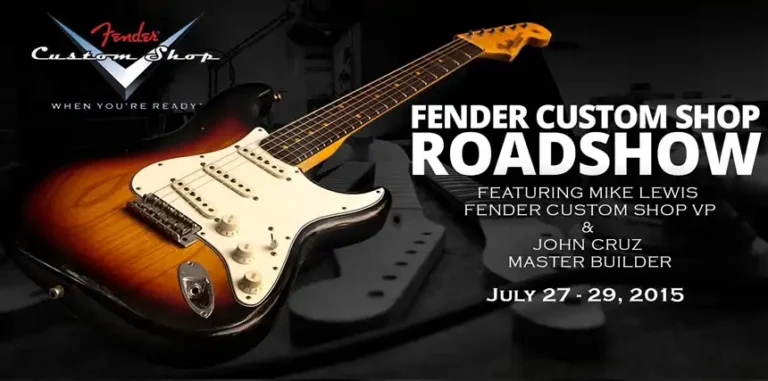
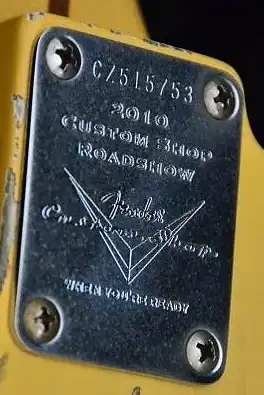
The Roadshow is a traveling event during which representatives of Fender Musical Instruments Corporation, together with selected Master Builders, showcase and present a selection of exceptionally rare Custom Shop instruments.
During the event, visitors can also watch Fender’s master luthiers at work—shaping necks, installing tuning machines, bridges, and frets, and applying decals.
It is also an opportunity to meet your preferred Master Builder in person, seek advice, collaborate on the design of an instrument, or even watch one take shape before your eyes.
Fender Custom Shop Series and Stratocasters Reference
- Custom Classic Series
- Set-neck and Contemporary Stratocasters
- Relic Guitar: the Cunetto Era
- Time Machine and Vintage Custom Series
- Master Design, Builder Select, Founders Design, and Dealer Select Series
- Stratocaster Pro, Proto Strat, and Postmodern Series
- Custom Deluxe, American Custom, and Artisan Series
