Squier’s Second Life:
Squier Production in China & Indonesia
THE EASTERN FACTORIES THAT SAVED THE BRAND
Table of Contents
ToggleSquier’s Global Shift: From Korea to China and Indonesia
In the early ’90s, Korean Squiers were struggling. Their plywood bodies became the target of negative publicity, and Squier was close to collapsing. Competitors challenged Squier by offering more features, higher-quality woods, and a wider range of colors and finishes at the same price points.
To respond, Fender needed even cheaper Squier guitars. Starting in 1994, China became the new supplier, and a few years later, Indonesia followed. China had an ample supply of wood, enabling the production of hardwood-bodied instruments at plywood prices. Meanwhile, Indonesian guitars offered comparable quality to those made in Korea, but at generally lower prices.
As a result, China and Indonesia quickly became Squier’s primary sources. Notable factories in China included Yako, AXL, Dalian Dongfang Musical Instruments Co., Ltd., and Grand Reward, while Indonesian production centered on Cort-Tek and P.T. Samick. Except for the AXL joint venture, all of these were Original Equipment Manufacturers (OEM)—companies that manufacture products or parts for another company, which then sells them under its own brand.
Main Chinese factories
Yako
The Taiwan-based Yako Musical Instruments Company was the first to produce Squier guitars under an OEM agreement in China. Yako, founded in 1993, was headquartered in Taiwan and had factories both there and on the mainland. Early plant management originated from Taiwan, but Squier instruments were manufactured in a factory located in Zhangzhou, southeastern China, about 300 kilometers from Hong Kong.
Yako received its first Squier order in May 1995, with delivery in August, for 2,000 Squier Stratocasters. These guitars have been manufactured since late 1994.
AXL
AXL Musical Instruments has had multiple factories in China since the late ‘90s and produced Squier guitars with serial numbers CA and CAE for Fender.
In 2004, a highly automated guitar factory in Shanghai marked the culmination of a joint venture between Fender Musical Instruments Corporation and AXL Musical Instruments. Opened with great fanfare on October 18, just before the Shanghai Music Fair, the new 200,000-square-foot plant was set to produce Fender’s Squier-branded guitars, initially sold in China and South America, and later expand outside China.
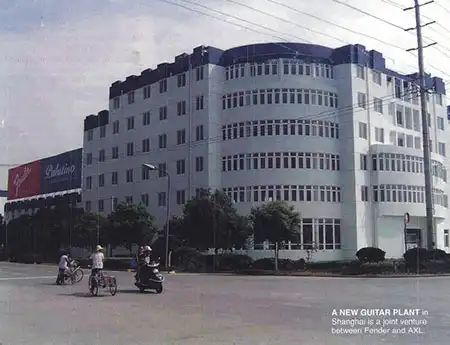
Both AXL and Fender representatives expressed intense enthusiasm for the new project. Fender Chairman and CEO Bill Schultz stated, “We needed to build a stronger position in the fast-growing Chinese market, and this was our best option. We are excited to be working with AXL Musical Instruments and believe that this new plant will play an important role as Fender supplies the world with quality guitars and amplifiers. The immediate benefit is to gain more control over the range and quality of products manufactured for our rapidly growing China and South America markets.”
Squiers produced at the new factory had a CXS serial number.
At the time of writing (2023), Axl Marketing and Administration offices are based in Hayward, CA, USA, with their manufacturing facility in China. They ship worldwide from their warehouse in Shanghai, China’s largest seaport.
Grand Reward
Grand Reward Education & Entertainment Co. (GREE) was established in October 1995 by Tsai Lai-feng and has served more than ten OEM customers, including Squier, while also building its own brand, Farida.
The Tsai family, originally from Taiwan, had been in the musical instrument business for three generations. As costs increased in Taiwan, Tsai and their business partners started considering a move to mainland China in the early 1990s. Since there were no direct flights between Taiwan and the mainland, they used Hong Kong as a logistics and capital hub. Huizhou, in Guangdong province in southern China—one of the mainland cities closest to Hong Kong—was selected as the location for the Grand Reward factory.
The 120,000 sq. ft. Grand Reward factory was situated on 180,000 sq. ft. of land. Here, 900 employees, including highly skilled production staff, handcrafted 13,000 instruments each month, exporting them worldwide—55% of the production was sent to the USA, and another 20% was shipped to Japan.
Grand Reward was the factory where the first Squier Classic Vibe instruments were made. This plant also produced a few artist models and the only Chinese-made Fender Stratocasters, the Fender Modern Player. This series included traditional models with some modern updates, designed for young, budget-conscious “modern players.” Examples: a Telecaster with a humbucker, a Jaguar without a pickguard, mahogany-bodied instruments, an HSH Stratocaster, and more.
In 2020, Tsai decided to stop manufacturing guitars for other companies and focus exclusively on developing his own brand, as Farida had by then established a strong presence in the domestic market.
Indonesian factories
P.T. Cort
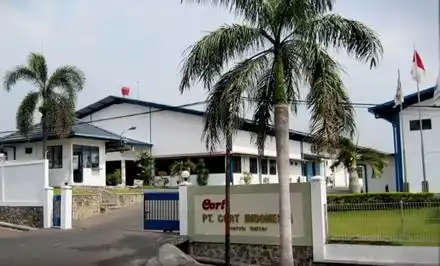
Cort Guitars, a subsidiary of Cor-Tek Corporation, was a South Korean guitar maker based in Seoul that manufactured instruments under OEM contracts for various brands.
In 1995, Cort opened its P.T. Cort facility in Ngoro Industri Persada, a well-known industrial area in Mojokerto, East Java, near Surabaya, which produced Squier instruments.
P.T. Samick
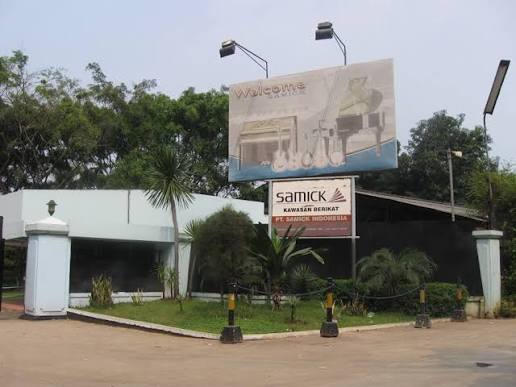
Samik Piano was founded in 1958 in South Korea by Lee Hyo-Ik. Initially, Samick started as a distributor for Baldwin pianos. By 1960, the company shifted to manufacturing its own upright pianos with imported parts. This move marked the beginning of Samick’s growth in musical instrument production. In 1973, the company incorporated as Samick Musical Instruments Mfg. Co., Ltd.
In 1992, Samick founded P.T. Samick, a joint venture between South Korea’s Samick Musical Instruments and local partners. Its factory was located in Cileungsi, near Bogor, Indonesia, spanning 50 hectares and comprising 11 buildings. The new factory employed about 3,000 workers and produced both acoustic and electric guitars under OEM contracts for several major brands, including Squier.
The Pak and the Team Squier Garage to Glory
Thanks to Joe Carducci’s idea, who was then the Marketing Manager for Squier, in 1997 Squier started selling packages, or as it was called in Fender-speak, in Paks.
This might seem obvious now, but it was a very innovative idea: take an affordable guitar, a small amp, a cord, a strap, a gig bag, strings, picks, and a beginner’s guide, put them all in a box, and sell it to parents who want to buy their child an electric guitar but know little about the instrument—all at bargain prices.

In 2004, a new slogan appeared in Squier Pak advertising: “Stop dreaming, start playing,” which reflected the brand’s renewed confidence. “We wanted to create a phrase that reached people on an emotional level rather than leaving it to specs or features,” Justin Norvell said. “And knowing that so many young people imagine themselves as rock stars in their bedrooms in front of the mirror and that many older beginners would love to play but find it hard, we felt it was a call to action on all of these levels.”

In 2005, to engage young guitarists, Squier decided to forgo the usual “established artist” photos featured in Fender Frontline and launched “Team Squier Garage to Glory” to showcase people who live and breathe Squier instruments every day. This contest was open to all guitarists aged 16 to 25, who had to email a photo of their band—either posed or in action—with their Squier guitars and include the band name. The winners appeared in the next year’s Frontline, which was sent to over 1 million people worldwide.
Chinese and Indonesian Series & Stratocaster Reference
