Baja California
Fender Made in Mexico
INSIDE THE ENSENADA FACTORY

Table of Contents
ToggleEnsenada origin
Since Leo Fender established the Fender Electric Instrument Co., Hispanic workers such as the renowned Tadeo Gomez, Lilly Sanchez, and Abigail Ybarra had always been employed in Fender factories. Therefore, the opening of the Mexican plant should not have come as a surprise—especially considering it was only about 200 miles from the U.S. factory in Corona.
Even during the CBS era, Fender had relied on Mexican firms for packaging and string production.
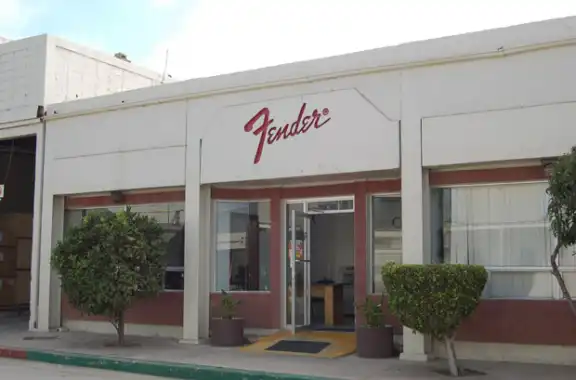
After the 1985 buyout, Fender Engineer Bashar Darcazallie traveled to Mexico and, on May 6, 1987, established a string manufacturing operation with five employees in a converted church in Ensenada, Baja California.
However, Bill Schultz soon recognized the potential for developing an instrument manufacturing facility in Mexico. In 1989, the factory moved from its original site to Calle Huerta. There, they started making parts for amplifiers.
The Fujigen’s Role
A key role in the development of this factory was played by the Japanese Fujigen, which made the F&F joint venture with Fender Musical Instruments Corporation.
Fender CEO Bill Mendello, interviewed in 2011, recalled,
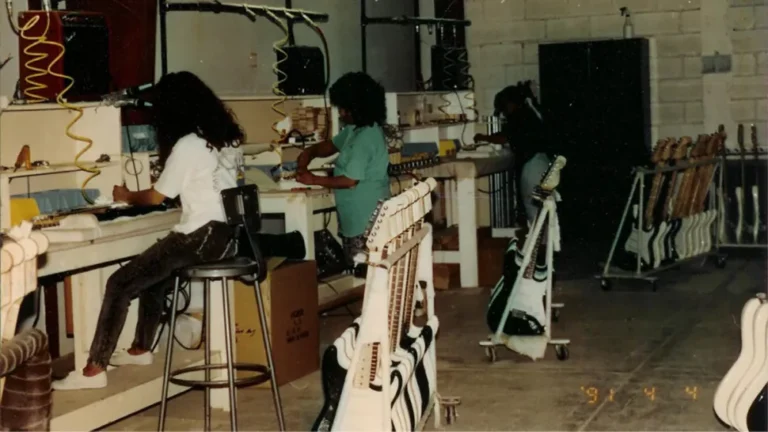
“Fujigen brought their machinery with them, plus five or six people. We opened up our Mexican operation, and Fujigen trained the people using their techniques. So, the manufacture of guitars in Mexico was more Japanese-like than US-like. We had a few people from the USA help them. But for the most part, the training, the techniques, the painting, all were Japanese.”
Bill Mendello

Under the 1989 joint venture agreement, FMIC provided the building and funding, while Fujigen contributed construction techniques and machinery. Initially, Fujigen had full operational control in Ensenada, with all foremen and supervisors being Japanese, while the upper management—the President and Factory Manager—were Fender personnel.
The joint venture lasted until late 1994, when Fender bought out Fujigen’s interest after a challenging 1993 yen-to-dollar shift. Fujigen’s president elected to sell their shares in 1994.
The first guitars
In the early 1990s, due to the proximity between Corona and Ensenada, there was a constant exchange of personnel and components. This meant a guitar started in the U.S. was often completed in Mexico. As a result, defining the nationality of a Stratocaster became quite difficult. Some Stratocasters built in Mexico during this period, such as the California Series, could in fact be considered USA/Mexico hybrid instruments.
The first guitars bearing the “MADE IN MEXICO” decal appeared in catalogs as early as 1991. These were not just Stratocasters made to Fender’s specifications, like the Squiers. They were genuine Fenders, crafted by Fender workers using Fender machinery. This made it possible to purchase a quality Stratocaster at an affordable price. However, the top-tier production remained U.S.-made, since the finest woods and components continued to be sourced in the U.S.

The Ensenada fire
On the evening of February 11, 1994, a routine maintenance procedure was underway in a spray booth at the Ensenada factory when a spark entered a spray booth vent. The spark ignited a devastating fire that quickly spread, reducing the 22,000-square-foot facility to ashes in less than an hour.
As President Bill Shultz recalled: “We were relieved that none of our employees sustained injuries, but the instantaneous destruction of the years of work that went into establishing this plant was overpowering”.
However, in less than a hundred days, Fender built a new factory twice the size of the previous one. “Fender’s ability to so quickly rebound from this disaster is a strong testimony to our quality workforce in Mexico,” Bill declared, “for without their help, assistance, and understanding, this accomplishment would not have been possible.”
According to Mike Lewis, Vice President of Product Development at the Fender Custom Shop, the newly expanded Ensenada factory significantly increased Fender’s production capacity.
“We had recently built our new factory in Mexico, following a bad fire in 1994, and so I had brought a lot of Fender guitars into what was now our own manufacturing plant. That’s why many Japanese guitars disappeared and went into Mexico: the Fender Classic series was made in Mexico, for example. We did a lot of things to bring guitars into our own manufacturing plant.”
Mike Lewis


Fender Mexican Series & Stratocasters Reference
Among the first Mexican series were the Standard Series (later replaced by the Player Series), the Special Series, and the Deluxe Series. In addition, there were various vintage-style guitars, such as the Classic Series and the Road Worn. There were also vintage/modern hybrids like the Classic Player Series—all later replaced by the Vintera Series—along with the many Artist guitars.
