Fender’s Crossroads:
Bill Schultz and Dan Smith
THE DUO BEHIND FENDER’S REVIVAL
Table of Contents
ToggleThe Men Who Saved Fender
Fifteen years of CBS management inevitably led to the downfall of what Leo had meticulously built through hard work. Weakened by its poor reputation and the growing interest of guitarists in vintage Stratocasters, CBS was now seeking new leadership to revive the company.
In 1981, CBS hired John McLaren to lead CBS Musical Instruments, the entire division that also included Steinway, Gemeinhardt, Lyon & Healy harps, and Gulbransen. McLaren, originally from Manchester, England, had come from Yamaha. That same year, he replaced Ed Llewellyn with Bill Schultz, also from Yamaha, as the new president of Fender/Rodgers/Rhodes.
Bill was a brilliant businessman. He was tasked with redesigning the company, improving product quality and reputation, and revitalizing production and the distribution network amid the challenges of the new global economy.
It was clear that the Stratocaster had to be purged of CBS’s influence. To achieve this, new colors, sound combinations, or brass components were not enough—something far more substantial was required. The very image of the Fender guitar had to be reconsidered and completely redesigned. According to Bill Schultz, the right man for this purpose was a designer he had worked with at Yamaha and who he hired in 1981: Dan Smith.
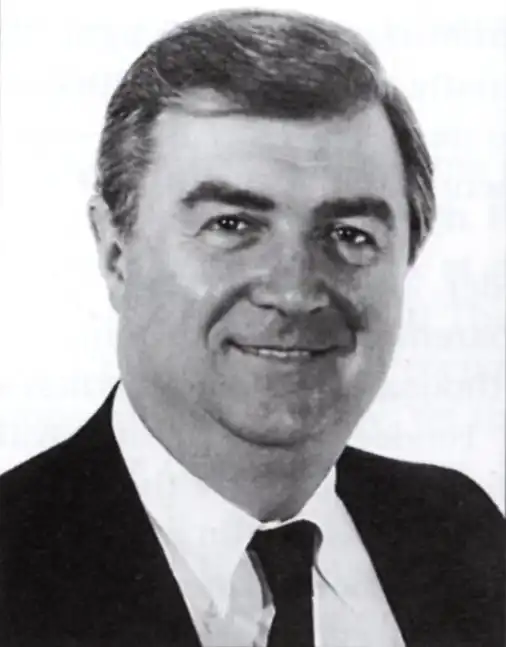
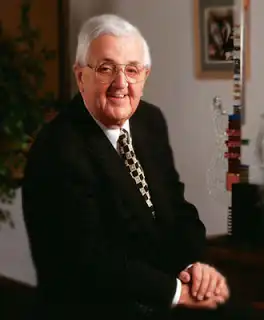
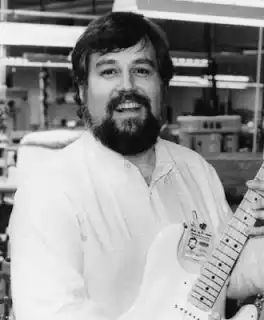
Dan was charismatic, knew how to communicate with people, and, at times, how to inspire them. He had a deep passion for Fender and was well-loved by his employees. He had undoubtedly been the most important person for the company since Leo. Without Dan, Fender probably wouldn’t exist today.
Rebuilding Fender – From Chaos to Control
“And at that point in time everybody hated what Fender had become. For about 10 years, the quality of the product had been awful. Not that there weren’t good guitars made during that time, but generally it had really gone down,” Dan Smith said. “The company had no soul at the top. When I first came there, I sat down and talked to guys like John Page and Troy Lane and some of the guys working on the line, and the players who worked for the company were really unhappy. They’d come to work for Fender because it had been a dream of theirs as kids to work for a guitar company, and they came in and they cared about the quality of the product. But the management at that time could really give a shit.” And, with respect to the Fullerton factory, he said: “Everything was antiquated. We had come from Yamaha – and at that point Yamaha probably had the most modern guitar factory in the world, for both acoustics and electrics – into a factory where guys were hand-cutting on a bandsaw with no guards, cutting out the contours. They’d have a thing they’d lay on top of it as a guide, they’d put a pencil mark on the back and a pencil mark on the front, they’d lay it into a tray, and the bandsaw blade was exposed so much. If that blade had snapped or something like that, the guy’d be dead.”
In The Fender Telecaster: The Detailed Story Of America’s Senior Solid Body Electric Guitar, André R. Duchossoir quoted Smith as saying, “Basically our goal was initially to restore the confidence of the dealers and the players in Fender. The only way we could achieve that was to raise the quality levels back up! We basically shut the plant down and retaught everybody how to make Fender guitars the way people wanted them.”
“My job at Fender? It’s to protect the past, carry on the tradition, and make a future for Fender. That means improvement. If Leo were here today, he wouldn’t want it any other way, because he was constantly trying to make a better product, pushing the envelope. He never stopped. Neither do we.”
Dan Smith
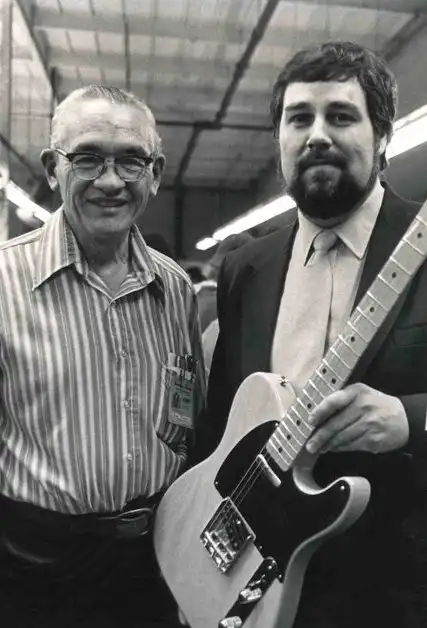
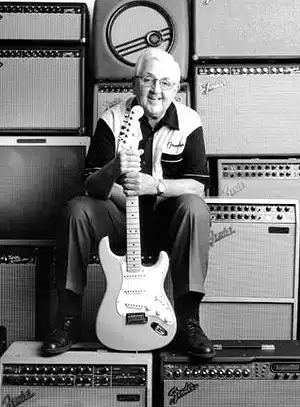
“We would not be here if weren’t for Leo Fender. We never forget that. […] We try to emulate his philosophy and his principles by building instruments with the same passion that the players bring to them. […] We are disciples of Leo.”
Bill Schultz
With input from key insiders, including John Page, Dan Smith began to introduce a range of changes. After the necessary reorganization of the company, employee retraining, and extensive product research, Fender began its rebirth. Under Dan’s leadership, not only were Fender instruments completely renewed, but the lineup was also expanded with new guitars, including the Vintage reissue models. For the first time, Fender also started producing guitars outside the United States, thanks to the joint venture Fender Japan.
