The Plus Series
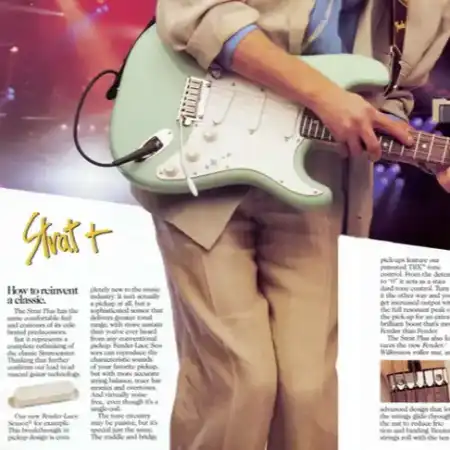
Introduced in 1987, the Fender Strat Plus was one of the first American-made Stratocasters launched after the company’s corporate restructuring under new ownership in the mid-1980s. Designed as a high-end model within the regular production line, the Strat Plus series offered modern upgrades while retaining the essential look and feel of a classic Stratocaster. It quickly became a popular choice among professionals and serious players looking for improved performance and reliability without sacrificing vintage appeal.
The most notable feature of the Strat Plus was its use of Lace Sensor pickups. Developed in collaboration with Don Lace, these pickups aimed to eliminate the 60-cycle hum typical of traditional single-coils while maintaining tonal clarity and dynamics. The standard configuration included Gold Lace Sensors in the neck, middle, and bridge positions, which produced a warm, balanced tone with a slight compression ideal for studio and stage use. Some later models experimented with different combinations, such as Blue, Silver, or Red Lace Sensors, offering more tonal variation.
Another significant innovation was the LSR roller nut (initially Wilkinson Roller Nut on early models), which, along with locking tuners (usually Schaller), greatly enhanced tuning stability—especially when using the tremolo. These hardware upgrades allowed players to perform aggressive vibrato techniques without the guitar going out of tune, a long-standing issue with traditional Strat bridges and nuts.
The Strat Plus featured a two-point synchronized tremolo system, which provided smoother action and less friction compared to the vintage six-screw design. It also came with staggered tuning posts, eliminating the need for string trees on some models and contributing further to tuning stability.
Cosmetically, the Strat Plus retained the iconic Stratocaster shape and pickguard design, but was offered in a wide variety of finishes, from classic sunbursts to bold, metallic colors typical of the late ’80s and early ’90s. The necks were usually modern “C” shapes with 22 medium jumbo frets and a 9.5″ radius, catering to players who preferred a flatter fingerboard for bending and faster playing styles.
Production of the original Strat Plus continued until the late 1990s, gradually evolving into the Strat Plus Deluxe and Ultra models, which introduced more electronics options like the TBX tone circuit and mini-switches for coil-tapping or series/parallel wiring. Eventually, the line was phased out around 1999 as Fender updated its American Standard line and introduced new models.
The Strat Plus remains a sought-after instrument on the used market. It represents a unique blend of traditional Fender craftsmanship and forward-thinking engineering, appealing to players who want a reliable, high-quality guitar with vintage looks and modern performance. Many artists used Strat Plus models on stage and in the studio during its heyday, further cementing its status as a significant part of Fender’s post-CBS legacy.