The American Original Series

Cover - American Original Series

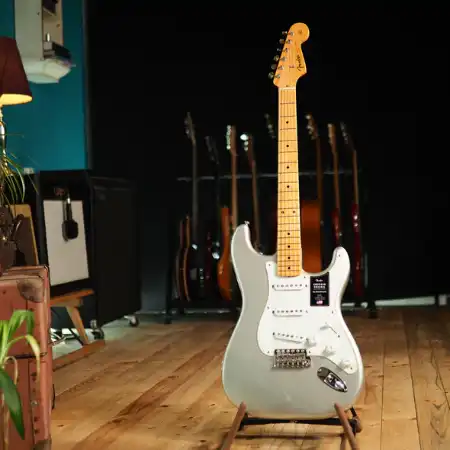
On January 16, 2018, Fender launched the American Original Series, replacing the long-running American Vintage line. While the Vintage Series focused on exact recreations of specific guitars, the American Original line blended standout features from each decade to balance vintage character with modern playability. Developed under Joey Brasler and Justin Norvell, the series took nearly two years of planning, design, and consultation with musicians. Key updates included a modern 9.5” fingerboard radius, narrow-tall frets, and period-correct nitrocellulose finishes. The American Original ’50s and ’60s Stratocasters reflected their respective eras with different neck profiles, pickup sets, and cosmetic details, while offering improved comfort and versatility. Fender emphasized that the new line wasn’t a step back, but a refinement designed for today’s players. Introduced at Winter NAMM 2018 alongside an ambassador campaign featuring Isaac Brock, Kurt Vile, Raphael Saadiq, and J.D. McPherson, the series represented Fender’s vision of timeless design made modern.

The Vintage Hot Rod Series

Cover - Vintage Rod Stratocaster

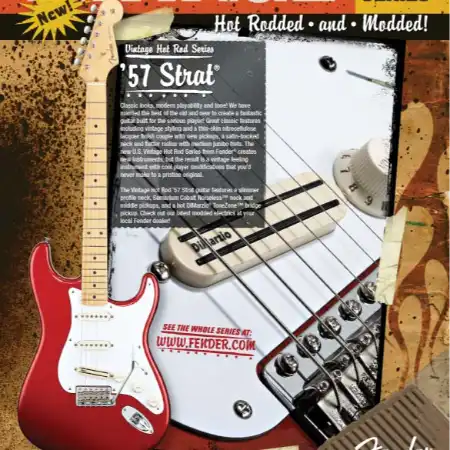
The Fender Vintage Hot Rod Series, introduced at Winter NAMM 2007, combined the classic appeal of American Vintage Reissue models with modern playability. Early models, the ’57 and ’62 Stratocasters, featured period styling enhanced with flatter fretboards, medium-jumbo frets, and hotter or noiseless pickups. A major 2013 revamp brought compound-radius necks, slimmer profiles, S-1 switching, and modern tremolos, expanding tonal versatility. The refreshed lineup included the ’50s and ’60s Stratocasters, each with unique pickup configurations and checkered-flag neck plates. Despite strong reception, Fender discontinued the series in 2014, leaving it as a transitional bridge between AVRI and American Original lines.

The American Vintage Series

Cover - American Vintage Series

The American Vintage Stratocaster line represented Fender’s commitment to refining its heritage models for modern players while honoring the company’s legacy. The first major update came in 1998, when the American Vintage ’57 and ’62 Stratocasters debuted. Built in Fender’s new Corona facility, these guitars featured more accurate vintage details, including nitro finishes, correct headstock shapes, rolled fingerboard edges, period-correct neck profiles, and newly designed “Original ’57/’62” pickups based on pre-CBS examples. A ’70s model was later added in 2006.

In 2012, Fender launched the second series under the “Pure Vintage Project.” Led by Mike Lewis and George Blanda, the team meticulously studied original instruments across the U.S., re-creating tooling, finishes, and components with unprecedented accuracy. New models included the ’56, ’59, and ’65 Stratocasters, each with period-correct pickups, hardware, and finishes. Marketed under the motto “Historic Benchmark, American Originals,” the series became a definitive statement of Fender’s craftsmanship and historical authenticity.

Vintage Reissue Stratocasters Specs

Index - Vintage Reissue

Fender’s Fullerton Vintage Reissue Stratocasters (c. 1982–1986) featured “Dan Smith style” headstocks, followed by the distinctive “pregnant” headstock when production moved to Corona. Logo decals evolved across three batches, varying in font, placement, and finish. Bodies were mostly alder, with limited ash “Mary Kaye” variants; Corona models had deeper, sharper contours. Early instruments show deepened cavities and extra neck-pocket holes. Dating is done via pencil neck-dates or later stamped/printed formats; serials became date-coded from around 2012. Finishes began with nitro over polyester, later expanding to custom colors. Electronics included staggered-pole pickups and CTS pots with Sprague caps.

Vintage Reissue Stratocasters

Index - Vintage Reissue

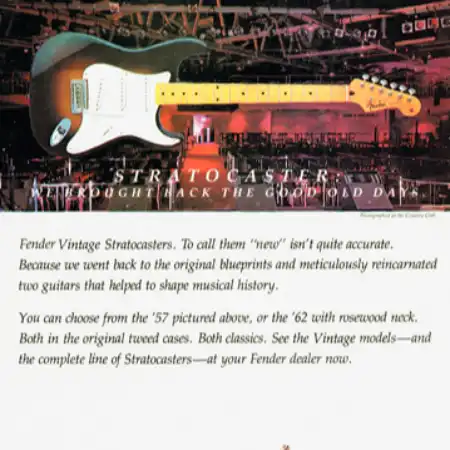
In the early 1980s, Fender responded to growing demand for vintage-style guitars by launching its Vintage Reissue series. While Japanese companies like Tokai dominated the market with affordable vintage-style models, Fender began producing guitars in Japan and simultaneously developed U.S.-made reissues. Led by Dan Smith and John Page, Fender sourced original pre-CBS Stratocasters for reference, working with experts like John Carruthers and Seymour Duncan to recreate classic features. The first models—the ’57 and ’62 Stratocasters—were officially introduced at the 1982 NAMM Show but delayed due to factory retooling.

Though advertised as exact replicas, these reissues included intentional design compromises for broader market appeal, such as altered neck shapes and finishes. Even so, they played a crucial role in Fender’s revival, funding the Standard line and paving the way for the Custom Shop.

Controversy arose when Fender’s 1982 catalog featured a Tokai neck in one photo, mistakenly fueling rumors of counterfeit parts. Ironically, Japanese-made reissues were more historically accurate in some details. The original U.S. models, now called Fullerton Reissues, were produced until 1985 and are highly collectible today. Production later shifted to Corona, and in 1998, the line was relaunched as the American Vintage Series.

The American Ultra Series and the American Ultra II Series

Index - American Ultra

Launched in November 2019, the Fender American Ultra Series marked a bold step forward for the iconic brand. Described as the company’s “most advanced modern guitar,” the series was a refined evolution of the earlier American Elite line. Fender reengineered virtually every component to enhance comfort, tone, and performance—without sacrificing the essential character of a Stratocaster. It introduced Ultra Noiseless Vintage and Hot pickups, offering classic Fender tone without hum, and the Double Tap Humbucker, which maintained balanced output in both humbucking and coil-split modes.

Ergonomics were a key focus: revised body contours and a newly sculpted neck heel dramatically improved upper fret access, while the exclusive Modern “D” neck and a 10″-14″ compound radius offered unprecedented playability. Satin urethane finishes and soft-touch knobs added to the tactile appeal, while the return of the Bi-Flex truss rod at the headstock aligned the model with classic Fender traditions.

In 2021, Fender introduced the American Ultra Luxe line, building further with stainless steel frets, a new Augmented “D” neck, and premium finishes. These guitars were touted as Fender’s most sophisticated factory models to date.

Continuing this innovation, the American Ultra II Series debuted on October 15, 2024, carrying the motto “Innovation never rests.” Described by Fender as its most advanced series ever, Ultra II models were fine-tuned to serve both traditionalists and modern players. EVP of Product Justin Norvell called them the “sports cars” of the Fender lineup—fast, sleek, and engineered for peak performance. The development process drew on extensive player feedback from artists, dealers, and online communities, echoing Leo Fender’s original approach of close collaboration with musicians.

While retaining many successful Ultra features, Ultra II brought subtle refinements designed to enhance speed, precision, and versatility, further blurring the line between vintage feel and modern tech.

From the original Ultra to the Luxe and Ultra II, Fender’s flagship guitars showcase decades of design evolution, innovative manufacturing, and a player-first philosophy. Built in Corona, California, with over 150 hand processes, these instruments blend the soul of vintage Fender with 21st-century performance.

The American Elite Series

Index - American Elite Stratocaster

The Fender American Elite Stratocaster, launched at the 2016 Winter NAMM Show, succeeded the American Deluxe Series as Fender’s top-tier U.S.-made guitar line. With over two years of research and development, it was promoted as Fender’s most advanced series yet, tailored to meet the demands of modern players. Priced at $1,799–$1,899, it introduced bold finishes like Autumn Blaze Metallic and came with a TSA-approved molded case.

One of the key innovations was the 4th Generation Noiseless pickups, built from scratch with new bobbins, magnets, and staggered AlNiCo 5 pole pieces for smoother, more balanced response. While inspired by vintage tones, they delivered a modern sound with reduced noise, aided by shielded wiring and visual markers like the silver “NOISELESS” logo.

The guitar also featured expanded electronics, including the S-1 switch for alternative wiring configurations and a No-Load tone control for greater clarity. HSS models added a Shawbucker and a Passing Lane button to bypass tone and volume controls entirely.

The neck was redesigned with a compound “C-to-D” profile and a 9.5″–14″ compound-radius fingerboard for improved playability, plus a new asymmetrical heel for better upper fret access. Originally available with maple or rosewood boards, Fender shifted to streaked ebony in 2017 due to CITES restrictions, promoting its sustainability and tonal brightness.

Additional upgrades included a wheel-style truss rod (replacing Micro-Tilt), a two-point Deluxe Synchronized Tremolo with a copper-infused block, locking tuners, soft-touch knobs, and redesigned strap locks. The gloss headstock bore a silver “Spaghetti” logo and a modern string tree.

The launch was supported by the “Built for the Pursuit” campaign, which spotlighted working musicians striving to perfect their sound. Featuring artists like John 5 and Ryan Merchant, the campaign emphasized Fender’s commitment to innovation and the evolving needs of today’s players—honoring not just tradition, but the drive for progress.

The Fender Select Series

Index - Fender Select

Launched at NAMM 2012, the Fender Select Series represented a major step forward in Fender’s production lineup. These U.S.-made guitars and basses were crafted as premium instruments for players seeking top-tier quality without entering Custom Shop territory. The series combined select tonewoods, elegant finishes, and refined details to deliver visually striking and sonically rich instruments that sat at the pinnacle of Fender’s regular production models.

The guitars featured figured maple tops, compound-radius fretboards, and quartersawn or bird’s-eye maple necks. A distinctive Fender Select medallion was embedded in the back of each headstock. Electronics included specially voiced Fender Select pickups, derived from popular Custom Shop sets like the Fat ’50s and Broadcaster, but refined for more balanced and expressive tone. Advanced features like the BiFlex truss rod and no-load tone control ensured stability and tonal clarity.

The Select Stratocaster debuted in a Dark Cherry Burst finish with natural binding, a flame maple top, a satin-lacquered flame maple neck, and high-end hardware. The HSS version included a humbucker at the bridge and finishes like Antique Burst with a rosewood fretboard.

In 2013, Fender introduced channel-bound necks, where the fretboard was inlaid directly into the neck. This created a smoother feel and improved resonance, offering the aesthetic benefits of binding without sharp edges.

According to Fender’s Justin Norvell, the Select Series was designed for those who walked into a shop and asked, “What’s the best one?” These guitars answered that call, blending modern innovation with Fender’s 60+ years of craftsmanship.

Though limited in production, each year brought new woods and designs, making the Select Series not only highly playable but also collectible. It stood as a bold restatement of Fender’s heritage—and future direction.

The American Deluxe Series and the Noiseless Pickups

Index - American Deluxe Series

The American Deluxe Series and the First Noiseless Pickups
The Fender American Deluxe Series, introduced in July 1998, marked a significant evolution in Fender’s lineup, replacing the Plus Series as the company’s premier American-made production model. This series aimed to enhance the Stratocaster’s sound and playability without altering its iconic design.

Design and Features

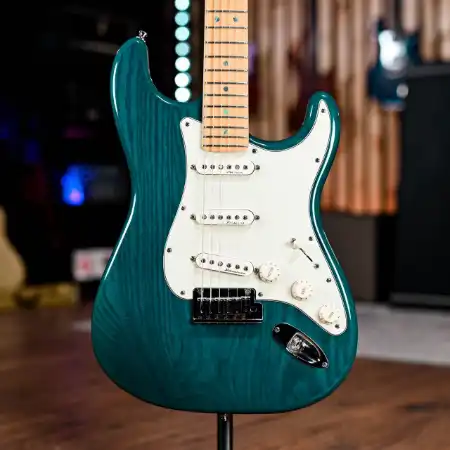
Fender revisited the original 1950s Stratocaster blueprints to ensure the body contours closely resembled the classic design. The bodies were crafted from high-quality alder or ash, often showcasing transparent finishes that highlighted the wood grain. To complement the visual appeal, Fender introduced features like rolled neck edges, a modern “C” neck profile, and staggered locking tuners, all contributing to improved comfort and playability.

Cosmetic enhancements included abalone dot markers, aged plastic parts, and a new raised silver “Appliqué” logo. The hardware was polished chrome, and the tremolo system was the Fender Deluxe 2-Point Synchronized Tremolo with a pop-in arm. Notably, the American Deluxe Stratocaster was among the first to feature Fender’s Noiseless pickups, aiming to deliver the classic Strat tone without the hum associated with traditional single-coil pickups.

The First Noiseless Pickups: Vintage Noiseless and Hot Noiseless

The introduction of Noiseless pickups was a response to the demand for single-coil tones without the unwanted hum. The first-generation Noiseless pickups, known as Vintage Noiseless, were designed to replicate the traditional Strat sound while minimizing noise. These pickups were well-received for their clarity and vintage character.

In subsequent years, Fender introduced the Hot Noiseless pickups, which offered a higher output and a more modern tone. These pickups were designed to provide a more powerful sound while maintaining the noiseless operation, catering to players seeking a more robust Stratocaster tone.

The Second Series: SCN Pickups and the S-1 Switch

In the early 2000s, Fender introduced the Samarium Cobalt Noiseless (SCN) pickups, which utilized rare-earth magnets to achieve a quieter operation and a more balanced tone. The SCN pickups were designed to provide a more traditional Stratocaster sound with reduced noise.

Additionally, Fender incorporated the S-1 switching system, allowing players to access a wider range of tonal options by engaging a secondary set of pickup combinations. This innovation expanded the versatility of the American Deluxe Stratocaster, catering to a broader spectrum of musical styles.

The Third Series: N3 Noiseless Pickups and Other Upgrades

The final iteration of the American Deluxe Series featured the N3 Noiseless pickups, which combined Alnico III, II, and V magnets to achieve a more balanced and dynamic tone. These pickups were designed to provide a more powerful sound while maintaining the noiseless operation, catering to players seeking a more robust Stratocaster tone.

Other upgrades in this series included enhanced fretwork, improved neck profiles, and refined hardware, all contributing to the overall playability and tonal quality of the instrument.

Conclusion

The American Deluxe Stratocaster series represents Fender’s commitment to innovation while respecting the classic Stratocaster design. By integrating modern features and the Noiseless pickups, Fender enhanced the playability and versatility of the Stratocaster, making it more appealing to contemporary musicians. The evolution of the Noiseless pickups further underscores Fender’s dedication to providing high-quality instruments that meet the demands of modern guitarists.
The Plus Series

Index - Plus Series

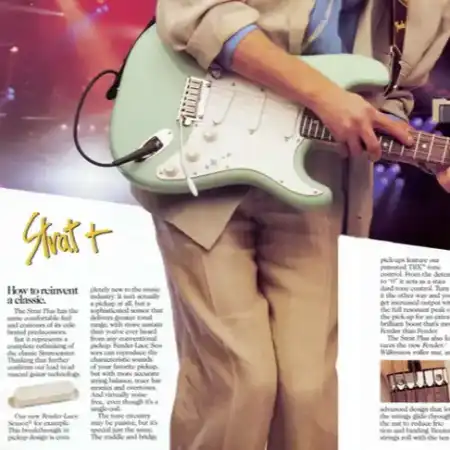
Introduced in 1987, the Fender Strat Plus was one of the first American-made Stratocasters launched after the company’s corporate restructuring under new ownership in the mid-1980s. Designed as a high-end model within the regular production line, the Strat Plus series offered modern upgrades while retaining the essential look and feel of a classic Stratocaster. It quickly became a popular choice among professionals and serious players looking for improved performance and reliability without sacrificing vintage appeal.

The most notable feature of the Strat Plus was its use of Lace Sensor pickups. Developed in collaboration with Don Lace, these pickups aimed to eliminate the 60-cycle hum typical of traditional single-coils while maintaining tonal clarity and dynamics. The standard configuration included Gold Lace Sensors in the neck, middle, and bridge positions, which produced a warm, balanced tone with a slight compression ideal for studio and stage use. Some later models experimented with different combinations, such as Blue, Silver, or Red Lace Sensors, offering more tonal variation.

Another significant innovation was the LSR roller nut (initially Wilkinson Roller Nut on early models), which, along with locking tuners (usually Schaller), greatly enhanced tuning stability—especially when using the tremolo. These hardware upgrades allowed players to perform aggressive vibrato techniques without the guitar going out of tune, a long-standing issue with traditional Strat bridges and nuts.

The Strat Plus featured a two-point synchronized tremolo system, which provided smoother action and less friction compared to the vintage six-screw design. It also came with staggered tuning posts, eliminating the need for string trees on some models and contributing further to tuning stability.

Cosmetically, the Strat Plus retained the iconic Stratocaster shape and pickguard design, but was offered in a wide variety of finishes, from classic sunbursts to bold, metallic colors typical of the late ’80s and early ’90s. The necks were usually modern “C” shapes with 22 medium jumbo frets and a 9.5″ radius, catering to players who preferred a flatter fingerboard for bending and faster playing styles.

Production of the original Strat Plus continued until the late 1990s, gradually evolving into the Strat Plus Deluxe and Ultra models, which introduced more electronics options like the TBX tone circuit and mini-switches for coil-tapping or series/parallel wiring. Eventually, the line was phased out around 1999 as Fender updated its American Standard line and introduced new models.

The Strat Plus remains a sought-after instrument on the used market. It represents a unique blend of traditional Fender craftsmanship and forward-thinking engineering, appealing to players who want a reliable, high-quality guitar with vintage looks and modern performance. Many artists used Strat Plus models on stage and in the studio during its heyday, further cementing its status as a significant part of Fender’s post-CBS legacy.