Superstrats: Contemporary, Boxer, Pro Feel and HM Strats

Cover - Superstrats

After the closure of Fender’s Fullerton factory in 1985 and before the launch of the American Standard, Fujigen became central to Fender’s output and innovation. Responding to the rise of hard rock and heavy metal, the Japanese factory introduced modern “super strat” models, first under the Squier brand and later as Fender exports.
The Contemporary Stratocasters debuted in 1983 for the Japanese market, with painted headstocks, flat fretboards, jumbo frets, and options ranging from Dragster humbuckers to Hot Rod single coils. Their early Rox System tremolo was soon replaced by the Blade Shooter and Schaller-made Fender System bridges. By 1985, export models appeared under both Squier and Fender names, often featuring Kahler units.
In 1984, the Boxer Series replaced the domestic Contemporary line, introducing modern features such as TBX tone controls, 22 frets, and high-output pickups. This evolved into the Pro Feel Series (1989), which refined playability with sculpted neck heels, asymmetrical plates, Lace Sensors, and Floyd-licensed ExTrem systems.
The peak of Fujigen’s superstrat era came with the HM (Heavy Metal) Strats of 1988–92. Designed with Dan Smith and Nick Sugimoto, they featured 24 frets, DiMarzio humbuckers, locking tremolos, and bold finishes, cemented by endorsements from shred virtuoso Greg Howe.
The ExTrad Series

Cover - ExTrad

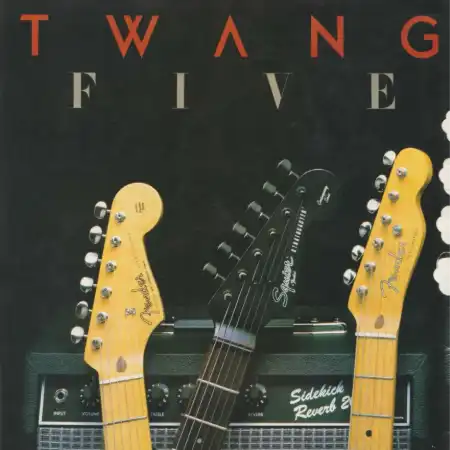
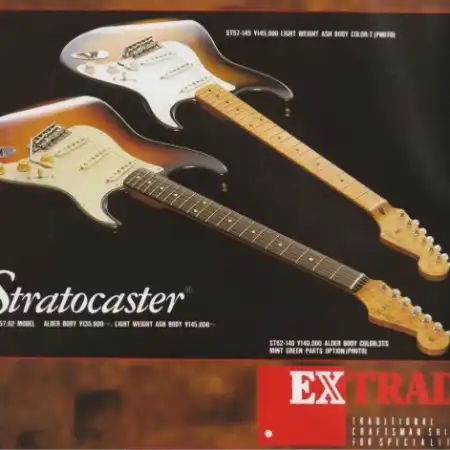
The ExTrad (“Extra Traditional”) Series debuted in Fender Japan’s 1986 Twang catalog and became official in 1989, aimed solely at the domestic market. Custom-order Stratocasters, they offered premium craftsmanship, fine tonewoods, custom pickups, and elegant finishes. Models included the ’54, ’57, and ’62 Strats, with alder or ash bodies. Special 30th- and 35th-anniversary editions celebrated classic years with sunburst finishes and bird’s-eye maple necks. Crafted by Makoto Sugimoto’s Custom Edition Team, these guitars reflected meticulous study of vintage Fenders. Identification relies on logos, serial numbers, neck-pocket stamps, and electronics.

Foto Flame

Cover - Foto Flame

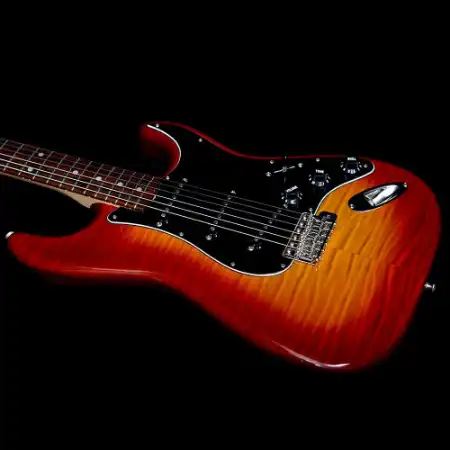
The Foto Flame finish, introduced between the late 1980s and 1990s on Japanese Fender Stratocasters, was not a photographic process but a digital image transfer developed and patented by Fujigen. Using heat-activated plastic film and a vacuum press, a thin flame maple “print” was applied to guitar bodies and necks, then clear-coated, creating the illusion of figured maple tops. Fender only supplied the name for marketing, while Fujigen also applied the process to Ibanez guitars and even luxury car interiors.

Multiple Fender models featured Foto Flame, including the 1989 US Contemporary Stratocaster, Collectable and HRR Strats, the 1994–1996 Foto Flame Stratocaster, and the Floyd Rose Standard Stratocaster Foto Flame, along with Japanese domestic models and Squier versions. While visually convincing, these instruments later developed characteristic cracks in the finish and, in some cases, unusual color changes. Today, Foto Flame guitars remain a curious blend of innovation, marketing, and imperfection in Fender’s history.

Collectables and HRR Stratocasters

Cover - Collectables and HRR

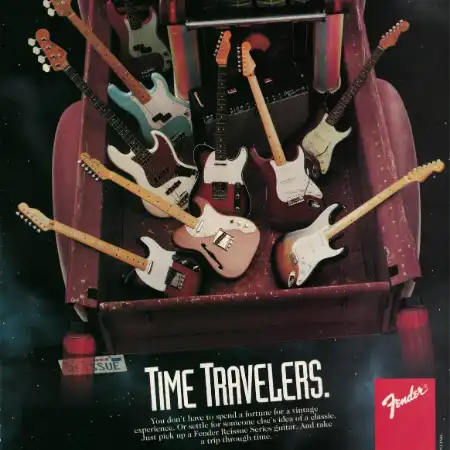
When Fender shifted Squier production from Japan to Korea, Fender Japan continued exporting reissue guitars, initially under the Reissue or Limited Edition Series, later grouped as the Collectables Series. These guitars, often built with basswood bodies and Reissue Strat pickups, lacked nitro finishes but carried the Fender name proudly, offering players affordable access to vintage-style instruments. The “Time Travelers” ad (c. 1995) promoted these reissues as a ticket to rock ’n’ roll history, featuring ’50s and ’60s Stratocasters, Telecasters, and vintage-style basses. Key models included the ’68 “Hendrix” Strat, the ’50s and ’60s Stratocasters (1989–1998), and the ’72 Strat, each with distinctive necks, pickguards, and hardware.

In 1990, Fender introduced the Hot-Rodded Reissue (HRR) Series, popularized by Richie Sambora. These Japanese-made Stratocasters featured hotter pickups, double-locking tremolos, and modern appointments, blending vintage aesthetics with aggressive tones. Notably, a 1991 Frontline catalog showed a heavily customized HRR Strat resembling Sambora’s signature, highlighting artist personalization and marketing strategy.

Standard Stratocasters made in Japan

Cover - MIJ Standard

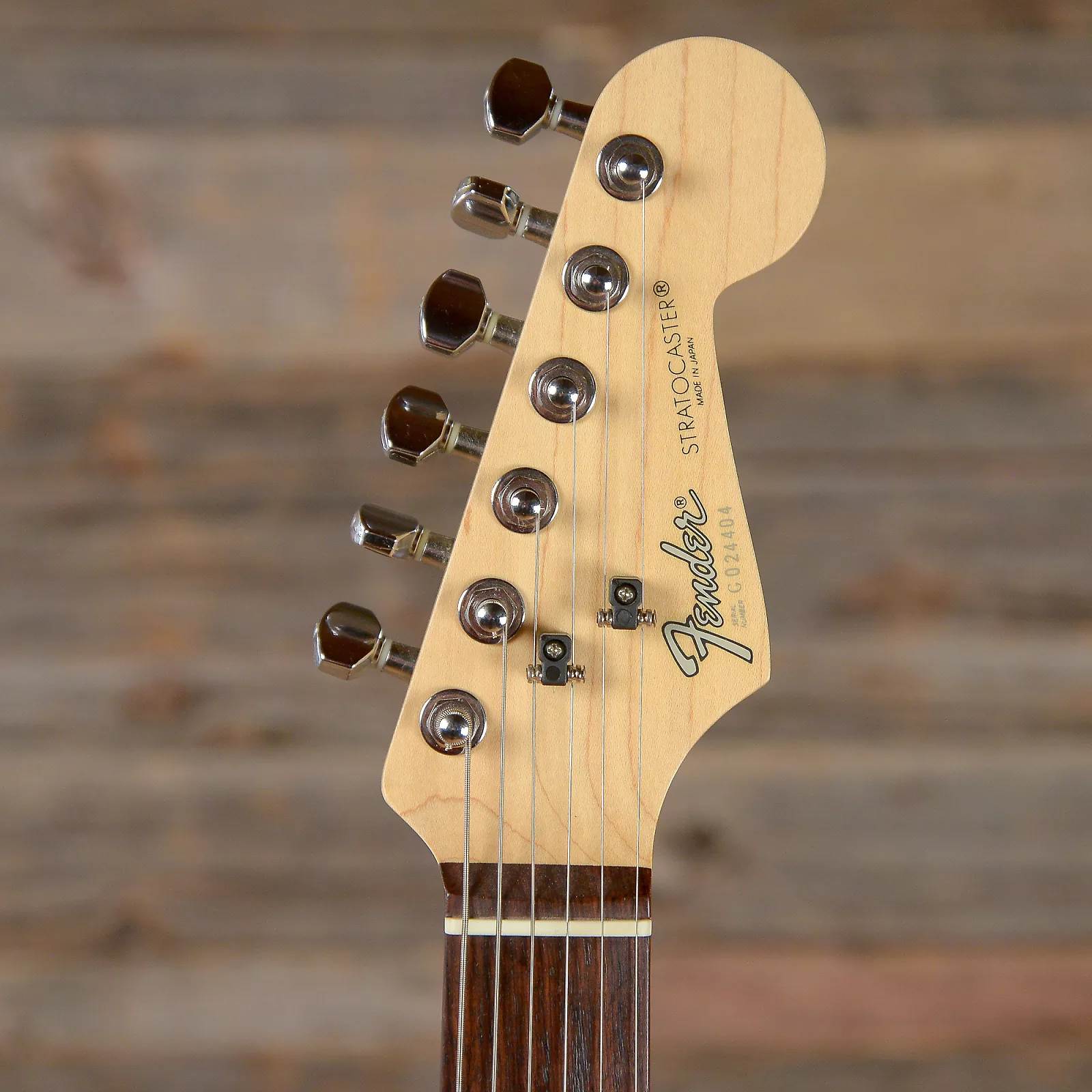
Fender Japan’s Standard Stratocasters, introduced in 1983, offered affordable, modern alternatives to vintage-style reissues. Unlike reissues, they featured silver CBS-style headstock logos, flat-pole pickups, and often basswood bodies. Produced for both domestic and export markets, early models like the ST83-80 mirrored U.S. “2-Knob” Stratocasters but added a 22-fret neck. Export versions included both Fender and Squier-branded guitars, with Squier Standards eventually rebranded as Fender models. Notable variants featured innovative tremolo systems like Fender System I and Kahler units, before a shift to traditional specs in 1988. The line ended in 1991 when Mexican production began, cementing these Japanese models’ collectible status.

Domestic Models and Series Overview (1984 Onward)

Cover - Domestic Model and Codes explained

From 1984 onward, Fender Japan produced a wide range of domestic Stratocasters, dividing them into Vintage, Current, Collectors, and Boxer Series, later joined by Pro Feel models. After the celebrated JV and SQ export series, Fender reserved its best guitars for Japan, exporting lower-tier models. The domestic lineup offered both high-end and affordable reissues, specialized Collectors instruments, and modern Boxer/Pro Feel designs. Fender’s intricate coding system identified model year, price, and features, though inconsistencies and factory stamps often confuse collectors. While most Japanese Stratocasters abroad are export versions, some domestic models have surfaced internationally through second-hand sales, adding to their intrigue.

The American Original Series

Cover - American Original Series

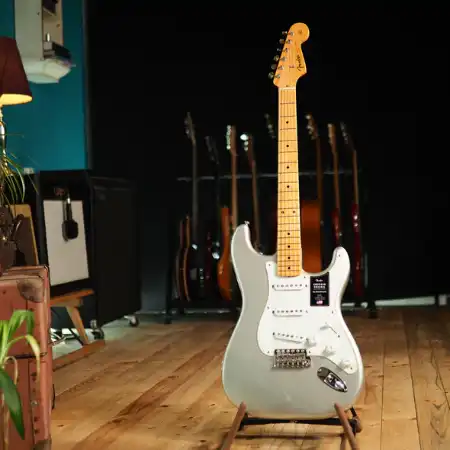
On January 16, 2018, Fender launched the American Original Series, replacing the long-running American Vintage line. While the Vintage Series focused on exact recreations of specific guitars, the American Original line blended standout features from each decade to balance vintage character with modern playability. Developed under Joey Brasler and Justin Norvell, the series took nearly two years of planning, design, and consultation with musicians. Key updates included a modern 9.5” fingerboard radius, narrow-tall frets, and period-correct nitrocellulose finishes. The American Original ’50s and ’60s Stratocasters reflected their respective eras with different neck profiles, pickup sets, and cosmetic details, while offering improved comfort and versatility. Fender emphasized that the new line wasn’t a step back, but a refinement designed for today’s players. Introduced at Winter NAMM 2018 alongside an ambassador campaign featuring Isaac Brock, Kurt Vile, Raphael Saadiq, and J.D. McPherson, the series represented Fender’s vision of timeless design made modern.

Vintage Reissue Stratocasters Specs

Index - Vintage Reissue

Fender’s Fullerton Vintage Reissue Stratocasters (c. 1982–1986) featured “Dan Smith style” headstocks, followed by the distinctive “pregnant” headstock when production moved to Corona. Logo decals evolved across three batches, varying in font, placement, and finish. Bodies were mostly alder, with limited ash “Mary Kaye” variants; Corona models had deeper, sharper contours. Early instruments show deepened cavities and extra neck-pocket holes. Dating is done via pencil neck-dates or later stamped/printed formats; serials became date-coded from around 2012. Finishes began with nitro over polyester, later expanding to custom colors. Electronics included staggered-pole pickups and CTS pots with Sprague caps.

Vintage Reissue Stratocasters

Index - Vintage Reissue

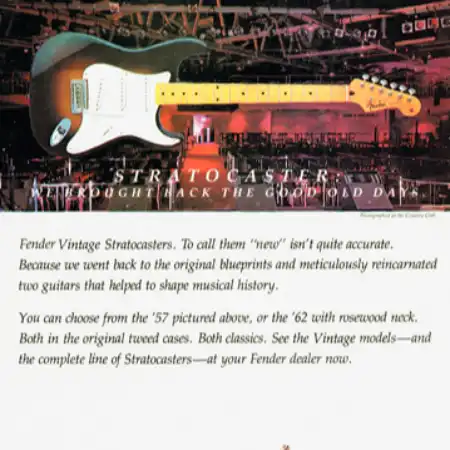
In the early 1980s, Fender responded to growing demand for vintage-style guitars by launching its Vintage Reissue series. While Japanese companies like Tokai dominated the market with affordable vintage-style models, Fender began producing guitars in Japan and simultaneously developed U.S.-made reissues. Led by Dan Smith and John Page, Fender sourced original pre-CBS Stratocasters for reference, working with experts like John Carruthers and Seymour Duncan to recreate classic features. The first models—the ’57 and ’62 Stratocasters—were officially introduced at the 1982 NAMM Show but delayed due to factory retooling.

Though advertised as exact replicas, these reissues included intentional design compromises for broader market appeal, such as altered neck shapes and finishes. Even so, they played a crucial role in Fender’s revival, funding the Standard line and paving the way for the Custom Shop.

Controversy arose when Fender’s 1982 catalog featured a Tokai neck in one photo, mistakenly fueling rumors of counterfeit parts. Ironically, Japanese-made reissues were more historically accurate in some details. The original U.S. models, now called Fullerton Reissues, were produced until 1985 and are highly collectible today. Production later shifted to Corona, and in 1998, the line was relaunched as the American Vintage Series.

The American Ultra Series and the American Ultra II Series

Index - American Ultra

Launched in November 2019, the Fender American Ultra Series marked a bold step forward for the iconic brand. Described as the company’s “most advanced modern guitar,” the series was a refined evolution of the earlier American Elite line. Fender reengineered virtually every component to enhance comfort, tone, and performance—without sacrificing the essential character of a Stratocaster. It introduced Ultra Noiseless Vintage and Hot pickups, offering classic Fender tone without hum, and the Double Tap Humbucker, which maintained balanced output in both humbucking and coil-split modes.

Ergonomics were a key focus: revised body contours and a newly sculpted neck heel dramatically improved upper fret access, while the exclusive Modern “D” neck and a 10″-14″ compound radius offered unprecedented playability. Satin urethane finishes and soft-touch knobs added to the tactile appeal, while the return of the Bi-Flex truss rod at the headstock aligned the model with classic Fender traditions.

In 2021, Fender introduced the American Ultra Luxe line, building further with stainless steel frets, a new Augmented “D” neck, and premium finishes. These guitars were touted as Fender’s most sophisticated factory models to date.

Continuing this innovation, the American Ultra II Series debuted on October 15, 2024, carrying the motto “Innovation never rests.” Described by Fender as its most advanced series ever, Ultra II models were fine-tuned to serve both traditionalists and modern players. EVP of Product Justin Norvell called them the “sports cars” of the Fender lineup—fast, sleek, and engineered for peak performance. The development process drew on extensive player feedback from artists, dealers, and online communities, echoing Leo Fender’s original approach of close collaboration with musicians.

While retaining many successful Ultra features, Ultra II brought subtle refinements designed to enhance speed, precision, and versatility, further blurring the line between vintage feel and modern tech.

From the original Ultra to the Luxe and Ultra II, Fender’s flagship guitars showcase decades of design evolution, innovative manufacturing, and a player-first philosophy. Built in Corona, California, with over 150 hand processes, these instruments blend the soul of vintage Fender with 21st-century performance.